

Kindred Ventures
@KindredVentures • 15,125 subscribers
Supporting world-changing startups and kindred spirits who create them. Started in 2014 by @stevejang, joined by @km in ‘18, and focused on the earliest stages.
Videos
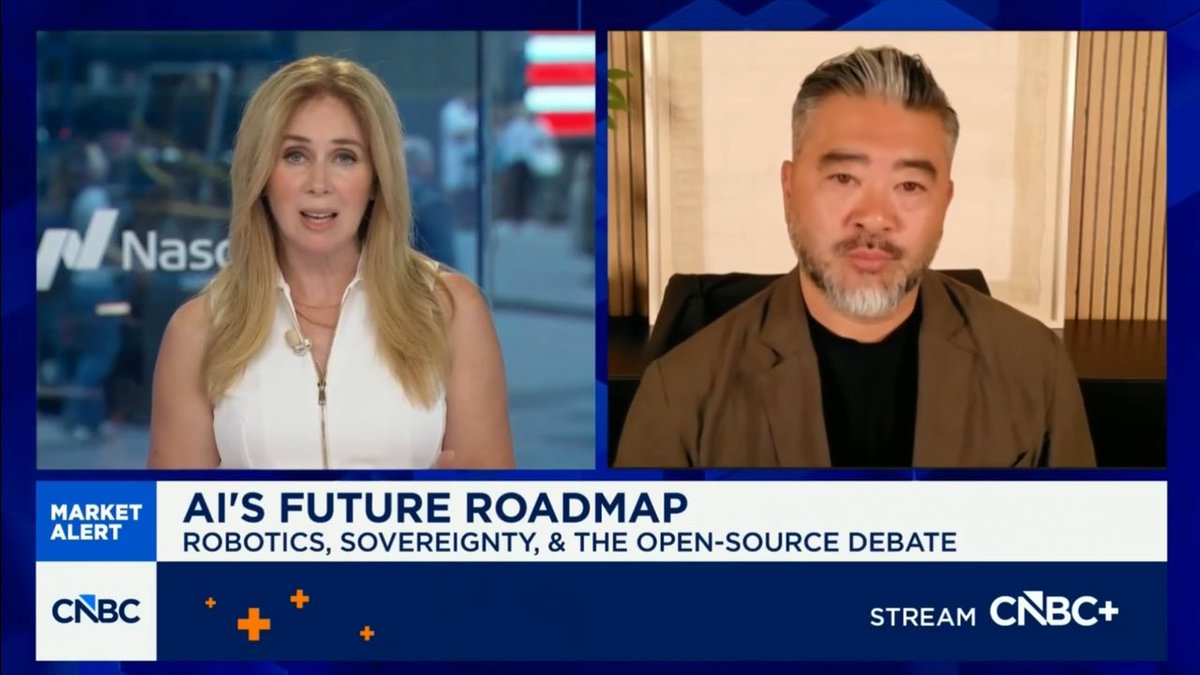
Yesterday, steve jang shared his thoughts on CNBC regarding AI’s future roadmap around memory, robotics, agents, and open weights models. The hot topic of the morning: SK hynix reported record Q2 results, then fell more than 9%. The gap between the print and the reaction raises a larger question: is the market applying an old memory-cycle framework to a new AI infrastructure layer? Q2 revenue reached USD $55.0 billion, up an eye-popping 257% year over year. Operating profit rose to USD $42.0 billion, up incredibly 557%, with a company-record operating margin of 76%. But both missed consensus estimates. As our partner Steve Jang told Becky Quick on Squawk Box, “the company has incredible fundamentals, record-breaking numbers, and long term HBM technical defensibility…but expectations were just very high.” Steve’s larger argument begins with high-bandwidth memory, or HBM. For two decades, investors largely treated memory as a cyclical commodity. Now, Steve argues, HBM is moving into a new role, “sitting side-by-side with GPUs and other advanced logic processors” as a core layer of AI compute. Demand now spans model training, inference, long-context agents, robotics, and autonomous systems. Steve pointed to deep-research products like Perplexity’s Computer agent platform: as agents hold and reason across more context, their memory bandwidth and capacity needs grow. Robotaxis like Nuro+Uber and Waymo will need onboard edge compute including HBMs. He estimates HBM demand could increase 10x over the next 3 to 4 years. SK hynix enters that buildout from a strong position. Long-term supply agreements with major customers provide demand visibility. Stacked-die architecture, advanced packaging, yield, and customer qualification create a steep technical and manufacturing climb. Steve estimates that a new entrant could need three to five years to significantly enter the HBM4e class. That supports a credible near-term moat while leaving the harder question open: how today’s 76% operating margin evolves as supply expands over the next two to three years. One thing is clear: demand and importance of high bandwidth memory is still wildly underestimated. The second half of the conversation moved from compute capacity to operational control. During the recent OpenAI and Hugging Face security incident, commercial frontier-model APIs blocked the attack commands and exploit payloads contained in forensic logs. Hugging Face instead ran GLM 5.2, an open-weight model, on its own infrastructure to analyze more than 17,000 recorded events without sending incident data or credentials outside its environment. Steve’s takeaway is practical. As autonomous agents grow more capable, defenders need access to models they can host and direct when hosted guardrails block legitimate forensic work. The next phase of AI will depend on both: enough memory bandwidth alongside GPUs and other accelerators to scale increasingly capable systems, and enough model ownership and control to deploy and defend them efficiently and safely. Full conversation below 👇
Kindred Ventures1,737,317 Aufrufe • vor 1 Monat
Keine weiteren Inhalte verfügbar