
Preston Rutherford
@PrestonRuther10 • 5,588 subscribers
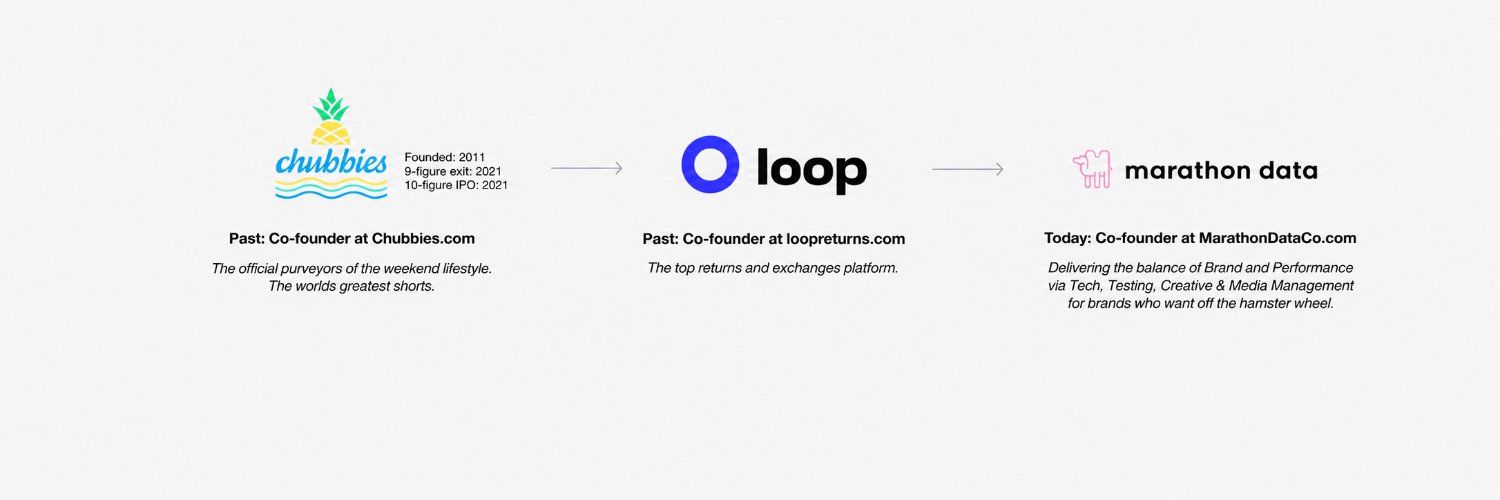
Founder @Chubbies, @loop returns, marathon data, marathon engine
Shorts

Videos

I used to think Brand was bullsh*t, so imagine my surprise when I was asked to speak at Meta's Performance Marketing Summit about Brand to a room of performance marketers How'd this happen? Many moons ago, I co-founded Chubbies. It's a nine-figure brand now: 8 straight years of top and bottom-line growth, EBITDA up 40% yoy But we almost went out of business first — running the exact playbook a lot of performance marketers are running right now CAC creeping up every year. Only 'growing' when we discounted harder, longer, wider. Same ads, same people, growth on loan from the algorithm Then we incorporated Brand into our 'performance' media, and revenue re-accelerated. More importantly, so did profit Here are 3 mistakes I made, 3 things I learned, and 3 actions you can take on Monday: Here's what I had wrong: 1. I thought brand was logos, fonts, or a brand book nobody opens 2. I thought spending ANY dollars on ads that didn't drive a conversion was the dumbest thing a performance marketer could do 3. And when I finally tried it, I chased the wrong thing — we went for meme-lord reach, piling up views with no connection back to the brand Here's what I know now: 1. Brand is the moat. It's pricing power. It's why people buy from you without you competing on price and features 2. The "trough of despair" everyone's scared of? It doesn't show up — because you fund brand by reallocating your least-efficient dollars, not by adding budget (and other reasons) 3. And it's accountable. Build a behavioral funnel, drive a real action like branded search, measure it with a geo-holdout. It's not a vibes contest More on this "trough of despair" being a nothing burger: 1. The brands we do this for don't see the trough. A ~$75M denim brand grew contribution dollars roughly 50% year over year — with new customers and total revenue climbing the whole time 2. An outdoor brand ran brand media alone — and the lift showed up everywhere its customers shop: its own site, Amazon, TikTok Shop, and strongest of all, 2.5x incremental revenue on a major brick-and-mortar retailer's shelves 3. A six-month geo-holdout showed brand driving 1.93x incremental revenue — while the saturated direct-response they'd been relying on was returning a blended 0.91x Les Binet's research concurs: grow your share of search, and good things follow So, three things you can do Monday: 1. Find the marginal return on your least-efficient dollars. Those can move to brand with no short-term revenue drop 2. Look at the creative you ship. Would your friends be hyped to see it — or "ugh, he's selling me something"? You want a healthy mix 3. Build your behavioral funnel. Define the action at every stage so brand stops being soft and starts being math The full vid is attached. Case studies in the comments. If you still think "performance" brand is bullsh*t — let's discuss What's the data you'd need to see to change your mind? Tell me where you're stuck/skeptical and let's get into it below
Preston Rutherford12,336 views • 4 months ago

The biggest misconception about Airbnb’s famous transition away from performance marketing is that they went from 100% performance to 100% brand They didn’t. They became more balanced. After studying their transition, here are the 5 ideas you can apply in your biz as you navigate finding the ideal balance for your brand. Why listen to Airbnb? They generated >$500M in profit in a single quarter and have maintained massive margins since shifting their strategy. Something’s working that’s not simply tied to the “return to travel boom”. 1) It's not "brand" OR "performance". It's a balance of "lasers" & "chandeliers" Brian Chesky, CEO: “We were spending a lot of money in performance marketing. I don't think performance marketing is a bad thing. I think of performance marketing as a laser, actually.” “We used to have this metaphor of lasers, flash bulbs and chandeliers. If you want to light up a room, performance marketing is a laser. It can light up a corner of a room. You don't want to use a bunch of lasers to light up an entire room - you should use a chandelier. And that's what brand marketing is.” “But if you do need to laser in and balance supply and demand, then performance marketing is really good.” 2) Brand marketing = Investment yielding accumulating advantages. Performance marketing = arbitrage seeking with eroding advantages. “Performance marketing, though, doesn't create very good accumulating advantages because it's not an investment.” “Now if you want to build it permanently, like Booking . com if you have a really high ROI now, you can have a performance marketing arbitrage business.” “But assuming you don't want an arbitrage business, you actually need to be investing.” 3) Brand building isn’t only talking about your values. Your product is just as central to the brand message, so tell people why it’s different and better. “We think of marketing as education, that we're educating people on the unique benefits.” “A lot of companies don't do product marketing. They do brand marketing, which are ads about the app, or they do performance marketing. But they're never really educating people about new things they're making.” 4) Word of mouth > everything “It's a full funnel approach. And last year we got 600,000 articles written about us. So, people talk a lot about Airbnb.” - Chesky from a recent Earnings call “When you invest in a brand, when your brand's a noun and a verb, and you have something unique, you get a lot of those benefits.” “90% of our traffic remains direct or unpaid.” - Dave Stephenson, Chief Financial Officer, Airbnb 5) The single reason you invest in brand is to make more money “Chesky said that the brand would never again rely so heavily on performance marketing. And shortly after the decision to reallocate marketing spend, the company reported its most profitable fourth quarter on record” - The Drum #brand #marketing #airbnb #profitability
Preston Rutherford13,452 views • 9 months ago

If you're a brand operator, this might be the most useful 4-minute video you watch all weekend. Cherene (Bobbi, ILIA Beauty: 100s of millions revenue) is the GOAT. If your playbook isn't working, you're stuck on discounts, or facing channel cannibalization, look no further than what she has to say. Spoiler alert: it's not about short-term ROAS. It's about Brand. She's in the trenches making it happen & articulates it brilliantly. If you listen to anyone, listen to her. My 3 key takeaways, quotes & actions you can consider: ***Takeaway 1: The old DTC playbook doesn't work anymore.*** "You can't just drive growth by doing running the same growth playbook." "And that works until it doesn't." "We have to, like, build equity into who we are as a brand... exploring, like, what happens if we move a little bit upper funnel?... not looking for, an immediate last click, direct response goal." "But like in order for me to drive the D2C business I'm going to need the total business to grow Like I can't that performance marketing is not enough to grow the business." "So we need to actually invest in brand marketing. We need like real top of funnel marketing dollars to put into the business." ***Takeaway 2: The reason why brands are struggling right now (because they rely on all of their traffic coming from Meta and Google Ads).*** "And I've talked to some of these brands too, like these smaller ones and they're just playing the like meta and Google game and it's really hard because they're not able to drive profitable acquisition because they're not getting traffic outside or acquisition outside of Google and Meta." "And so I think that's where it's like, okay, are you competing in the auction against other brands and how well are you competing?" ***Takeaway 3: The truth about retail expansion and 'cannibalization' (you must expand your brand faster than your distribution).*** "And if you expand your distribution faster than you're able to expand your brand, then you're just trading sales between channels and one channel is going to eat the other." "Well, it's like, no, actually, the brand's responsible for growing its awareness as fast as it's growing its distribution." "And if you think that you can just get sales by expanding distribution, you're gravely mistaken." "So now it's your job to, like, find more people. And that's the challenge, which is again, why that awareness type of marketing is so important as you grow and have distribution." Actions you can take: Ask yourself these Q's on your next vision quest 1. Is my rolling reach up? 2. Organic traffic growth vs. overall business: Is it keeping pace? If not, what are the risks (esp. with Meta CPMs up >25% YoY)? 3. Branded organic search: Are you gaining share vs. competitors? (Crucial to track this data beyond Google Trends). Hope this helps ✌️❤️🤘 Thank you to Andrew Faris for the awesome podcast. All eps are gold.
Preston Rutherford17,112 views • 1 year ago

Sean has built DUDE Wipes to over $150M. It's one of the strongest brands on planet Earth. In this video, he addresses the age-old question of how to invest in Brand Marketing in a world that's obsessed with measuring the short-term return from performance marketing. As a recovering performance marketer myself, learning this lesson was one of the most humbling but value-unlocking realizations in the journey to the 9-figure exit We learned many of the same lessons Sean gives here, which helped us gain confidence in broadening the set of people we were reaching (via paid, unpaid, and everything else) with content and tactics that aimed to reach tons of ppl AND increase the probability the Brand came to mind when the buyer went in-market vs. focusing all efforts on converting those already in-market to get a good ROAS number Btw, I was one of those marketers who, for too long, lived by the idea that if it didn't show up in the reporting within our short-term attribution window, it didn't exist. But hey, my loss is your gain, so here are the 6 most helpful lessons and quotes from the video 1. It's about balance. "If you're too focused on branding or too focused on performance, you're going to end up hurting yourself because you're going to be stuck in one lane" 2. Only when you invest in Brand can you fight increasing acquisition costs with performance marketing "You have to be spending on performance marketing where you can track the return and understand how to acquire customers. Then you have to be spending on building the Brand where it's not as trackable, and that'll actually make your performance work better." 3. Do it all. Find what works for YOU at YOUR stage "Sampling, getting your product in people's hands. Experiential marketing. You have to do everything well, and then you have to find the mix that works the best for your Brand. And that's going to change over time." 4. Ignoring Brand early on is a deadly trap "So early on you may have to be spending typically more on performance because the dollars really got to work for you. One pitfall is that people ignore brands early on because of that. They get lost in the Meta D2C loophole, and that's like a drug." 5. The Brand has to be able to stand on its own outside of the Meta Loophole "You're only, you're only as good as your last hit as your last click. As soon as you stop paying that money -if it's all DR Advertising based, you don't mean anything to anybody and your Brand can't live on its own" 6. Saying you don't have the money to invest in Brand is a lazy excuse. "That doesn't need to cost a lot of money in the beginning. That's where we learned the guerrilla tricks. You should always be a guerrilla building your Brand. Don't use the excuse of 'oh well, we don't have the funds to build a Brand'. We never had the funds. We built a Brand, so it's not about the resources. Be resourceful. Be creative. Find ways to get your Brand out there" #brand #performance #marketing
Preston Rutherford17,064 views • 1 year ago
No more content to load