

RetroChainer
@RetroChainer • 3,833 subscribers
Prediction markets | Content creator | Researcher All in @Polymarket
Shorts


Videos

She makes $1,000s on Etsy from thrift-store junk she never even buys. She doesn't buy the item. She photographs it. A weird vintage bust, a gas mask, something nobody else is selling she snaps it on the shelf and walks out. AI turns the photo into a 3D model. The printer runs overnight. The listing is up by morning. She never learned to 3D model. The AI did that part. The edge isn't the printer. Everyone has a printer. The edge is that thrift stores are full of one-of-one shapes nobody has digitized yet and she's the one photographing them. The whole supply chain: a phone, a $200 printer, and a shelf she doesn't pay for.
RetroChainer422,930 views • 3 months ago


WHAT THE F*CK DID I JUST WAKE UP TO. CLAUDE, GPT AND GROK BOT TRADED MEMES ON ROBINHOOD ALL NIGHT, AND $20,000 BECAME $74,759. plus $54,759, plus 273 percent, by 07:08 in the morning. this is GrokTrading on the Robinhood rail. three brains on one desk. Claude Fable 5.1 holds the reasoning seat and runs orion and vega. GPT-6 Astra holds the execution seat and runs titan and luna. Grok Bot is primary, on its own persistent cloud computer, so the desk never sleeps. the tape was pure Robinhood Chain meme. $PONS. $CASHCAT, the biggest cap on the chain at $224M. Artificial Inu right behind it. $SHRUB, $DEGEN, chump-coin:native, $PIPEDOG. a whale wallet mirrored on one, a narrative spike on another while it trended on X. the wall at close: $740.9K turned over, 1,294 fills across eight venues, hit rate 76 percent, gates safe 97. every fill on that feed went the same way: routed through Robinhood, verified, walked to grok, locked in. and in the bottom corner the light that decides everything: owner gate, red. the outside world still waits for my hand. the memes themselves I pick up here, same rail the desk uses: three models, six seats, one hand on the money. that hand is mine. save this.
RetroChainer86,128 views • 27 days ago

YOU DON'T NEED A SERVER RACK. SIX USED MINI PCS AND A $60 CISCO SWITCH WIRE INTO A HOME CLUSTER ON YOUR DESK. that clip is six tiny mini-pcs stacked and patched into one cisco business 110 switch, red cables, a single power strip. each box is a full x86 computer, the kind offices dump by the pallet. used, they run $30 to $60 each. six of them plus the switch is a real cluster for a couple hundred dollars. what a stack like this runs: proxmox or kubernetes spread across all six nodes pi-hole, a nas, home assistant, docker services, each on its own node a local model or two on the boxes with enough ram the trick isn't raw power, it's separation. one node dies, the cluster keeps going. one service crashes, it doesn't drag the rest down. no server rack, no datacenter noise, no monthly cloud bill. the uncomfortable part isn't that it's cheap. it's that the "real infrastructure" you were told needs a rack and a budget fits on a desk and boots off a power strip. follow RetroChainer for more ways to build real infrastructure for pocket money, and bookmark this before the next office dumps its mini pcs.
RetroChainer95,267 views • 2 months ago

YOUR HOMELAB IS USELESS IF YOU CAN'T REACH IT FROM ANYWHERE - AND YOU SHOULD NEVER OPEN A PORT TO DO IT. that clip is a homelab in a tiny rack: cheap used mini-pcs running a proxmox cluster with ollama for local ai. but the hardware isn't the hard part. reaching it safely when you're not home is. the wrong way: forward a port on your router. now your services face the whole internet, and every bot on earth starts knocking. the right way, and what he's running: a mesh vpn like twingate, netbird or tailscale. it builds a private encrypted network between your devices and the lab. no open ports, no public ip, nothing exposed. your phone in a cafe talks to your proxmox box at home like they're on the same wifi, and the internet sees nothing. that's the piece that turns a pile of mini-pcs into infrastructure you actually use. no port forwarding, no exposed dashboard, no public attack surface. the uncomfortable part isn't building the lab. it's that most people either can't reach it, or reach it by leaving the front door wide open. follow RetroChainer for the homelab step everyone skips, and bookmark this before you forward a single port.
RetroChainer58,500 views • 1 month ago

> you pay $5,000 a year for AI > and still ration every request > AMD just broke that math > Ryzen AI Max+ 395. 200B on one die. > EVO-X2. Claude Code. one evening. > one variable and Claude Code points at your room > nothing leaves the network. nothing on the meter. > stop paying per token stop rationing > the edge isn't the cloud. it's the meter being off.
RetroChainer81,891 views • 3 months ago

THIS WHOLE 3-NODE CLUSTER RUNS PROXMOX, CEPH AND KUBERNETES - ON 10 WATTS TOTAL. that clip is three zima boards wired to one little switch, and the power meter reads 10 watts for the entire thing. on those three tiny fanless boards: proxmox running a real cluster, three nodes as one datacenter ceph spreading storage across all three, so a node can die and your data doesn't kubernetes on top, kube1/2/3, plus docker and high-availability failover this is the exact stack that runs in datacenters, shrunk onto a shelf. kill one node and the vms migrate to the other two. it heals itself. and it pulls less power than a light bulb. no server rack, no cooling, no power bill you'd ever notice. the uncomfortable part isn't that it's small. it's that "enterprise infrastructure" was mostly the rack and the noise, and none of that was the actual capability. follow RetroChainer for more ways enterprise gear shrinks to a shelf, and bookmark this before you rent another vps.
RetroChainer42,348 views • 1 month ago

THE $4,000 DGX SPARK BENCHMARKS AT 342 T/S ON PROMPT PROCESSING - THEN DROPS TO 73 WHEN IT ACTUALLY GENERATES. that clip is a dgx spark running llama-bench on qwen3-coder 30b, side by side with a mac. two numbers decide everything here: pp512, prompt processing = 342 tokens/sec tg128, token generation = 73 tokens/sec that gap is the whole lesson. local ai isn't one speed, it's two. prompt processing is reading your input: your files, your long context. the spark is compute-heavy, so it eats that fast. token generation is writing the answer, and it's bound by memory bandwidth, where the spark is modest and unified-memory macs stay close. so "which box is faster" has no single winner. feeding huge context or running agents that read a lot? prompt processing wins, the spark shines. long chat replies, one token at a time? generation matters more, and a mac holds its own. no single benchmark number, no universal "fastest box", no upgrade that wins every workload. the uncomfortable part isn't that the spark is fast. it's that "tokens per second" was always two numbers, and the hype only ever quotes the flattering one. follow RetroChainer for the benchmark truth nobody screenshots, and bookmark this before you buy on one number.
RetroChainer42,451 views • 1 month ago

I told Claude to predict the next BTC candle using Kronos. didn't touch anything. +$4,200 overnight. Kronos isn't another LLM wrapper. it's a GPT-style model trained on 12 billion candles from 45 exchanges. Binance, NYSE, NASDAQ, LSE. it reads OHLC the way GPT reads English. > words = candle patterns > sentences = OHLC sequences > the corpus = every trade ever printed > the edge is simple: P(next | history) = softmax(W · h_t) same math GPT uses to predict the next word, except the "word" is the next candle. no twitter sentiment. no blog scraping. no hallucinated confidence. just statistics over 12B real price moves. I plugged Kronos into a 5-min BTC Polymarket bot. input: last 50 candles output: probability next candle closes up trades only when |p_model - p_market| > 0.04 72 hours: $300 → $4,500 ChatGPT looks at a chart and pattern-matches against an article it read. Kronos looks at the chart and remembers 12 billion of them. 87% of Polymarket is exit liquidity. one of these models is actually trading the market. 21.8k stars, free, MIT license. Tsinghua University release.
RetroChainer94,591 views • 5 months ago
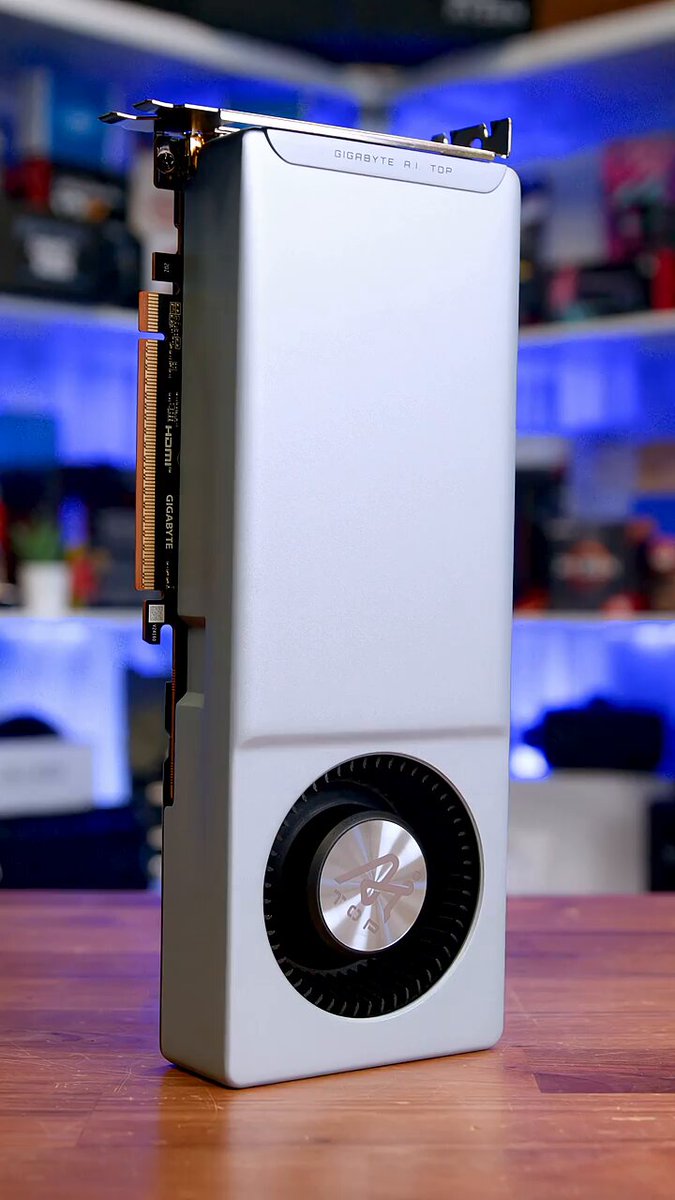
THIS $1,300 CARD HAS THE SAME 32GB OF VRAM AS A $2,000+ RTX 5090 - FOR LOCAL AI, THAT'S THE SPEC THAT DECIDES EVERYTHING. that clip is the gigabyte radeon ai pro r9700 ai top, 32gb of vram, built for local ai. the pitch is simple: the same memory capacity as an rtx 5090, for roughly a third of what a 5090 actually sells for. here's why that matters, and where it doesn't. for ai, vram is the gate. a model either fits in memory or it doesn't. 32gb loads models a 16gb card can't touch, full stop. so for running local llms and image models, this card does the one thing that counts, cheap. honest line: this is not a 5090 for gaming. the 5090 is far faster at raster and ray tracing. they only match on how much vram they carry. if you want frames, buy the 5090. if you want to fit big models locally, you just found the same 32gb for a third of the money. no $2,000+ price tag, no cloud gpu rental, no model too big for 16gb. the uncomfortable part isn't that amd is cheaper. it's that for local ai you were about to overpay for gaming power you'd never use. follow RetroChainer for more on paying for the spec that matters, and bookmark this before your next gpu.
RetroChainer38,844 views • 1 month ago

THIS IS WHERE "THE CLOUD" ACTUALLY LIVES - A ROOM OF DELL STORAGE ARRAYS YOU RENT A SLIVER OF EVERY MONTH. that clip is a real datacenter aisle, rack after rack of dell powerstore arrays, every hexagon panel packed with drives. this is "the cloud." not a metaphor, this room, plus the power, cooling and staff keeping it alive. when you pay for cloud storage, you rent a few gigabytes of these arrays. forever. the bill grows with every photo. here's the part they'd rather you not connect. these enterprise drives run on a schedule. data centers swap them out long before they fail, by the pallet. those decommissioned drives get tested and resold as recertified, the same 20tb enterprise disk for a fraction of new. so the exact hardware humming in this room ends up in a nas on your desk, minus the monthly rent. no cloud subscription, no data on someone else's array, no bill that grows with your library. the uncomfortable part isn't that the cloud is huge. it's that "the cloud" was always just this room, and you can buy a piece of it once instead of renting it forever. follow RetroChainer for what the cloud doesn't want you to picture, and bookmark this before your next storage renewal.
RetroChainer34,236 views • 1 month ago

BOLT A GPU ONTO THIS $200 FANLESS BOARD AND IT DOES THE TWO THINGS A RASPBERRY PI PHYSICALLY CAN'T: LOCAL AI AND 4K TRANSCODING. that clip is a zimaboard with a graphics card plugged straight into its pcie slot. that slot is the whole point. a pi has gpio and usb, but no real pcie, so it tops out where this one starts. drop a gpu in and the tiny box suddenly does: ollama and local models with actual gpu acceleration, not cpu crawl plex or jellyfin transcoding several 4k streams at once, in hardware anything else that was "you need a real pc for that", on a fanless board the rest of the board backs it up: quad-core intel up to 3.6, dual sata, dual 2.5gbe, runs zimaos, linux, even windows. so one silent box becomes a nas, a media server, and a local ai node at the same time. no tower, no raspberry-pi ceiling, no cloud gpu rented by the hour. the uncomfortable part isn't that it takes a gpu. it's that "a pi can do it" quietly stopped being true the moment the workload needed a real pcie lane. follow RetroChainer for the small boxes that punch way above their size, and bookmark this before you buy a whole tower for one gpu job.
RetroChainer24,813 views • 1 month ago

> "I'm not real here's how to make me in 10 min" 1. pinterest → search "girl selfie", save one 2. nano banana pro → swap the face 3. drop the image into kling 2.6 4. three nodes: image, text, video gen 5. photo → image node, prompt → text node 6. connect, pick kling 2.6, set duration 7. hit generate. done > 2 prompts. that's the whole pipeline now
RetroChainer48,176 views • 4 months ago

> the guy does the gesture > the girl copies it perfectly > she was never in the room > that's motion control you steal movement off anyone 1. take a frame of the source person 2. generate your character into a new scene (glorify) 3. source video = motion, your image = character 4. generate. the photo now does the exact gesture > the face is one input. the movement is another > you don't need a person. you need their clip
RetroChainer45,297 views • 4 months ago

> one recording of you > becomes Mystique, Van Gogh, Monroe, the Grinch, the Joker > same face muscles, same gestures different character every time 1. record yourself talking and moving 2. screenshot one frame 3. nano banana pro turns that frame into any character 4. your video + that image → kling 2.6 motion control 5. the character copies your every move > you film once. the character list is infinite > that's the unlock the performance is reusable
RetroChainer44,914 views • 4 months ago

> the pipeline behind "AI dancing girl" accounts: 1. find a viral tiktok dance, download it 2. screenshot frame 1 → chatgpt writes the prompt 3. generate your model from it (freepik) 4. wavespeed → kling 2.6 motion control 5. add image + dance video → run 6. your model does the viral dance 7. post 2x/day → traffic → fanvue > the tech is real > the "$7,500 a day" is bait for the paid group > they're not selling the model. they're selling the funnel
RetroChainer36,908 views • 4 months ago

AMD JUST KILLED THE $200 - A - MONTH AI SUBSCRIPTION - A 65-WATT BOX WITH 128GB OF UNIFIED MEMORY THAT RUNS 70B MODELS LOCALLY. that clip is amd's ryzen ai max+ 395 mini box, held up on stage. the whole pitch is one spec: 128gb of high-speed unified memory. why it matters: cpu, gpu and npu share the same 128gb pool, so a model that used to need a rack of vram just fits. what it actually runs: llama 70b in full precision on the built-in gpu open models up to ~100b parameters, locally, no cloud all of it in a mini pc pulling around 65 watts that's the part that ends the subscription: your prompts, your data, your model, on a box on your desk, not metered by the token. honest line: this runs open models, not gpt-5 or claude opus. for chat, coding help and agents on your own data it's more than enough. for the absolute frontier, the cloud still wins. and it isn't free: the box runs ~$1,500 and up. but that's a few months of a $200 sub, then it's yours forever. no monthly ai bill, no tokens metered, no prompt leaving the room. the uncomfortable part isn't that amd made a fast box. it's that "you need the cloud for ai" was a pricing choice, and unified memory just made it optional. follow RetroChainer for the hardware that turns rent into ownership, and bookmark this before your next ai renewal.
RetroChainer16,995 views • 1 month ago

100 MAC MINIS ON ONE METAL SHELF. IN THE CLOUD, EACH OF THOSE RENTS FOR $120 TO $500 A MONTH. that clip is a homemade rack: wire shelving packed with mac minis, each running macos, wired into one cluster. why macs and not a normal server? two reasons. you can only build, sign, and notarize ios and mac apps on apple hardware. cloud providers know it and charge for it. and apple silicon sips power and runs near-silent, so you can stack a lot of them on a shelf in a room, not a datacenter. the rent they're escaping: a single mac in the cloud runs ~$120 to $500 a month (macstadium up to aws) one engineer documented saving $4,000+ a month by self-hosting mac minis instead of cloud ci runners a used or new mini is a few hundred dollars once, then a few dollars of electricity what a shelf like this actually runs: ios and mac build farms, render jobs, app and device testing automation, and increasingly local ai inference. own the boxes, rent nothing. the uncomfortable part: the cloud was never the only option. it was the convenient one. the people who did the math bought the shelf. the honest caveat: it's real capex up front, real heat and power, and you become the sysadmin. no rented rack means no one to call at 3am. worth it at scale, overkill for one build a week. no rack rental, no per-hour metering, no fleet you don't own. save this before your cloud invoice renews again.
RetroChainer21,055 views • 2 months ago

MOST "SECOND BRAINS" ARE JUST FOLDERS YOU FEEL GUILTY ABOUT. HERE'S HOW CLAUDE TURNS ONE INTO A BRAIN THAT ANSWERS YOU. that clip is the build: obsidian plus claude, structured like a filing cabinet. three drawers, one job each: raw: everything you dump in, docs, sheets, pdfs, transcripts, untouched new knowledge: what claude distills, links and rewrites into clean notes and the connections between them, drawn automatically the part most note apps miss: you are not the librarian. you drop the raw in. claude reads it once, files it, links it to what you already had, and updates the index. then you never dig through the raw pile again. you ask the brain, and it answers from the clean layer with sources. that graph on screen isn't decoration. every line is a connection you didn't have to make by hand. no re-reading the same pdf, no notes you wrote once and never opened, no app that guilts you for not organizing. the uncomfortable part isn't that note apps are messy. it's that a second brain was never about saving more, it was about something rereading you after you stopped. follow RetroChainer for systems that keep thinking after you close the tab, and bookmark this before your notes turn into another graveyard.
RetroChainer13,775 views • 1 month ago

EVERYONE'S BUYING THE M4 MAC MINI AS A CHEAP DESKTOP. HERE'S WHY IT ENDS UP UNUSED. the pitch is irresistible: a tiny mac that runs cool, quiet, and cheap. then the receipt shows up. the mac mini ships with no screen, no keyboard, no mouse. add a monitor, a decent keyboard and mouse, and more storage, and the "$799 mac" is past $1,000 fast. and macos isn't windows. if your world is gaming, specific windows apps, or the setup you already know, the mini fights you the whole way. that's how so many end up back on a pc, the mini in a drawer. so what is the mac mini actually great at? not being your main desktop. it's the box you never look at. headless in a corner, it's a near-silent always-on server: run local ai models on it, host your automations, keep your files, and reach it from the laptop you already use. it earns its keep by disappearing. the honest turn: the mac mini isn't a cheap desktop. it's a cheap server pretending to be one. buy it for the job it's quietly brilliant at, not the one the ads imply. want a main computer? price the whole setup first. want a silent little box that runs ai and never bothers you? this is the one. no monitor in the box, no keyboard, no "just $599". save this before you buy the sticker price instead of the real one.
RetroChainer14,184 views • 2 months ago

> Opus 4.8 shipped a dial most people won't touch > type /effort in claude code > a menu of compute levels opens up > low for quick stuff, max for the hardest > the one to know: ultracode > xhigh thinking + automatic workflow orchestration > point it at a big task, it plans and runs it end-to-end > same per-token rate at every level > you're not paying more you're choosing the depth > the upgrade isn't the model. it's the dial
RetroChainer18,244 views • 4 months ago