
Stefan 3D AI
@Stefan_3D_AI • 8,308 subscribers
Stefan Vaskevich: 3D AI Explorer. Sharing my insights.
Shorts


Videos

I spent 2.5 billion tokens, every limit I had and five days to make this. A GTA-style city, built with GPT-6 using only prompts. No code or 3D by hand. The whole point was to push it as far as it goes and wire in every API I had. The setup: Codex driving Unreal Engine 5, with Higgsfield, Tripo, Meshy, Seedance, Seed Audio and fal handling the buildings, characters, animations, materials and sound. 8 buildings taken from concept to game, 247 generated voice lines for residents and police, 10 radio tracks across 5 stations. Here's the honest part. Most of those tokens didn't go into building. They went into fixing. The model writes a mechanic, runs it, watches it break, and tries again for hours. Getting a character to open a car door and actually sit in the seat took an absurd number of passes. A carjacking needed two separate bodies to stay locked to the same grab. Half the work was animation that looked fine on its own and fell apart the moment it ran in the game. And almost all of that 2.5B is the same project history being re-read from cache on every request, not unique code. Procedural generation from prompts is genuinely fun to watch and wildly inefficient at the same time. The city started as glowing blocks with working driving, money and jobs underneath, and ended up somewhere I'd actually screenshot. Full breakdown:
Stefan 3D AI120,186 görüntüleme • 2 gün önce

Day 10. Building the game I've dreamed of for 15 years with AI. I still can't get over the feeling that I can finally animate all the creatures I've been imagining for this game. Animation was the part I was most worried about when I started. I thought I'd need an animator, especially for creatures like centaurs, scorpions and spiders. So today I went off-plan and made a Scorpid. It won't even be in the first version of the game. I just wanted to see whether I could get its animations working. I started with a good model made in Tripo P2.0, already optimized and split into logical parts. I think that preparation matters a lot. GPT-6 works with the mesh through code and calculations. A sensible number of vertices and well-organized parts make it easier to work out bone placement and skin weights. Then I made video references for the animations with SD 2.5 and repeated the same workflow. About an hour and a half with GPT-6 Astra on xhigh: five animations ready for the game, including several rounds of feedback. Another hour later, I had it running in Unity. I used to run a 3D studio. Work like this used to take weeks. Now I'm watching this thing move around in my game, and I still can't quite believe my eyes.
Stefan 3D AI306,278 görüntüleme • 7 gün önce

Day 9. Building the game I've dreamed of for 15 years with AI. I'm still in shock from GPT-6. Today I handed it my game's UI. I'd started working on it last week with Fable 5.1 and design skills. I built it in HTML first, preparing the images and icons along the way. Figuring out what I wanted and how it should work took time. I needed that time. I also made animated character portraits. I tried Seedance 2.5 for those, and MiniMax H3 gave me much better results for this job. By the end, I had an interactive prototype with the UI logic worked out and all the assets ready. I could click through it and test how everything behaved before taking it into the game. Once I'd tested it and worked through the remaining questions, I opened GPT-6 in the same project. Gave it the interface and all the materials, and asked it to implement everything in Unity. About two hours later, I had a working UI and nothing to complain about. GPT-6 even went through different resolutions on its own. I'd expected this part to be difficult. It ended up being one of the easiest parts so far. I'd recommend building your UI in HTML first. Iterations are faster, you can click through it just like a real interface, and it's easier to catch the things you missed. Once you've worked those out, connect it to the game. You still have to wait for the engine to compile, whether you write the code yourself or use AI.
Stefan 3D AI270,690 görüntüleme • 8 gün önce

Day 11. Building the game I've dreamed of for 15 years with AI. I thought humanoid animations would be the easy part. Then I spent half the night trying to get a skeleton to swing its arm. I wanted that awkward, broken skeleton movement. GPT-6 Astra couldn't get the attack right in Blender on its own, even though other parts were working. Time to bring in some of my own animation knowledge. Three things I tried: 1. Recorded myself doing the arm swing, turned the video into mocap, and gave that animation to Codex. I asked it to fix just the arm, keeping the parts that already worked. 2. Put my generated Seedance video references through mocap too. They converted surprisingly well. The free option I tried was Unreal Engine 5.8; Quick Magic was the paid one. Both gave me motion I could use. 3. Let the agent try Cascadeur through its MCP server. It set up AutoPosing and experimented with AutoPhysics. This part is still inconclusive for me. The MCP integration felt too limited to call it a reliable part of the workflow yet. GPT-6 took those mocap clips and assembled the final animations. About six or seven rounds, roughly half an hour each. Today I got the skeletons into the game, and I'm so happy with how they turned out. I'm already working on the archers. For difficult movements, I'll be using mocap references much more often now. GPT can take just an arm movement from a clip and adjust the rest itself. Being able to combine those two approaches is what finally got this working for me.
Stefan 3D AI145,425 görüntüleme • 5 gün önce

GPT-6 makes me scared as a 3D artist, cuz it's freaking insane. I mean, I'm testing this first hand everyday, but this time it is massive leap. look, 4 month ago I was testing GPT & Claude in Blender and they were not able to position simple objects in simple scene.. And look now... Whole car assembled from primitives in ONE prompt and animate it (hate to say that, but it was indeed one prompt). Yes, yes, it is not perfect and maybe not really usable still at this stage. BUT WHAT A JUMP.
Stefan 3D AI188,107 görüntüleme • 13 gün önce

GPT-6 changes 3D modeling forever. It works inside Blender completely autonomously, like an artist: gathers reference photos on its own, builds the scene, renders test frames, checks them against the references, then fixes what's off. When the scene holds up, it ships it to Unreal Engine 5 as a walkable level. Clips from the OpenAI launch. More demos in the thread. Full announcement:
Stefan 3D AI158,493 görüntüleme • 14 gün önce

Day 8 of building the game I've wanted to play for 15 years with AI. I absolutely love GPT-6. I'm switching from Claude completely. Today it finally happened: a full animation set for a non-humanoid character. My wolf is rigged and animated. All of last week I was trying approaches in parallel: Mesh2Motion, Cascadeur, Animate Anything, a pile of smaller tools. Everything kept almost working and then falling apart. Then GPT-6, and it's done. To be fair, I came in with a worked-out workflow: 1. Generate the model optimized from the start. Tripo P2.0 with multiview input, around 10k polygons, and the model came out great. 2. My agent turned the same side reference I used for the 3D gen into motion references with Seedance 2.5. Takes vary, so I picked the best ones. I only need 4 animations. 3. I decided the timing of each animation upfront, so they drop into the game as is. 4. Handed all of it to GPT-6 with Blender MCP. A couple of hours and a couple of feedback rounds later I have working animations I'm taking into the game. I fought this with Fable and the automation always came out crooked. This time it just worked. If you've been stuck on animations for a creature like this, try that route. And if anyone wants my workflow MD for GPT-6, I'll share it.
Stefan 3D AI90,850 görüntüleme • 9 gün önce

Day 7 of building the game I've wanted to play for 15 years with AI. More assets, plus mechanics checks. Skeleton castles and Urs castles went onto the map, and the whole picture changed again. Touched the trees too, and scattered more rock variety around. Then navmesh. I reworked the map so heavily that I had to sit down and test how it plays and how units walk through it. Asked Claude for a debug mode for navmesh work, and by the end of the day everything moved the way it should. Even got the minimap in. The one an RTS just has to have. Week one is done. I'm really happy with where this landed. And GPT-6 is out. The coming days I'll be running it hard on this project: it feels like it handles my tasks noticeably better than Fable, just a bit slower.
Stefan 3D AI67,931 görüntüleme • 11 gün önce

Unity shipped NEW official plugin for AI agents. They released it for Claude Code, but of course I tested it with Codex CLI. GPT-6 is better now😁 Setup got quicker: it's on the Codex marketplace too, one command to hook up. You still install the package with the CLI inside Unity, the simplification is on the agent side. I've been on a custom Unity MCP for months, so I wanted to see if the official become better. It did improved. My test setup: Unity MCP + Blender MCP together. The agent generated models, rigged and animated them in Blender, then wired everything into Unity. For rigs and animations this is flat out the best setup I've tried: just give it Blender via MCP! Watching GPT-6 autotest the game is something else. It writes autotests fast, they catch real bugs, and on my recording it's blasting through test runs like a maniac. 27 skills right now, and the Unity team says more updates are coming. If you want to build your game with AI today, pick Unity. Everything is simply faster. Unreal works too, but it's a much harder road. Source - Install:
Stefan 3D AI44,481 görüntüleme • 8 gün önce
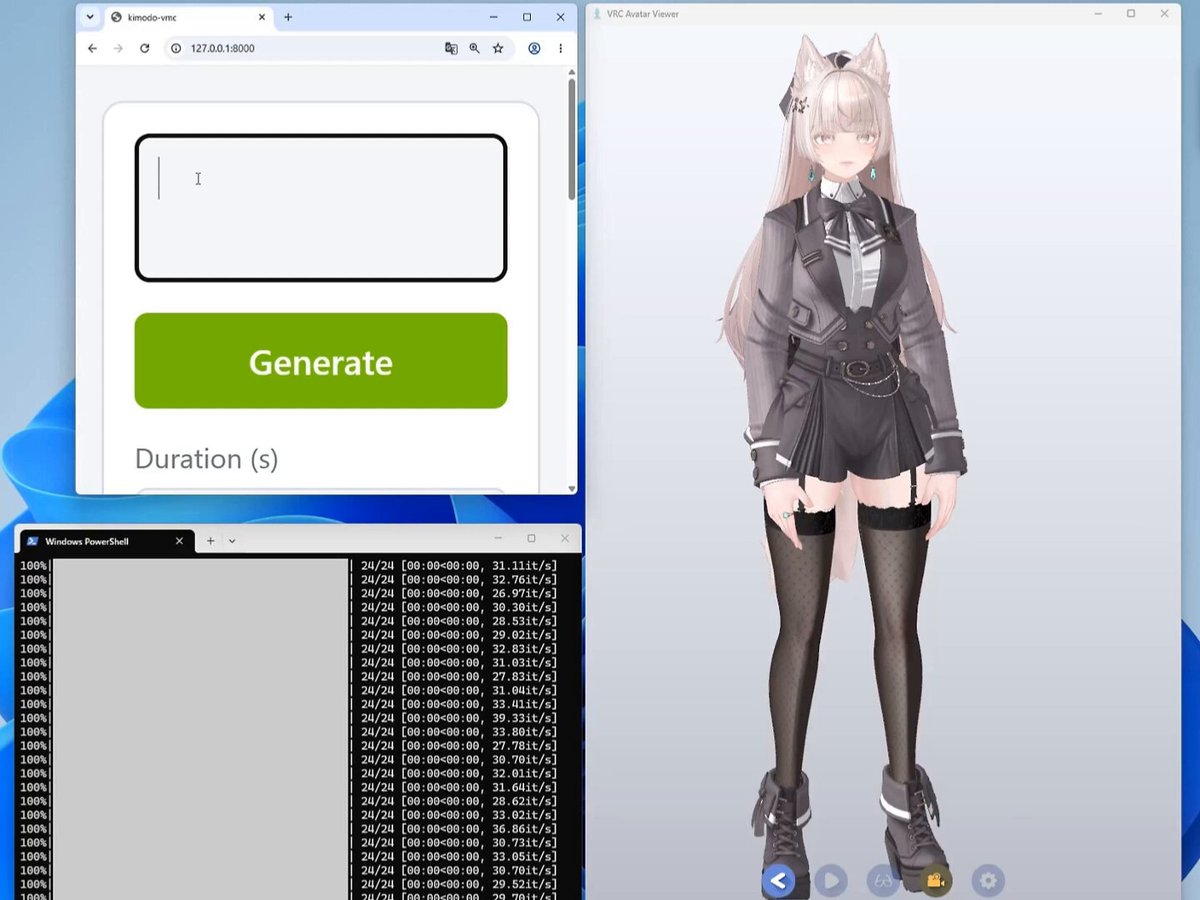
kimodo.cpp is live. NVIDIA's Kimodo, the best AI animation model right now, running natively on CPU or Vulkan. Type a sentence, get character animation, locally on your own machine. Before, you needed the whole PyTorch and CUDA stack standing up before you could generate a single motion. Now it is a native C++/GGML build that loads GGUF models and comes with a local web demo. No Python environment to fight. It gives you SMPL-X, and from there you retarget onto pretty much any skeleton you want, like Mixamo. Great piece of work Richard Palethorpe
Stefan 3D AI107,037 görüntüleme • 25 gün önce


I gave Astra one brief and it delivered the whole scene in Blender, camera direction included. All of it ran inside MiniMax Design. Astra sits there as the agent and talks to Blender over an official connector, so everything syncs straight onto the canvas. The final video is MiniMax H3, from the same canvas. #MiniMaxdesign -
Stefan 3D AI16,550 görüntüleme • 4 gün önce

Whoever wonder how good is Computer Use by GPT-6 Astra - It's overhype ahah I mean, official trailer definitely shows more that it is. Don't get me wrong, it is crazy smart but unimaginable slow lol. Attached is 1h time-lapse of making character from image. It took 5 min to just save file ahaha. I waited for 1h and abandoned this idea, too long and impractical.
Stefan 3D AI46,987 görüntüleme • 13 gün önce

GPT-6 is one of most noticable jumps you can't argue. And 3D is where it shows the hardest. I ran it through Blender few days: assembled a whole car from primitives, rigged and animated my quadruped creature, built a stylized island town and more. The full video with every test is out. My recommendation: run it through MCP. Computer Use is more of a fun demo, but with the right MCP tools it gets close to magic. If you don't want to wait forever and burn all your tokens, use the full setup. I break down mine in the video.
Stefan 3D AI39,362 görüntüleme • 10 gün önce

A playable MetaHuman in Unreal Engine whose animation comes from a real-time AI, on CPU. That's NVIDIA MotionBricks after the localai-org folks ported it to C++/GGML: a 0.73 GB model, free, running locally without a GPU. I wrote the Unreal plugin, wired up all 15 movement styles and fixed the stutters, the input lag and the wrists along the way. It works, but of course still limited in range of motion, but super impressive. Full breakdown:
Stefan 3D AI17,733 görüntüleme • 5 gün önce

I think a lot of people are missing what GPT-6 can really do because they're using it out of the box. Give it the right free MCPs and skills, and it starts to feel like magic. Start with Blender MCP. In my tests, it works faster and uses fewer tokens than computer use. If you want to have fun with procedural modeling, go for it. For more detailed models, I use 3D generators and let GPT handle the processing, rigging and animation. You don't need to burn tokens making it build every detail from scratch. I've spent the last six months putting this setup together. These are the tools I actually use for Blender, Unity, Godot and Unreal, including my 3D generation tools. Full breakdown:
Stefan 3D AI26,245 görüntüleme • 8 gün önce

AI retargeting without manual bone mapping. This could be big for game animation. Different skeletons and body proportions have always made reusing animation a headache. You already have the mocap, but getting it onto a new character can mean another round of bone mapping and cleanup. UMR learns how points on body surfaces correspond, then uses that mapping to transfer motion without manually matching bones. The research focuses on humanoid robots. I see a lot of potential for game animation here. Reusing the same motion library across characters with very different proportions, with less setup for each rig, would make a big difference. I think we'll see people adapting this for 3D workflows pretty soon. For the method and experiments, here's the full paper -
Stefan 3D AI20,300 görüntüleme • 6 gün önce

Unreal Engine 5.9 is official, and it's about AI. Announced at Unreal Fest Seoul on Aug 20. The new stuff coming in 5.9: • More MCP skills: AI agents reach more of the engine • Epic Developer Assistant: project context, screenshots, direct links into the docs • Semantic Search: describe an asset, the Content Browser finds it Plus diffusion models as extra render passes on top of the real-time frame. Nano Banana Pro, ChatGPT Images 2.0, Seedance 2.0 and Ray 3.14 were on screen. Key segment in the next post.
Stefan 3D AI61,713 görüntüleme • 23 gün önce

I got this custom scorpion rigged, animated and running in my game in one full day with AI. GPT-6 built the entire rig. My part was preparing the model and motion references, then giving feedback. After trying a few approaches, I found a workflow that worked: 1. Give it a model that makes sense. I generated the model with Tripo P2.0, then cleaned it up myself. Low-poly, optimized, split into logical parts. I think that preparation mattered a lot. GPT-6 works on the mesh through code. A manageable vertex count and sensible parts give it a clearer starting point for bone placement and skinning. 2. Show it the movement you want. I took a reference image of the character and used Seedance to generate side-view animation videos. I decided which animations the game needed and selected the takes with the movements I liked. Then I gave GPT-6 the model, the videos and that animation list. There was no existing rig to start from. 3. Compare the animation frame by frame. This was the idea I wanted to test: ask GPT-6 to compare its Blender animation against the reference video frame by frame, from the same view. That gave it concrete poses and timing to work toward. I could point to where the feet should be planted or when the tail should strike. 4. Expect to give feedback. A generated run can look like hopping. An attack can start with a jump you never wanted. Choosing the references matters, and a side view still leaves depth and hidden legs to figure out. It took several iterations. I explained what looked wrong and how I wanted it to move, and GPT-6 kept refining the animation. Once the walk worked, I also had it create left and right strafe animations procedurally from that walk. Those didn't need their own reference videos. By the end of the day, the creature was in Unity. I've recorded the full workflow, including the Blender setup and feedback process:
Stefan 3D AI12,141 görüntüleme • 4 gün önce

How about one image straight to an editable UE5 or Blender scene? Lumera just dropped paper - Engine-Native Editable 3D World Reconstruction with Objects & Lighting. You give it an image. It figures out what's in the scene, rebuilds every object as a separate mesh, then recreates the lighting as actual engine lights you can move and tweak. Even pulls an HDR environment out of the shot. The lighting part is the big deal here. Every other image-to-3D approach bakes it in. Lumera keeps it a parameter, like the scene was built in the engine from the start. Code and weights marked as "Soon". Paper -
Stefan 3D AI47,223 görüntüleme • 19 gün önce