
The Math Flow's banner
The Math Flow's profile picture

The Math Flow

@TheMathFlow57,819 subscribers

Mathematics insights presented through animations, formulas, pictures, graphics, quotes, books, history, and memes. DM for inquiries.

Shorts

(a + b + c)² = a² + b² + c² + 2(ab + ac + bc)

(a + b + c)² = a² + b² + c² + 2(ab + ac + bc)

82,239 Aufrufe

Unrolling Euler's Formula.

Unrolling Euler's Formula.

273,610 Aufrufe

A plane sliding through a double cone traces every conic section.

A plane sliding through a double cone traces every conic section.

39,662 Aufrufe

You Can Watch Euler's Formula, Unrolled.

You Can Watch Euler's Formula, Unrolled.

94,397 Aufrufe

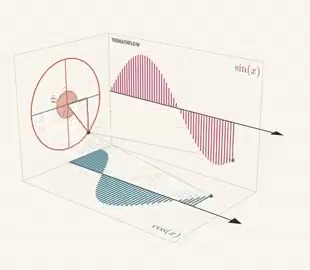
Sine and Cosine waves are...nothing but the shadows of a spinning circle.

Sine and Cosine waves are...nothing but the shadows of a spinning circle.

1,068,500 Aufrufe

The Geometry of Integration by Parts.

The Geometry of Integration by Parts.

481,620 Aufrufe

The distance a circle travels in a single revolution without slipping equals π times its diameter, regardless of the wheel's size.

The distance a circle travels in a single revolution without slipping equals π times its diameter, regardless of the wheel's size.

27,362 Aufrufe

At any point on a curve, there's one circle that fits the curve better than any other. It touches the curve at that point, leans in the same direction, and bends by the same amount. It tells you how sharply the curve is bending at that exact spot, and which way it's leaning. If the curve is bending sharply, the circle is small. If the curve is nearly straight, the circle is huge. The osculating circle of the curve.

At any point on a curve, there's one circle that fits the curve better than any other. It touches the curve at that point, leans in the same direction, and bends by the same amount. It tells you how sharply the curve is bending at that exact spot, and which way it's leaning. If the curve is bending sharply, the circle is small. If the curve is nearly straight, the circle is huge. The osculating circle of the curve.

46,308 Aufrufe

Rotation Matrices in Motion.

Rotation Matrices in Motion.

144,777 Aufrufe

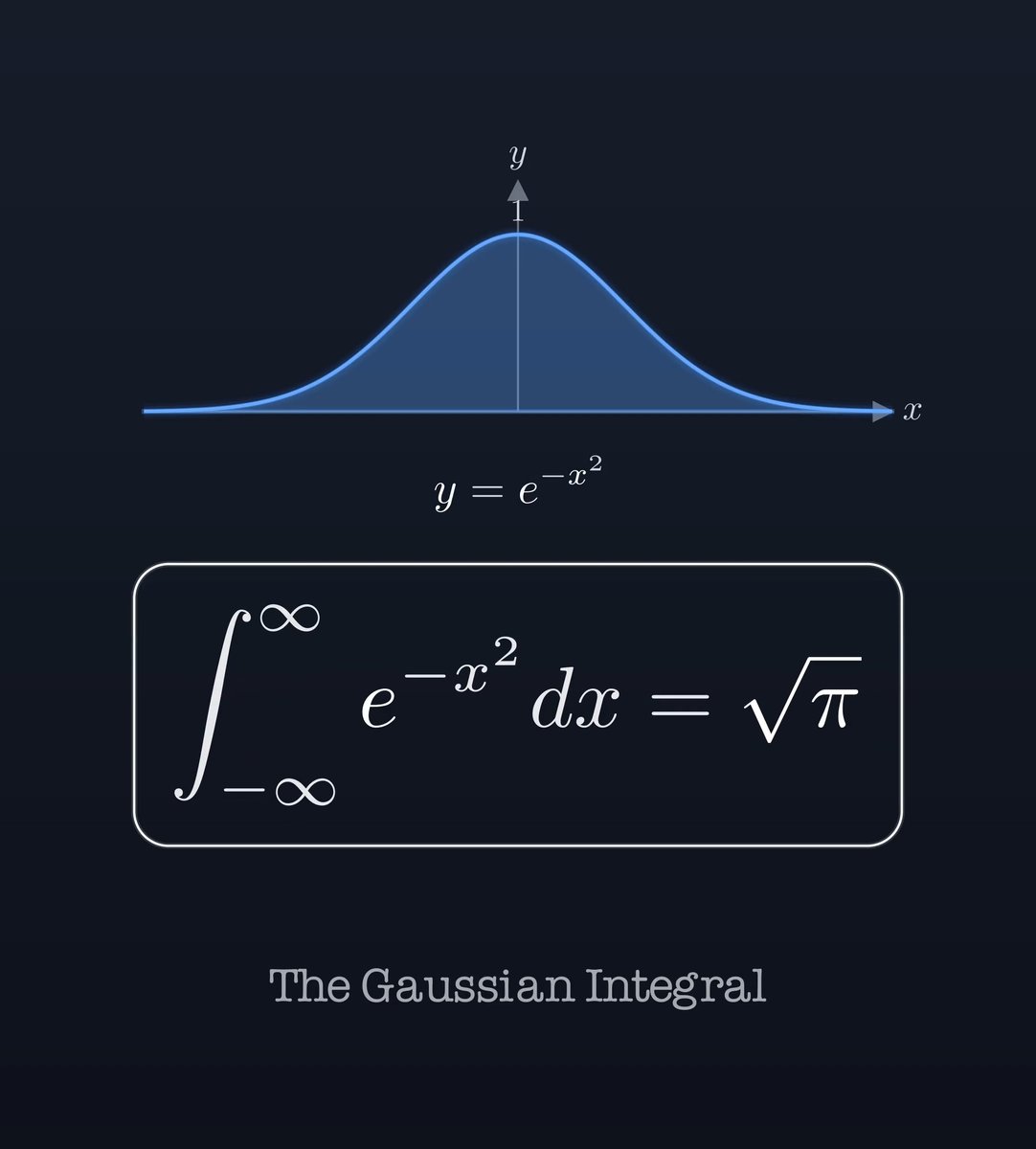
The Beautiful Gaussian Integral.

The Beautiful Gaussian Integral.

86,489 Aufrufe

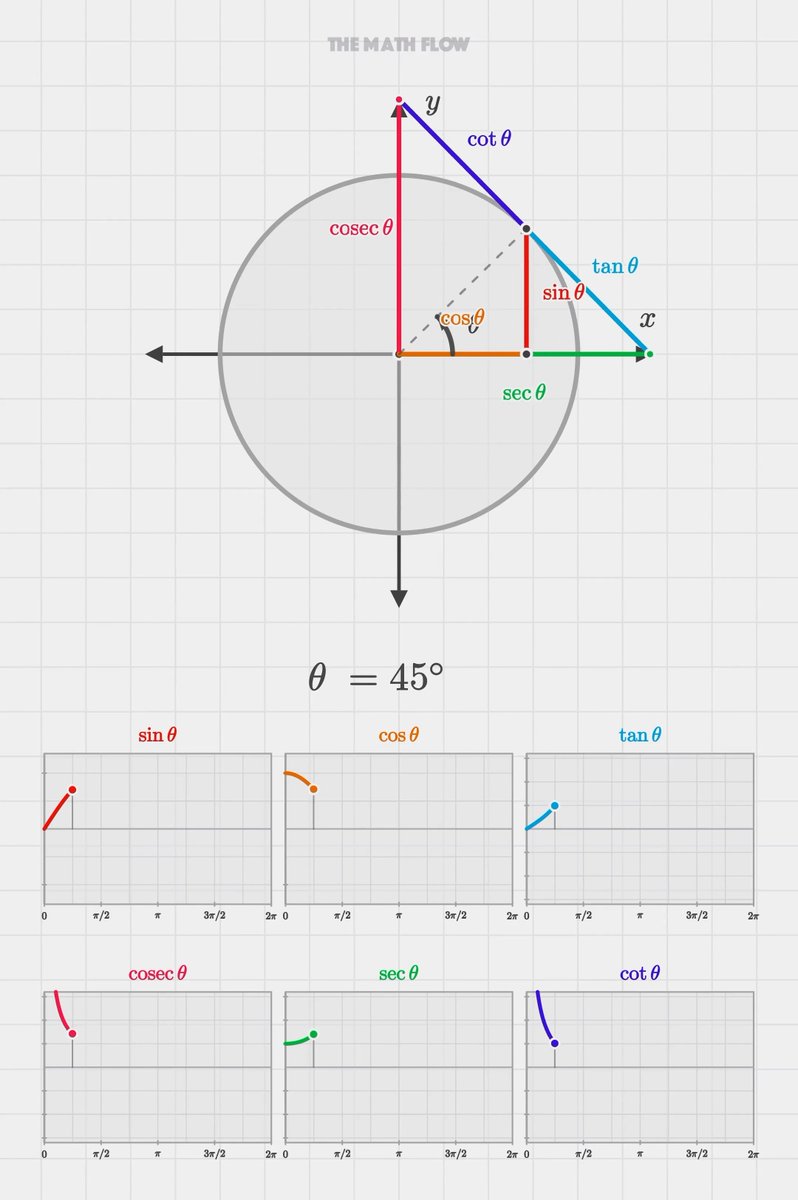
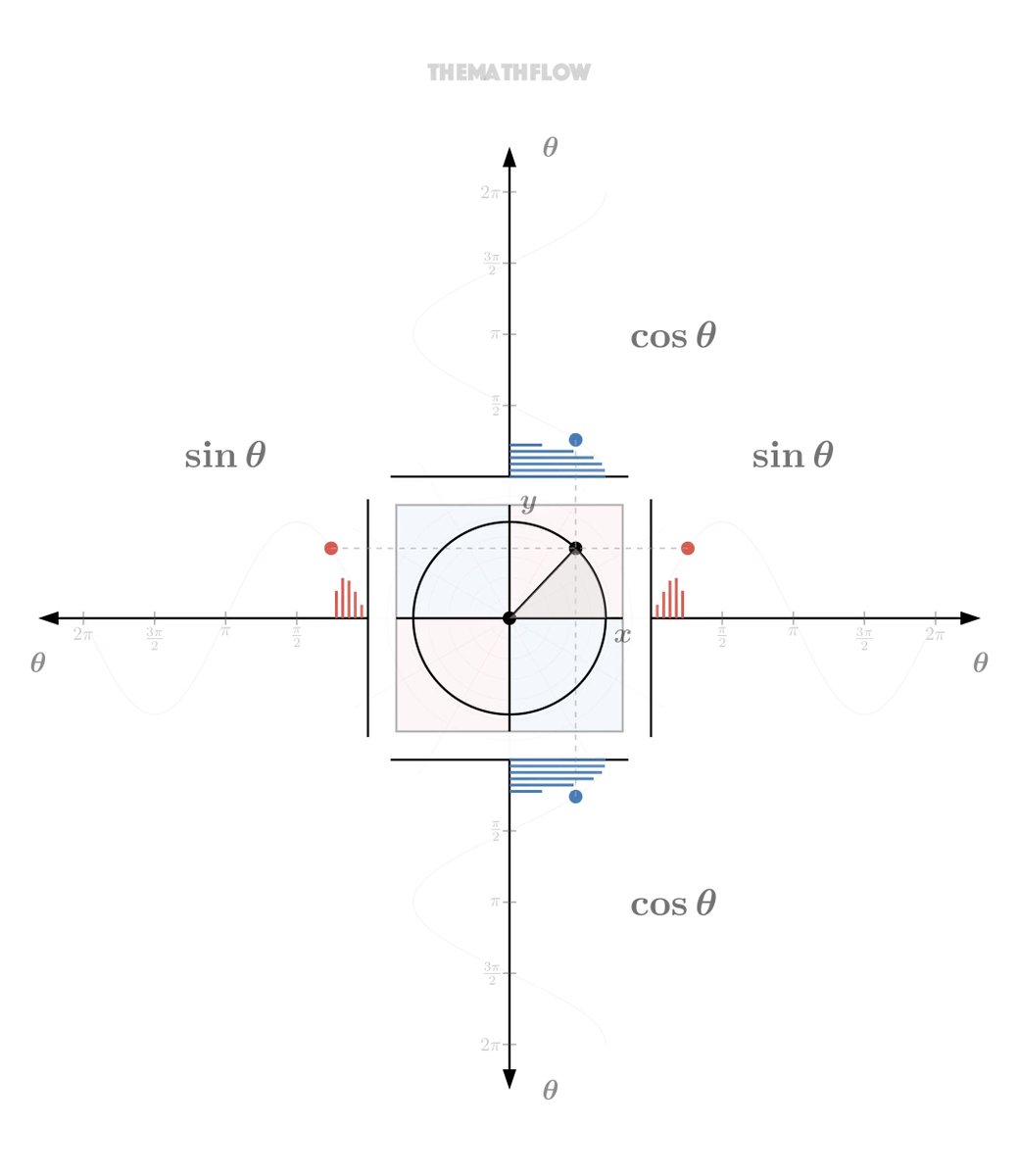
The Hidden Geometry of Trigonometric Functions and the Unit Circle.

The Hidden Geometry of Trigonometric Functions and the Unit Circle.

66,179 Aufrufe

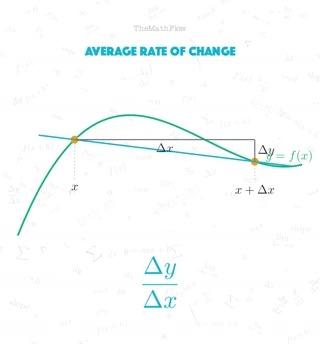
The difference between Δy/Δx and dy/dx.

The difference between Δy/Δx and dy/dx.

50,226 Aufrufe

In 1963, mathematician Stanislaw Ulam got bored during a meeting and started doodling a grid spiral of sequential numbers. By highlighting only the primes, he uncovered what remains one of the most mesmerising visual mysteries in number theory: the Ulam Spiral.

In 1963, mathematician Stanislaw Ulam got bored during a meeting and started doodling a grid spiral of sequential numbers. By highlighting only the primes, he uncovered what remains one of the most mesmerising visual mysteries in number theory: the Ulam Spiral.

52,594 Aufrufe

Viviani’s Theorem, named after the Italian mathematician Vincenzo Viviani, states that for any point inside an equilateral triangle, the sum of the perpendicular distances from the point to the three sides is always equal to the altitude (height) of the triangle.

Viviani’s Theorem, named after the Italian mathematician Vincenzo Viviani, states that for any point inside an equilateral triangle, the sum of the perpendicular distances from the point to the three sides is always equal to the altitude (height) of the triangle.

39,726 Aufrufe

a² - b² = (a+b)(a-b)

a² - b² = (a+b)(a-b)

46,344 Aufrufe

The Geometry of Square Waves.

The Geometry of Square Waves.

30,386 Aufrufe

The Fibonacci’s Elephant.🐘

The Fibonacci’s Elephant.🐘

27,310 Aufrufe

A circle is secretly a triangle!

A circle is secretly a triangle!

27,386 Aufrufe

The Basics of Electromagnetic Waves: Electricity and magnetism can sit still, like static electricity in your hair or a magnet stuck to your fridge. But when they move and change, they actually create each other. Together, they team up to form invisible ripples of energy called electromagnetic waves. Unlike ocean waves or sound waves, which need water or air to ripple through, electromagnetic waves don't need any material at all. They can easily travel through the completely empty vacuum of space. Maxwell's Big Idea: In the 1860s and 1870s, a Scottish scientist named James Clerk Maxwell figured out how this works. He wrote down the math showing exactly how electricity and magnetism link together to make these travelling waves. Today, scientists call his famous rules Maxwell's Equations. Hertz Proves It: Later, a German physicist named Heinrich Hertz took Maxwell's ideas and brought them to life. He was the first person to actually create and catch radio waves. To honour his work, we use the word hertz to measure how fast a wave vibrates (one cycle per second). Hertz's experiments proved two massive ideas: Radio waves are just invisible light: He showed that radio waves travel at the exact same speed as light, proving that they are actually a form of light we just can't see. Going wireless: He finally figured out how to detach these energy fields from physical wires, allowing the waves to fly freely through the air exactly as Maxwell had predicted.

The Basics of Electromagnetic Waves: Electricity and magnetism can sit still, like static electricity in your hair or a magnet stuck to your fridge. But when they move and change, they actually create each other. Together, they team up to form invisible ripples of energy called electromagnetic waves. Unlike ocean waves or sound waves, which need water or air to ripple through, electromagnetic waves don't need any material at all. They can easily travel through the completely empty vacuum of space. Maxwell's Big Idea: In the 1860s and 1870s, a Scottish scientist named James Clerk Maxwell figured out how this works. He wrote down the math showing exactly how electricity and magnetism link together to make these travelling waves. Today, scientists call his famous rules Maxwell's Equations. Hertz Proves It: Later, a German physicist named Heinrich Hertz took Maxwell's ideas and brought them to life. He was the first person to actually create and catch radio waves. To honour his work, we use the word hertz to measure how fast a wave vibrates (one cycle per second). Hertz's experiments proved two massive ideas: Radio waves are just invisible light: He showed that radio waves travel at the exact same speed as light, proving that they are actually a form of light we just can't see. Going wireless: He finally figured out how to detach these energy fields from physical wires, allowing the waves to fly freely through the air exactly as Maxwell had predicted.

37,313 Aufrufe

Visualization of equation: 1 + tan² (θ) = sec² (θ).

Visualization of equation: 1 + tan² (θ) = sec² (θ).

18,322 Aufrufe

Videos

TheMathFlow's profile picture

Fractal Spirograph.

The Math Flow

126,513 Aufrufe • vor 14 Tagen

TheMathFlow's profile picture

The Geometry of Perspective.

The Math Flow

105,230 Aufrufe • vor 1 Monat

TheMathFlow's profile picture

Mathematics. Functions. Dance.

The Math Flow

322,490 Aufrufe • vor 5 Monaten

TheMathFlow's profile picture

The Rössler Attractor.

The Math Flow

89,233 Aufrufe • vor 4 Monaten

TheMathFlow's profile picture

Law of Sines: Visual proof

The Math Flow

14,790 Aufrufe • vor 20 Tagen