
Matthew Vines
@VinesMatthew • 20,163 subscribers
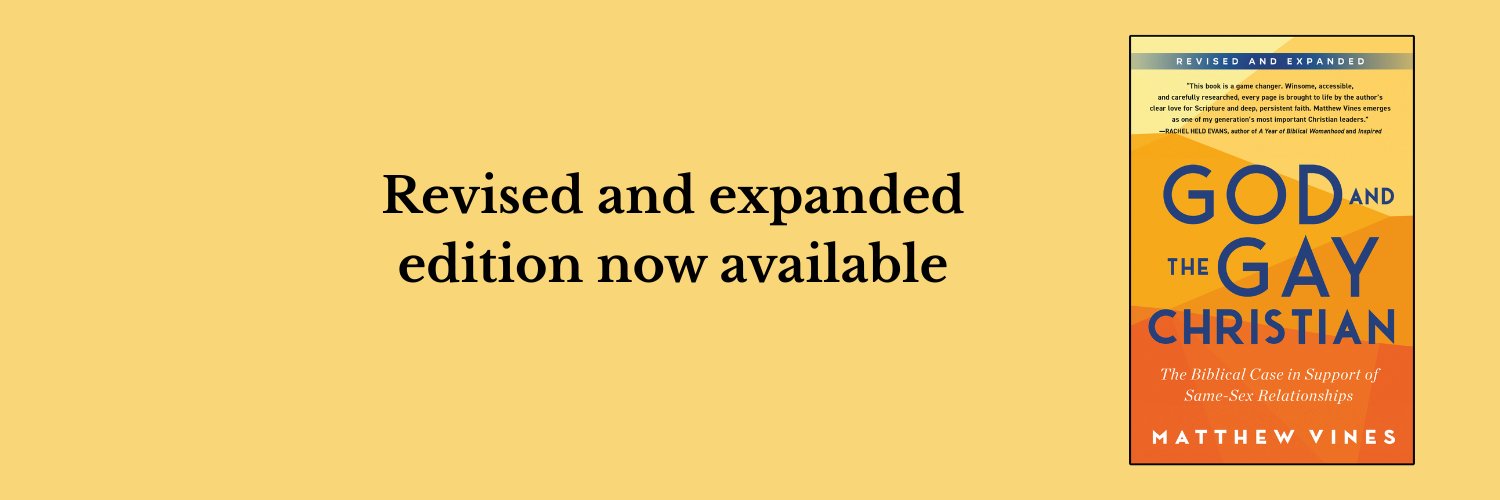
Author of 'God and the Gay Christian;' revised and expanded edition now available (https://t.co/d7of8kPG9k). Executive Director @ReformationP.
Videos

If you are gay and criticize any aspect of LGBTQ activism as too extreme, you will inevitably be called a "pick me." This is, of course, a cheap ad hominem, but it's also profoundly manipulative. It's similar to a romantic partner telling you that, if you break up with them, no one else will ever love you. From my conversation with Michael Pezzullo, LMFT:
Matthew Vines16,130 次观看 • 1 个月前


Public support for non-monogamy and polyamory has risen considerably in recent years. Many advocates argue that normalizing non-monogamy is a progressive reform in line with women's equality and same-sex marriage. But this view is seriously misguided, as I argue in this new talk. Normative monogamy played a critical and underappreciated role in enabling the rise of democracy, women's rights, and gay rights—and eroding that norm will undermine rather than advance those values. That is true whether the norm of monogamy is challenged from the right (i.e., patriarchal polygamy) or from the left (i.e., polyamory and consensual non-monogamy). From the teaching of Jesus himself onwards, Christianity has always upheld monogamy as an important moral standard. That norm has had a far greater and more beneficial impact on our society than many realize, and it cannot be altered without producing significant unintended negative consequences. In short: Monogamy matters, and it is very much worth defending. Why Monogamy Matters, from the 2025 Reformation Project conference: (0:00) Introduction (0:36) Same-sex marriage and slippery slope predictions (7:46) Non-monogamy statistics (11:42) Understanding consensual non-monogamy (16:29) A Christian case for non-monogamy? (20:43) Polygamy in the Old Testament (28:15) Emerging Jewish opposition to polygamy (31:58) Jesus's teaching on marriage and monogamy (34:16) The New Testament and monogamy (39:28) Polygamy vs. monogamy historically (45:13) Polygamy's math problem (47:06) How monogamy benefits societies (49:22) How polygamy harms women and children (51:37) How polygamy harms men and boys (53:15) How polygamy harms societies (55:58) What about modern polyamory? (57:03) Polyamory's math problem (58:46) Polyamory's community problem (1:07:16) Polyamory's gender problem (1:12:48) Gay men and monogamy (1:19:06) Why monogamy matters
Matthew Vines12,352 次观看 • 11 个月前


Can Christians legitimately reinterpret biblical prohibitions based on a distinction between contemporary and ancient forms of a prohibited practice? When it comes to same-sex relationships, many instinctively say no. But in fact, Christians have done so in the past on the issue of usury. Although usury today has broadly been redefined to mean charging excessive interest on loans, in the Bible and throughout most of church history, it meant charging any interest at all on a loan. Condemned categorically in Psalm 15:5 and as an "abomination" warranting the death penalty in Ezekiel 18:13, church fathers declared usury a sin against nature that jeopardized the eternal salvation of anyone who practiced it. The medieval church went so far as to declare that any Christian who even doubted the inherent sinfulness of usury should be "punished as a heretic." But in the 16th century, John Calvin argued for a reinterpretation of the biblical prohibitions of interest. Their original purpose, he said, had been to prevent the rich from exploiting the poor. But in the commercial economies of his day, lending at moderate interest to the wealthy could advance the common good. Calvin agreed that the Bible's broad prohibition of usury had been "apt" in the ancient world. But, he said, "our situation is quite different. For that reason, I am unwilling to condemn it, so long as it is practiced with equity and charity." Today, while Christians rightly continue to oppose exploitative forms of interest, hardly any Christians condemn interest outright. No denominations are splintering over it, nor are people being accused of heresy because of it. Calvin's hermeneutic is not new, nor is it inherently controversial. The question is simply whether we are willing to apply his basic interpretive principle to the topic of same-sex relationships given the vast cultural differences that exist between ancient same-sex practices and modern same-sex marriages. As I argue in this recent talk about the parallels between usury and same-sex relationships, we have a strong case for doing so.
Matthew Vines11,208 次观看 • 11 个月前
没有更多内容可加载