
a16z crypto
@a16zcrypto • 1,608,539 subscribers
We back bold entrepreneurs building the next internet. Posts are not investment advice or an advertisement for investment services. See https://t.co/CrY32IX80W 👇
Videos

AI is getting better at solving hard math problems, especially given recent drops. But what does that mean for the cryptography that protects everything from private messages to healthcare to banking and crypto wallets? Stanford cryptographer Dan Boneh, with Eddy Lazzarin ☀️, Justin Thaler, Liz Harkavy, and Sonal Chokshi, makes sense of the warnings sounded recently. They cover: - what’s fact vs. assumption - what’s new and what risks cryptographers have long prepared for - where quantum computing doesn't (and does) fit - opportunities for builders Highlights: 00:37 – What sparked the most recent debate about AI and cryptography 01:35 – Signal vs. noise: What the math does and doesn’t tell us 05:29 – Why cryptography depends on open problems 09:25 – Why the stakes go beyond blockchains 10:43 – How AI could strengthen confidence in cryptography 13:50 – Considerations for users and institutions 20:10 – Where AI and quantum threats overlap 22:32 – Building systems that can change cryptographic methods 23:59 – Hash-based versus lattice-based cryptography 33:07 – Opportunities for builders, and better security tools 38:14 – What comes next if there were a cryptographic break?
a16z crypto160,443 просмотров • 10 дней назад

Crypto is at a pivotal moment. As Congress debates landmark market structure legislation, Marc Andreessen and Chris Dixon discuss the decisions that could shape where the next generation of financial infrastructure is built, and whether the United States remains the global leader in crypto innovation: 00:00 Intro 05:31 From crypto subculture to financial infrastructure 08:37 Why crypto needs rules now 12:20 The regulatory war on crypto 15:41 How CLARITY could prevent another FTX 22:42 Why criminals using crypto may be easier to catch 26:20 Privacy, blockchains, and the invention of HTTPS 30:41 Government ethics and crypto 34:52 The banking lobby’s stablecoin fight 37:05 Why every major bank is building on blockchains 41:04 Developer liability as a killshot 45:23 How CLARITY provides oversight 49:30 What happens if CLARITY fails? 50:50 Regulation vs. innovation 54:12 Why America should lead 55:36 What CLARITY could unlock Marc Andreessen 🇺🇸 Chris Dixon Robert Hackett
a16z crypto955,366 просмотров • 2 месяцев назад


A handful of ideas hold up the entire digital world, but most of us never learn where they came from. So we went to the source: the people who solved these problems, and won Turing Awards and Nobel Prizes for it. First Principles, hosted by Tim Roughgarden. First episode out now.
a16z crypto658,624 просмотров • 4 месяцев назад

AI can’t find an algorithm that doesn’t exist. The worry is we’re wrong about what exists. Liz Harkavy and Justin Thaler on AI vs. cryptography: "We generally believe there is no efficient algorithm for these problems. ... And so if there's not one, it doesn't matter how smart the AI is; it cannot find the non-existent algorithm."
a16z crypto27,809 просмотров • 6 дней назад

Crypto succeeds when we stop calling it crypto. GP Guy Wuollet thinks financial services will run on blockchains, just like other businesses now run on the internet. So what gets us there? 00:00 "Everything is computer — except finance" 00:52 From a16z intern to general partner 14:34 How crypto moves into the mainstream 19:28 Why timing matters for crypto adoption 23:31 Token launches, liquidity, and going public 28:20 Backing founders for the long term 36:21 Opportunities in crypto 38:42 New markets for energy and compute 39:49 Stablecoins and finance’s digital transformation 43:29 Why perpetual futures are gaining traction 45:26 What tokenization changes for Wall Street 49:04 On oil painting and the pleasure of making things
a16z crypto44,883 просмотров • 13 дней назад

First Principles Ep. 6 with Shafi Goldwasser What if you could prove something is true without revealing why it’s true? Turing Award winner Shafi Goldwasser tells the origin story of zero-knowledge proofs: how a playful question about playing poker securely over the telephone led her, Silvio Micali, and Charles Rackoff to rethink what a mathematical proof could be. Goldwasser traces those ideas through interactive proofs, the sum-check protocol, SNARKs, and the systems now used to verify computation and preserve privacy on blockchains. She also reflects on why breakthrough ideas are often rejected at first, how toy problems can produce foundational theories, and whether AI systems should have to prove their answers. Hosted by Tim Roughgarden with Justin Thaler 00:00 Intro 03:36 How mental poker inspired zero-knowledge proofs: Proving that something is true without revealing the underlying information 06:30 The simulation paradigm and the meaning of “zero knowledge” 08:33 Why the original paper was repeatedly rejected 10:33 How interactive proofs became more powerful than conventional proofs 13:36 The road to modern SNARKs 19:02 Why the sum-check protocol is so useful for verifiable computation 25:31 Why many so-called “zk proofs” are not actually zero knowledge 34:06 Why toy examples, playfulness, and narratives can produce deep theory 37:23 The role of rigor and computational assumptions in cryptography 42:44 Applying zero-knowledge proofs to law, evidence, and secret software 45:23 Training AI systems to provide proofs alongside their answers 54:27 Why genuinely new ideas are often difficult for experts to recognize
a16z crypto202,758 просмотров • 2 месяцев назад


Can a sufficiently powerful quantum computer forge the signatures used to authorize Bitcoin and Ethereum transactions? What would it take to upgrade both networks before that happens? In this new lecture, Stanford cryptographer Dan Boneh explores why blockchains may turn to signatures built from hash functions. He also presents new research on threshold signing. The talk ends with the questions Bitcoin still has to answer, including whether post-quantum signatures will require larger blocks, what happens to abandoned coins, and how someone such as Satoshi could prove ownership after Bitcoin’s current signatures have been retired. 00:00 Why blockchains need to prepare for quantum computers 03:05 Why Bitcoin may bet on hash-based signatures 06:25 The “big footgun” in stateful signatures 08:58 A quantum-safe signature that takes one billion hashes 14:13 Inside SLH-DSA’s virtual tree 20:30 How Bitcoin and Ethereum could make the switch 23:48 What happens when a wallet loses its state? 32:47 Can threshold signing survive the quantum transition? 36:39 How to hide lattice cryptography from the blockchain 38:49 Why threshold one-time signatures seem impossible 45:36 How context prevents forged signatures 49:37 The forgotten idea behind Winternitz signatures 54:50 Turning one-time signatures into threshold signatures 1:04:27 Will quantum-safe signatures require bigger Bitcoin blocks? 1:06:26 Abandoned bitcoin and Satoshi’s recovery problem
a16z crypto120,891 просмотров • 1 месяц назад


Wall Street runs on Excel... But what if you had an Excel sheet that anyone could access and everyone agreed on?
a16z crypto25,667 просмотров • 12 дней назад


First Principles Ep. 4 with Alvin Roth Long before crypto made coordination programmable, Nobel Prize winner Alvin Roth was designing markets where coordination could save lives, matching doctors to hospitals, students to schools, and kidney donors to the patients who need them. Roth explains why markets are not just natural forces, but engineered systems; why the details of timing, congestion, incentives, and trust can make or break a marketplace; and why some of the most important markets are the ones where simply exchanging money can’t do the work. Hosted by Tim Roughgarden with Scott Kominers. 00:00 Intro: Why market design matters 04:18 The economist as engineer 08:09 When theory meets the real world 07:02 Fixing the medical residency match 15:32 Why markets unravel 18:22 Redesigning NYC high school admissions 28:05 The hidden problem of congestion 34:47 How kidney exchange saves lives 45:26 How the internet changed market design 48:25 Airbnb, Uber and smarter marketplaces 51:28 Repugnant transactions and moral economics 53:32 When markets need social support 54:32 The unexpected effects of criminalizing surrogacy 01:04:58 Preference signals and the job market 01:18:53 A broken market: resettling refugees and other migrants
a16z crypto127,644 просмотров • 3 месяцев назад

Our founder Chris Dixon on why the next big thing looks like a toy. 00:00 Intro 01:07 From programming to Wall Street and venture capital 16:59 Hunch and the challenge of being early to AI 20:22 Building AI products that can compete with ChatGPT 26:35 Backing founders and learning from Ron Conway 30:02 Joining Andreessen Horowitz 32:37 Why the next big thing starts as a toy 37:27 What Chris saw in Oculus 39:48 Why Coinbase stood out 42:05 Launching a16z’s first crypto fund 46:47 Blockchain networks, stablecoins, and regulation 51:36 Lessons from Marc Andreessen and Ben Horowitz
a16z crypto53,950 просмотров • 1 месяц назад
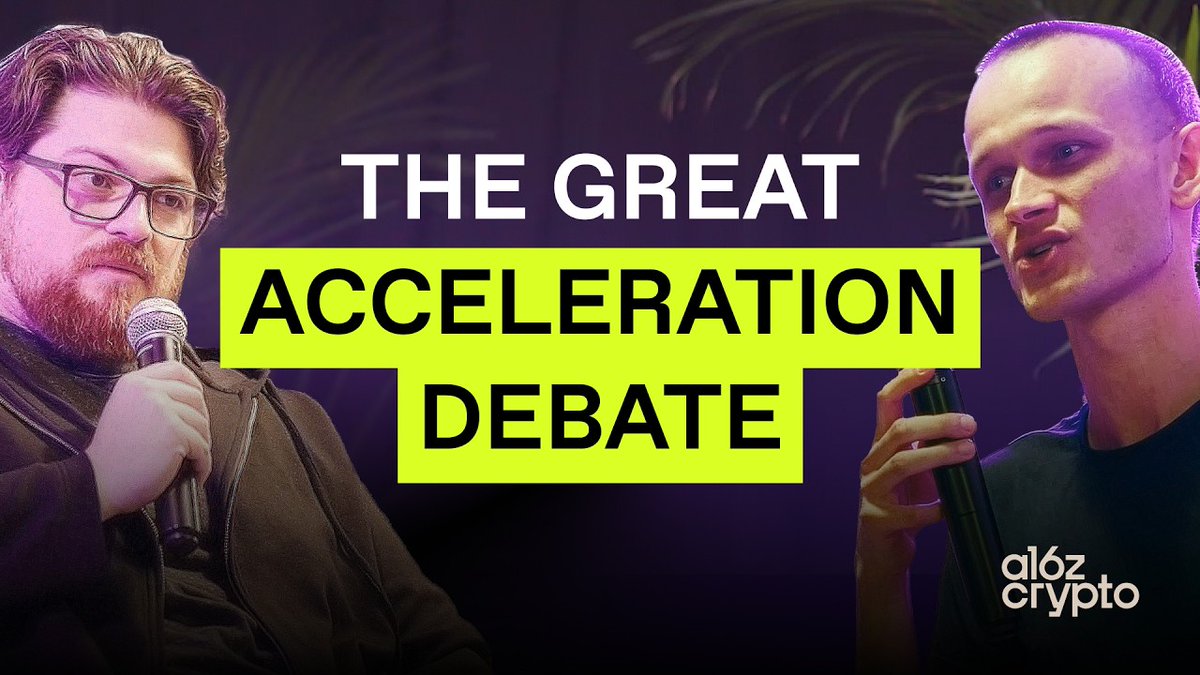
E/ACC vs. D/ACC: THE DEBATE vitalik.eth thinks slowing down AGI by four years is worth it. Beff (e/acc) thinks that's exponential opportunity cost. They debated it live, moderated by Eddy Lazzarin ☀️ and Shaw. 00:00 Opening 07:02 Thermodynamics and first principles 16:04 Acceleration, entropy, and civilization 28:29 The core disagreement 32:42 Comparing and contrasting e/acc and d/acc 36:20 Open source, open hardware, and local intelligence 54:18 Should AI be slowed down? 1:02:35 Autonomous agents and artificial life 1:21:07 Crypto as the trust layer between humans and AI 1:35:37 Closing arguments
a16z crypto236,835 просмотров • 6 месяцев назад

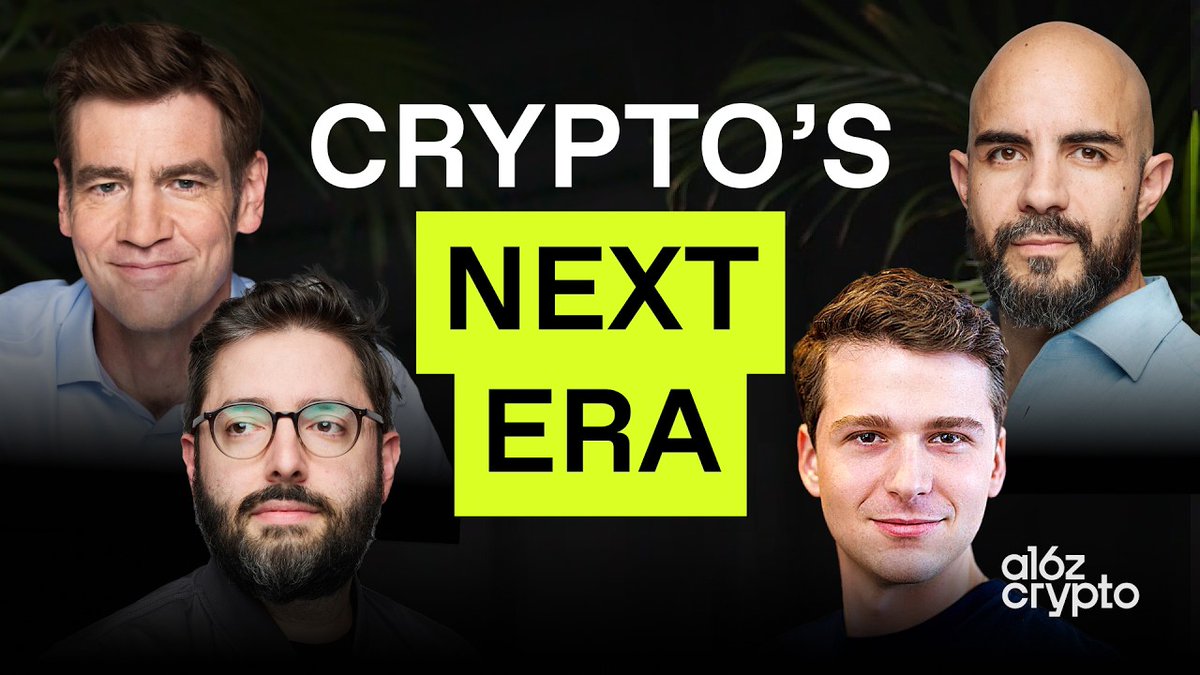
"It's a wonderful time to be a pragmatist building onchain." Chris Dixon, Ali Yahya, Eddy Lazzarin, and Guy Wuollet on Crypto Fund 5, where crypto is right now, and where it's heading next. 00:00 Open 01:31 Why raise Crypto Fund 5 now 02:10 The GENIUS Act and what regulatory clarity unlocks for builders 04:32 Why stablecoins are crypto's WhatsApp moment 08:54 Why the next era of crypto founders will be pragmatic, not ideological 11:49 From cypherpunk revolution to crypto's "collared shirt era" 15:02 Programmable money meets AI 21:15 Onchain capital markets for compute, energy, and credit 25:57 Why finance is the foundation, not the ceiling 28:48 AI agents as first-class economic actors 38:19 Why privacy is the only moat 41:26 Jevons paradox and the future of blockspace demand 43:20 Jolt and the zero-knowledge breakthrough 58:15 Writing the next chapter of Read Write Own Chris Dixon Eddy Lazzarin ☀️ Guy Wuollet Robert Hackett
a16z crypto172,561 просмотров • 5 месяцев назад
