

Alex Boge
@alexboge • 19,658 subscribers
Photographer, SCUBA DiveMaster, Harley-Davidson Rider, IPSC Open Master, degrees in CIS & Physics, studying conspiracies, Bitcoin+MSTR+ASTS+RKLB
Shorts


Videos
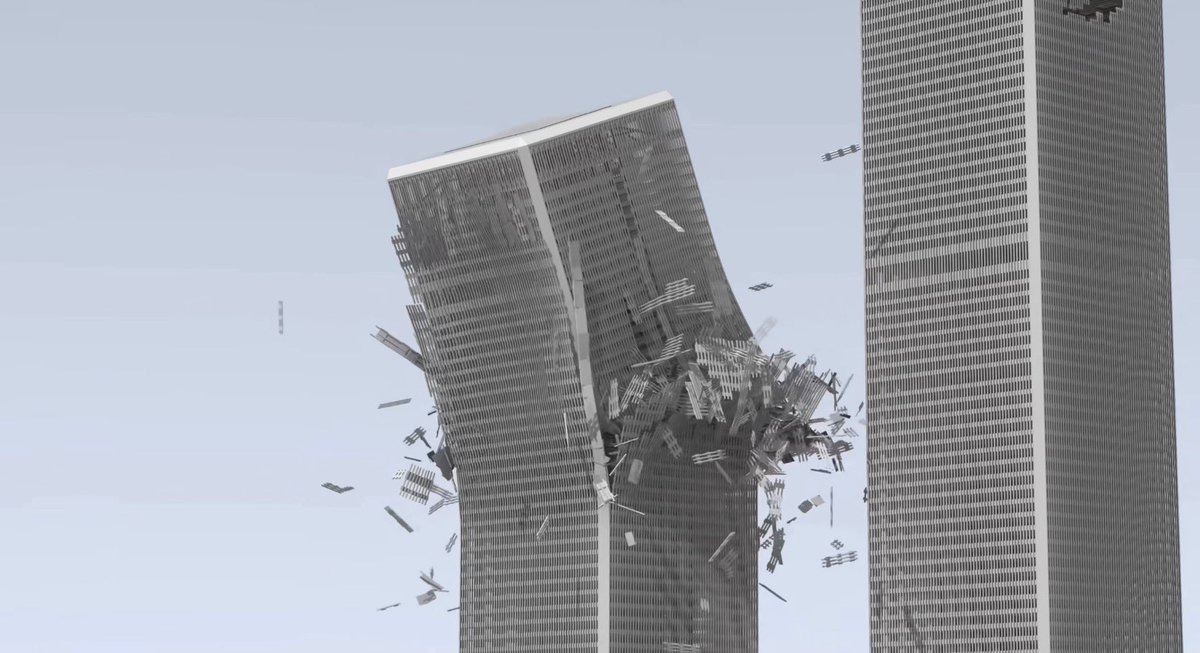
I find these World Trade Center simulations by Kostack Studio fascinating because they remove the smoke and let you see the collapse much more clearly. In the real footage, so much is hidden by fire, dust, debris, distance, and chaos that many people come away with the impression that the towers simply dropped straight down into their own footprints. But that is not really what happened. These simulations make it much easier to see that the collapse begins in the heavily damaged and fire-weakened region, the upper section starts moving and tilting, and the destruction then propagates downward through the structure. The towers do not simply disappear vertically into their own footprints. Large portions of the upper structure and exterior are moving outward and to the side as the collapse develops. Much of that motion is simply obscured in the real videos once the enormous debris cloud forms. And this is also why I find these simulations useful when people describe the collapses as looking like “controlled demolition.” Strip away the smoke and dust and the resemblance becomes much less convincing. What you see is a highly asymmetric structural failure beginning around the aircraft-damaged and fire-affected floors, followed by an enormous moving mass progressively overwhelming the structure beneath it. There is tilting, rotation, exterior columns peeling away, debris being thrown far outside the building footprint, and structural failure occurring chaotically as the collapse moves downward. That is very different from the neat mental image usually implied by “controlled demolition,” where structural supports are deliberately severed in a carefully timed sequence to produce a predetermined collapse. And importantly, we already know what preceded these collapses. Both towers suffered massive aircraft-impact damage. Fireproofing was stripped from portions of the structure. Large, uncontrolled fires then burned across multiple floors - for about 56 minutes in the South Tower and about 102 minutes in the North Tower - heating and weakening structural components until collapse initiated. Once that upper mass began moving, the loads imposed on the floors and structure beneath became vastly greater than anything they had been designed to carry. The result was progressive collapse. No, an animation is not proof simply because it looks convincing, and these are not official NIST simulations. They are visualizations built under particular assumptions. But as visualizations, I think they are extremely useful. They let you see something the original footage often cannot show clearly: beneath that enormous cloud of smoke and debris was a complicated, violent, asymmetric structural failure - not two buildings neatly dropping straight down into their own footprints. A note on the simulation: this is not intended to reproduce the collapse down to the exact motion of every beam, floor panel, and fragment of debris. No practical simulation could do that. Its value is in modeling the large-scale structural behavior - how the major sections deform, move, tilt, separate, and progressively fail. Think of it as a visualization of the mechanics and overall collapse behavior, not a frame-by-frame reconstruction of where every piece of steel ultimately landed.
Alex Boge62,384,268 Aufrufe • vor 1 Monat
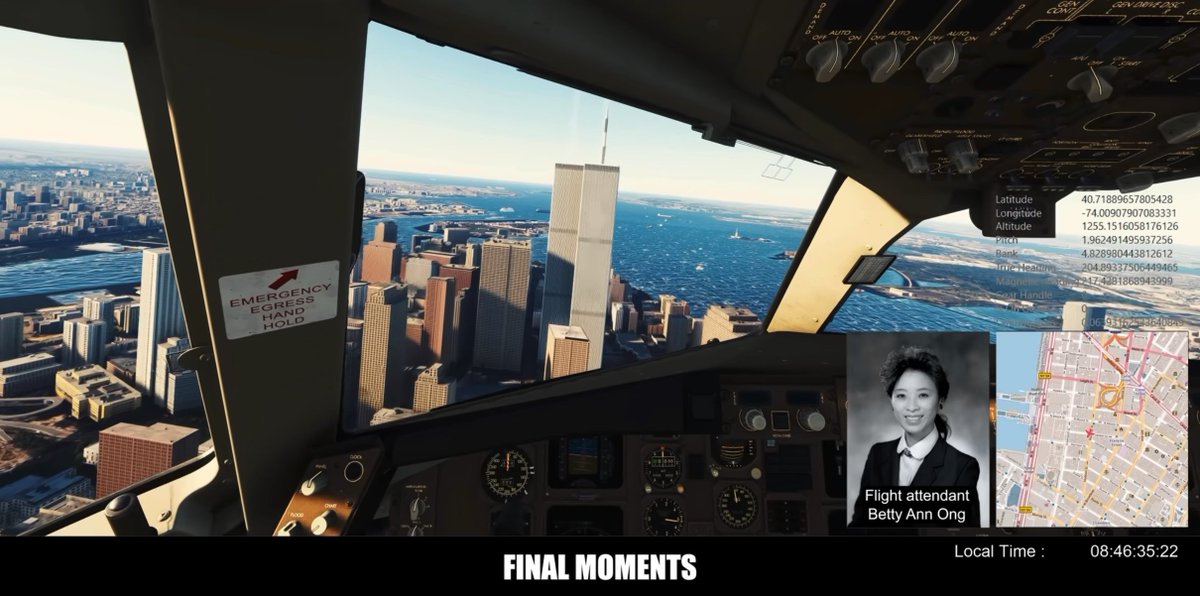
This may be one of the eeriest - and frankly, most terrifying - 9/11 reconstructions I’ve seen. The simulation recreates the final moments of American Airlines Flight 11 from the cockpit, essentially showing what hijacker Mohamed Atta would have seen as the North Tower rapidly filled the windshield. But the audio you’re hearing is real. Flight attendant Betty Ong, aboard Flight 11, was calmly reporting what was happening inside the hijacked aircraft - crew members stabbed, mace in the cabin, the cockpit inaccessible, and the realization: “I think we’re getting hijacked.” American Airlines operations specialist Nydia Gonzalez was monitoring Ong’s call and relaying her reports to the airline’s operations center as Flight 11 raced toward New York. At 8:46 a.m., the aircraft struck the North Tower. Watching a reconstruction of what the hijacker would have seen while simultaneously hearing the actual voices of the people trapped aboard that aircraft is deeply unsettling.
Alex Boge10,208,230 Aufrufe • vor 28 Tagen

Ashton Forbes posted a recolored version of one of his MH370 "teleportation" videos. He should not have done that. Watch the crosshair in the middle of the screen. A reticle sits on top of everything behind it. Every reticle, on every targeting system. It doesn't matter whether it's a physical one in a rifle scope or an electronic one on a targeting display. That's the whole point of it. How do you aim at a target if the target hides your crosshair the moment you put it there? (Yes, that includes the camera pods on drones.) In his video, the plane covers the reticle. At least five times in 61 seconds. That's not a camera filming an airliner. That's a layer stack: background, then reticle, then a plane pasted on top. The hoaxer put the layers of his CG hoax in the wrong order and never caught it. Every freeze frame in the video is stamped with the time in his own clip, so check them yourself. My favorite is 0:34.20. The crosshair is visible above the plane, visible below it, and gone in between. Credit to cryshlee, who first brought this to my attention.
Alex Boge88,418 Aufrufe • vor 2 Tagen

One of the great misconceptions about Ground Zero is that everything was destroyed so completely that nothing meaningful could be recovered. This example footage shows otherwise. For nearly nine months, recovery workers searched the wreckage of the World Trade Center. Approximately 22,000 fragments of human remains were recovered, carefully catalogued and taken to the New York City medical examiner for analysis. Through DNA testing and other forensic methods, remains have now been identified from more than 1,650 of the 2,753 people killed at the World Trade Center. The work continues to this day. And the debris was searched just as carefully. Approximately 1.8 million tons passed through the Fresh Kills recovery operation, where evidence teams from 55 of the FBI’s 56 field offices searched for remains, personal possessions and evidence of the crime. They recovered human remains, jewelry, identification cards, aircraft wreckage and countless tiny personal effects. They did not recover a demolition charge, detonator, blasting cap, firing wire or identifiable fragment of any explosive device. Ground Zero yielded heartbreaking evidence of thousands of lives. It yielded no physical evidence of controlled demolition. The latest official identification figures come from the New York City Office of Chief Medical Examiner, while the scale of the debris examination is documented by the Department of Justice Inspector General.
Alex Boge456,608 Aufrufe • vor 24 Tagen

Here's a video I think very few people have seen. It reveals something fascinating. The strip in the middle is frozen just before impact. Everything above and below it is live. Watch the South Tower's edge slide back and forth against it. That's roughly 22 inches of sway at the roof, per NIST, and it stayed up. That's a credit to the people who designed it. They planned for a Boeing 707. What hit it was a bigger, heavier 767 doing roughly 545 mph. NIST measured the sway from impact video and found the building's rhythm barely changed, meaning the hit didn't appreciably affect its overall stiffness. So it wasn't the impact that brought the towers down. And it certainly wasn't nonexistent explosives. It was the fire. The crash stripped fireproofing off the steel, the fires weakened it, sagging floors pulled the outer columns inward until they buckled, and then thousands of tons of building came down on floors that were never built to stop it. The South Tower fell 56 minutes after this clip.
Alex Boge497,072 Aufrufe • vor 1 Monat
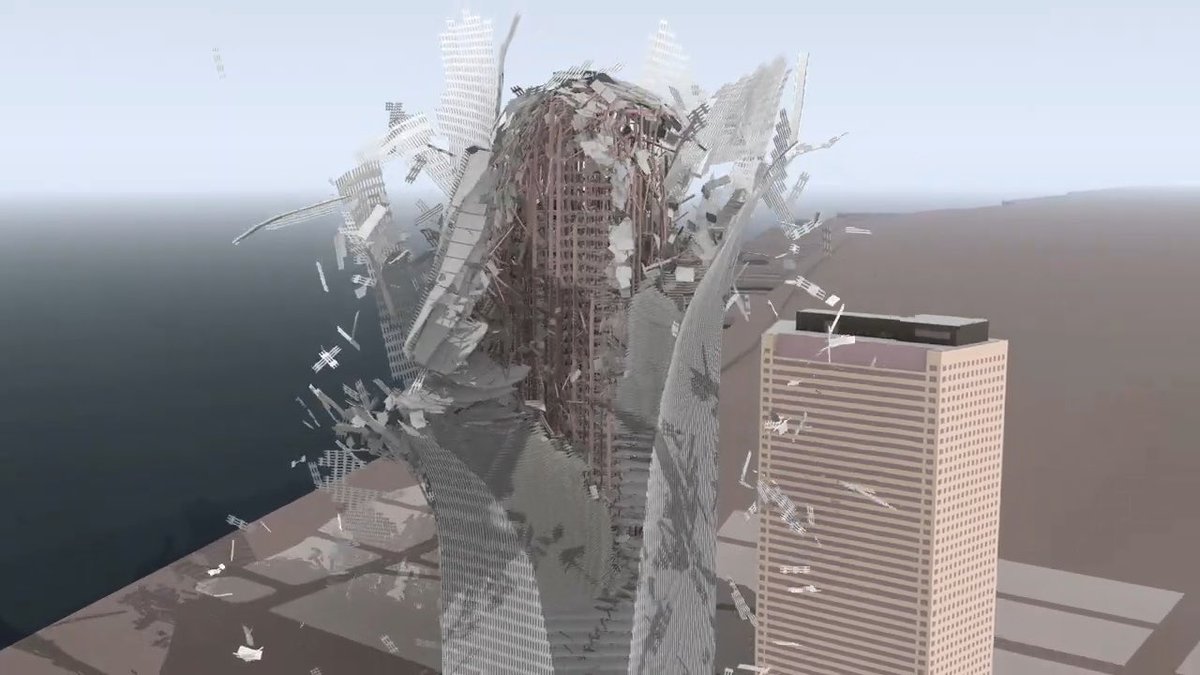
New Video: You’ve watched the North Tower collapse hundreds of times. But you’ve probably never actually seen it like this. Pay very close attention to the central core. The floors and exterior structure descend around it while substantial portions of the core remain standing considerably longer. That is one of the most important things this visualization reveals. In the familiar footage of 9/11, enormous clouds of dust and debris quickly obscure almost everything. Most people naturally perceive the collapse as beginning when the exterior starts visibly moving and ending when debris reaches the ground. But that is not the complete structural collapse sequence. There is evidence that internal structural failures, including dropped floors, were already occurring before the unmistakable global descent became obvious from outside. And after that descent began, the dust cloud concealed much of what happened next. NIST noted that significant portions of the towers’ cores remained standing for roughly 15 to 25 seconds after collapse initiation. Think about what that means when someone tells you the entire building simply “fell at free-fall speed.” It also creates a serious problem for the controlled-demolition claim. If explosives had rapidly destroyed the tower’s primary structural supports to initiate the collapse, we should not be watching substantial portions of the central core remain standing after the surrounding floors and exterior structure had already descended. Yet that is exactly what the real footage shows. And this is important: this animation is a visualization, not a perfect frame-for-frame reconstruction. Do not treat every beam, every floor failure, or every second of the internal sequence as literal. Much of the real collapse was hidden from every camera, so no model can reproduce every detail perfectly. What Kostack Studios has done is remove the enormous visual obstruction and allow us to appreciate structural features that are very difficult to see in the original footage. The model also illustrates debris from the North Tower striking World Trade Center 7, helping show how WTC 7 sustained damage and fires following WTC 1’s collapse. But the biggest thing I want you to watch is the core. The North Tower did not simply disappear downward as one intact object. Different parts of the structure failed at different times, and substantial portions of the central core remained standing after much of the surrounding structure had disappeared into the dust cloud. Full credit to Kostack Studios for the tremendous amount of work that went into this visualization. In the first comments I’ll include several photographs showing the surviving core through the dust, the subsequent NIST-authored forensic paper discussing evidence of internal floor failures before global collapse, and a link to the complete original Kostack Studios video. Please take a moment to watch the original video and give it a like. The creator deserves the views and credit for the work that went into it.
Alex Boge103,638 Aufrufe • vor 7 Tagen

My prior post featured simulations by Kostack Studio of the Twin Towers collapses. What made those especially fascinating to me was that they removed the smoke, debris, and surrounding visual clutter, making it easier to see the broader structural behavior that the real footage often obscures. By far the most common response in the comments was: “Now do Building 7.” Fair enough. So here is Building 7. Before getting into the simulation itself, a quick reminder of the basic context: WTC 7 was not struck by an airplane, but it was heavily damaged when debris from the collapse of the North Tower tore a large gash into its south face. That debris ignited fires on multiple floors. The building’s water supply and fire suppression capability were severely compromised, firefighters were eventually pulled back for safety reasons, and the fires were left to burn uncontrolled for nearly seven hours before the building finally collapsed at 5:20 p.m. What I find so impressive here is not just the final animation, but what went into producing it. According to the creator, this WTC 7 simulation was built using more than 28,000 structural elements and roughly 703,000 constraints, incorporating actual steel dimensions, steel thickness, plastic deformation, and connection-breaking behavior derived from physical parameters. In other words, this is not some cartoon sketch of a collapse. It is a serious attempt to model large-scale structural behavior as faithfully as possible with the information available. And I also appreciate the creator’s candor. He does not pretend this simulation is a perfect recreation of exactly what happened, down to every beam, every floor panel, and every fragment. Nobody can do that. A real collapse of this complexity becomes chaotic very quickly, and even with extensive modeling there are limits to what can be known with absolute precision. That honesty is part of what makes the project more compelling to me, not less. This is not being presented as an official NIST model, and it is not being offered as final proof of every detail. It is a visualization - an informed structural simulation built from the available evidence, the known geometry of the building, video observations, and the broader body of engineering work that has been done over the years by NIST and others. And that is exactly why I find it worth sharing. One of the biggest problems in discussing WTC 7 is that most people only know the exterior video. They see the outer shell descend and then leap immediately to conclusions. What they usually do not see is the internal failure sequence that, according to NIST and many subsequent analyses, was already underway before the visible exterior drop. This simulation helps make that concept easier to understand. It does not settle every argument. It does not reproduce every last detail with magical perfection. But it does provide a serious, visually clear attempt to show how the building could fail internally before the exterior facade gave way, and why the final visible descent can look simpler from the outside than the underlying structural reality actually was. So no, none of us should pretend this is “exactly” what happened in every microscopic detail. But as a close large-scale reproduction built from the best information available, I think it is genuinely fascinating. And given how many people demanded “Now do Building 7,” I hope this helps answer at least some of those questions.
Alex Boge285,257 Aufrufe • vor 1 Monat
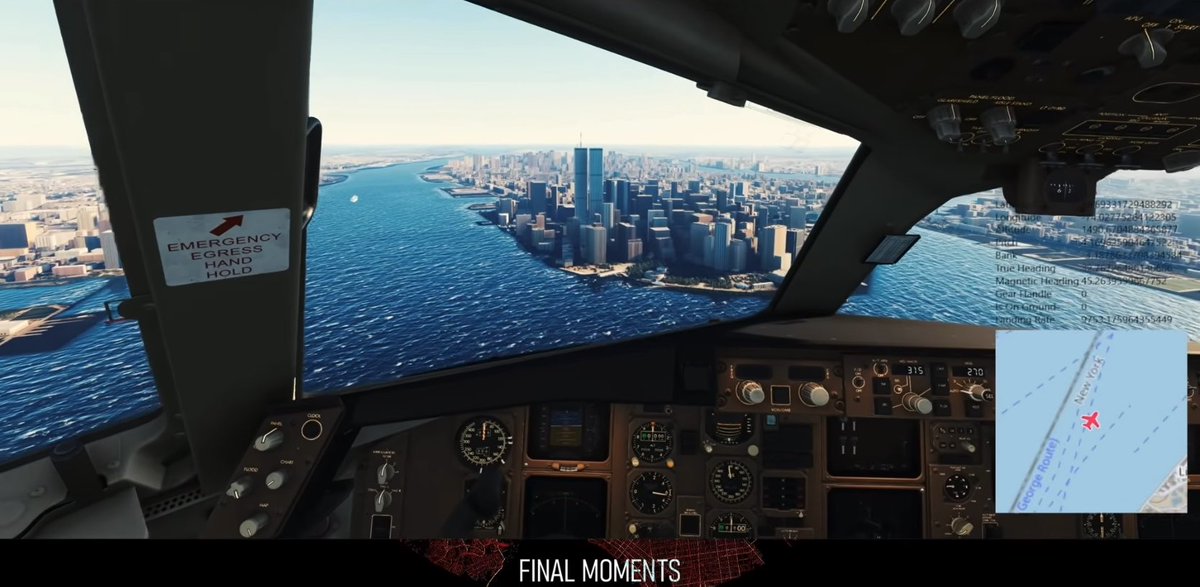
Most of the world watched this moment live on TV, from the ground on 9/11. Here's what it looked like from the cockpit. These are the final moments of United 175, making its approach toward the South Tower (2 WTC) about 17 minutes after Flight 11 hit the North Tower. The audio is the actual air traffic control from that morning, as controllers realized a second plane was headed for the city. There were 60 innocent passengers and crew on board. You'll hear people claim this flight was impossible, beyond the capabilities of both the pilot and the plane. Watch it for yourself. No precision aerobatics. A fast descent toward a building over 200 feet wide, with a sloppy last-second bank to line it up. Well within what a 767 can do, and he only had to get it right once. Where were you when you saw it?
Alex Boge154,188 Aufrufe • vor 22 Tagen
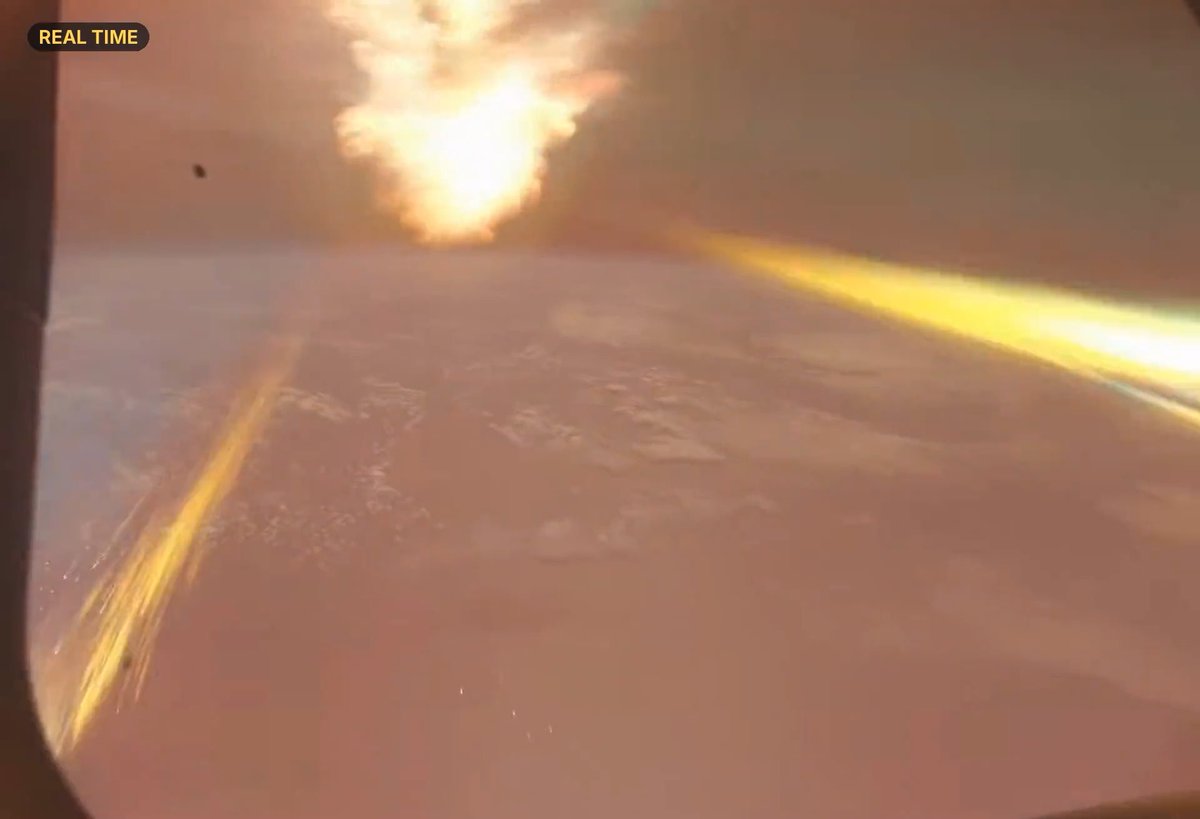
This is what hitting the atmosphere at about 35 times the speed of sound looks like from the inside. Artemis II, April 10, 2026. Four astronauts on their way back from a flight around the Moon. Most of it is sped up 10x, but I dropped to real time for the best of the plasma so you can hear the thrusters firing. Every time the view jumps, that's them. And that tiny dot at the very start? That's the Moon, setting behind Earth. Video: NASA
Alex Boge24,926 Aufrufe • vor 4 Tagen

There are a lot of videos out there about the Pentagon on 9/11. This is the one I keep coming back to. It covers the last few seconds. The final approach of American Airlines Flight 77, a Boeing 757, into the west wall of the Pentagon at 9:37:46 a.m. at roughly 530 mph. 184 people were murdered. 59 passengers and crew aboard Flight 77, and 125 people inside the building. What makes this video different is the structure. It runs the animation, and every time something happens along that flight path, it stops and cuts to a photograph of the actual thing. Animation says it clipped a light pole. Cut to the light pole, down in the road. Says it hit a taxi. Cut to the taxi. Says it took out a generator on the way in. Cut to the generator. Over and over, all the way down the approach to the facade. Five light poles sheared off in a line, each one photographed where it fell. Then it closes with a compilation of the aircraft debris recovered from the scene. That's the whole ballgame. Every step is a falsifiable claim with a picture attached. It isn't a model asking for your trust. It's a model you can check. And the photographs aren't the whole case. The flight data recorder was recovered and read completely. Speed, altitude, heading, control inputs, all the way to impact. That's what the NTSB used to reconstruct the approach, so the line you're watching in the animation isn't an artist's guess. The cockpit voice recorder was also recovered, but fire destroyed the recording. I'll say that plainly, because it's true and because someone will throw it at me. One box gave us everything. The other gave us nothing. Remains were recovered and identified by DNA. All but five of the people who died at the Pentagon were identified. Separately, five sets of remains matched no victim and no family reference sample. Those were the hijackers. Landing gear. Engine components. Fuselage with airline markings. Passengers' personal effects. All of it came out of that building. So here is my challenge to anyone who wants to tell me it was a missile. One. Explain the eyewitnesses. Over a hundred recorded accounts of a large commercial jetliner coming in low and fast, many of them naming American Airlines. Two. Explain the C-130. Reagan controllers asked an Air National Guard C-130H that had just departed to identify the unknown aircraft. The pilot spotted it, identified it as a Boeing 757, tried to follow it, and then radioed Washington Tower that it had crashed into the Pentagon. A military pilot in the air, looking directly at it. Three. Explain the five light poles. A missile does not shear off a line of poles across hundreds of feet on its way in. Four. Explain the two flight recorders pulled from the impact site, and explain the data on one of them. Missiles do not carry black boxes. And that recorder's speed, altitude, heading and control inputs match the primary radar track Dulles controllers were watching at 9:32. Two independent systems, one airborne and one on the ground, no shared hardware, same flight path. Five. Identify the missile. Type. Launch platform. Where it came from. Who put it there. Six. Tell me where Flight 77 went. Tell me where the 59 passengers and crew went. Real aircraft, real tail number, real people who boarded at Dulles that morning and had funerals. Where did they go? Twenty five years. Still waiting on number six. Watch the video. Video credit: Mike J. Wilson, "911 Case Study: Pentagon Flight 77
Alex Boge124,510 Aufrufe • vor 1 Monat

Prominent Flat Earthers explaining what a 24‑hour sun in Antarctica would mean. And in their own words, confirming the obvious: “If there is a 24‑hour sun in Antarctica, the Earth cannot be flat.” No debunking needed. Just receipts - paired with uninterrupted Antarctic sunlight, personally witnessed and recorded by multiple Flat Earthers and normal travelers, using multiple cameras, during a documented trip to Antarctica. Timelapse credit: Dave McKeegan
Alex Boge796,855 Aufrufe • vor 9 Monaten

I require this level of patience dealing with conspiracy addicts. I don’t always succeed.
Alex Boge183,616 Aufrufe • vor 3 Monaten
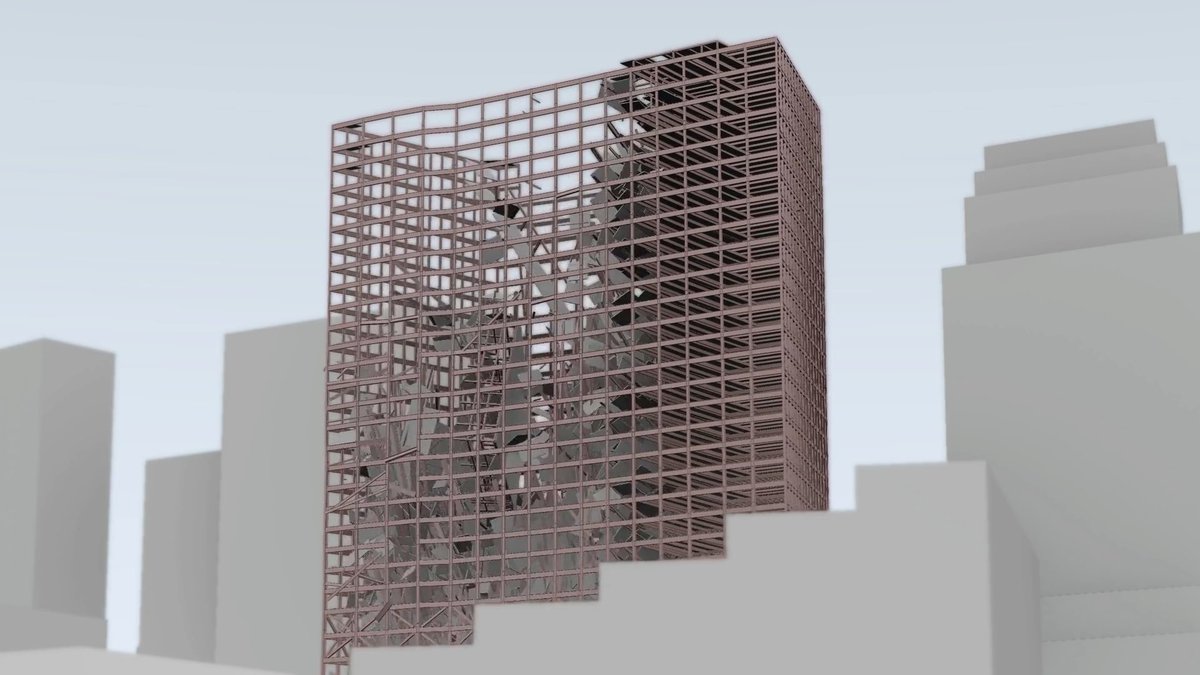
My prior post featured simulations by Kostack Studio of the Twin Towers collapses. What made those especially fascinating to me was that they removed the smoke, debris, and surrounding visual clutter, making it easier to see the broader structural behavior that the real footage often obscures. By far the most common response in the comments was: “Now do Building 7.” Fair enough. So here is Building 7. Before getting into the simulation itself, a quick reminder of the basic context: WTC 7 was not struck by an airplane, but it was heavily damaged when debris from the collapse of the North Tower tore a large gash into its south face. That debris ignited fires on multiple floors. The building’s water supply and fire suppression capability were severely compromised, firefighters were eventually pulled back for safety reasons, and the fires were left to burn uncontrolled for nearly seven hours before the building finally collapsed at 5:20 p.m. What I find so impressive here is not just the final animation, but what went into producing it. According to the creator, this WTC 7 simulation was built using more than 28,000 structural elements and roughly 703,000 constraints, incorporating actual steel dimensions, steel thickness, plastic deformation, and connection-breaking behavior derived from physical parameters. In other words, this is not some cartoon sketch of a collapse. It is a serious attempt to model large-scale structural behavior as faithfully as possible with the information available. And I also appreciate the creator’s candor. He does not pretend this simulation is a perfect recreation of exactly what happened, down to every beam, every floor panel, and every fragment. Nobody can do that. A real collapse of this complexity becomes chaotic very quickly, and even with extensive modeling there are limits to what can be known with absolute precision. That honesty is part of what makes the project more compelling to me, not less. This is not being presented as an official NIST model, and it is not being offered as final proof of every detail. It is a visualization - an informed structural simulation built from the available evidence, the known geometry of the building, video observations, and the broader body of engineering work that has been done over the years by NIST and others. And that is exactly why I find it worth sharing. One of the biggest problems in discussing WTC 7 is that most people only know the exterior video. They see the outer shell descend and then leap immediately to conclusions. What they usually do not see is the internal failure sequence that, according to NIST and many subsequent analyses, was already underway before the visible exterior drop. This simulation helps make that concept easier to understand. It does not settle every argument. It does not reproduce every last detail with magical perfection. But it does provide a serious, visually clear attempt to show how the building could fail internally before the exterior facade gave way, and why the final visible descent can look simpler from the outside than the underlying structural reality actually was. So no, none of us should pretend this is “exactly” what happened in every microscopic detail. But as a close large-scale reproduction built from the best information available, I think it is genuinely fascinating. And given how many people demanded “Now do Building 7,” I hope this helps answer at least some of those questions.
Alex Boge51,630 Aufrufe • vor 1 Monat

A tiny little scene in Season 1, Episode 6 of The Expanse shows Uncle Mateo, a Belter, popping open his helmet for a few seconds to yank out a sparking sensor wire that had come loose inside his helmet. He takes a big breath first to better oxygenate his bloodstream, then begins exhaling steadily as he opens the helmet. He pulls the wire, seals it, and repressurizes - and he's fine. It always got me thinking how over-the-top Hollywood usually makes exposure to vacuum in movies. But this scene actually gets the science right. (Note: In real spacesuits you can't open a helmet like this - the pressurized bubble stays sealed. But the physics of what would happen if you could is still fascinating.) You MUST exhale steadily, and here's why: The reason is Boyle's Law. When external pressure drops to zero, the air trapped in your lungs wants to expand dramatically. Even at only 4.3 psi inside the suit, that creates a huge unbalanced pressure pushing outward against the delicate alveoli. On Earth a big breath is safe because pressure is equal on both sides. In vacuum it's not - the alveoli can tear, sending air bubbles into your blood (an arterial gas embolism that can hit your brain or heart). Game over. Even if you somehow held it, you couldn't use the oxygen anyway. In vacuum the pressure gradient reverses and your lungs start stripping oxygen out of your blood. So you take that big breath to load up your bloodstream with extra oxygen, then you begin a steady exhale as you open the helmet, and… - 0–2 seconds: What little bit of air is left rushes out of your lungs. - 3–5 seconds: Your saliva starts fizzing and boiling on your tongue - that weird, carbonated, Pop-Rocks feeling. If you stay exposed without resealing: In 10–15 seconds you black out from lack of oxygen. Once you pass out, your face and body start swelling from water vapor forming in the tissues. Not the dramatic explosion of bad sci-fi - more like severe bloating, and it reverses almost completely once you repressurize. But you could last unconscious for up to approximately three minutes. Should someone reach you, seal your helmet, and repressurize, you'd have a surprisingly good chance at recovering. Uncle Mateo was fine. His exposure was very brief. He exhaled, and as a Belter, he'd probably become used to that mild Pop-Rocks feeling. NASA proved all of this with real tests in the 1960s - Jim LeBlanc's near-vacuum accident plus animal chamber studies. It's not movie nonsense. It's physics.
Alex Boge214,193 Aufrufe • vor 5 Monaten

Some time ago, flat Earthers were asked for their models, and the majority who provided specifics described a domed flat Earth with the sun and moon as small, local objects under the dome - both about 32 miles in diameter, circling at around 3000 miles high, with stars projected on the dome roughly 100 miles above them. The animation below models exactly these values. It fully incorporates atmospheric effects (density, scattering, and obscuration), the inverse square law for light falloff, and is 100% faithful to the described flat Earth model. Let’s see how well it matches everyday observations, shall we? To the inevitable deniers flooding the comments: If your personal model differs, post about it on your own content. You didn’t specify one when asked - so it wasn’t incorporated. (Probably because you know it falls apart too.)
Alex Boge142,154 Aufrufe • vor 9 Monaten

The ISS orbiting Earth - making a full orbit in approximately 90 minutes at ≈17,500 mph (about 5 miles per second). Beautiful 😍 The straight edges of the solar panels that remain perfectly straight as they adjust in this sped-up footage prove this is not a fish-eye lens.
Alex Boge60,624 Aufrufe • vor 6 Monaten

Earth, rotating in full view, captured by NASA’s EPIC camera aboard NOAA’s DSCOVR spacecraft. DSCOVR sits near Sun-Earth L1, about 1 million miles away, where it can continuously view the fully sunlit side of our planet. This is not composited, these are full Earth hemisphere photos assembled into a video. EPIC takes 10 narrow-band spectral images of Earth, from ultraviolet through visible light, roughly 13 to 22 times per day. The public images are natural-color views assembled from that real data. Frame after frame, Earth turns. Cloud systems move. Continents rotate through sunlight. Weather evolves across a curved, spinning world. This is what reality looks like. Flerfs in denial.
Alex Boge54,511 Aufrufe • vor 5 Monaten