Dr Andreas Krieg
@andreas_krieg • 54,892 subscribers
Author - Associate Professor - Directing Staff - CEO of @MENAanalytica Interests: MENA, Gulf, Network-centric statecraft Views are my own
Videos

"This is not about the strength of the Houthis but the weakness and fragmentation of the anti-Houthi front. It is about overestimating what has been built in the south. Different patrons have built overlapping loyalties and patronages competing over authority. Abu Dhabi's attempt to build its own networks in the south at the expense of Saudi in the north has created a fragmentation that the Houthis are now exploiting."
Dr Andreas Krieg18,202 Aufrufe • vor 5 Tagen


"Israel is a highly traumatized country. It exists in a sociopsychological bubble built around victimhood relying on a government system dominated by the military. In such a militarized society, there is no room for political strategy. It is a system built for perpetual war...Military leaders are terrible rulers and terrible at strategic decision making outside the battlefield. This is why Israel has never strategically won a war because it is still fighting 80 years on" Watch the full episode with Bianca Nobilo History Uncensored
Dr Andreas Krieg140,003 Aufrufe • vor 2 Monaten

"I think the UAE is probably the most interesting case because it has shifted significantly along the continuum. At the beginning of the war, Oman was on one side, taking a very clear position: neutrality, diplomacy, and the view that negotiation was the only viable way forward. At the other end of the spectrum was the UAE, which at the time was talking about defiance and projecting strength. Its posture was centred on coercion and deterrence. Now, however, the UAE appears to have moved. It has reportedly pulled $3 billion from Pakistan as punishment for Islamabad taking a more conciliatory approach towards Iran. At the same time, Abu Dhabi now seems to have come around to embracing the MOU and the wider diplomatic process, including support for Qatari efforts. What is particularly interesting is that there are clearly tensions within Abu Dhabi, and also between Abu Dhabi and the northern Emirates, over how to deal with Iran. MBZ’s position has been one of defiance, strength, and deterrence, rather than entanglement and engagement. Then you have Tahnoun, who has suddenly reappeared on the surface. He had been largely absent from public view for months, but has now returned to lead on this policy issue. Tahnoun’s strategic mindset has always been built around entanglement and weaponised interdependence through commercial networks. This approach shaped the UAE’s earlier policy: allowing the IRGC to do business in the UAE in the expectation that, in return, the UAE would not be attacked. That equation clearly did not ultimately deliver the desired outcome. Nonetheless, there was no obvious alternative. Tahnoun’s argument appears to have been that the UAE cannot win this militarily. Israel is not going to win the war on behalf of the UAE, because Israel cannot win the war for itself. The United States does not want an all-out war. The GCC partners around the UAE do not want a war either. As a result, Abu Dhabi has little choice but to come to the negotiating table. It therefore seems that Tahnoun has won this internal debate, at least for now, over MBZ’s earlier and more assertive approach. The underlying calculation appears to be that a united GCC position may ultimately serve the UAE’s national interest far better than a situation in which everyone pulls in different directions"
Dr Andreas Krieg174,366 Aufrufe • vor 3 Monaten

"I think we need to give the Gulf states more credit. This is not simply Saudi, Qatari or Emirati money pumping billions into Washington and buying people. It is not like that. If you are MAGA, if you believe in America First, the Gulf lobby’s narrative resonates. It says: we want stability, we want growth, we will put money into your economy, and we will allow your companies to come over and make money in the Gulf and the wider region. The Gulf states are willing to underwrite American policies. After all, all the bases in the Gulf are paid for by the locals, by the Gulfies. They are not paid for by US taxpayers. The Gulf states are willing to buy American jets and weapons. They are injecting cash into American AI companies. They are willing to support American power where they can. They are net contributors to American power By contrast, Israel is a net consumer of US power. It drains US power. It sucks money out of the US economy and from US taxpayers."
Dr Andreas Krieg141,755 Aufrufe • vor 2 Monaten

Israel’s most highly decorated soldier confirms the points made by the intelligence community and military strategic planners already: - No military way to contain Iran for months on end - No military way to open up the Strait of Hormuz - Hamas and Hezbollah we’re beaten tactically but not strategically - Israel hasn’t abandoned its mowing the lawn approach, even if the mowing has become more intense
Dr Andreas Krieg217,549 Aufrufe • vor 5 Monaten

"The Iranian regime is not a hierarchical system where decapitation is even “on the table”. So, even if you were to kill the Supreme Leader — or even the line of succession — which is, I think, what the Israelis are trying at the moment by taking out operational and strategic commanders across the IRGC, theocratic leaders, and political leaders, it doesn’t mean the regime is just going to collapse. The fact is, what we’ve seen since January is a complete decentralisation of the chain of command and command-and-control. So, despite this heavy attack this morning, there is no paralysis in Iran. Iran is sustaining it. They were very quick to strike back across the Gulf — escalating — and the operational tempo is still there. That shows command-and-control has been delegated down to the local level. We also see, for example, that the Basij — the major component of the IRGC that controls the public on the ground — has been on alert for quite some time and has organised itself at the local level without having to rely constantly on the main chain of command in Tehran"
Dr Andreas Krieg224,057 Aufrufe • vor 6 Monaten


#Qatar's PM: "It is a big sense of betrayal. Just an hour after the start of the war, Qatar and other Gulf countries have been attacked. We made clear that we were not going to take part in any wars against our neighbours...all the attacks on the Gulf countries - we never expected this from our neighbour. We have always tried to preserve a good relationship with Iran, but the justifications and pretexts they are using are completely rejected...We continue to seek de-escalation"
Dr Andreas Krieg175,181 Aufrufe • vor 6 Monaten

"The Gulf cannot just accept Iran's imposition of sovereignty over Hormuz as it undermines the sovereignty and autonomy of the business model of the GCC states...it cannot just pay its way out of the crisis either because for Iran this is not just about money but a spoils of war. It is about ego and prestige." Me chatting to Borzou Daragahi 🖊🗒 on his podcast badlands
Dr Andreas Krieg52,391 Aufrufe • vor 2 Monaten

"This Houthi Saudi standoff may therefore remain outside the wider escalation between the United States and Iran. That is my hope, at least. There may be a way for the Saudis to deal with the Houthis directly, without the Bab al-Mandab becoming another Iranian bargaining chip in the broader negotiations with the United States. That is obviously what we are trying to avoid." Arab Digest Bill Law بيل لو 🎙️🔊
Dr Andreas Krieg42,982 Aufrufe • vor 1 Monat

"This extraordinary networked attack in #Lebanon exploited a zero-day vulnerability physically implanted into the pager devices together with explosives. It suggests that #Hezbollah's and Iran's supply chain has been heavily infiltrated and compromised by #Israel" Defence Studies KCL
Dr Andreas Krieg389,034 Aufrufe • vor 2 Jahren

"Since October 7th, we were never asked to expel Hamas officially. We were never told to stop mediating. On the contrary—when we asked the Hamas leadership to leave Qatar...we were asked by the Biden administration at that time to bring Hamas back in order to continue mediation"
Dr Andreas Krieg201,569 Aufrufe • vor 1 Jahr

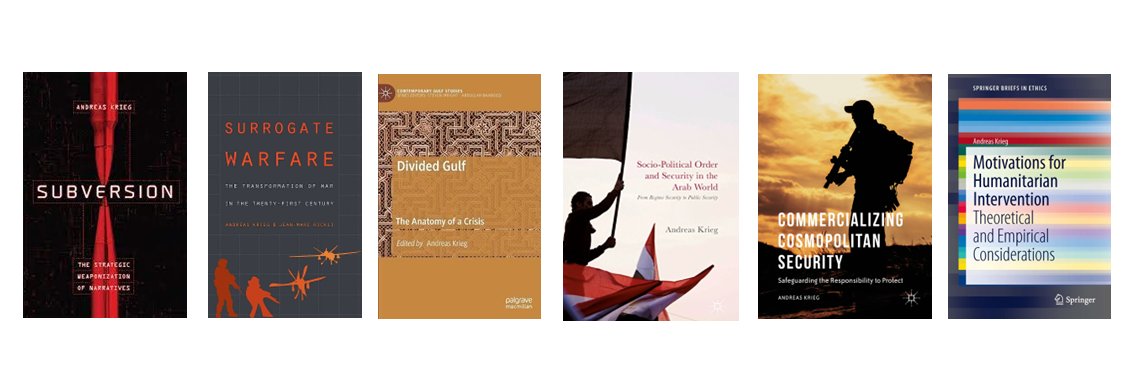
#Subversion and weaponized narratives are among the greatest threats to liberal civil societies Check out my new book 📚 Georgetown University Press Defence Studies KCL King's Security Studies #Psyop #infowar #disinformation #fakenews #UAE #Russia #Ukraine #China #Saudi #Cyber
Dr Andreas Krieg585,356 Aufrufe • vor 3 Jahren

"What the UAE have tried to do since the Arab Spring, is building a network of networks in breakaway regions across the Arab world...put together the STC and the War in Yemen is part of that. The 'Axis of Secessionists' creates a regional order that includes the Israelis but excludes other Arabs states, the Gulf and Turkey" The rest of Inside Story here 👇 Aziz Alghashian
Dr Andreas Krieg120,933 Aufrufe • vor 8 Monaten

"#India is a country that doesn't want to choose sides. It does not want to be pushed into certain alignments or into a zero-sum game. And that is the sort of game Netanyahu is in. Netanyahu is a man cornered, fighting for political survival and international survival, and a man who is extremely zero-sum, extremely assertive. That does not necessarily align with Modi’s vision for India as a great power" #Israel
Dr Andreas Krieg89,789 Aufrufe • vor 6 Monaten

"Both US and Iran are trapped in a spiral of escalation that started as horizontal escalation and is becoming more and more vertical as target sets widen. This escalation trap mostly burdens in the Gulf states, with Qatar and Oman being the principal interlocutors for Iran to climb down from this escalation. Iran is risking overplaying their hand pushing the Gulf states into a corner triggering them to get involved more proactively"
Dr Andreas Krieg30,965 Aufrufe • vor 1 Monat

I have been saying this since November 2023: Israel's obsession with military/technological superiority means tactical excellence but strategic drift Ronen Bergman on PBS: "After two and a half years, nothing is done. Nothing has been brought to a close. So Hamas still controls Gaza. Hezbollah is still the most important military and political power in Lebanon... Netanyahu thought that at least he would be able to shut down, to close, one of the fronts. So he also supported opening another front with Hezbollah, and Hezbollah fired back. And the Israelis suddenly got a really strong reminder that Hezbollah is still there. Hamas in Gaza, Hezbollah in Lebanon, the clerical regime in Tehran. They killed the leader, but they have another Ayatollah, with a younger group around him. So nothing is done. Nothing is closed. Nothing is finished."
Dr Andreas Krieg70,538 Aufrufe • vor 5 Monaten

Andreas Krieg: " Die Frage, die sich die Golfstaaten nach diesem Irankrieg fragen, ist "Kann man sich auf die USA verlassen?" Die Antwort ist "Nein". Spätestens seit dem Irankrieg letztes Jahr, ist es klar; dass die USA die Sicherheit, die sie Israel gewährleisten, nicht den Golfstaaten gewährleisten können"
Dr Andreas Krieg67,283 Aufrufe • vor 5 Monaten

Somalia's state minister for foreign affairs Ali Omar suggesting Somalia's federal government might take DP World to court for not vacating concessions they have in Bosaso and Berbera Puntland and Somaliland have their own laws and will likely block Mogadishu's efforts - but it shows that there is growing resentment among central governments towards the UAE's Axis of Secessionists in Africa
Dr Andreas Krieg21,876 Aufrufe • vor 1 Monat