
Anish Moonka
@anishmoonka • 134,762 subscribers
Storyteller | Building Imprint - Helping Founders communicate their stories on X | DM or 📧 [email protected] | Follow for Curiositymaxxing 🌱 (1B+ views)
Videos

September 1997. Steve Jobs stands before Apple employees and tells them he's been up until 3am finishing an ad. He's been back at the company for eight weeks. Apple lost $1 billion that year. Three months earlier, WIRED put Apple's logo on its cover, wrapped in barbed wire, with the word "Pray." He starts by saying what he's found since coming back. He couldn't figure out Apple's own product line. He spent weeks trying to understand which model was which and how they fit together. He talked to customers. They couldn't figure it out either. He cut 70% of the product roadmap. People whose projects were canceled were, in his words, "three feet off the ground with excitement" because, for the first time in years, someone told them where the company was going. Then he says something about marketing that changed how every tech company thinks about advertising. He says Nike sells a commodity. They sell shoes. But when you think of Nike, you feel something different than a shoe company. Nike never talks about their products in ads. Never tells you why their air soles are better than Reebok's. "They honor great athletes. And they honor great athletics. That's who they are." He compares it to the dairy industry spending 20 years trying to convince people milk was good for them, failing, and then running "Got Milk," which doesn't even mention the product. Focuses on its absence. He says Apple spends a fortune on advertising. "You'd never know it." Then he fires the ad agency. Not just fires them. Apple was running a competition with 23 agencies. He scrapped the whole thing and hired Chiat/Day, the agency he'd worked with a decade earlier on the 1984 Macintosh commercial that advertising professionals voted the best ad ever made. The question they asked themselves: "Our customers want to know who is Apple and what is it that we stand for?" His answer: "Apple at its core, its core value, is that we believe that people with passion can change the world for the better. And that those people who are crazy enough to think they can change the world are the ones that actually do." Then he plays the ad. In this room. To Apple employees. For the first time. "Here's to the crazy ones. The misfits. The rebels. The troublemakers." He says almost none of these people had ever appeared in an advertisement before. He personally obtained Yoko Ono's permission to use John Lennon. He says the estates and living subjects agreed because of their feelings toward Apple. "I don't think there is another company on Earth that could have done this campaign." The ad broke that Sunday during the network premiere of Toy Story on ABC. Two 60-second spots. Newspaper ads in the Wall Street Journal, New York Times, and USA Today. Billboards in major cities. Buses in five cities featuring Rosa Parks. Painted walls. The whole thing. Apple's stock was around $0.10 split-adjusted when this meeting happened. The company is worth $3.68 trillion today. Think Different ran for five years. Every product that came after, the iMac, iPod, iPhone, iPad, was built on the identity this campaign established by a guy who'd been back at the company for eight weeks and finished the ad at three in the morning. Video: Steve Jobs internal staff meeting at Apple, September 1997. This is the first time the Think Different campaign has been shown to employees. Jobs had been back at Apple for eight weeks. Footage leaked from an internal recording.
Anish Moonka1,152,220 Aufrufe • vor 4 Monaten

September 2009. Jensen Huang walks onto a small stage at the Fairmont hotel in San Jose. About 1,500 people are in the room. He runs a company that makes chips for video games. He spends the next 8 minutes doing math on a whiteboard, explaining why the future of computing won't come from making CPUs faster. He calls it "CEO math" and apologizes in advance to every computer science professor in the audience. Then he lays out an argument that almost nobody took seriously at the time: the way to make computers dramatically faster is to pair a regular CPU with hundreds of tiny parallel processors, the kind that already exist inside graphics cards. One CPU for the sequential stuff. Hundreds of GPU cores for everything else. He calls it "heterogeneous computing." He shows the math. A workload that can be split into many pieces at once gets up to 200x faster on this combined system. A workload that has to run one step at a time loses nothing. "The most important thing in creating a new architecture," he says, "is to make sure it does no harm." This was the first GPU Technology Conference. NVIDIA had launched a software platform called CUDA three years earlier, in 2006, to let developers write programs that run on graphics cards instead of just regular processors. Almost nobody cared. GPUs were for rendering Call of Duty, not for scientific computing. The academic world was polite but skeptical. The enterprise world ignored it entirely. By this point, Huang had been making this argument for years. NVIDIA was a $7 billion company. It competed with AMD and Intel for market share in the graphics market. That was the whole business. Jensen kept saying the GPU wasn't just a gaming chip; it was a computing platform. He kept saying parallel processing would reshape every industry from medicine to finance to physics simulations. People kept nodding, then doing nothing. Then deep learning happened. Around 2012, AI researchers discovered that training a neural network, which means teaching a computer to recognize patterns by running the same calculation millions of times across huge datasets, was exactly the kind of workload Jensen had been describing. GPUs can train AI models 10 to 50 times faster than CPUs. The architecture he outlined in this 2009 talk, with one CPU handling step-by-step tasks while hundreds of GPU cores crunch through massive amounts of parallel data, is now the literal blueprint for every AI data center on earth. ChatGPT runs on NVIDIA GPUs. Claude runs on NVIDIA GPUs. Gemini, Llama, Midjourney, nearly every major AI model you've heard of was trained on NVIDIA hardware using CUDA, the software platform Jensen built for a market that didn't exist yet. NVIDIA was worth about $7 billion when Jensen gave this talk. It is worth over $4.4 trillion today. That's a 600x increase. Jensen Huang, who founded the company at a Denny's in 1993 with two friends, now has a net worth of over $160 billion. He made Forbes' list of the 10 richest people for the first time this year. GTC 2026 is currently ongoing. 17,000 people are packing a hockey arena to watch the same guy explain what comes next. In 2009, 1,500 people showed up at a hotel ballroom, most of them for gaming graphics.
Anish Moonka413,645 Aufrufe • vor 5 Monaten

1996. Steve Jobs is asked on television what went wrong at Apple. He hasn't worked there in over a decade. Within a year, Apple will buy his company NeXT and bring him back. Within 18 months, he'll be running the place. He doesn't know that yet. Nobody does. At this point, he's running NeXT, a small software company, and Pixar, which just released Toy Story. Apple is falling apart. The stock is collapsing. The company has lost over a billion dollars. Its market share has dropped from 18% to around 4%. WIRED will put Apple's logo on its cover, wrapped in barbed wire, with the word "Pray." The interviewer asks Jobs what happened. His answer is one paragraph, and it's basically the entire turnaround strategy he'll execute a year later. He says when he left Apple ten years earlier, they were ten years ahead of everybody else. It took Microsoft a full decade to copy what Apple had built. But Apple stopped. "Even though it invested cumulatively billions in R&D, the output has not been there, and people have caught up with it." He says Apple's advantage over Microsoft has eroded. And then this: "The way out is not to slash and burn. It's to innovate. That's how Apple got to its glory, and I think that's how Apple could return to it." When Apple bought NeXT in December 1996 and brought Jobs back as an advisor, things got worse before they got better. By September 1997, Apple was about 90 days from running out of money. The board made Jobs the interim CEO. He cut 70% of the product line, but not to save money. He cut it so the remaining 30% could be great. He launched Think Different. He built the iMac. Then the iPod. Then iTunes. Then the iPhone. Then the iPad. Every single one of those products was the "innovate, don't slash and burn" philosophy from this interview, applied over and over for 14 years. He also says something in this interview that stands out. He says the most exciting thing in software is the internet, and the reason is "no one owns it. It's a free-for-all. It's much like the early days of the personal computer." He says if any one company gets a dominant position, "the rate of innovation is going to drop precipitously." He's talking about Microsoft. But he could be talking about 2026. Apple is worth about $3.7 trillion today. When this interview was filmed, Apple was worth about $3 billion and falling fast. Jobs walked back into Apple nine months later with no title, no authority, and the same diagnosis he gave on camera in this clip. Video: Steve Jobs Television Interview, 1996. Original broadcast footage.
Anish Moonka345,051 Aufrufe • vor 4 Monaten
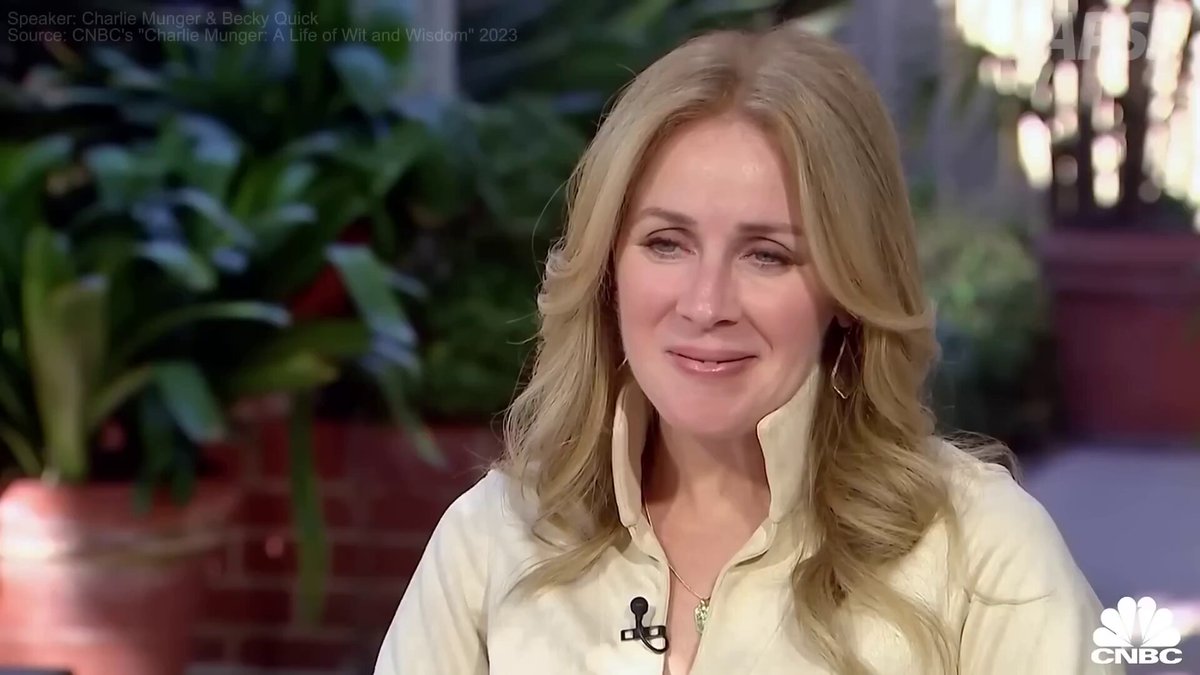
Charlie Munger explained why AI will solve diseases faster than anything in human history. He did it two weeks before he died, at 99. In 1954, his eight-year-old son Teddy was diagnosed with leukemia. There was no treatment. The survival rate for childhood leukemia in the 1950s was close to zero. Munger was 31, freshly divorced, nearly broke. His friend Rick Guerin said Munger would go to the hospital, hold Teddy, then walk the streets of Pasadena alone, crying. Teddy died in 1955 at the age of 9. A reporter asks how he got through it. He says, "You can't bring back the dead. You can't cure the dying child. You have to soldier through. If you have to walk through the streets crying for a few hours a day, it's part of soldiering. You go ahead and cry away. But you can't quit." Then he says, "In those days, the fatality rate with childhood leukemia was 100%. That's gone away. Now the cure rate is way up in the 90s." He's right. The five-year survival rate for the most common childhood leukemia (called ALL, acute lymphoblastic leukemia) was close to zero before 1950. By the 1960s, it was under 15%. Today, it's about 90%, according to the American Cancer Society. It took 70 years of researchers running clinical trials and developing combination drug therapies to get there. That was without AI. Human researchers work on one hypothesis at a time. There are now over 170 AI-discovered drug programs in clinical trials. AI is compressing early drug discovery timelines by 30 to 40%, turning what used to take three to four years of preclinical work into 12 to 18 months. No AI-discovered drug has yet received FDA approval, but the first is expected in 2026 or 2027. The pipeline is real and growing fast. What took seven decades for leukemia, AI could compress into years for diseases we haven't cracked yet. Munger said it plainly: "What mankind did, what civilization did, was soldier through those tough years that took away my cousin Tommy from meningitis, and then took away my son Teddy from leukemia. Imagine pretty well fixing that disease for families who came into life later. It's a huge achievement." He lost his son 68 years before this interview. He watched civilization solve the thing that took his boy. He died two weeks later, at 99. AI is about to make civilization progress much faster.
Anish Moonka128,556 Aufrufe • vor 4 Monaten

2009. Alex Karp goes on Charlie Rose. He almost never does television. He's running a company called Palantir that has zero salespeople, took three years to build before generating a dollar of revenue, and is named after the seeing stones in The Lord of the Rings. His resume makes no sense for a tech CEO. Stanford Law, then a PhD in neoclassical social philosophy at Goethe University in Frankfurt. He spent years studying questions like "what does it mean to know something," and says the work was intelligible to maybe 30 or 40 people on earth. He co-founded Palantir in 2003 with Peter Thiel and a group of former PayPal engineers because he believed Silicon Valley should be involved in the fight against terrorism. That's the actual origin story. A philosopher and a bunch of payment processing guys decided to go after Al-Qaeda. What he says in this interview is wild in hindsight. Everyone in government at the time was doing broad data mining, casting giant algorithmic nets across datasets and hoping something useful came back. Karp called that approach broken. His argument had two parts. One: terrorists are entrepreneurs. They figure out how the last guy got caught and change their patterns overnight. A static algorithm against someone who adapts every week is a losing game. Two: when algorithms nobody understands are scanning everyone, civil liberties disappear because there's no record of what the government actually looked at or why. So Palantir built the opposite. A platform where a human analyst sits in the loop, interacts with data directly, spots patterns in real time, and every single step gets tagged. If the government looked at you, there's a paper trail. Where did the evidence come from? Were they allowed to see it? Did they use data from one case and sneak it into another? Karp called it "predicate-based search." Find the needle. Leave the haystack alone. Then he drops this line about cyber warfare: "What would have taken a large government organization can now be done with two or three teenagers in a coffee shop." In 2009. He described the attribution problem years before most people had heard the word. You get attacked, you don't know if it's a nation-state or a kid in a basement, and you, as the president, have to decide how to respond. He warned that if Americans ever felt like there was a trade-off between security and freedom, "we'll lose." The company took 17 years to go public. Seventeen. They did a direct listing in September 2020 at $9.50 a share, valued at around $16 billion. Wall Street was skeptical. Many people hated Palantir for its government work. The stock trades around $155 today. Market cap is roughly $370 billion. That's the 30th-most-valuable company on Earth, with about 4,400 employees. Revenue has crossed $4 billion a year. The guy studying what it means to know something at a German university in the 1990s is now running one of the most important defense and AI companies alive, and the interview where he laid out exactly why is sitting on YouTube with barely any views.
Anish Moonka112,435 Aufrufe • vor 4 Monaten

December 2010. Jack Dorsey invented Twitter because he was a weird kid who couldn't stop staring at maps. He grew up in St. Louis. By age eight, his bedroom walls were covered with maps torn from magazines and gas stations. He walked the city constantly, watching trains, taxis, and police cars move through it. When his dad brought home an IBM PC Jr., Dorsey taught himself to code for one reason: he wanted to draw his own maps on the computer. At 14, he started listening to emergency dispatch radio. Police scanners, ambulance frequencies. He wrote software that could plot those vehicles as moving dots on his digital maps. Each dot had a meaning: here's who you are, here's where you are, here's what you're doing. He was tracking real-time city movement from his bedroom in Missouri. By 15, he'd written dispatch routing software that some taxi companies kept using for decades. In this interview, he explains exactly how that obsession became Twitter. The concept is pure dispatch: "Someone broadcasts a message and whoever is interested follows." That's how ambulance dispatchers work. A message goes out, and whoever needs it, listens. Everyone else ignores it. He actually built a prototype in 2000. A Blackberry 850, a ten-person email list. He walked to the bison paddock in Golden Gate Park and sent a message: "I'm at the bison paddock." It went to all ten people. He noticed that other BlackBerry users were weirdly interested in the fact that he was standing near some bison. That was the first tweet. Six years before Twitter existed. He shelved it. Went back to dispatch work. The timing wasn't right. In 2005, he joined Odeo, a podcasting startup. The month after he arrived, Apple launched its podcast directory in iTunes, effectively killing its business. Morale collapsed. The CEO asked everyone for new ideas. Dorsey pitched the dispatch thing again: let people broadcast short status updates over SMS. Built a prototype in two weeks. Noah Glass found the word "twitter" in the dictionary: "a short burst of inconsequential information, and chirps from birds." They needed a five-character SMS shortcode, so they stripped the vowels. TWTTR. That code was already taken, so they added a subscriber line, and it became the Twitter we know. They also invented the words "follow" and "unfollow." Those didn't exist before. Dorsey's concept was a blank wall. You write on it. People walk up and read it when they want. They leave when they don't. Follow and unfollow. Then he tells the Square origin story. His co-founder, Jim McKelvey, a glass artist he'd known since he was 15, called him one day and said he'd just lost a $2,000 stained-glass sale because he couldn't accept a credit card. They both had iPhones. Computers in the palm of their hand, but no way to take a payment. They decided to fix that. Within a month, they had a prototype: a small reader plugged into an iPhone headphone jack that could swipe a card. Dorsey first tweeted on March 21, 2006. Twitter went public in November 2013 and was eventually sold to Elon Musk for $44 billion in 2022. Block, the company formerly known as Square, is worth about $40 billion today. All of it traces back to a kid in St. Louis tracking ambulances on a map he drew himself. Video: Jack Dorsey jack interviewed by Kevin Rose Kevin Rose on "foundation," circa 2011. This was during Square's early days. original footage from Foundation/Kevin Rose.
Anish Moonka84,528 Aufrufe • vor 4 Monaten

November 1998. A 27-year-old Elon Musk sits in a tiny office in Palo Alto with a leaky roof. He's been living there. Sleeping on a futon. Showering at the YMCA down the street. He and his brother drilled a hole through the floor to tap into the internet provider below them because they couldn't afford their own connection. A CBS reporter asks him: "What do you see as the future of the internet?" He says, "The internet is the superset of all media. It is the be-all and end-all of media. One will see print, broadcast, arguably radio, essentially all media folding into the internet." Nobody knew who this guy was. Three years earlier, he'd dropped out of Stanford's PhD program after two days because Netscape had just gone public at a $2.9 billion valuation, and he figured the internet was about to change everything. He started a company called Zip2 with his brother Kimbal. They had about $2,000 between them. Their father later put in around $28,000. They shared one computer. The website ran on it during the day. Musk coded on it at night. Seven days a week. By the time this interview was filmed, Zip2 had contracts with 160 newspapers, including the New York Times. A few months later, Compaq bought it for $307 million. Musk walked away with $22 million. He took most of that and founded a new company, X dot com, an online bank. X dot com merged with a competitor called Confinity, which had a payment tool called PayPal. eBay bought PayPal in 2002 for $1.5 billion. Musk's cut was about $176 million. He put $100 million into SpaceX and about $70 million into Tesla. By 2008, all three companies were on the verge of failing, and he was borrowing money to pay rent. But go back to what he said in this clip. "All media folding into the internet." In 1998, most Americans didn't have broadband. Netflix was a DVD-by-mail startup. Google had been incorporated five weeks before this interview. YouTube wouldn't exist for another 7 years. The iPhone was 9 years away. And a guy showering at the YMCA, running a company most people have never heard of, described the future of media more accurately in 15 seconds than most media executives would over the next decade. The Forbes 2026 billionaires list, published last month, puts his net worth at $839 billion. He is the richest person who has ever lived. The leaky office in Palo Alto costs less per month than a studio apartment.
Anish Moonka17,400 Aufrufe • vor 5 Monaten

2001. Larry Page and Sergey Brin sit for their first-ever television interview. Google has 200 employees. They explain that the company almost didn't get off the ground because they couldn't cash a check. The check was for $100,000. It came from Andy Bechtolsheim, one of the co-founders of Sun Microsystems. Page and Brin showed him what they'd built. He said, "This is great, how about I write you a check?" and just wrote it out. Made it out to Google. The problem was that Google didn't exist as a company yet. There was no bank account. No lawyers. No incorporation paperwork. The check sat in Larry Page's desk drawer for a month. They literally could not deposit it. They're both in their late twenties in this interview. They met at Stanford as PhD students and, by their own account, disliked each other from the start. Brin says Page is "kind of obnoxious." Page doesn't disagree. Brin says they argued about everything, debated every single point, and then realized that was their commonality. They became friends, started building a search engine they never planned to build, and put their PhDs on hold to get it out into the world. The part that stings watching this in 2026 is the rejection tour. Before starting Google, they approached existing search companies to sell or license the technology. They went to Yahoo. David Filo, one of Yahoo's founders, told them, "This is great search technology. Why don't you guys make a company, and maybe we'll use you someday?" They went to Excite. They went to InfoSeek. Same response. Page says a CEO at one of those companies told them: "If our search is 85% as good as the next guy's, that's good enough for us." Page and Brin didn't buy that. They thought the search was too important to be 85% as good. So they started Google. No marketing. No ad campaign. They launched it at Stanford, and it grew 20% per month, every single month, for three years straight. Pure word of mouth. By the time of this interview, they're handling over 100 million searches a day. They get 500 resumes in the mail every single day. The office space around them is 30% vacant because the dot-com bubble just popped, but Google is profitable. Page makes a point of this: "We've been really interested in being profitable, like long before it was fashionable." They'd also just hired Eric Schmidt, former CTO of Sun, as CEO. Brin's explanation for why: "Parental supervision, to be honest." Page adds that they're "past the age where we're rebellious" and that running a search engine used by 100 million people a day with 200 employees is "a large responsibility." The number that caught my eye: when Google started in 1998, it indexed 30 million web pages. At the time of this interview, three years later, they indexed 1.3 billion. The page says that if you printed them all out and stacked the paper, it would be about 70 miles high. And it was doubling every year. Every search company they approached turned them down. Yahoo eventually came back and hired Google to power its own search results. The CEO who thought 85% was good enough ran a company that no longer exists. Alphabet, Google's parent company, is worth about $3.6 trillion today. It has about 190,000 employees. That $100,000 check sat in a desk drawer because nobody had incorporated the company. Bechtolsheim's stake from that investment is now worth billions.
Anish Moonka12,042 Aufrufe • vor 4 Monaten
Keine weiteren Inhalte verfügbar