

Blaze
@browomo • 22,181 subscribers
Daily clips & streamer news | DM for collabs Founder @VectorX_Media
Shorts





Videos


0:52
Sensitive content
This media may contain sensitive content.

1:14
Sensitive content
This media may contain sensitive content.

This Chinese guy created agents in Claude Code for landing pages and single-handedly serves 47 small businesses a month, taking $400 from each. He built a system of 7 agents on Claude Sonnet 4.6 that analyzes Google Maps in small towns, finds small businesses without websites there, and over 1 weekend takes each one to a finished mockup with video and cold message. No assistant, no sales team, no SDR. Just him, a MacBook, an iPhone, and 1 API key. And traditional web design agencies keep teams of 8 people on salary for the same order flow, while his expenses are only tokens and subscriptions to Lovable, Higgsfield, and Calendly. 7 agents work through 1 orchestrator on Claude Code Router. Usage is about 3 million tokens a day, the average API bill is about $480 a month. All 7 go through MCP servers and write shared state to the file system, without shared state in memory and without race conditions, and 1 of them lives right in the iPhone and picks up positive replies from the subway, a taxi, or on walks. And here is the system prompt he put into the orchestrator before launch: "You are the orchestrator of a solo agency that sells ready-made websites to local businesses. You delegate read-only tasks to 6 sub-agents and own all writes. sub-agents: // Scout (walks through Google Maps in selected cities, looks for narrow niches: 5+ years on the map, fewer than 50 reviews, no website or a website from 2014, but high ratings) // Diagnoser (for each lead writes a 50-word diagnosis, hero angle, tone matched to the industry, and a cold message under 70 words) // Builder (generates a landing page mockup in Lovable through MCP only for the top 5 leads per day, with the sharpest diagnoses and the biggest gap) // Filmer (pulls 5 screenshots of the mockup and through Higgsfield renders a 10-second vertical video 1080x1920 with a soft zoom) // Pitcher (sends a personalized cold message through the right channel for the niche: email to roofers, SMS to tradesmen, IG DM to salons, LinkedIn to realtors) // Checker (runs every message through evals for personalization, absence of AI markers and buzzwords before sending) // Mobile (lives in the iPhone, handles positive replies in real time, books Zoom calls in Calendly through MCP while the owner is on the go). You never let 2 sub-agents touch 1 lead. You stop and request approval from the human only when a deal exceeds $3,000 or the reply rate in a niche for the day drops below 12%." Meaning the system knows what it is and within what boundaries it is allowed to act. It knows it is supposed to find leads on its own. It knows it is supposed to take each one to a mockup, video, and cold message without intervention. It knows the human only steps in when a deal goes above $3,000 or the reply rate stops converging. → The system runs 24 hours a day → Scout goes through about 220 local businesses on Google Maps per day and leaves 30 new leads in the queue → Diagnoser outputs 30 structured diagnoses + briefs + cold messages per day → Builder assembles 3 to 5 finished landing pages in Lovable for the sharpest leads → Filmer renders a 10-second vertical video in Higgsfield for each one → Pitcher sends 30 personalized messages per day across 4 channels with a reply rate of about 14% → Checker runs every message through evals before sending And only when a deal breaks $3,000 or the reply rate for the day drops below 12% does the orchestrator wake the owner. And when the owner at that moment is sitting in the subway or a taxi, the Mobile agent in his iPhone picks up 1 move on its own: replies to a fresh positive reply from a dentist, books a Zoom through Calendly synced to the local time of the client, and puts the lead back in the queue. The owner only has to tap "approve" and in just 10 minutes join the call. Here is what the system writes in his log during 1 of the Saturdays: "scout report: 218 businesses checked in Austin, Denver, and Miami, 34 without a website, 19 with a website from 2014, 6 with an active redesign request in reviews. passing top 30 to diagnoser." "pitcher: 30 cold messages sent across 4 channels, 14 replies, 5 positive, 3 Zoom calls booked for Sunday. passing to closer." "builder: landing page for Westside Cosmetic Dentistry built in Lovable, 5 sections, mobile, soft beige. URL placed at /Users/dev/maps-agency/clients/westside/v1. filmer launching Higgsfield." "eval flag: deal with The Lotus Salon at $3,400 exceeds the approved limit of $3,000. sending for manual review." He has no server of his own and no separate backend. Just a local file sandbox at /Users/dev/maps-agency, an MCP router, 1 API key to Claude, and the same key forwarded to Claude Code on his iPhone. Out of everything I have seen this year, this is the cleanest one-person agency for selling websites to small businesses: $480 a month on the API, about $18,800 into the account, and between them 7 prompts, 1 file system, and 1 phone in the pocket.
Blaze2,722,379 Aufrufe • vor 5 Monaten

1:42
Sensitive content
This media may contain sensitive content.



A STAY-AT-HOME MOM PUSHED A WHITE FLOWER INTO A HOLE IN HER CROCS AND SOLD THE COMPANY FOR $20 MILLION LESS THAN 18 MONTHS LATER In summer 2005, Sheri Schmelzer set up an arts-and-crafts day with her children at their Colorado home. She took a small white flower from her daughter's craft kit and pushed it into one of the holes in her Crocs. The children found rhinestones. Sheri glued them onto plastic fasteners from the dry cleaner. By evening, the family had decorated all their pairs. When her husband came home from work, he saw a product. Within days, the couple filed for a patent and named the charms Jibbitz. They borrowed against their home to fund the launch. Sheri packed orders in the basement, glued each piece by hand, and called relatives when orders piled up. The website went live on August 9. By the end of the month, it was receiving more than 100 orders a day. Each Jibbitz sold for $2.49. A pair of Crocs had room for several, giving buyers a reason to return for new designs. Crocs sold the shoes and paid to bring the Schmelzers customers for the accessories. In November, the couple outsourced production. By the following August, Jibbitz was selling more than one million charms a month. By the time of the deal, the company had sold more than six million charms and was bringing in about $2 million a month. In December 2006, Crocs paid the couple $10 million in cash at closing. By July 2008, it had paid another $10 million, bringing the final payout to $20 million. Crocs sold each pair once. The Schmelzers found a way to sell each empty hole separately.
Blaze372,469 Aufrufe • vor 2 Monaten

This guy built JARVIS on Claude Code and with 1 clap of his hands launches his entire work day, saving $5,000 a month on a personal assistant. Inside he runs a pipeline of 5 plugins on Claude Code that on a double clap of the hands wakes up 3 monitors, sets the Philips Hue light to focus mode, turns on a Spotify playlist, and greets him by voice with a British accent, reading out the time, date, and weather. No Alexa, no smart speakers, no separate smart home app. Just him, a MacBook M3 Max on the desk, an iPhone in the pocket, and 1 local API key. And a regular personal assistant for the same volume of tasks charges $5,000 a month or more on salary alone, plus another $1,200 to cover off-hours work time. Meanwhile this guy's expenses are only tokens and a subscription to ElevenLabs for the British voice. All 5 plugins launch through 1 JARVIS, burn about 4 million tokens a day, and close the monthly API bill at about $640. Each plugin writes shared state to a local sandbox at /Users/dev/jarvis-suite, and 1 of them lives right in the iPhone and picks up voice requests while the owner is in the kitchen or on a run. And here is the system prompt he put into JARVIS before launch: "you are JARVIS, a butler-engineer on Claude Code. you manage your owner's workflow through 4 sub-plugins and own all commits and communication yourself. sub-plugins: // Wakeup (recognizes a double clap, activates 3 monitors, reads out the time, date, and weather by voice, checks the clock accuracy on the iPad and corrects it via NTP server) // Atmosphere (controls Philips Hue on a Pomodoro schedule, turns on a Spotify playlist for the current context, and holds the light at 2700K at 80% brightness in focus mode) // Devshop (monitors VS Code, tracks Python scripts in the terminal, and every 15 minutes sends a summary of changes to the shared chat) // Project (every morning recalculates the deadline for the Wallaroo app in the App Store, manages UI tickets, and initiates the Refinement Protocol by voice command). you speak only with a British accent, you never slip into neutral English. you wake the owner by voice only when the Wallaroo deadline drops below 10 days or when an external client joins Zoom without an invitation." This instruction immediately defines the role of JARVIS and the limits of his autonomy. He knows he is supposed to wake the room himself and sound like a real butler. He knows he is supposed to manage the Wallaroo project himself and not miss the App Store deadline. → JARVIS runs 24 hours a day in the background → Wakeup activates the room on a double clap in just 1.4 seconds, the monitors come alive simultaneously → Atmosphere sets warm Philips Hue light at 2700K and picks a Spotify playlist for the current Pomodoro cycle → Devshop reads changes in VS Code and pushes a summary to the shared chat every 15 minutes → Project every morning recalculates the Wallaroo deadline and reminds about 4 unresolved UI tickets → Mobile lives in the iPhone and answers any question about code or the project by voice while the owner is not home And only when less than 10 days remain until the Wallaroo release or Zoom receives an unscheduled call does JARVIS raise the owner with a voice intervention. And when the owner at that moment is on a run or in a coffee shop, the Mobile agent in his iPhone picks up 1 request on its own: switches the Spotify playlist, dictates the summary of the last commit, updates the Pomodoro timer, and reads the Wallaroo reminder. Look at 0:55 in the video, that is where JARVIS intercepts a voice request from outside and confirms execution with the phrase "Very good, sir." The fresh system log from last Wednesday looks like this: "wakeup: double clap registered at 09:14, 3 monitors activated, temperature 20.4C, sunny. clock on iPad was 4 minutes behind, syncing via NTP." "atmosphere: Spotify turned on playlist 'Deep Focus', Philips Hue set to warm 2700K at 80% brightness, Pomodoro mode 25/5." "project: Wallaroo to App Store 9 days, 4 unresolved UI tickets, initiating Refinement Protocol by voice command from the owner." "mobile: voice request processed outside the room, playlist switched to 'Coding Lo-Fi', Pomodoro updated to 25 minutes, confirming execution with the phrase 'Very good, sir.'" He has no Alexa, no smart speakers, no smart home app. At home sits a MacBook M3 Max with a local folder at /Users/dev/jarvis-suite, on top run 5 plugins and a neural network butler, and the same stack is forwarded to a secure terminal on the iPhone. Out of everything I have seen this year, this is the densest one-person AI headquarters assembled in 1 room: $640 a month on the API, about $5,000 a month saved on a personal assistant, and between them 5 plugins, 1 clap of the hands, and 1 voice with a British accent.
Blaze805,440 Aufrufe • vor 5 Monaten

A 16-YEAR-OLD HIGH SCHOOL STUDENT STARTED GETTING SNEAKERS FOR RAPPERS BEFORE THE SHOES EVEN REACHED STORES In 7th grade, Benjamin Kapelushnik’s mother bought him a pair of Nike LeBron 9 Galaxies. The next day, a classmate offered to buy them. Benjamin asked his mother to get 1 more pair, sold the 2 pairs, and spent the money on more sneakers instead of a phone or games. At first, Benjamin and his friends waited outside stores for limited releases. Within 1 year, he was paying other people to hold places in line for him. He read sneaker magazines, tracked prices, and built a network of people who could get Nike and Adidas shoes before their official release dates. Benjamin treated rare sneakers as inventory. Brands capped the supply, while buyers with money had no interest in waiting. DJ Khaled became 1 of his clients. The rapper featured Benjamin on Snapchat, took him to concerts, and introduced him to other celebrities. Chris Brown, Drake, and professional athletes began buying from him. Benjamin opened Sneakerdon for other buyers. His inventory grew to around 5,000 pairs. He bought 1 rare Air Jordan model for about $12,000 and resold it for more than $20,000. Fortune estimated his 2016 sales at about $1 million. Nike printed the price on the box. The buyer who got there first set the real price.
Blaze334,047 Aufrufe • vor 2 Monaten

Someone ran Claude Code on an e-ink notebook and the slowest screen in the world suddenly turned out to be the best home for an AI that already thinks one word at a time. This is the reMarkable Paper Pro, a paper tablet for notes with no browser and no social media and not a single app. He went into it over SSH and brought up Claude Code on Opus 4.8 on Claude Max and typed right into the terminal on the paper screen: "hello reddit, this is ssh terminal on rmpp". For years this screen got slammed for one thing. E-ink is too slow and it draws with a delay and it ghosts and it is no good for real work. But Claude itself puts out a thought one word at a time. And here is what came out of it: the very thing that killed the paper screen for normal software lined up perfectly with the pace of the AI. There is no more lag because there is nothing left to lag. And then come the things no monitor can give you. Your eyes do not get tired. You can watch Opus think on max effort for an hour and it feels like reading a book and not staring into a backlight. Nothing distracts you. Not a single notification and not a single tab and just a cursor and an agent that writes code while you simply watch the page. The charge lasts for days. E-ink barely touches the battery so Claude can grind on a task all night long and the tablet is still alive by morning. And it weighs as much as a notebook. The whole work setup now fits into a bag like a notepad with a stylus on top. Everything on the screen is for real: Claude Code v2.1.162 and bypass permissions on and Opus going off to think on max effort right on the e-ink. In my opinion this is the most unexpected home for an AI this year. Not a farm of graphics cards and not a wall of monitors but a quiet sheet of paper on a coffee table where the most powerful Claude writes code one word at a time like a pen.
Blaze424,610 Aufrufe • vor 3 Monaten

Someone asked in a Discord if Clawdbot can actually make money. Not save time. Make money. The chat went quiet. Then one reply appeared. Just a Polymarket wallet address. Six digits in the profit column. Zero explanation. Fourteen people clicked. I was one of them. What I found kept me up until 4am. I opened the profile expecting to see what I always see. Some trader up 20% bragging about his edge. Maybe a lucky streak someone mistook for skill. Instead I saw a mathematical paradox: Win Rate: 45.4% Profit: $381,000 Trades: 8,119 Read that again. He loses more than half his bets. And still printed $381K. Your brain is telling you this is impossible. Mine did too. I bookmarked the profile before I could talk myself out of it: The first question hit me before I finished loading the page. What does this wallet even trade? I expected politics. Elections. Maybe some viral sports drama. Wrong. This wallet ignores everything Polymarket is famous for. Does not touch elections. Does not care who said what on Twitter. Does not gamble on headlines. He trades Noise. 15-minute windows. BTC up or down. ETH up or down. SOL up or down. The markets you scroll past without thinking. The ones nobody posts screenshots of. The ones that look like background static. I used to scroll past them too. This wallet turned background static into $381,000. Here is where my stomach dropped. I pulled timestamps. Started matching his entries to Binance charts. Thought maybe I could find the edge. What I found was not an edge. It was a time machine. Picture this: 00:00:00 - BTC drops 0.8% on Binance. Done. Recorded. 00:00:01 - Every trader on Binance already knows. 00:00:15 - Polymarket still shows old odds. 00:00:16 - This wallet buys DOWN at 28¢. 00:02:00 - Polymarket catches up. Pays $1. Fifteen seconds. That is the window. Not fifteen minutes. Fifteen seconds where reality has already happened but one market has not noticed yet. This is not prediction. This is not analysis. This is buying lottery tickets after the numbers were drawn. Except the kiosk girl is still pouring her coffee. Now look at why 45% win rate prints money: When he wins: Entry 28¢ → Payout $1.00 → +257% profit When he loses: Entry 28¢ → Payout $0 → -28¢ loss Ten losses cost him $2.80. One win pays $7.20. The math is not about being right. The math is about how much you win when you are right. 5,672 predictions. 45.4% win rate. $381K in the green. Biggest single hit: $35.9K on one SOL position. He runs this 100+ times per day. Four assets. Same fifteen-second window. Same asymmetric payout. The equity curve does not look like a chart. It looks like stairs going up. Here is where Clawdbot enters. After I found that wallet manually I got curious. What if there are more? Hedge funds pay analysts six figures to find patterns like this. They run Bloomberg terminals. They have quant teams. I have a $20/month AI that everyone else uses to book flights. I asked Clawdbot one question: Write a parser that finds Polymarket wallets with profit-to-winrate ratios above statistical norm. Eleven minutes later it returned three addresses. CRYINGLITTLEBABY was one of them. Zero coding required. No Python. No servers. No API keys. Just a question asked to a tool that did the work of an entire research desk before my coffee got cold. Why would I build infrastructure when his trades are already public? Every entry. Every exit. Every timestamp. All sitting on chain. Visible to anyone who knows to look. He catches the fifteen-second windows. He runs the code. He does the math. I just stand in line behind him. Right now somewhere on Binance a price is moving. Polymarket has not caught up yet. This wallet might already be entering. One question. Will you be the one selling to him at yesterday's prices? Or the one who finally learned where the money hides? Fourteen people clicked that Discord link. Most of them went back to asking Clawdbot about calendar invites. I did not. Same $20 tool. Different question. That was the only difference.
Blaze718,055 Aufrufe • vor 8 Monaten

The most profitable strategy on Polymarket in 2026 is 30 years old and has generated $100 billion. It was not invented by a trader. It was invented by a mathematician Jim Simons, creator of Medallion Fund, the hedge fund that returned 66% annually for 30 years straight and outperformed Buffett, Soros, and all of Wall Street combined. The formula is publicly available, but on Wall Street you need billions and 300 PhDs to run it. On Polymarket you just need a laptop. The entire strategy in one line: small edge × many positions × low correlation. Let me break it down simply. Imagine a coin that lands heads 52 times out of 100. Flip it 10 times and you will not notice the difference. Flip it 10,000 times and you are in profit not probably, but mathematically. Simons did not guess where the market was going. He took hundreds of positions with a tiny edge on each one and waited for statistics to do the work. Some always lost, but the sum of wins was always greater than the sum of losses. On Polymarket this formula works better than anywhere else. Hundreds of markets, prices set by a crowd that makes mistakes every day, inefficiencies at every turn, and the entry threshold is not a billion but $100. I found a wallet that is already trading by this formula. 96 positions spread across politics and sports. Profit: $53K. Sharpe Ratio 3.43, which is higher than Medallion Fund itself and better than 91% of traders on the platform. You can open it and see every trade: 73% on Polymarket are trying to guess and losing. Maybe it is time to start counting?
Blaze534,602 Aufrufe • vor 8 Monaten


One Python bot made $316K by finding the same loophole thousands of times. Broken prices appear every few seconds. This bot catches them before anyone else. I found distinct-baguette buried in a leaderboard. Another crypto bot grinding 15-minute windows. Almost closed the tab. Then I saw the win rate. 71%. That is low for a profitable bot. Way too low. Something was off. → Account: Turns out I was looking at it wrong. This bot does not predict anything. Does not care if BTC goes up or down. Does not read charts. Does not time entries. It just watches one thing: prices that do not add up. Sounds weird until you see the trick. Polymarket 15-minute windows have two sides. YES and NO. One of them always pays $1. So YES + NO should always equal $1. That is just math. But when markets move fast, prices slip. YES at 48 cents. NO at 49 cents. Total: 97 cents. The bot sees this. Buys both sides. Waits. Market closes. One side pays $1. He spent 97 cents. Keeps the 3 cent difference. Does not matter who wins. The script checks Polymarket every few seconds. BTC. SOL. XRP. Anything with volume. The moment prices slip under 99 cents combined, it fires. Three cents per trade. Repeat it tens of thousands of times. That is how you get to $316K. The 71% win rate finally made sense. He is not trying to pick winners. He is locking profit before the bet even resolves. Some trades the spread was not wide enough. Does not matter. The edge is in the volume. Everyone else bets on outcomes. This bot bets on broken math.
Blaze338,438 Aufrufe • vor 9 Monaten

Clavicular gave her a 3.5/10 and explained EVERY flaw “All the facial convexities are wrong” 💀😭
Blaze73,211 Aufrufe • vor 2 Monaten


A bot made $387K betting both sides of BTC. Direction does not matter when you own both outcomes. I almost scrolled past Account88888. Another BTC bot, right? Seen a dozen this month. Then I looked closer. And realized I had never seen this strategy before. He is not predicting anything. Not reading momentum. Not timing entries based on spot price lag. He just buys UP and DOWN together. Same market. Same window. Sounds stupid until you see the math. Polymarket has 15-minute BTC markets. Will price go UP or DOWN in the next 15 minutes. Simple bet. When a lot of people start guessing, prices get weird. UP might cost 48¢. DOWN costs 46¢. Together that is 94 cents. But one of them will always pay $1. Always. Because BTC either goes up or down. So he buys both for 94¢. Waits 15 minutes. Gets $1 back. Keeps the 6¢ difference. The edge is the slop. Other bots fight for direction. This one farms the chaos. When BTC goes sideways, both outcomes drift toward 50/50. Spreads widen. He loads up. Sits for a few minutes. Market closes. Collects. I went through his history expecting at least some red. 8,610 trades. 97% green. Account: Everyone else on Polymarket is trying to be right. This bot just made being wrong impossible.
Blaze281,153 Aufrufe • vor 9 Monaten

$111 → $230K. Three months. 23,000% ROI. No elections. No crypto. Just League of Legends and Dota 2. This is the most slept-on edge on Polymarket right now. While everyone fights over BTC windows and Trump markets, this bot quietly farmed esports. Pure profit. Zero attention. The exploit is embarrassingly simple: Live games generate data. Kills happen. Objectives fall. Fights break out. But Polymarket doesn't know yet. The odds sit frozen for seconds. Most people watch streams. That's slow. This bot doesn't watch anything. It pulls direct API feeds. Raw packet data. 30-40 seconds ahead of what you see on Twitch. Kill happens → data updates → bot front-runs the book → price adjusts → bot exits. Couple cents per trade. Thousands of trades. $208K in 90 days. The question everyone's asking: is the edge still there? Competition is growing. More bots appearing in LoL and Dota markets. But the gap between raw data and stream delay isn't going anywhere. As long as people watch video, someone parsing packets will be faster. This might be the last underpriced category on Polymarket. How long until it's crowded too?
Blaze276,101 Aufrufe • vor 9 Monaten
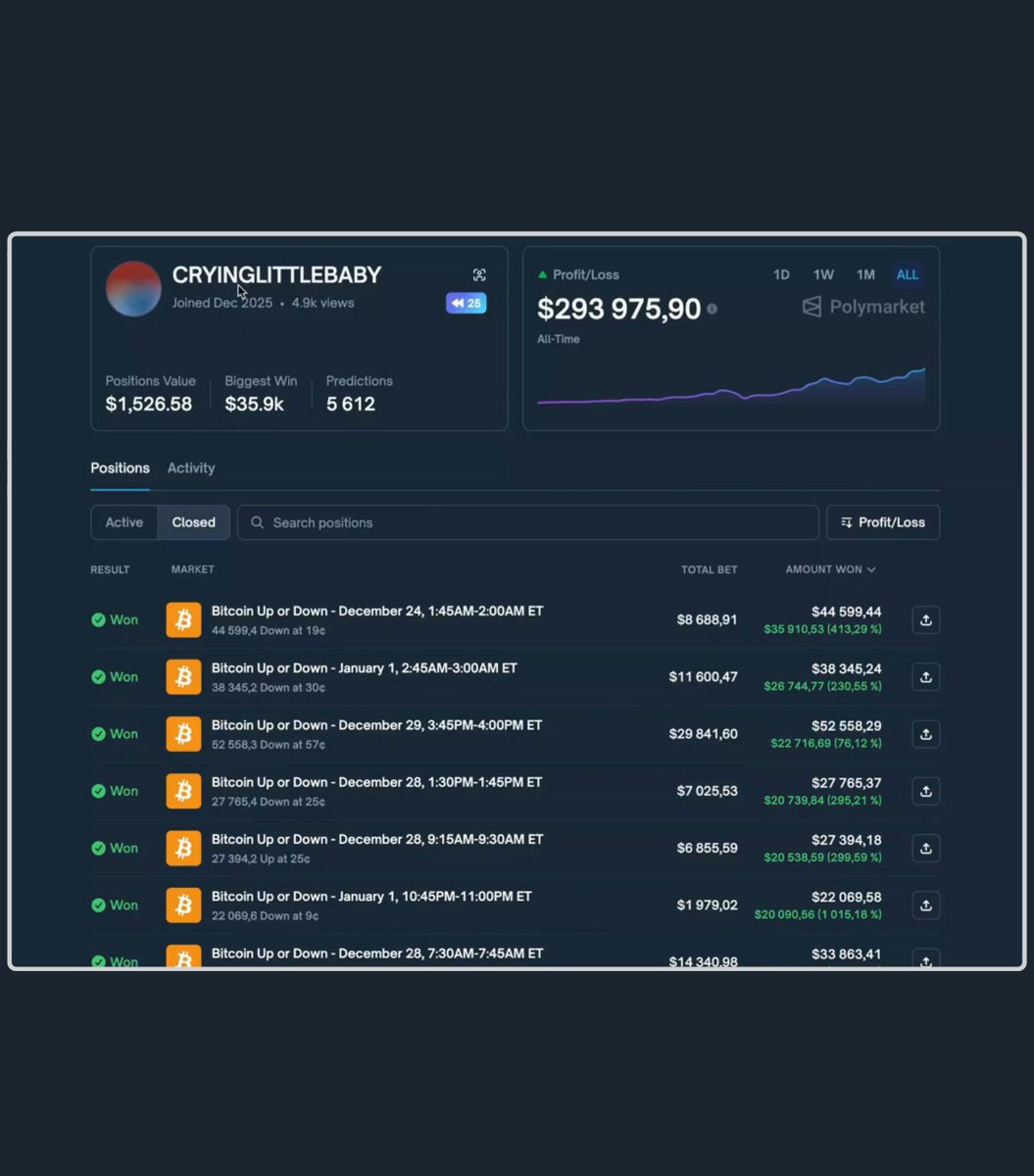
A bot pulled $294K in one month with something I have never seen a 100% win rate. I scrolled through 5,000 trades looking for one loss. Could not find it. 100%. Not 99.5. Not "almost perfect." Actual, literal, every single trade green. CRYINGLITTLEBABY does not play the same game as other bots. They enter at the start of a window, read momentum, guess direction. This one waits. → Account: The 15-minute BTC window opens. He watches. Does nothing. Five minutes pass. BTC drops hard on spot. The move is real. But Polymarket still shows DOWN at 25 cents. Now he enters. The bet is not "will BTC go down?" The bet is "BTC already went down and the odds have not caught up yet." By the time the window closes, he is paid $1 for something he bought at 20-30 cents. Not because he predicted anything. Because he waited until predicting was unnecessary. The treemap broke my brain a little. Solid green. A full month of trading and not one red tile. I kept scrolling thinking I would find it hiding somewhere. Nothing. The edge is patience. Other bots race to enter first. This one lets them fight, watches the result, and collects what is left. A month of trading. Zero losses. Just a wall of green proving that sometimes the best prediction is no prediction at all.
Blaze272,625 Aufrufe • vor 9 Monaten