
Jiafei Duan
@DJiafei • 8,037 subscribers
Assistant Professor at @NUScomputing | Robotics & AI PhD @uwcse | Host of @RoboPapers | Ex-@allen_ai robotics lead, @NVIDIA | Magician | my opinion is my alone.
Shorts


Videos


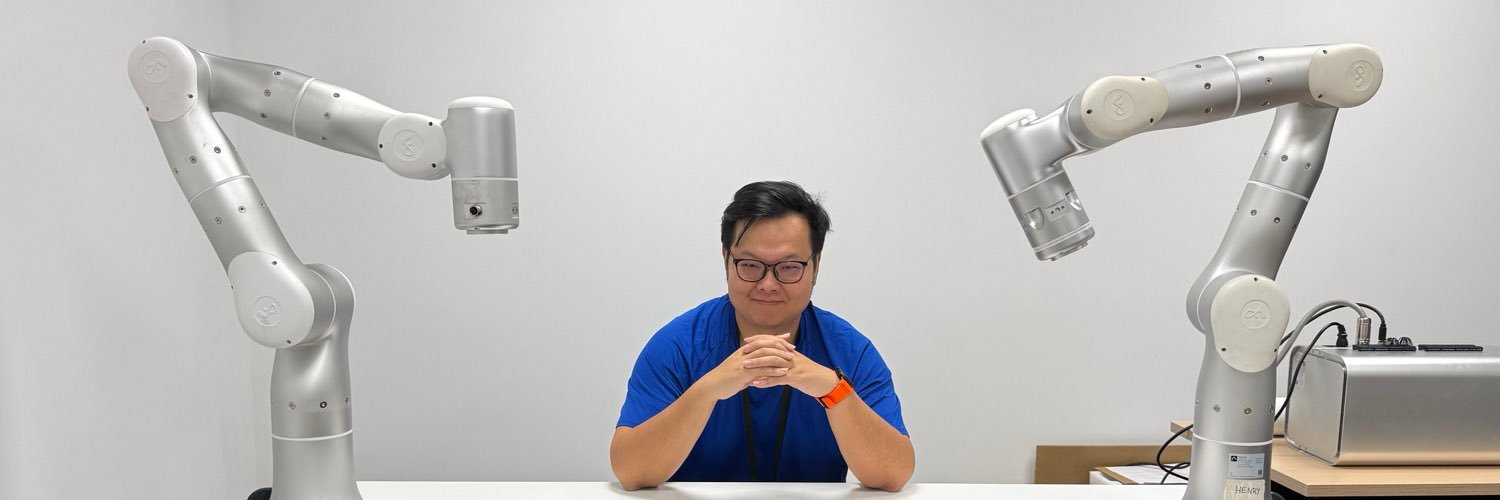
Ran the first policy in my new lab at NUS Computing. Zero-shot, fresh out of the box.
Jiafei Duan455,655 views • 2 months ago

People watching GPT-6 Astra demos on X may not realise how slow it actually is in real time. Here’s a rollout of GPT-6 Astra controlling the MolmoAct2 YAMs to complete this task in real-time. There is potential, but i don’t think it’s practical for real-world robotics deployment yet. I applaud your patience if you make it through the whole video.
Jiafei Duan61,959 views • 22 days ago


Is Opus 5.5 better than GPT-6 Astra at Physical Intelligence "literally" ? put GPT-6 Astra and Claude Opus 5.5 in two Unitree G1s in MuJoCo Ring Fence. Every 2 sim seconds: state → LLM → joint targets → act. Goal: force the other out of the ring, and Astra won after 31 second.
Jiafei Duan54,246 views • 26 days ago


Most capable generalist robotics models today are closed or at best, open weights. But robotics won’t reach its ChatGPT moment without real openness. That GPT moment was built on years of open tools and datasets such as Python, PyTorch, ImageNet and more, that let researchers inspect, reproduce, and build. Today, we’re introducing MolmoAct 2: a fully open-source action reasoning model for real-world robotics. We rethought and reshaped everything! 🧵👇
Jiafei Duan117,636 views • 5 months ago

Instead of asking a VLM to output progress, it reads the model’s internal belief directly from token logits. No in-context learning. No fine-tuning. No reward training. 📈 We introduce: TOPReward, a zero-shot reward modeling approach for robotics using token probabilities from pretrained video VLMs. The simplest way of doing reward modelling for robotics! Project: 🧵👇
Jiafei Duan108,387 views • 7 months ago

Are you training your VLAs or WAMs correctly? Your action expert may be learning vision–action shortcuts that undermine generalization beyond the training distribution. Introducing Latent Interface Training (LIT 🔥): Learn to act first, then learn how to use vision. 🧵👇
Jiafei Duan16,420 views • 1 month ago

Why do generalist robotic models fail when a cup is moved just two inches to the left? It’s not a lack of motor skill, it’s an alignment problem. Today, we introduce VLS: Vision-Language Steering of Pretrained Robot Policies, a training-free framework that guides robot behavior in real time. Check out the project: 👇🧵 (Watch till the end: VLS runs uncut, steering pretrained policies across long-horizon tasks.)
Jiafei Duan74,089 views • 8 months ago

Reasoning is central to purposeful action. Today we introduce MolmoAct — a fully open Action Reasoning Model (ARM) for robotics. Grounded in large-scale pre-training with action reasoning data, every predicted action is interpretable and user-steerable via visual trace. We are open-sourcing everything!
Jiafei Duan99,944 views • 1 year ago

Given the strong community adoption and real-world deployment of MolmoAct2 on YAM, we're introducing zero-shot evaluation of MolmoAct2 Bimanual YAM in simulation. Now you can test out our models without a real-world robot and build on them! Code: Simulation built on Maniskill!
Jiafei Duan37,276 views • 4 months ago

Humans use pointing to communicate plans intuitively. Compared to language, pointing gives more precise guidance to robot behaviors. Can we teach a robot how to point like humans? Introducing RoboPoint 🤖👉, an open-source VLM instruction-tuned to point. Check out our new work:
Jiafei Duan64,511 views • 2 years ago


Humans learn and improve from failures. Similarly, foundation models adapt based on human feedback. Can we leverage this failure understanding to enhance robotics systems that use foundation models? Introducing AHA—a vision-language model for detecting and reasoning over failures in robotic manipulation. Project page: 🧵Thread👇 Aha!
Jiafei Duan48,830 views • 2 years ago
