
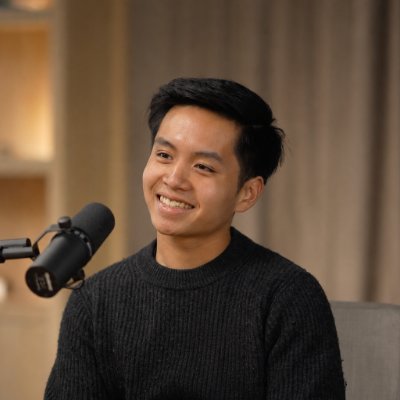
Ethan Kho
@ethanrkho • 21,854 subscribers
Host of Odds on Open (presented by @onyxcapgroup)
Videos

Retail investors vs. hedge fund managers: who wins? Ex-Tudor quant PM Tom Costello (20%/yr, 1.4% max drawdown) DEBATES Market Wizard Chris Camillo ($20K → $80M, tells you to expect 70% drawdowns). Chris Camillo (Chris Camillo) turned $20K into ~$80M over 18 years, audited by Jack Schwager for Unknown Market Wizards at 77% annualized. Founded TickerTags, sold to Jefferies. Co-founder of Dumb Money. Tom Costello (Tom Coste) ran money at Tudor, Moore Capital, and Caxton. Started as a quant on JPM's exotic swaps desk. Now CIO at Bedrock Digital Assets. We cover: - Why a 50% drawdown is "a career-ending event" for a PM and "completely rational" for a retail investor with a 20-year horizon - Chris's case that everyone should have a levered, concentrated risk bucket, and expect a 70% drawdown in it - Tom's pushback: "At least half of the aspiring engineering students who wanna be day traders are gonna go broke" - Why hedge funds don't beat the S&P, and why that's a category error - 3x leveraged S&P ETFs held for decades: ~1.85x market returns, and the futures roll cost buried inside - The e.l.f. trade: one YouTube video, a full day sitting in a Walgreens, and every cosmetics analyst on Wall Street asleep - Chris spent 5 years selling social data to the biggest funds. They couldn't institutionalize it because "the words keep changing" - Vita Coco: a viral TikTok sound → the biggest quarter in company history → +34% on earnings - Tom's bet: LLMs hand social arb to the quants. Chris: "there's still plenty of time" - "I know very few day traders who ever made anything like real money" - Why Chris gives the strategy away after an 18-year run Highlights: 00:00 Intro 00:50 Who's better positioned to take risk: retail or hedge funds? 05:58 A message from ONYX 06:30 Why a 50% drawdown is rational for concentrated retail capital 08:57 Beta vs alpha: what two-and-twenty actually pays for 18:56 Should retail embrace 70% drawdowns? Bucketing risk capital 23:59 Can ordinary investors really compound 2–3x market returns? 30:08 Fair value, mistakes, and why 99% of day traders lose 35:32 Are 3x leveraged S&P ETFs a long-term buy? 43:31 Too big to fail: AI concentration and the case for leverage 46:06 Situational Awareness, crypto correlation, and overfit backtests 53:44 Social arb explained: Beacon Roofing, Hunger Games, Stranger Things 01:01:07 Is social arb crowded? Tiger Cubs, Ticker Tags, e.l.f. 01:07:42 Will Citadel and LLMs arb away TikTok alpha? 01:17:09 Incentives: why "hedge funds don't beat the S&P" is a category error 01:19:35 Why Chris shares social arb: $20K to $80M and the wealth gap 01:25:45 Closing: retail freedom vs institutional resources
Ethan Kho413,365 görüntüleme • 6 gün önce

"Hedge funds don't even beat the S&P." An ex-Tudor PM says that's a category error: Ex-Tudor quant PM. Ran money at Moore Capital and Caxton. Now CIO at a quant crypto hedge fund. Tom Costello (Tom Coste) explains: "What a hedge fund is always looking for is an uncorrelated return. That's the whole product." "If I have the S&P 500 in one hand, and another asset that goes up as well but is completely uncorrelated, I can combine them, lever it, and get an even higher return than either of them. That's portfolio construction done in the hedge fund style." "A retail investor is a completely different investor class. They're controlling their own beta. So that beta manifests a different set of incentives." "I think it's a category error to say, 'Well, a hedge fund doesn't even beat the S&P.'" "I'm not selling that beta. I'm not selling the S&P, so I don't beat the S&P." "My hedge fund doesn't beat the S&P, but I earn 20% a year. So add my return to the S&P, and guess what? You're beating the S&P."
Ethan Kho139,274 görüntüleme • 6 gün önce

"A lot of game theory is very technical, but it really can be reduced to one thing: play weaker players. Don't get into the ring with Mike Tyson." Alix Pasquet (Alix Pasquet) is the Managing Partner & portfolio manager of Prime Macaya Capital Management, a behavioral long/short fund a decade in, built on refusing to fight the pods on their terms. "We don't try to compete with the pods. They're richer than we are, smarter than we are, move faster than we are, and in many cases better looking." We cover: - Strategy is trade-offs: no required management meetings, no alt data, no Wall Street research. "Let them have that, we'll be right here" - The time-horizon inefficiency small funds still own: 6-18 month dynamics the pods have abandoned - Pods are interviewing college sophomores at $300K+, so he waits for the analytical turnover and hires them after - What a top quant fund taught him: behavioral exploitation at scale, data scrubbing, transaction costs, and temporal stops (if the trade hasn't paid in a set time, get out) - When the fund wouldn't share its models, he mapped where its employees went to school and studied those departments' sciences - Idea generation: Phil Fisher found close to 80% of his best ideas came from other investors. Build the network, track the 13Fs - The top-100 CEO list, five years of crashing the same conference, and the "female test" that surfaced Lululemon - Why cheap stocks are cheap for terrible reasons now: the information environment that broke old-school value investing - Your network is your moat, because most hedge funds have restaurant-level failure odds and no terminal value - Margin of safety as a life principle: 3-5 years of personal cash, and the multibillionaire who still flies coach Highlights: 00:00 Intro 00:54 Three edges: analytical, informational, and behavioral advantage 09:18 Sponsor break 09:48 Reading for edge: the canon, timing, and change investing 16:40 What a top quant fund taught a fundamental PM 23:24 Data skepticism, alt data, and the quantification fetish 26:50 How small funds compete with multi-manager pods 30:51 Idea generation: networks, 13Fs, and colliding themes 44:44 People as indicators: bull-bear debates and cross-referencing 51:00 Why technical analysis works: a behavioral lens 58:52 The future of the analyst job in the AI era 1:06:54 AI blind spots: wicked environments and non-stationary markets 1:14:34 Personal competitive advantage: energy, power pairs, network as moat 1:23:41 Margin of safety as a life strategy
Ethan Kho277,772 görüntüleme • 23 gün önce

Value investing worked because information was scarce. Today, if a stock is cheap, there's a reason, and the reason is terrible: Alix Pasquet (Alix Pasquet), managing partner of hedge fund Prime Macaya Capital Management, explains: "Value investing taught you to look at things bottom up. You look at the business, and that's it. And that wasn't because Graham or Warren were bad at understanding an industry. It's because back then, they didn't have access to the information we have now." "One of the reasons value investing worked really well is you could buy something cheap that was very good, and no one knew it was good, because there wasn't enough information on it." "But today there's so much information that if something is cheap, usually there's a really good reason why it's cheap, and that reason is terrible." "You're not gonna have a really good athlete trade cheaply for a short period of time. People are gonna know." "I look at certain long-only, quality-focused investors and say, I bet you 100 bucks to a hat pin that Visa or MasterCard are in that portfolio. And yes, it is. The cat's out of the bag." "But guess what happened this year? Quality took a dive, a really big one. It's gonna take those guys a couple years, if not five, to dig themselves out of that. It's gonna be painful."
Ethan Kho207,494 görüntüleme • 18 gün önce

Ex-IMC semiconductor options trader Lihong Wang on seeing the whole market's flow, betting the entire AI stack, & why foundation models are good enough to beat the S&P 500. Lihong Wang (Lihong) | Discretionary semiconductor options trader @ IMC Trading | Now co-founder of Freeport, a YC-backed event-driven perps exchange "You see what everyone's doing, you trade against the people who are stupid, and you get out of the way or you follow the people who are smart." We cover: - How a bet actually gets made on a vol desk: not predicting the future, just selling what's expensive and buying what's cheap - The edge of the seat: being counterparty to 20-40% of flow in certain options markets, a view "maybe a few dozen people on the entire planet" have - Knowing who HAS to trade: reverse-engineering banks' structured-product hedging from issuance data - How desks blow up: overestimating correlation, and why NVDA -17% on DeepSeek didn't mean AMD -12% - The trader group chats: ~3x beta to the S&P, median 30% drawdown in July, and everyone still bullish - His portfolio: 50 chip/AI stocks covering the entire stack, up 470% bottom-to-peak, then a 70% drawdown ("I'm literally down an entire Ferrari today") - Why trading firms may be the third-largest consumers of AI tokens on the planet - Moats vs. growth: why Cursor got funded with no moat, and what that means for careers in the age of AI - His hot take: foundation models can already beat the S&P 500 risk-adjusted. The model isn't the hard part, the harness is Highlights: 00:00 Intro 01:09 How discretionary options bets get made — and blow up 10:23 A message from Onyx 10:53 Warehousing benign flow through July's deleveraging 16:40 Seat leverage and how trading firms allocate talent 22:03 Why quant traders are levered long the AI stack 26:27 Playing the AI hand: leverage, moats, personal brand 36:42 From IMC to Freeport: AI agents for event-driven trading 45:26 Perp DEX endgame: liquidity, fragmentation, and SEC rulemaking 51:21 Sourcing semiconductor alpha from trader dinners 56:05 Narrative edge, DeepSeek puts, and a 70% drawdown 01:04:24 Is AI a bubble? Compounding, path, and Kelly leverage 01:08:39 US, China, and comparative advantage under ASI 01:12:17 Risk-taking when you're post-economic
Ethan Kho181,433 görüntüleme • 17 gün önce

"You shouldn't invest the money you have. You should invest the money you're ever going to have." An ex-IMC trader on why young people are under-allocated: Lihong Wang (Lihong), traded semiconductor options at IMC, one of the largest options market makers in the world. Lihong explains: "People discuss rising inequality in the US, driven by rising asset prices. There are moral statements you can make about this, but that trend is probably going to continue. If you truly believe AI is gonna create value, more value is gonna accrue to capital." "If you're really young, 18, 20, 22, you're not married, no kids, no real responsibilities, there's no particular reason you shouldn't be at least a little bit leveraged. And this is not financial advice, for legal purposes." "Consider how much the average college kid has in savings by senior year. A few hundred, few thousand dollars. Then consider how much they'll have after working a few years. As your career progresses and your human capital compounds, you're gonna make exponentially more." "Which means super early on, most people are extremely under-allocated into capital. You shouldn't really just invest how much money you have right now. You should, in some sense, invest how much money you're ever going to have." "This is made really clear in trading. Kids get offers between 600K to a million a year, and they're starting with a 50 to 100K portfolio from internship money. By the end of the year they're guaranteed to at least 4, 5x that. There's no reason they shouldn't be 3 to 4x leveraged."
Ethan Kho106,891 görüntüleme • 11 gün önce

"Crypto is the dumbest market in the world" Scott Phillips (Scott Phillips, O.G.) runs HyperTrend — $20M of his own capital, one losing year in six. His edge? Picking the table big firms can't sit at. "There's no second-best counterparty in crypto. You see crime, you run towards it — crime is the foundation of edge." We cover: - Why crypto still has edge in 2026 — even when your uncle is talking about Bitcoin at Thanksgiving - The simple rules (buy 20-day highs, top-20 coins) that print through any market - Why stacking trend + momentum + carry gets you there from a spreadsheet — no automation required - Price-insensitive buyers (Saylor), price-insensitive sellers (North Korea) & why both are permanent alpha - The 90-day Binance listing short — an edge hiding in plain sight in market maker contracts - Why most shit coins trend to zero — and how to trade the ones that don't - Building a tokenized, permissionless DeFi hedge fund on hyperliquid — 2 & 20, fully on-chain - Why the best quant firms are run by near-non-verbal autists with one translator Thank you so much Scott Phillips, O.G. for coming on the pod! Highlights: 01:04 Table selection and the math of competitive alpha 06:21 Why basic trend following yields outsized Sharpe in crypto 08:49 Why market inefficiency persists despite institutional inflows 14:58 Price insensitive buyers: Cults, VCs, and North Korean hackers 17:17 Factor analysis and the size-decay effect in shitcoins 25:40 The structural edge in mid-frequency crypto strategies 32:43 Tokenized DeFi vaults and on-chain hedge fund governance 40:43 Designing a robust portfolio: Equal weighting vs. MVO 44:21 Sourcing alpha from ghost chains and VC exit liquidity 49:58 Exploiting market maker contracts and post-listing drift 53:55 Operational alpha: Managing margin and manipulated funding rates 01:01:13 Shifting from quant to CEO 01:11:28 How to bridge the mentorship gap with elite traders 01:22:38 Building network triads: The secret to compounding social capital 01:29:23 Why 10x goals require total identity transformation
Ethan Kho1,464,463 görüntüleme • 5 ay önce

Ex-Point72 Proprietary Research Head Kirk McKeown on building edge, alpha decay, & why everything that happened on Wall Street is about to happen on Main Street. Kirk McKeown (8.5 years @ Point72 under Steve Cohen | Built primary research at Glenview under Larry Robbins | Now founder of Carbon Arc Carbon Arc) "Alpha rewards those who value assets in a cold way. You want to get it right — not be right." We cover: - How alpha creation differs across multi-manager vs. concentrated shops - The 3 vectors every middle office function must move to justify its existence - Why he worked 6-hour Sundays from 2006-2020 — and the math behind it - The TSMC call that signaled semiconductor cancellations before anyone else knew - What the quant revolution on Wall Street tells us about the AI economy today - His framework: 4 market structures, 9 business models, & why they have rules - The MIT beer game & why every business problem is really an inventory problem - His hot take: a top hedge fund launches an enterprise AI lab in 2026 Highlights: 00:00 Intro 04:47 Tutor vs Glenview vs Point72: how edge differs 12:29 How to build “lift” for PMs: at-bats, hit-rate, sizing 18:44 Building research edge: outwork, read, fieldwork 27:16 Personal moat in 2026: analogs, history, decision trees 40:08 “Main Street becomes Wall Street”: what that actually means 44:30 Carbon Arc thesis: “decimalization” of data market structure 46:43 Why the edge migrates to data plus domain context 51:00 How to win in commoditized research: sample size beats anecdotes 01:03:26 Factorizing everything: themes, market structure, business models 01:08:37 Pruning decision trees: signals, scale points, inventory dynamics 01:14:18 Contrarian 2026 take: hedge funds launching enterprise AI labs 01:23:32 Final question: one habit to build career alpha
Ethan Kho1,538,462 görüntüleme • 6 ay önce

"I haven't seen a real new idea in trading in at least 15 years." Tom Costello (Tom Coste) ran money at Tudor, Moore Capital, and Caxton. Built one of the first NLP-driven equity systems in 2003. 20 years managing capital, never had a down year. "Comparing what a retail trader does to what a quantitative hedge fund does is like comparing driving a bus on the New Jersey Turnpike to winning a Formula One race." We cover: - His hot take: no genuinely new trading idea in 15 years — only better people doing the same things faster - Why everyone in quant finance is a genius — and why that makes you ordinary, not special - Crypto is "super smart guys cosplaying at finance" — built for retail, which is exactly why it's the easiest money in finance right now - Why AGI won't beat the hedge fund industry — all the readily-capturable alpha is already captured - The status trap: why the path that made Paul Tudor Jones a billionaire won't work for the kid trying to copy it in 2026 - His friend the investment banker who'd quit it all to run a 10-employee ambulance supply company worth $150M - Why excitement is "wildly overbid" in finance — and why wanting an exciting trading job is itself a disqualifier - The most honest end of the financial industry — and why the media has it exactly backwards Thanks so much to Tom for coming on Odds on Open! Highlights: 00:00 Intro 01:18 Building institutional credibility for early-stage managers 03:01 The Pareto distribution of hedge fund returns 04:25 Applying the Unified Field Theory of Finance to fair value 08:14 Trading against human incentives in a deterministic market 13:54 Why allocators don’t steal alpha from prospective PMs 25:16 Evaluating career edge in quantitative finance for 2026 30:48 Paul Tudor Jones and the art of game selection 33:42 Analyzing the economic viability of starting a new fund 35:16 Identifying common retail pitfalls: Mean reversion and arbitrage 38:55 Why there hasn't been a new trading idea in 15 years 50:33 Managing tail risk: Physics vs. deterministic financial distributions 59:10 Career pathing for PMs after a fund blow-up 1:07:53 SBF and FTX: Credibility vs. the "Founder-Genius" archetype 1:13:44 Establishing proof-of-concept through audited multi-year returns
Ethan Kho1,187,584 görüntüleme • 5 ay önce

Ex-Citadel PM Rich Falk-Wallace (Rich Falk-Wallace) on why 90% of hedge fund blowups are portfolio construction — not bad ideas. Rich Falk-Wallace (PM @ Citadel | Viking Global | Silver Point | Now founder & CEO of Arcana Arcana — risk & portfolio software used by ~7 of the 10 largest multi-manager hedge funds) "When they blow up, the story is never 'Shucks, I actually am not as brilliant as I was before.' What they got wrong was risk, portfolio construction." We cover: - Why 90% of PM failures come from sizing & portfolio construction, not thesis quality - The only two ways to survive long-term: extreme hit rate/slugging, or managing ex-ante correlation - The math of 10 pods long the same trade: factor bets compound, idio bets diversify - Why LTCM is the classic backward-looking correlation failure — and why ex-ante is the whole job - The paradox: "pure fundamental" concentrated funds take the biggest factor bets (up to 80% R²) - Why the best PMs treat every factor exposure like a stock position — same limits, same diligence - Sharpe ratio as a t-statistic against the null hypothesis that you have no skill - The tiger cub who moved to a pod seat and said it felt like playing a video game - Are junior analysts screwed? Dispersion, not extinction - His contrarian take: capital is opening up beyond the Big Four via SMAs Highlights: (00:00) Intro (01:10) The real job of a hedge fund PM: a product sold to allocators (02:52) The 90% failure vector: risk leakage, not bad theses (10:25) Two ways out: hit rate/slugging vs. managing correlations (18:17) Factor bets compound, idio diversifies: why 80% idio becomes 60% at scale (27:33) Factor models as the "perfect benchmark" for every stock at every moment (38:57) The old-school PM who calls factors bullshit — Rich's answer (44:48) Treat factors like stock positions: limits, diligence, sizing (55:29) Why concentrated "pure fundamental" books take the biggest factor bets (01:05:34) Are junior analysts screwed? AI, mock books, & dispersion (01:15:52) Contrarian take: SMA capital opening up beyond the Big Four (01:19:42) The #1 new-launch killer: trying to do too many things at once
Ethan Kho530,754 görüntüleme • 2 ay önce

Victor Haghani helped build LTCM & watched it collapse — with winning trades still on the books. The lesson was never what to buy. It was how much. Victor Haghani (Co-founder @ LTCM | Founder @ Elm Wealth | Author of The Missing Billionaires) "It wasn't on the selection of the trades. It was on the sizing." We cover: - The two decisions every investor makes: what to own and how much, and why everyone fixates on the harder one - The biased-coin game that bankrupted Wall Street PMs and finance grads: a 60/40 edge handed to them, and they still blew up - Why the cost of risk is a fee you pay yourself, plus the napkin rule to price it (15% vol = 2.25% a year) - The Elon problem: 50% vol on your net worth means a ~90% chance of little left in 10 years, before anyone's even bearish - "The right answer to the wrong question," and why chasing billionaire money wrecks the plan - The crystal-ball game: hand someone tomorrow's WSJ front page and watch 1 in 6 still go bust - Claude, GPT, Gemini and Grok play the same game, and the two AIs that actually lost money - His 92-year-old mother, who day-trades every day and won't hear a word of it Highlights: 00:00 Right & ruined — the LTCM paradox 01:40 The two decisions: what to invest in vs. how much 02:50 The 60/40 coin & why max-EV bankrupts you 04:00 The experiment: PMs & PhDs sizing it all wrong 07:00 Kelly in plain English — a constant 10–20% 08:20 Why sizing isn't zero-sum, but beating the market is 10:30 Why even pros don't optimize sizing 12:50 The cost of risk is a fee — paid to yourself 15:20 Pricing your own risk: variance as the charge 16:30 Concentrated stock: 30% vol = a 9% toll 20:50 Elon, 50% vol & the log-normal trap 22:45 The right answer to the wrong question 23:35 The real objective: smooth lifetime spending & giving 27:35 The crystal-ball / WSJ front-page game 33:25 Claude, GPT, Gemini & Grok step up to trade 37:40 Claude's 66% hit rate — & the two AIs that lost money 40:35 Can anyone actually beat the market? 50:25 How much risk a young person should take 58:00 Estimating your human capital 1:02:40 The mom who won't stop day-trading 1:07:30 The one rule: if you don't save, nothing else matters
Ethan Kho627,138 görüntüleme • 3 ay önce

Maybe a few dozen people on the planet can see the entire US options market. An ex-IMC trader was one of them: Lihong Wang (Lihong), traded semiconductor options at IMC, one of the largest options market makers in the world. Lihong explains: "The top five options market makers do maybe 80, 90% of liquidity provision in the United States." "So when we say there are maybe literally a few dozen people on the entire planet that have that view, I think that is quite literally true." "You are among the few dozen people on the planet that have this full view of the market, and you're uniquely able to take advantage of that." "The value of the seat is by itself already very high. You're in a highly leveraged position with access to information the vast majority of the market doesn't have." "But that skill set doesn't convert as well to personal trading. Now that I no longer have access to that flow information, I don't think I'm better at predicting where the market's gonna go by myself."
Ethan Kho78,893 görüntüleme • 15 gün önce

You can pump a $50M coin to $1B with $1.5M of real buying. Scott Phillips (Scott Phillips, O.G.) on how new token listings actually work: "There's a huge industry of market makers operating out of Dubai. Their business model is: we're gonna pump your coin, and we want 30% of the profit when we dump it on exit liquidity day." "They run the ball up. Buy, sell, buy. Create momentum ignition. Retail finally buys in the middle of a bull run — and then it dumps." "Buying 20-day highs works best on the top decile. By the fourth decile, you get negative momentum effects." "Anything in the bottom 20% of market cap on Binance perps that makes a 20-day high — short it. That is a very strong edge." "The market maker contract runs 90 days. It's priced as a call option on the 7-day VWAP after launch." "Once the strike kicks in, delta hedging from market makers drives these coins down." "Wait 7 days. Short it for 90 days. I kid you not." "That's not an edge big enough for institutional. That's an edge for retail guys with a small account."
Ethan Kho866,714 görüntüleme • 5 ay önce

"85% accuracy on Wall Street will get you 100% fired." Brett Caughran (Brett Caughran) has managed analysts at Citadel, D.E. Shaw & tiger cub funds. His take on AI and the future of junior analysts: "There's almost no better time to be starting a career as a fundamental investor. These tools let junior investors get to the juicy part of the investment process more quickly." We cover: - Why the junior analyst role is transforming faster than any point in the last 20 years — and why the juniors who adapt will reach the real work of investing years sooner - The old grunt work that's already dead — and what's replacing it - Why billion-dollar funds won't cut analyst headcount, but the job description is changing dramatically - “Should I still learn Excel modeling?" — yes, because you can't debug what you don't understand - Why creativity & tenacity are becoming the new differentiators over raw quantitative skill - How multi-manager alpha factories scaled from $10B to $60B+ while sustaining double-digit returns — proof that more information hasn't compressed alpha - Why reading a 10-K with pen and paper still matters even when AI can summarize it in seconds - The most underrated skill in the best investors he's worked with: genuine curiosity Thanks so much to Brett (Brett Caughran) for coming on Odds on Open! Highlights: 00:00 Intro 01:29 Frameworks for developing a differentiated variant perception 05:16 Financial drivers vs. narrative cycles: The Focus 5 framework 08:29 Analyzing the stock vs. business: Bayesian updating in public markets 12:52 AI as an intellectual power tool vs. consensus "alpha slop" 17:21 Accelerating the hunch-to-hypothesis pipeline with AI sniff tests 21:52 The evolution of junior analysts: From data entry to primary research 28:46 Why market microstructure and behavioral alpha prevent index efficiency 38:44 Training junior analysts: Earning the right to use power tools 48:28 LLMs as orchestration tools for human primary research 54:55 Teachable scientific process vs. revealed investment judgment 57:54 Common threads across Multi-Managers, Single Managers, and Tiger Cubs 59:49 Curiosity as a meta-skill and the art of system thinking
Ethan Kho881,215 görüntüleme • 5 ay önce

Citadel, Millennium, Point72 and BAM are richer, smarter, and faster than you. Here's how small hedge funds can win regardless: Alix Pasquet (Alix Pasquet), managing partner of hedge fund Prime Macaya Capital Management, explains: "A lot of game theory is very technical and mathematical, but it really reduces to one thing: play weaker players. Don't get into the ring with Mike Tyson. That's not what you want to do." "We don't try to compete with the pods. They are richer than we are, smarter than we are, move faster than we are, have more resources, and in many cases are better looking. That's bad for our self-esteem, for our ego, and also our wallet." "We don't compete with them on who they hire. They're interviewing sophomores and juniors in college now. I can't afford to pay an analyst $300,000 plus a bonus including half a million dollars. But the analytical turnover inside these shops is high enough that you get to hire these kids afterwards." "Whereas pods have been lengthening their trades to weekly, monthly, we like dynamics that are six to 18 months and above. There's names we've owned forever, and there's names we'll own expecting 18 months where the upside happens in weeks." "Some of these hedge funds pay the Wall Street banks more to get the first one-on-one meeting with management, so they can trade on it. We don't do that." "I'm rewriting my business plan for the age of AI, and one of the sections is: we have no requirement in our process that says you have to meet management teams. No requirement that says you need alt data. No requirement for Wall Street research. No requirement to hire from certain schools. Strategy is about trade-offs. Let them have that. We'll be right here. There's a lot more advantage here than you would think."
Ethan Kho92,891 görüntüleme • 20 gün önce

Ex-WorldQuant Head of Data Strategy Matt Ober on why quants don't care about the stock market, & why prediction markets become a new asset class. Matt Ober (Ex-Chief Data Scientist @ Third Point | Ex-Head of Data Strategy @ WorldQuant | Now GP @ Social Leverage) "Nobody actually really cared about the stock market. I bet if you asked people there when Nvidia was reporting, nobody had a clue." We cover: - The WorldQuant thesis: out-consume the world on data, out-manage the world on money - How a Chico State grad found the job on Craigslist — then walked into a room of PhDs - Revere, the alt-data goldmine only quants understood - Tracking CEOs' private jets to front-run M&A - WorldQuant's factory vs Third Point's fine-art boardroom - Selling data science to analysts who thought it was a joke - Why you sell beta, not alpha — alpha erodes, beta is sticky - The "degenerate economy," and why he can't hire interns anymore - Prediction markets as the next asset class — bigger than options and futures - The only edge left in an AI world: your network Thanks a ton Matt Ober for coming on the pod! Highlights: (00:00) Intro (01:18) The WorldQuant thesis - more data, more money (02:00) Building the alt-data stack (03:00) Revere - the dataset only quants understood (04:50) A finance major among PhDs (09:40) Trading datasets like stocks (10:30) Why quants don't watch the market (12:30) WorldQuant Ventures is born (16:30) Factory vs. boardroom (18:30) Data's wild west at Third Point (23:15) Tracking private jets to front-run M&A (24:20) Igor vs. Dan & the power of network (32:10) The degenerate economy (36:25) Patience & outworking everyone (38:55) Alpha vs. beta, markets & careers (46:10) Somebody's gotta sell (51:20) Prediction markets, the new asset class (53:30) The DoorDash earnings call (56:35) Going mainstream (01:03:10) The single source of all edge
Ethan Kho584,212 görüntüleme • 4 ay önce

This guy beat the market for 17 straight years trading a sector many investors have written off post-2008 Derek Pilecki (Derek Pilecki) runs a financials-only fund. 21%+ annualized. His edge? A corner of the market many investors moved away from after the GFC. We cover: - Why he expanded from 25 → 40 positions and returns went UP - His counterintuitive rule: buy higher, not lower (positions get LESS risky as they rise) - The Robinhood call — bought late 2023, rode it to a multibagger - Why he's quietly watching FactSet, Morningstar & Verisk right now - His view on private credit risk (and why he disagrees with Jamie Dimon) - How he uses AI to analyze more stocks without losing his edge - Why markets chronically underreact to good news — and how to exploit it - The brutal career reality no one tells young PMs about Highlights: 00:00 Intro 01:06 Derek's +21% annualized return track record 02:50 Fundamental business change vs market noise in Robinhood 05:25 Portfolio construction: Concentration limits and adding to winners 09:09 Sourcing alpha and identifying three-year doubles in financials 12:44 Developing edge through repetition and management team cycles 14:16 Why the post-GFC regime fundamentally changed bank underwriting 17:07 Assessing tail risk and leverage in the private credit market 21:23 AI-driven market dispersion and identifying moaty businesses 24:11 Why shareholder base turnover matters for timing broken charts 29:37 Integrating AI into fundamental research and SEC filing analysis 35:39 Risk management: Permanent capital loss vs mark-to-market volatility 37:12 Capacity constraints: Optimizing for returns over AUM scale 50:39 Career risk and the reality of active money management
Ethan Kho801,418 görüntüleme • 6 ay önce

"Greed makes markets." Annanay Kapila (ak0) spent years as an HFT quant at Flow Traders and Tower Research before founding QFEX (QFEX), a perpetual futures exchange for equities, commodities & FX. Cambridge Maths. At his last job, the desk traded $10B+ of volume a day, run almost entirely by algorithms. In this lecture, he builds market making from first principles: - The map of systematic trading: prop money vs. other people's money, HFT vs. mid-frequency, and why every strategy lives in one quadrant - Why prop firms can return 50-100% a year while hedge funds can't: HFT never leaves you holding a big position - The order book from scratch: bids, offers, limit orders, and why the first order on a price level gets the trade - No free lunch: how arbitrageurs force every order book to reveal a fair price without anyone trying to - The entire strategy in one line: bid below fair value, offer above it, collect the difference forever - Market making is "time-spreading risk," warehousing positions between a seller who shows up now and a buyer who shows up later - Adverse selection: you're most likely to get filled precisely when your price is most wrong - Why market makers are completely self-serving, and why that's exactly what makes markets work - The competitive race that compresses spreads: greed among market makers means lower costs for everyone else - Thick books vs. thin books, and the vicious loop that keeps illiquid markets illiquid Highlights: (00:45) The systematic trading map: capital vs speed (01:45) Prop firms vs hedge funds: return-on-capital economics (06:29) A message from Onyx (07:55) Where market making sits: high-Sharpe prop HFT (08:55) Fungibility and why exchanges exist (11:00) How a central limit order book actually works (17:40) No free lunch: arbitrage-free pricing in the book (19:55) Theo: reading fair value from the mid (22:45) Who really posts the book (not retail) (24:35) Market making as warehousing risk across time (27:20) Edge: quoting around your fair value (29:45) Queue priority and the adverse selection problem (33:05) How competition compresses the bid-offer spread (37:40) Thick vs thin books: liquidity begets liquidity (43:55) Scaling to $10B a day on algorithms
Ethan Kho111,598 görüntüleme • 1 ay önce

Ex-Balyasny PM Ying Hua (Ying Hua) on why automation will increase demand for hedge fund talent, the quant/fundamental convergence, & why quant is blackjack but fundamental is poker. Ying Hua (PM @ Balyasny — built & led a quantamental team covering US insurance, capital markets & fintech | ~5 yrs @ Citadel running a long/short insurance book | Equity research @ Goldman Sachs | MS in Data Science @ UC Berkeley | Now founder & CEO of Implied Implied) "One of the best-kept secrets: fundamental investors are not good at sizing. Quant funds are really good at sizing." We cover: - The only real line between quant and fundamental: historical pattern matching vs. "how is this time different" — and the alpha neither group is looking at - Why she rebuilt her process so every model updated within 2 minutes of a print - Scraping highway patrol data from 15 states to track auto insurance losses live, every single day - The Malibu wildfire: mapping burned mansions from celebrity tweets to estimate losses before any industry consultant published a number - Her automation math: data gathering ~100% automatable, processing ~80%, judgment still 100% human - AI is quant for words — next-token prediction is pattern matching, which makes this just the next automation wave after quant and indexing - The proof differentiated views pay more: insurance stocks moved 2-3% on earnings in 2010; by the time she left, 15-20% intraday - Why "hook Claude Code up to data and let it rip" fails: BloombergGPT losing to a smaller open-source model, & why horizontal models are college grads - Quant is blackjack with card counting; multi-manager investing is poker — your hand, others' perception of it, your seat, everyone's stack - Most PMs are playing the wrong game: the positioning game hiding inside "fundamental" sectors with no new money coming in - Her hiring bar at BAM: every fundamental analyst learns Python — and the one skill she says can't be trained - The only two truly meritocratic jobs: hedge fund PM & sales Highlights: (00:00) Intro (00:40) How a quantamental PM actually puts on a position (02:05) The only real line between quant and fundamental (04:45) Why quantamental lowers the burden on your brain (06:40) Scraping 15 states of highway patrol data to nowcast insurance losses (09:25) The Malibu wildfire: estimating losses from celebrity tweets (11:55) How much of fundamental investing can be automated (13:45) Quantifying intuition: when a CFO's filler words jump 8% to 20% (16:25) The contrarian case: automation expands demand for talent (18:15) Earnings vol exploded — differentiated views pay more (20:25) Why Claude Code can't run your book (23:40) Horizontal models are college grads with no domain knowledge (30:50) Why chat is the wrong interface for investors (36:20) Will AI make markets more or less efficient? (39:10) Two things every fundamental PM should do today (41:50) The moat that expands: talent, redefined (45:50) Sometimes the game is positioning, not fundamentals (48:25) Blackjack vs. poker vs. surfing: matching the game to your horizon (52:00) Should young analysts chase the hottest sector? (57:55) Munger vs. Musk: two philosophies of wealth (1:01:05) Self-awareness in investing is bimodal (1:07:05) The only two truly meritocratic jobs: hedge funds & sales (1:08:50) The one skill for every regime: reconstruct the narrative
Ethan Kho248,035 görüntüleme • 2 ay önce

"He's got 50% vol on his entire net worth. It's insane." The richest man alive — and the math nobody around him is running: Victor Haghani co-founded LTCM. Now runs Elm Wealth. Victor Haghani explains: "I guarantee Elon isn't thinking about any of this." "Not bearish, not bullish — just assume everything he owns is fairly priced." "Now draw the log-normal distribution." "Almost all of the probability mass sits below where he is today." "There's a ~90% chance he has very little wealth in 10 years — from the math alone."
Ethan Kho350,991 görüntüleme • 3 ay önce