
The Forgotten South
@forgotten_south • 13,760 subscribers
✍🏼 Stories of Forgotten Places 🪦Cemetery Advocate 📜Historian 📷Photographer
Shorts


Videos

👉🏼 This hotel in the mountains of Tennessee was built in the 1880s. Imagine stepping off a train in 1900 to find a grand hotel rising along the banks of the Hiwassee River in the Appalachian Mountains. Back then, the Higdon Hotel welcomed railroad crews, summer tourists, and mountain wanderers alike. Today, it sits quiet and hollow, just a ghost from a golden age when rivers and railroads brought life to this tiny Tennessee town in the mountains. You can see a photo of it from 1910 below....
The Forgotten South246,422 views • 8 months ago

This log cabin was built by the McCarrolls, an Irish immigrant family, in the 1840s, when this part of Florida was still a frontier. It was later lived in by the Hogan family. The cabin includes a board-and-batten kitchen that was added onto the back of the original log structure. Today, the house sits at Morningside’s Living History Farm in Gainesville, where it was relocated to help recreate what a family farm in 1870s Florida might have looked like. The farm includes the 1840s cabin, the attached kitchen, a barn, a one-room schoolhouse, an heirloom garden, and heritage-breed farm animals. On the first Saturday of each month (September–May), the Farm offers live interpretive experiences that bring this history to life.
The Forgotten South189,144 views • 10 months ago

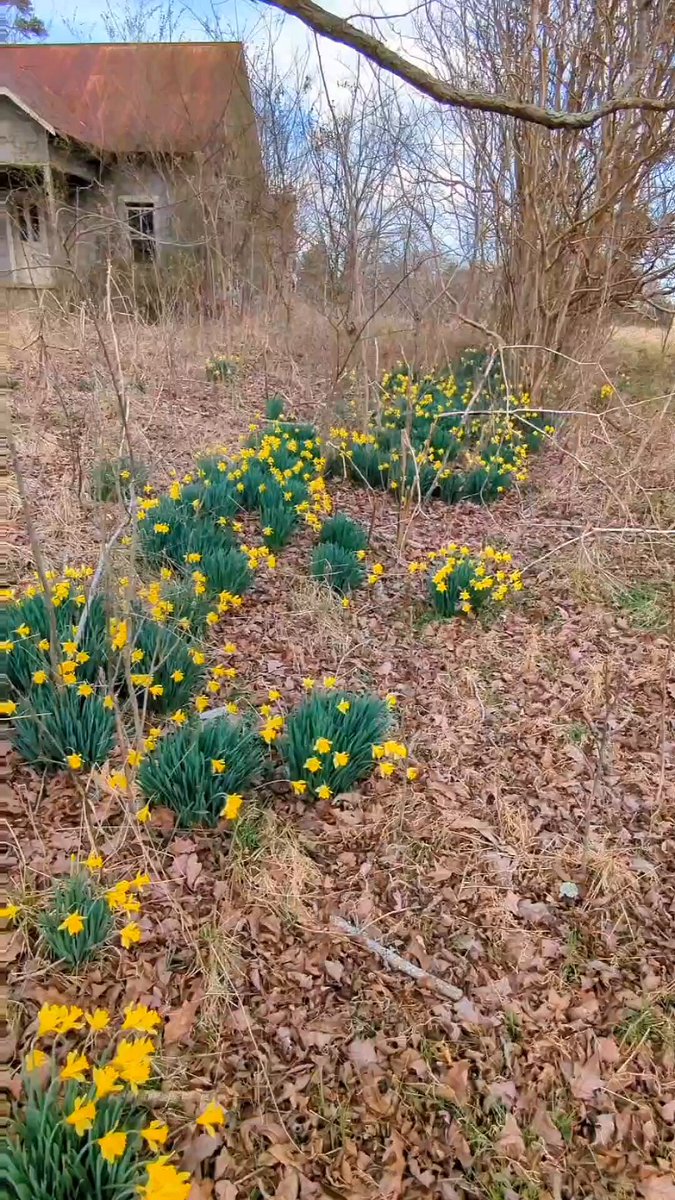
🌼✨Hiking through the woods, I stumbled onto a hillside glowing with daffodils- hundreds of them. I followed their trail and found this forgotten cabin, once home to an unmarried Cole sister whose name was never recorded. She lived her life quietly here, but every spring her daffodils still bloom, lighting up the woods long after she’s gone.
The Forgotten South174,357 views • 11 months ago


What do you think was the hardest part of life here? 📍Buncombe County, North Carolina
The Forgotten South77,987 views • 10 months ago

🌼“Ghost Garden” is a term I came up with to describe the gardens I find all the time at old homesites across the South. Hardy perennials, like daffodils, can bloom for generations without tending, so once they’re planted, they continue to shine their bright light at the end of winter, heralding the arrival of spring. And although daffodils thrive in this region, they aren’t native here- which means someone had to plant them. So if you ever spot a clump of daffodils in the woods, along the roadside, by a creek bed, or out in a field, you can bet there was once a homesite nearby. And if you take a look around, you might find an old chimney, a house foundation, or maybe even a family cemetery.
The Forgotten South46,010 views • 9 months ago

This school in rural South Carolina probably looks much like it did when it was built in the 1920s and is still as isolated as it was back then. It's easy to understand why it fell out of use, but it would be great to see it get another shot at life, serving some new purpose for the rural community where it has stood for nearly 100 years.
The Forgotten South33,240 views • 8 months ago

By the summer of 1864, the Civil War had turned brutal in the Virginia countryside. Confederate Colonel John S. Mosby and his rangers were terrorizing Federal units across northern Virginia, striking supply lines, ambushing couriers, and vanishing back into the landscape before Union troops could respond. In one raid alone, Mosby's men attacked one of Sheridan's supply trains, burning 40 wagons and seizing hundreds of mules, horses, and cattle. Union soldiers grew so fearful of the Rangers that some said they would rather charge into open battle than patrol Valley roads alone. In the fall of 1864, Union General Philip Sheridan was ordered to put a stop to it. Grant ordered Sheridan to destroy all mills, barns, and crops he could, carry off livestock, and leave the Shenandoah Valley a barren waste. During these Burning Raids, 230 barns, 8 mills, 1 distillery, 10,000 tons of hay, and 25,000 bushels of grain were reported burned across a stretch of Virginia in just days. Civilians watched their entire livelihoods reduced to ash. These stone wall ruins are all that's left of Potts Neer Mill (built c. 1840s), one of the only surviving remnants from that time.
The Forgotten South27,640 views • 7 months ago

📍 Western North Carolina No one has called this place home in a long time, but at one point, the Teague family called this homestead their own in the Blue Ridge Mountains. It started as a simple log cabin, built sometime in the mid-1800s. Over the years, it grew into the 1.5-story saddlebag house still standing today. Look close, and you can still see the outline where the front porch used to be. The creek and river beside the home swelled during Hurricane Helene in 2024. Bridges were wiped out, roads destroyed, and many modern homes nearby didn't survive. But this old place did. Empty for years, open to the weather, carrying its scars, yet still it stands. I hope someone realizes the value in a place built this well, and breathes new life into it.
The Forgotten South13,615 views • 3 months ago

👉🏼Which of these old houses speaks to you the most? #1- 1890s era mansion in the Virginia countryside #2- 1880s farmhouse from the mountains of Western North Carolina #3- 1890s house with double verandas in North Florida #4- Antebellum Georgia farmhouse set on a dirt road in the countryside #5- Early 1900s farmhouse with a wrap-around porch in South Carolina #6- Antebellum farmhouse in rural Georgia
The Forgotten South28,870 views • 10 months ago
No more content to load