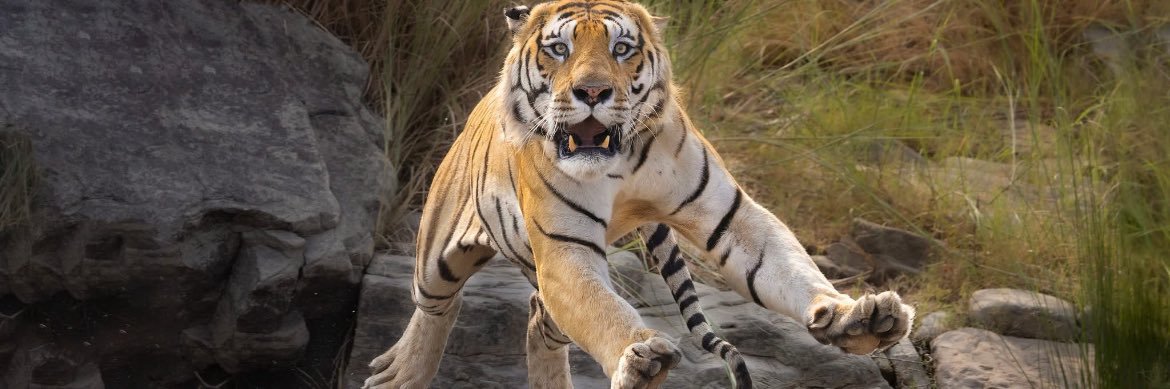
Gaurrav bhrdwj's banner
Gaurrav bhrdwj's profile picture

Gaurrav bhrdwj

@gaurravbhrdwj2,763 subscribers

“Founder @ATigerTrailsFoundation Saving Tigers & Corridors | Wildlife Stories 👉central India “Satpura is my Home” “The Resounding Voice of the Tiger Society”

Shorts

Missing for Weeks: Cheetah Nirva, Ranthambore Tiger RBT-2512 and a Second Dispersing Tiger Who Will Answer if Poachers Have Struck Again in the Kuno Landscape? My concern has now grown after the mass-level poaching of leopards in the Shivpuri–Kuno landscape. The same alarm bells are ringing for female cheetah Nirva and the two tigers RBT-2512 that came from Ranthambore and another tiger that crossed the Chambal from Karauli towards Morena. Female cheetah Nirva has been missing for the last 25 days. At the same time, the male cub of Sultana T-107, RBT-2512, has also been missing for two months. In these two months, no Kuno forest staff has had a direct sighting of this tiger, nor have any scats or pugmarks been found. Prima facie, I suspect that this organised poaching network may have treated female cheetah Nirva and both these male tigers as a source of income and killed them. If this turns out to be the case, who will take responsibility? Will the officials responsible be punished, or will they also escape? I request the Rajasthan government to speak with the Madhya Pradesh government and immediately order an investigation into this matter. In the case of cheetah Nirva as well, shortcomings of the Kuno administration have come to light. When this female cheetah’s radio collar was already giving broken signals, why was it not replaced? The senior officer here has no control over his language. He addresses people who raise genuine demands as “dimagi naxals.” And this same officer, who daily sings his own praises, gets 4–5 papers to publish his self-glorification. Please consider it necessary to reply to all these points. #leopardkilling #poachersganginkuno #cheetahnirvamissing #kunonationalpark #bigcatprotection #ranthambhoretigerreserve

Missing for Weeks: Cheetah Nirva, Ranthambore Tiger RBT-2512 and a Second Dispersing Tiger Who Will Answer if Poachers Have Struck Again in the Kuno Landscape? My concern has now grown after the mass-level poaching of leopards in the Shivpuri–Kuno landscape. The same alarm bells are ringing for female cheetah Nirva and the two tigers RBT-2512 that came from Ranthambore and another tiger that crossed the Chambal from Karauli towards Morena. Female cheetah Nirva has been missing for the last 25 days. At the same time, the male cub of Sultana T-107, RBT-2512, has also been missing for two months. In these two months, no Kuno forest staff has had a direct sighting of this tiger, nor have any scats or pugmarks been found. Prima facie, I suspect that this organised poaching network may have treated female cheetah Nirva and both these male tigers as a source of income and killed them. If this turns out to be the case, who will take responsibility? Will the officials responsible be punished, or will they also escape? I request the Rajasthan government to speak with the Madhya Pradesh government and immediately order an investigation into this matter. In the case of cheetah Nirva as well, shortcomings of the Kuno administration have come to light. When this female cheetah’s radio collar was already giving broken signals, why was it not replaced? The senior officer here has no control over his language. He addresses people who raise genuine demands as “dimagi naxals.” And this same officer, who daily sings his own praises, gets 4–5 papers to publish his self-glorification. Please consider it necessary to reply to all these points. #leopardkilling #poachersganginkuno #cheetahnirvamissing #kunonationalpark #bigcatprotection #ranthambhoretigerreserve

19,946 次观看

Two Rajasthan Tigers Reached Kuno. Both Have Now Vanished. A tiger from Rajasthan’s Ranthambore RBT-2512 used a corridor, completed a short journey, crossed the Chambal and Parvati rivers, and reached the Kuno landscape in February 2026. From there this tiger was directly sighted by tourists two or three times during safari in the Tiktoli area of Kuno National Park. The entire world knows that this Ranthambore tiger is present in Kuno. Separately, another tiger from Karauli crossed the Chambal river and reached the Kuno landscape in Morena district in April 2026. Both tigers have now vanished from this landscape. Some questions in my mind urgently need answers: 1. Is there still any evidence of these tigers’ presence? 2. Is the protection of Rajasthan’s tigers not the responsibility of Madhya Pradesh? 3. Have these tigers been poached by some hunter? 4. Has the Rajasthan Forest Department coordinated with the Kuno forest administration on this matter? Rajasthan received two tigresses relocated from Madhya Pradesh. Meanwhile, two tigers naturally moved from Rajasthan into Madhya Pradesh at the beginning of this year. When those people relocated the tigresses, they imposed a full protocol. Rajasthan has put in place tight, foolproof security arrangements for those tigresses. Madhya Pradesh Forest Department, however, does not appear to have made any such airtight protection arrangements. The Rajasthan government must demand serious answers from the Madhya Pradesh government on this issue. And strict action must be taken against all idle, surplus officers and staff from top to bottom in this landscape who are only sitting in the chain of command. #ranthambhoretigerbloodline #kunonationalpark #cheetahproject #tigerkilling #kunopoachers

Two Rajasthan Tigers Reached Kuno. Both Have Now Vanished. A tiger from Rajasthan’s Ranthambore RBT-2512 used a corridor, completed a short journey, crossed the Chambal and Parvati rivers, and reached the Kuno landscape in February 2026. From there this tiger was directly sighted by tourists two or three times during safari in the Tiktoli area of Kuno National Park. The entire world knows that this Ranthambore tiger is present in Kuno. Separately, another tiger from Karauli crossed the Chambal river and reached the Kuno landscape in Morena district in April 2026. Both tigers have now vanished from this landscape. Some questions in my mind urgently need answers: 1. Is there still any evidence of these tigers’ presence? 2. Is the protection of Rajasthan’s tigers not the responsibility of Madhya Pradesh? 3. Have these tigers been poached by some hunter? 4. Has the Rajasthan Forest Department coordinated with the Kuno forest administration on this matter? Rajasthan received two tigresses relocated from Madhya Pradesh. Meanwhile, two tigers naturally moved from Rajasthan into Madhya Pradesh at the beginning of this year. When those people relocated the tigresses, they imposed a full protocol. Rajasthan has put in place tight, foolproof security arrangements for those tigresses. Madhya Pradesh Forest Department, however, does not appear to have made any such airtight protection arrangements. The Rajasthan government must demand serious answers from the Madhya Pradesh government on this issue. And strict action must be taken against all idle, surplus officers and staff from top to bottom in this landscape who are only sitting in the chain of command. #ranthambhoretigerbloodline #kunonationalpark #cheetahproject #tigerkilling #kunopoachers

11,254 次观看

23 Years of Tiger Massacre: International Poacher Kalya Bawariya (Aadin Singh) Still Active Through Network The Madhya Pradesh Forest Department arrested an international wildlife trafficker, Kalya Bawariya, last year. He was a resident of Karauli district in Rajasthan and had been involved in this criminal activity for the past 23 years. This man, along with his gang, was responsible for wiping out the tigers of Sariska. At that time, he was working under the notorious international trafficker Sansarchand. He virtually emptied Sariska of tigers. He also carried out indiscriminate poaching of almost all tigers in the Ranthambore-2 and Karauli ranges, and a significant number of tigers in Ranthambore itself. During that period, Sariska had been reduced to zero tigers, while Ranthambore was left with just 16 tigers when it received the status of a Tiger Reserve. Later, after becoming the most wanted criminal in Rajasthan’s forest department, Kalya Bawariya fled the state and continued operating his gang through local small-time traffickers in the Gadchiroli districts of Madhya Pradesh and Maharashtra, as well as in Chhattisgarh. During interrogation, he confessed to poaching 50 tigers and over 100 leopards in recent years. These hunts involved local hunters from Chhattisgarh, Madhya Pradesh, and Maharashtra. However, many of these poachers are still operating underground and continue to harm wildlife. A large number of police and forest department personnel are also allegedly involved in this network, yet both the Forest and Police departments have so far failed to apprehend these wildlife criminals and their sleeper cells. Until concrete and strict action is taken against these individuals, it is impossible to truly revive wildlife in this region. For this, it is essential to form a joint task force comprising officials from all three states (Maharastra , Madhya Pradesh, and Chhattisgarh). There is an urgent need to appoint top officers in this area who genuinely love and care for wildlife. At the same time, it is equally important to strictly transfer incompetent, lazy, and anti-wildlife officers from these sensitive zones. This will not yield immediate results, but it will lay a strong and effective foundation for long-term wildlife protection. #tigerprotectionact #bigcatalliance #wildlifeawareness #tadobatigerreserve #chattisgarhwildlife #wildlifeindanger

23 Years of Tiger Massacre: International Poacher Kalya Bawariya (Aadin Singh) Still Active Through Network The Madhya Pradesh Forest Department arrested an international wildlife trafficker, Kalya Bawariya, last year. He was a resident of Karauli district in Rajasthan and had been involved in this criminal activity for the past 23 years. This man, along with his gang, was responsible for wiping out the tigers of Sariska. At that time, he was working under the notorious international trafficker Sansarchand. He virtually emptied Sariska of tigers. He also carried out indiscriminate poaching of almost all tigers in the Ranthambore-2 and Karauli ranges, and a significant number of tigers in Ranthambore itself. During that period, Sariska had been reduced to zero tigers, while Ranthambore was left with just 16 tigers when it received the status of a Tiger Reserve. Later, after becoming the most wanted criminal in Rajasthan’s forest department, Kalya Bawariya fled the state and continued operating his gang through local small-time traffickers in the Gadchiroli districts of Madhya Pradesh and Maharashtra, as well as in Chhattisgarh. During interrogation, he confessed to poaching 50 tigers and over 100 leopards in recent years. These hunts involved local hunters from Chhattisgarh, Madhya Pradesh, and Maharashtra. However, many of these poachers are still operating underground and continue to harm wildlife. A large number of police and forest department personnel are also allegedly involved in this network, yet both the Forest and Police departments have so far failed to apprehend these wildlife criminals and their sleeper cells. Until concrete and strict action is taken against these individuals, it is impossible to truly revive wildlife in this region. For this, it is essential to form a joint task force comprising officials from all three states (Maharastra , Madhya Pradesh, and Chhattisgarh). There is an urgent need to appoint top officers in this area who genuinely love and care for wildlife. At the same time, it is equally important to strictly transfer incompetent, lazy, and anti-wildlife officers from these sensitive zones. This will not yield immediate results, but it will lay a strong and effective foundation for long-term wildlife protection. #tigerprotectionact #bigcatalliance #wildlifeawareness #tadobatigerreserve #chattisgarhwildlife #wildlifeindanger

79,118 次观看

(CDV update) from kanha reserve. News of another male tiger has emerged from Kanha once again. Tourists and guides spotted the tiger exhibiting abnormal behavior and an unusual condition. They immediately informed the forest officials. A rescue team reached the spot and successfully rescued the tiger. Upon examination, the tiger tested positive for Canine Distemper Virus. It has been kept in complete isolation at the quarantine center in Mukki, and treatment has already begun. The tiger is unable to maintain its balance, which indicates that the disease has directly attacked its nervous system. I pray to the Lord for its speedy recovery and for it to roam freely in the jungle once again. 🙏 #caninedistempervirus #kanhatigerreserve #tigerprotection #bigcatsafety #straydogs

(CDV update) from kanha reserve. News of another male tiger has emerged from Kanha once again. Tourists and guides spotted the tiger exhibiting abnormal behavior and an unusual condition. They immediately informed the forest officials. A rescue team reached the spot and successfully rescued the tiger. Upon examination, the tiger tested positive for Canine Distemper Virus. It has been kept in complete isolation at the quarantine center in Mukki, and treatment has already begun. The tiger is unable to maintain its balance, which indicates that the disease has directly attacked its nervous system. I pray to the Lord for its speedy recovery and for it to roam freely in the jungle once again. 🙏 #caninedistempervirus #kanhatigerreserve #tigerprotection #bigcatsafety #straydogs

43,987 次观看

This video is yesterday’s footage of Mahavir Mail, which was captured in the Kisli Core area. In the video, it is clearly visible that saliva is dripping from the tiger’s mouth and it is in a very weak condition. However, locating a tiger in dense forest especially when it is injured or sick is an extremely difficult task because during such times the tiger’s movement becomes restricted to a limited area. As for its fate, the video surfaced yesterday evening, and the Forest Department confirmed the presence of Mahavir Mail. This morning, a patrolling team found it dead. That said, we cannot blame anyone here because this is nature’s rule the strong will survive and return, while the weak will merge back into nature. The post-mortem report also cited lung infection and the inability to hunt as the cause of death. But in reality, this tiger had so much strength and courage that it could have easily ruled the Kisli zone for the next 6-7 years. Unfortunately, destiny had other plans. I don’t know why, but the death of every tiger whether natural or unnatural deeply saddens me. It forces me to think: in which direction are we really doing conservation? Perhaps the original spirit and purpose of conservation has been left far behind. RIP Mahavir Mail 🪦 #tigerdeath #mpforest #kanhatigerreserve #bigcatofindia #mpwildlife

This video is yesterday’s footage of Mahavir Mail, which was captured in the Kisli Core area. In the video, it is clearly visible that saliva is dripping from the tiger’s mouth and it is in a very weak condition. However, locating a tiger in dense forest especially when it is injured or sick is an extremely difficult task because during such times the tiger’s movement becomes restricted to a limited area. As for its fate, the video surfaced yesterday evening, and the Forest Department confirmed the presence of Mahavir Mail. This morning, a patrolling team found it dead. That said, we cannot blame anyone here because this is nature’s rule the strong will survive and return, while the weak will merge back into nature. The post-mortem report also cited lung infection and the inability to hunt as the cause of death. But in reality, this tiger had so much strength and courage that it could have easily ruled the Kisli zone for the next 6-7 years. Unfortunately, destiny had other plans. I don’t know why, but the death of every tiger whether natural or unnatural deeply saddens me. It forces me to think: in which direction are we really doing conservation? Perhaps the original spirit and purpose of conservation has been left far behind. RIP Mahavir Mail 🪦 #tigerdeath #mpforest #kanhatigerreserve #bigcatofindia #mpwildlife

13,629 次观看

I have gained experience over a long period of time, and based on that, I am sharing this with all of you. Tigers that leave Bandhavgarh and move into territorial forests do not find safe habitat at all in the forests of Shahdol and Anuppur districts. Similarly, tigers coming out of Panna often reach the forests of Sagar and Katni, where they face a major threat to their safety. In the same way, in the Balaghat Territorial Forest Division (both northern and southern ranges) adjoining Kanha Tiger Reserve, there is absolutely no safe habitat for tigers. Nauradehi holds the tag of being the largest tiger reserve, yet tigers are not safe here either. Madhav Tiger Reserve has never been favorable for tigers from the beginning—past experiences in this park have not been good. The route that tigers use while coming from here towards Rajasthan is also unsafe for wild animals. Yes, the arrival of cheetahs has somewhat increased the movement of monitoring teams in this area automatically. We think that tigers have developed the habit of living with humans or amidst villages, but the reality is exactly the opposite, which we are completely ignoring. In the past 3 years alone, 140 tigers have fallen prey to poaching in Madhya Pradesh. And the surprising thing is that Madhya Pradesh is the only state where 380–400 tigers are present in the territorial (non-reserve) forests. “This number of tigers is more than double the total tiger population of Rajasthan.” Some of these tigers do move in and out of reserve forests or share boundaries with them, but most of them live entirely outside protected forests, without any security or monitoring. This is an extremely worrying issue. Today, tigers have completely distributed themselves across both the Vindhya and Satpura mountain ranges in Madhya Pradesh. Whatever new initiatives and innovations the state and central governments are bringing for their protection, in reality, they are either insufficient or are not being properly implemented on the ground. If nature has blessed the earth with such a beautiful and powerful creature, then it is the duty of every individual to protect it. Our country is fortunate that 75% of the world’s wild tiger population resides in India. I got a bit emotional, so I felt it necessary to write all this. If you like what I’ve said, please share it. #bandhavgarhnationalpark #kanhatigerreserve #madhavtigerreserve #Ranthambhorenationalpark

I have gained experience over a long period of time, and based on that, I am sharing this with all of you. Tigers that leave Bandhavgarh and move into territorial forests do not find safe habitat at all in the forests of Shahdol and Anuppur districts. Similarly, tigers coming out of Panna often reach the forests of Sagar and Katni, where they face a major threat to their safety. In the same way, in the Balaghat Territorial Forest Division (both northern and southern ranges) adjoining Kanha Tiger Reserve, there is absolutely no safe habitat for tigers. Nauradehi holds the tag of being the largest tiger reserve, yet tigers are not safe here either. Madhav Tiger Reserve has never been favorable for tigers from the beginning—past experiences in this park have not been good. The route that tigers use while coming from here towards Rajasthan is also unsafe for wild animals. Yes, the arrival of cheetahs has somewhat increased the movement of monitoring teams in this area automatically. We think that tigers have developed the habit of living with humans or amidst villages, but the reality is exactly the opposite, which we are completely ignoring. In the past 3 years alone, 140 tigers have fallen prey to poaching in Madhya Pradesh. And the surprising thing is that Madhya Pradesh is the only state where 380–400 tigers are present in the territorial (non-reserve) forests. “This number of tigers is more than double the total tiger population of Rajasthan.” Some of these tigers do move in and out of reserve forests or share boundaries with them, but most of them live entirely outside protected forests, without any security or monitoring. This is an extremely worrying issue. Today, tigers have completely distributed themselves across both the Vindhya and Satpura mountain ranges in Madhya Pradesh. Whatever new initiatives and innovations the state and central governments are bringing for their protection, in reality, they are either insufficient or are not being properly implemented on the ground. If nature has blessed the earth with such a beautiful and powerful creature, then it is the duty of every individual to protect it. Our country is fortunate that 75% of the world’s wild tiger population resides in India. I got a bit emotional, so I felt it necessary to write all this. If you like what I’ve said, please share it. #bandhavgarhnationalpark #kanhatigerreserve #madhavtigerreserve #Ranthambhorenationalpark

10,772 次观看

Videos

gaurravbhrdwj's profile picture

A surprising development has emerged in recent days. The Chief Wildlife Warden of Uttarakhand has issued orders to the concerned forest ranges to kill 13 leopards and 3 bears, and to tranquilise 21 tigers. These animals have repeatedly attacked villagers, killing and injuring several people. The root causes are clear: large-scale conversion of forest land into agricultural fields, indiscriminate exploitation of forests by local communities, and the rapid rise in tiger numbers. As a result, leopards have been pushed towards human settlements. This is by no means a sudden or unexpected process. When even tigers are beginning to face a shortage of suitable habitat in Uttarakhand, what chance do leopards have? Today, nearly 40 tigers are already confined behind bars at the Jim Corbett rescue centre due to human-wildlife conflict. These additional 21 tigers further highlight the deteriorating condition of our forests. Interestingly, most of these are young tigers that were raised by their mothers in buffer zones and areas close to villages. I cannot view this issue from only one side. These animals are precious, but so are human lives. In recent years, the pace of human encroachment into forests has been alarming. Strict action must be taken against this instead of providing political protection by treating these encroachers as a vote bank. All forest land under illegal occupation should be immediately freed and handed back to wildlife. I once again request the Hon’ble Chief Minister of Uttarakhand, Shri Pushkar Singh Dhami, and the Chief Wildlife Warden to revoke or thoroughly review this order to kill these animals. A better, more balanced plan for these animals must be developed. If you would like me to share a detailed and practical plan on this issue, please write in the comments. I would be happy to explain it in depth. #Uttarakhand #HumanWildlifeConflict #WildlifeConservation #SaveLeopards #SaveTigers

Gaurrav bhrdwj

158,447 次观看 • 1 个月前

gaurravbhrdwj's profile picture

Is Uttarakhand’s Kill Order for 13 Leopards & 3 Bears Politically Motivated? A secrecy report behind the order issued by the Chief Wildlife Warden of Uttarakhand directing the killing of 13 leopards and 3 bears, and the tranquilisation and capture of 16 tigers states that for a long time, neither the capture of tigers and leopards nor their deaths in conflict situations has led to any reduction in attacks on humans. What surprises me most about this order is this: when the secret report itself shows no decline in human-wildlife conflict, what sudden necessity has arisen to kill these animals in their own habitat? Is this decision politically motivated? Is it being carried out as a misadventure simply to please a certain vote bank and secure it for political gains? Issuing killing orders on such a mass scale is deeply disturbing for anyone who cares about wildlife. The biggest question that needs serious thought is this: How exactly will the specific aggressive animals be identified? What if a leopard that has never been involved in any such incident still ends up becoming a victim? That would be a serious matter of concern. It appears that swab samples are being stored after every human killing, and DNA matching will be done only after the animals are killed. This approach is completely wrong and unconstitutional. The Chief Wildlife Warden must revoke these orders and adopt a better, more scientific solution. Otherwise, this will amount to one-sided arbitrariness. I also appeal to the Hon’ble Chief Minister of Uttarakhand to issue clear directions for the cancellation of this order. At the same time, the concerned officers should be instructed to find better and safer alternatives while ensuring the protection of these animals. #Uttarakhand #HumanWildlifeConflict #SaveLeopards #StopKillOrders #WildlifeConservation #PushkarSinghDhami

Gaurrav bhrdwj

39,344 次观看 • 1 个月前

没有更多内容可加载