
Goshawk Trades
@GoshawkTrades • 79,550 subscribers
Algorithmic trader | 7 years live | 10+ algos live Turning every trader algorithmic. Co-founder @AskEdgarIO (agents for funds). Advisor to Long Ridge EP.
Shorts


Videos

bill ackman on why large, boring companies now drop 25% in a day, something he says almost never happened when he started: "a quarter of every american business, plus or minus, is owned by some combination of vanguard, state street and northern trust. when you shrink the float of a public company, the marginal buyer and seller is going to have more impact on the stock price." "the marginal buyer and seller today is a citadel or a millennium. they operate with a large amount of leverage, very large gross books, and they're increasingly short-term." "most investors are very short-term focused because they're compensated that way. they won't invest in a company unless they're confident the price is going to be higher on december 31st." passive owns the float, pods set the price, and both are structurally unable to hold through a bad quarter. that inability is the opportunity.
Goshawk Trades1,311,927 Aufrufe • vor 16 Tagen

ken griffin, founder of the $77 bn hedge fund firm citadel, has little patience for blaming every losing trade on hedge fund deleveraging. he says people love that explanation because it removes their own accountability. his first questions are about the prices changing, the information his team lacks, and what other investors may have worked out. only after exhausting those paths does he want to discuss who might be forced to sell. his concern with reaching for that explanation too quickly: “I actually stop learning.”
Goshawk Trades122,475 Aufrufe • vor 4 Tagen

citadel's global equities head says some of the biggest hedge-fund losses now happen without a major market selloff. “The S&P 500 didn't move very much.” justin lubell describes huge P&L swings driven by factor shocks and rotations inside the market. a portfolio can look diversified by ticker and still be one crowded bet.
Goshawk Trades173,984 Aufrufe • vor 7 Tagen

alexandr wang spent his 19th birthday as an MIT freshman on a winter internship at hudson river trading. around the table: jeff yan, who went on to start hyperliquid (~$20B) scott wu, who went on to start cognition ($48B) jesse zhang, who went on to start decagon ($4.5B) and wang, who started scale AI, got $14.3B from meta for 49% of it, and now runs meta's superintelligence lab. when HRT's founder told him they were starting to do private investments: "just invest into the interns. all the interns get seed checks." another wonderful episode from David Senra.
Goshawk Trades407,526 Aufrufe • vor 15 Tagen

flood's trading partner was asked how he'd turn $100k into $1 million. his answer: "get a job" kyle soska says a $100k portfolio is too small to devote your entire working life to compounding. at $1 million, his answer changes. keep living costs under control, take smaller opportunities and wait for the rare trade worth sizing up. people do often underestimate how capital intensive trading is.
Goshawk Trades278,056 Aufrufe • vor 11 Tagen

a 24-year-old ex-openai researcher ran a fund to $45 billion with eight people, was up 439% net through june, and by the end of july had sold his entire public stock portfolio to ken griffin in a single block trade. griffin described this exact failure mode two years ago, asked why portfolio managers wash out at citadel: "you have a portfolio that is extraordinarily highly concentrated, you have large positions, you cannot demonstrate a clear and concise competitive advantage in why you own those positions." "and there are some people that just, with full information, are unable to help themselves and get to a better portfolio construction." he was also asked the opposite question in the same interview, why citadel keeps working, his third and final answer was this: "it's experience. it's the price paid in losses and pain that converts into wisdom. my leadership team, we've been through a lot of very difficult moments of the markets together. we've learned some very bitter lessons. but it makes us much more effective as investors in periods of turmoil and crisis." citadel started in november 1990. situational awareness started in 2024, long AI infrastructure and short software at roughly 4x leverage. both legs went against it in the same three weeks. there was no bitter lesson priced into that book yet. that's what got bought. he wasn't wrong about AI. he was wrong about the construction of his book.
Goshawk Trades1,657,827 Aufrufe • vor 2 Monaten

Jane Street just showed the inside of their AI training data center in Texas. 4,032 GPUs. 56 racks. 8,000 km of fiber. liquid cooling running through every server because air cooling can't handle the heat anymore. but the part that got me was the origin story. Ron Minsky, who co-heads their technology group. said their first compute cluster was literally six Dell boxes stacked on top of each other at the end of a desk row. they called it "the hive." the trading systems sat out in the room with the traders because they wanted to be able to unplug them if something went wrong. at one point, someone vacuuming the office unplugged a live trading system in the middle of the day. from six Dell boxes and a vacuum cleaner incident to a liquid-cooled GPU data center processing trades in under 100 nanoseconds. that's a 20-year arc.
Goshawk Trades2,278,737 Aufrufe • vor 5 Monaten

jane street doesn't allocate its GPU cluster by committee. it runs a live internal auction and lets researchers bid against each other for it. no approvals. no allocation meetings. no manager deciding whose model matters more this quarter. "our compute cluster is available for everybody. you're tasked with realistically thinking about how to value this job you're running versus all the other things." "and there's not really any guard rails." it's also globally readable and writable. anyone can see what anyone else is running, and anyone can kill anyone else's job. "you can just nuke somebody else's job anytime." which produced exactly the outcome you'd expect at least once: "there was an instance where an unwitting researcher ran a command in a jupyter notebook to adjust the bids on his job. he accidentally ran the command without any arguments — which meant he changed the bids of every single job running on the hive." they fixed that one afterwards. but the visibility is the point. if your job is failing while you're away from your desk, someone else sees it and pauses it for you. "i see that you're running this job and this MFU is just terrible. what's going on?" "a lot of things can be sorted out without it going up the ranks." that cluster is the same one from their data centre film. 4,032 GPUs, 56 racks, 8,000km of fiber, allocated by internal price discovery. they built a market to decide who gets to use the market-making machine.
Goshawk Trades659,403 Aufrufe • vor 2 Monaten

stan druckenmiller on what he calls “probably the biggest mistake investors make”: investing in the present. his example is a cyclical company losing money while the industry shuts capacity. everyone can see the bad earnings. he’s asking what profits could look like 18–24 months later, once that supply has disappeared.
Goshawk Trades13,385 Aufrufe • vor 1 Tag

Lloyd Blankfein, former CEO of Goldman Sachs, broke down his entire personal trading setup: portfolio: 98% risky assets. 75-90% single stocks. mostly big tech hyperscalers plus "second tier" names slightly below blue chip. "i invest in risky assets. that's what's fun for me." "do you have a team? oh, just me." hardware: no computer. an iPad and a phone. information source: texting and calling people. "somebody will text me. i'll text them. then i'll get tired of tapping things out because of my fat fingers. so i just call people up." frequency: trades every single day. multiple times. "it's taking a lot of discipline not to look at my screen while i'm talking to you right now." "some people listen to music. to me, the market is like music. it's out there. it's going on." has he outperformed the market? "yes, i have for a while. it's because of where i focused, tech, energy, and financial services. i know a lot about financial services having been in financial services." the former CEO of Goldman Sachs. manages his own money. on an iPad. alone. focused on three sectors he actually knows. and beats the market. sometimes the edge isn't the model. it's 40 years of pattern recognition and a phone full of the right contacts.
Goshawk Trades1,071,512 Aufrufe • vor 4 Monaten
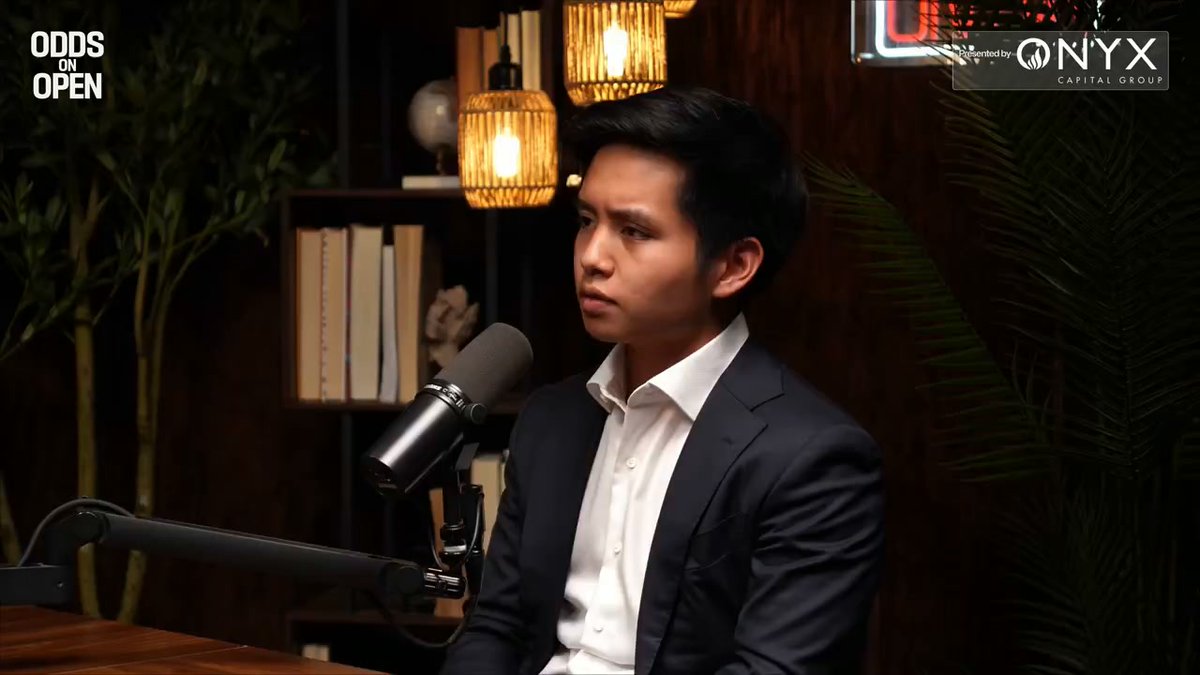
militia capital, a hedge fund reporting 48.3% annualized returns, recruited a TV game-show winner with no big-bank or major-fund background. founder david orr says the guy had a personal trading account with a sharpe ratio above 2 over several years. that was enough to give him a shot. orr says he'd consider a delivery driver too, provided the trading results were there. “It could be anybody.”
Goshawk Trades21,677 Aufrufe • vor 3 Tagen

Ken Griffin on the single factor he looks for when hiring at Citadel: "show me an athlete who did well academically." "an athlete because they know what it takes to win and they've had to experience loss." talent is everywhere. what's rare is someone who knows how to lose, recover, and still perform at a high level. same thing separates profitable traders from everyone else.
Goshawk Trades1,220,750 Aufrufe • vor 5 Monaten

did a defense contractor just sell me a Nintendo 64? palmer luckey sold oculus to facebook for $2 billion at 21. now runs anduril, a $61 billion autonomous weapons company. and this weekend I find him on youtube, 30 minutes deep, explaining an N64 clone he engineered to last for centuries. gold-plated every connector. removed every component that can physically degrade. built the first bluetooth 6.2 device on earth to get wireless latency down to 0.375ms. then open sourced the entire thing. "i wish that all hardware was designed this way, but i unfortunately only designed the hardware that i saw."
Goshawk Trades551,592 Aufrufe • vor 2 Monaten

militia capital, a hedge fund reporting 48.3% annualized returns, has an unusual habit: its portfolio managers avoid comparing how they invest. david orr says they deliberately avoided those conversations even when the team got together in new york. “we try not to get correlated” he thinks preserving their independence matters more than picking up another manager's process. if everyone starts using the same inputs and signals, another manager may add much less diversification causing worse overall returns.
Goshawk Trades12,058 Aufrufe • vor 2 Tagen

druckenmiller at 27, running $6 billion with no experience, when the shah of iran fell: "I said this is easy, let's put all our money in oil stocks and defense stocks. if I had been a little older, a little wiser, I would have diversified. it went up a lot, so everybody thought I was a genius." "I wasn't a genius. I just didn't know any better."
Goshawk Trades276,298 Aufrufe • vor 1 Monat

"every single trader out there seems to make the same mistake over and over again. their position size is probably two to ten times more than it should be." martin shkreli built a kelly criterion simulator to test exactly this. "most folks don't actually have an edge when they trade. but if they did, they're trading as if they had a 4x or 5x kelly edge." "if you run the simulator, you will go to zero each time." "even with a 60/40 edge on every trade you make, you'll go bust if you overbet." "and who has a 60/40 edge in the stock market? nobody has a 60/40 edge." even a real edge, sized wrong, still ends at zero. sizing is too commonly the part I see every trader consider second or third.
Goshawk Trades341,984 Aufrufe • vor 2 Monaten

this guy won a World Series of Poker bracelet, then became a quant at Susquehanna (a firm with over $500B in market making). here he breaks down the decision process behind every trade of theirs: incomplete information, time, and EV. this clip is worth 3 minutes of your day.
Goshawk Trades559,312 Aufrufe • vor 6 Monaten

3Blue1Brown (grant sanderson) asked a jane street researcher whether people modelling markets think about time as continuous rather than discrete. "when you're modeling real world time series, they're not always so cleanly discrete, or as regular." "i do also think when you're modeling real world physical phenomena it is actually quite nice to say time is continuous. we just sample it at some points that we care for." in language the index is the whole object. token 1, token 2, token 3. there is no duration between tokens unless you add one. market data comes with a clock attached. quotes and trades arrive when they arrive, a 1m or daily bar is a grid you laid over them afterwards, and the waiting time between two events carries information: intensity, liquidity, whether anything is happening at all.
Goshawk Trades176,670 Aufrufe • vor 1 Monat

When Russia invaded Ukraine, BP, Shell, and Vitol ran from Russian oil. A 27-year-old trader ran toward it. Three years later, Christopher Eppinger made $250 million, owns a €7M villa on the French Riviera, and a private jet. The full story of how he did it below:
Goshawk Trades520,046 Aufrufe • vor 6 Monaten

poker is one of the most important cheat codes in trading. jeff yass trains susquehanna traders with it, and MIT turned it into an actual course. 8 lectures on poker theory and how it applies to investment management and trading. completely free. the guest lecturers: - bill chen, susquehanna quant, 2 WSOP bracelets, co-wrote the mathematics of poker - aaron brown, AQR's chief risk officer at the time, wrote the poker face of wall street - matt hawrilenko, ex-susquehanna, won a $1M WSOP bracelet
Goshawk Trades41,372 Aufrufe • vor 14 Tagen