
Kyle Walker
@kyle_e_walker • 20,282 subscribers
Professor and entrepreneur working on topics in geospatial, AI, and open source software. Building AI solutions for energy: https://t.co/LK0sd3E3CZ
Shorts


Videos

1.47 billion dots mapped across India - one for every person. Visualized in a browser on a laptop with MapLibre + PMTiles, built with freestiler. I developed freestiler earlier this year to make massive interactive mapping workflows more accessible. Until recently, I hadn't been able to push it above 1 billion points. The latest batch of optimizations - coming soon to the package - make these sorts of workflows possible. In this workflow, freestiler streams in data from a parquet file, keeps memory in check by partitioning the data, and tiles in parallel with Rust. This tiling session took about 21 minutes on my MacBook with a peak memory usage under 9 GB. I'm working on making this even faster. The map here shows 1 dot for every person in India when fully zoomed in, derived from WorldPop 2026 population projections at 100m grid cells (modeled data, which is why you see uniform densities in large cities). Dots are placed randomly within those cells. I'll write up an article showing you how to do this soon.
Kyle Walker815,076 views • 1 month ago


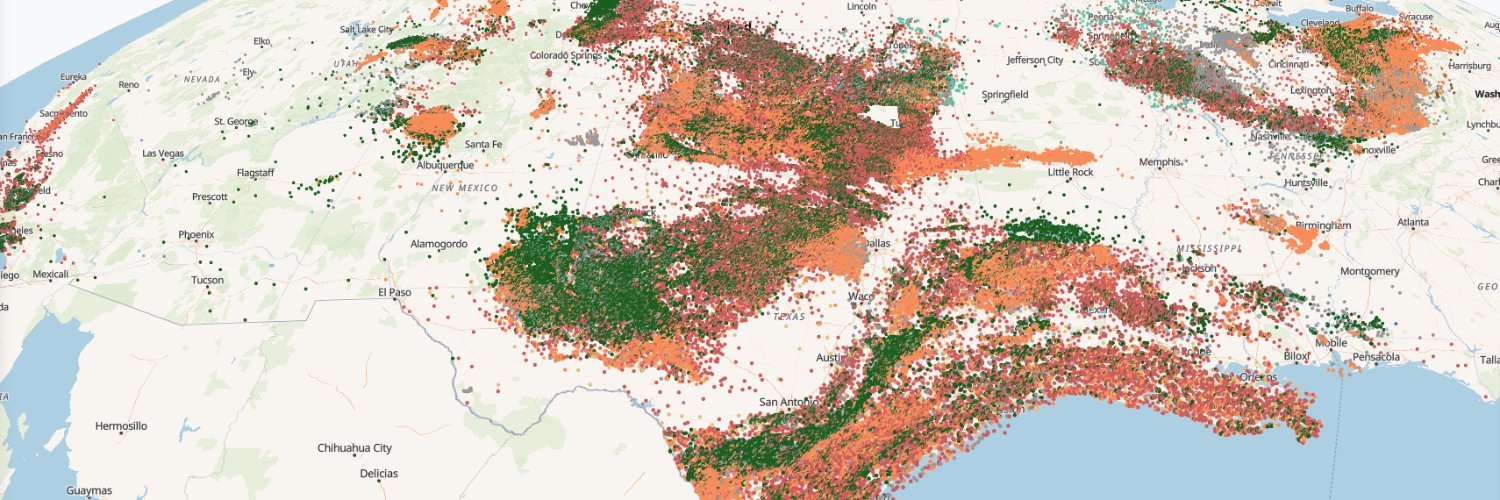
My most popular post of the year: mapping 1.7 million Texas oil & gas wells with zero performance lag. Draw a lasso, instantly query operators. There are so many opportunities for advanced GIS + AI to impact oil and gas, helping operators, mineral buyers, brokers, and more.
Kyle Walker542,801 views • 9 months ago

Nearly 800 swimming pools identified from Mapbox satellite imagery with Meta's SAM3 in a section of Beverly Hills. In the soon-to-be-released {geosam} R package: review results by confidence level, filter, then export. This is shaping into a tool for serious applied work.
Kyle Walker285,468 views • 10 months ago

I know I'm being "that guy" here but isochrone APIs have been available in other platforms for quite some time, and we have a ton of tools that help us use them. For example, Mapbox isochrones are also traffic-aware, and you can use my R packages mapboxapi and mapgl for visualization / analysis. That said, it is awesome that isochrones have landed in Google's platform. Hopefully we see more use of this instead of straight-line buffers for urban analysis!
Kyle Walker80,100 views • 3 months ago

I configured my OpenClaw bot to fetch the most recent drilling permits from the Texas Railroad Commission. It grabs the permits, parses the data, maps them over satellite imagery, and sends them over to me via Telegram. The opportunities for AI + GIS in oil and gas are massive.
Kyle Walker180,535 views • 8 months ago


Showed my Advanced GIS students Claude Code this week. We built this map of code compliance violations in Fort Worth; heatmap giving way to points on zoom. Used the ArcGIS SDK for JavaScript. Took 10 minutes. Faculty need to be teaching skills for 2026, not for 2016.
Kyle Walker177,542 views • 8 months ago


My product Wells Intelligence is four months old. It started as a viral map of Texas RRC data I posted last fall. Enough oil & gas people reached out about it that I decided to build a real product. I would never have attempted this two years ago - I don't have an engineering team or VC funding. Agentic AI has empowered me to take this on - helping with everything from engineering tasks to figuring out Stripe. That said, AI can't do the hardest parts. I've spent hours on the phone with customers learning what they want from the product. I've had to figure out strategies for pricing, marketing, and churn prevention. But it's been a lot of fun taking on challenges like this that I wouldn't have considered before. Four months in, Wells Intelligence pays for itself and then some. And I have some awesome new features rolling out that I'll be posting about soon. Give Wells Intelligence a try:
Kyle Walker54,185 views • 3 months ago


Gemini has always been my go-to LLM for document extraction - but accurate bounding boxes with agentic vision are a huge value-add in the latest Gemini models. Shown: extracting structured data from an oil & gas lease in Ector County Texas with the best bboxes I've seen yet.
Kyle Walker79,646 views • 8 months ago

All 8.1 million US Census blocks. Visualized smoothly in 3D. Instant population and housing totals from a lasso selection. All running seamlessly in the browser, no traditional backend. While everyone’s talking about AI, it’s an incredible time for geospatial tech.
Kyle Walker106,842 views • 1 year ago

