
Mason ヨンハク
@mason_8718 • 29,385 subscribers
South Korea's advanced technologies, radar, missile, sonar, naval, and air systems. Posting about weapons and contracts. [email protected] 📧
Shorts


Videos

Shortly after selecting Hanwha’s K9MH for the MTC-W program, the U.S. Army issued a Request for Information (RFI) for the MTC-T program. And Hanwha released a new video of the K9A2. It certainly seems like the K9A2 has become somewhat heavier and larger. The U.S. Army states that the objective is to acquire a tracked self-propelled howitzer for armored unit operations. Key considerations include the maturity, interoperability, and upgrade potential of the howitzer and its ammunition, as well as solid plans for U.S.-based production and the required timeline. ● While there are fewer suppliers offering tracked self-propelled howitzers compared to those that bid for MTC-W, there is a possibility that companies other than the MTC-W selectee could receive bonus points to ensure fairness. ● Like MTC-W, this program is expected to bring significant profit, future prospects, and prestige to the winning company. (There is a reason why companies invest such immense effort into selling weapons to the U.S., even at the risk of taking a financial hit.) ● The U.S. Army is still in the stage of gathering potential candidates.
Mason ヨンハク127,853 görüntüleme • 1 ay önce

🇫🇷🇰🇷 Absolutely beautiful. It is reported that the South Korean Air Force's F-35As and the French Air and Space Force's Rafales conducted joint operations in South Korea for the first time in three years. South Korea deployed F-35A, F-15K, KF-16, and FA-50 along with a KC-330 tanker, while France deployed Rafale fighters and an A-330 tanker.
Mason ヨンハク86,810 görüntüleme • 1 ay önce

🇵🇱🇰🇷 Yes, that is correct. Hanwha and LIG are actively proposing the L-SAM High Altitude Long-Range Interceptor System to Poland. It would be ideal for responding to various types of Russian ballistic missiles in a multi-layered manner. To recall these interesting points, one of the key features is that whether they are the M-SAM-I, II, or III, or the L-SAM-I, II, or LAMD-I, II, they can be integrated with foreign C2 systems to enable multi-band radar and missile uplink and downlink operations. Furthermore, if you possess the L-SAM, the High Altitude Interceptor (HAI) and Glide Phase Interceptor (GPI) of the more advanced L-SAM-II can be easily integrated into existing L-SAM-I batteries. In addition, since all these systems are being invested in on a large scale at the national level as part of the KAMD within the Three Axis System strategy, post-launch support is guaranteed. It would be the most reasonable choice among the very few high-altitude interceptor systems available on the market. This is considering factors such as the potential for future upgrades and the integrity and sovereignty of the IP, in addition to elements like the battery's price, performance, and acquisition timeline. We look forward to the Polish government's future decision.
Mason ヨンハク73,237 görüntüleme • 1 ay önce

The South Korean military news channel has unveiled the final model of the K17 submachine gun to replace the K1. Like the K1, the K17 uses 5.56mm and even has the appearance of a typical AR like the K2, but its position is that of a submachine gun. It seems that ARs these days all look similar. The developer is SNT Motive, and this company is likely known to you as the developer of interesting weapons such as the USAS-12, K5, and K11, in addition to the K2 and K1. (SNT Motive is a different company from SNT Dynamics. They deal in machine guns, transmissions, etc.) Regardless of hardware and appearance, such factors are secondary; the most important factors are the presence of large-scale requirements, the final selection by the military, as well as mass production and deployment. This is the same principle I always mention regarding the development and acquisition programs for missiles, sensors, and combat platform systems. In particular, the K17 represents a significant change as it will largely replace the K1 currently used throughout the entire military. It is true that the K2 rifle is a standard weapon, the K17 is expected to be supplied in large quantities to various branches of the military—including artillery, armored, air defense, Marine Corps, Air Force, and Navy—even excluding special forces units that will be issued the K17 as standard equipment. Consequently, the tactical combat efficiency of individual South Korean soldiers is expected to increase.
Mason ヨンハク76,124 görüntüleme • 1 ay önce


Hyundai Rotem has released cool footage of the Polish K2PL. It looks like Leopard 2A8. It will also become the standard model for export to Romania, Saudi, the UAE, Egypt, Iraq, and Peru. K2PL boasts four key features. First, Hyundai Rotem's new APS is impressive. While similar to the Israeli "Trophy," it uses "Trophy" interceptor. (Think about the iPhone, which uses components from Korea and Japan.) The main computer, high-resolution AESA radar, optical sensor, launcher, loading device, and integration are all from Hyundai Rotem and unknown Korean sensor company. Second, it features upgraded special armor. It appears the existing state-of-the-art internal armor will be replaced with the latest technology from Samyang, minimizing volume and weight to improve overall performance. The third and fourth features are the anti-drone jammer and RCWS, which have been covered numerous times, so I'll skip them. Note that this footage is based on the 2024 KADEX, and the final design is likely to differ slightly. There's another AESA radar for the APS described previously, supposed to be located on top of the turret. It's unclear whether the K2PL will be applied to later batches. ●The name of the Hyundai APS has not been decided. ●Hyundai Rotem and Hanwha Group's APS are successors to the APS-11K, developed 17 years ago. Hanwha Group's APS looks similar to the APS-11K. ●The Hanwha Group's new APS is unlikely to be applied to the K2. ●The K2, an MBT released after the 2000s, is fundamentally highly digitalized and uses new materials to reduce weight. This reiterates the point, which has been circulating on social media, that more weight doesn't necessarily mean more survivability. ●As weight increases, overall performance deteriorates, and maintenance costs skyrocket. There's a reason why the global MBT development trend is toward lightweighting. ●Protecting vital areas is crucial. ●Of course, you can use cages and thicken the armor if you wish. ●The K2's unique active tank suspension contributes to the platform's expandability and contributes to its top-notch driving performance and combat capabilities. Self-hull-down technology improves detectability and protection in desert, flat, and mountainous terrain. In any case, performance isn't a crucial factor in combat platform transactions, as it's negotiable for large companies with robust solutions. In weapon acquisition, packaged price is the most important factor, followed by localization, time, offsets, and so on. This trend is particularly evident in naval combat platforms. While platforms can be expanded at any time, combat systems(most important), ammunition, and missiles, which account for at least 20-50% of the cost, are non-negotiable. I hope that the true meaning of the next-generation K3 tank will also do well in exports.
Mason ヨンハク337,130 görüntüleme • 1 yıl önce

Rare footage of American Harpoon and Korean C-Star anti-ship cruise missiles. Definitely overkill. Made her as scrapped metal. The C-Star proved its power in both the Colombian and Philippine navies, sinking ships with just one shot. C-Star will soon have an upgrade. I wonder when they will show their coastal defense supersonic cruise missile just like this video.
Mason ヨンハク527,476 görüntüleme • 2 yıl önce

Congratulations, Egypt. 🇪🇬🇰🇷 Egypt will be the first of the 10 countries that operate K9 artillery to have anti-ship capability as a coastal defense purpose. Hanwha Aerospace said it exported 51 K11 fire direction control vehicles and 216 K9A1 SPHs to Egypt, and the K11 was modified for an anti-ship mission. It appears that the K9 has unimaginable potential as I expected. It would be great if Egypt had K239 long-range rocket artillery and K9A2 or K9A3 long-range SPH. (K9 proved its anti-ship capabilities in Egypt before the contract) South Korea, Turkey, Poland, Norway, Estonia, Finland, India, Australia, Egypt, and Romania are the current K9 family users.
Mason ヨンハク481,981 görüntüleme • 1 yıl önce


🇳🇴🇰🇷 Breaking news. The Norwegian government and a majority of parliament decided that they would purchase South Korea's K239 long-range missile system and 500km range ballistic missiles instead of the European and Israeli PULS and MARS-3. A Norwegian Conservative politician says this is one of the most powerful weapons in Norwegian history and a crucial investment in modern defense. According to the recommendations of the Norwegian Ministry of Defence, the approval of the Norwegian Cabinet, and my sources at a Norwegian defense consulting firm, the contract is worth $1.88 billion and will involve the purchase of 15 to 23 launchers. A contract is expected to be signed soon. This would make Estonia the first official buyer of the CTM-MR medium-range tactical missile, and Norway is the first official buyer of the CTM-X ballistic missile. Norway, Poland, and Estonia also operate Hanwha Aerospace's K9 self-propelled howitzer, and South Korea has been discussing this with Norway for several years. So, it was expected. ●The existence of the US HIMARS option is currently unconfirmed. ●The Norwegian K9 is named VIDAR, the son of Odin. What will the K239 be named? ●Two major defense investment projects have been confirmed for Norway. One involves purchasing two additional submarines from the previously approved submarine program, bringing the total to six, with the budget reportedly increasing from NOK 52 billion to NOK 98 billion. The other is the LLPI program, a long-range precision-guided munitions program for the army (NOK 19 billion). ●South Korea, Poland, Saudi Arabia, the UAE, and Estonia have purchased the K239, and it is being offered to Norway, Egypt, Latvia, and Lithuania. ●The K239 MRLS can operate a wide variety of general purposes, special purposes, medium range, and long-range missiles. K239 version 3.0 is now underway.
Mason ヨンハク217,504 görüntüleme • 9 ay önce

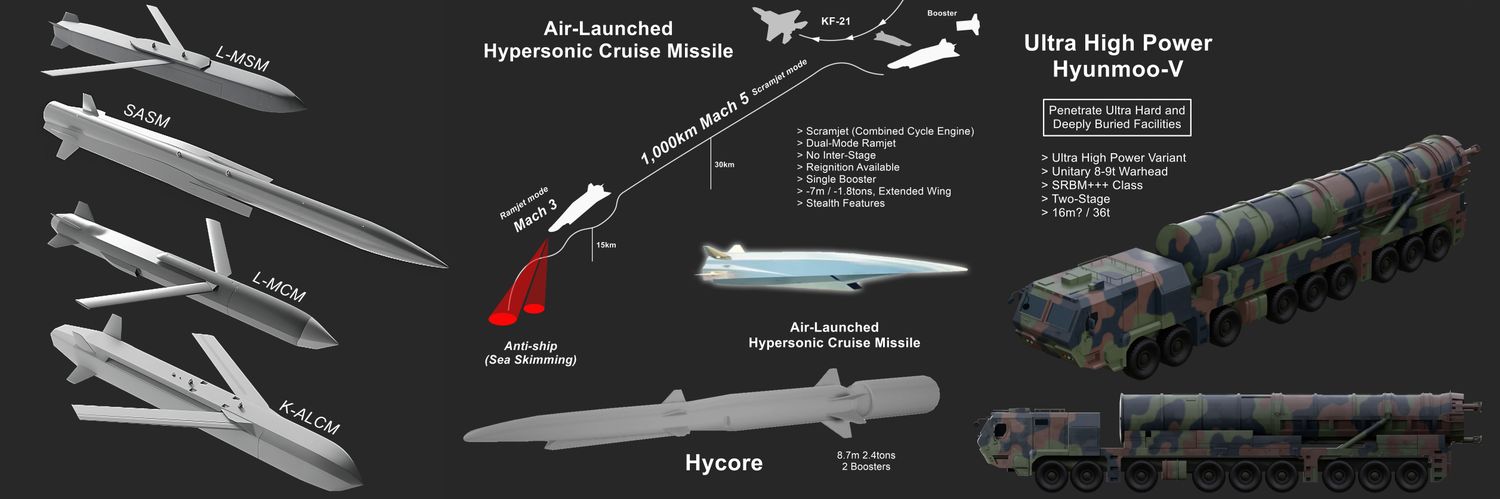
It is reported that the South Korean government's defense budget has been set at a historical high of $54 billion, and a budget has been allocated for the KSS-N nuclear submarine program for the first time. Massive investments have been confirmed for various MD systems. Such as L-SAM-I, L-SAM-II, M-SAM-III, and LAMD to accelerate the acquisition of high-altitude, long-range interceptor systems. Furthermore, huge investments have been made for the further research, production, and deployment of future air combat systems, including the KF-21 series and unmanned air systems. The budget for the Three-Axis System is also increasing annually. This system includes multi-domain space surveillance and reconnaissance, as well as the mass projection and retaliatory capabilities for long-range strategic ballistic missiles and cruise missiles. In addition to the specified programs and systems, news regarding improvements to the Army's armored forces, 6th-gen fighter jets, next-gen warships, and various next-generation Hyunmoo strategic missiles has been continuously revealed recently. The government and the military have repeatedly stated their intention to accelerate the KSS-N nuclear powered submarine program to the maximum extent; given that preparations have been underway for a long time, it appears the project will proceed faster than expected.
Mason ヨンハク49,091 görüntüleme • 1 ay önce

🇵🇱🇰🇷 Poland has released a live-fire video of the Homar-K rocket artillery's CGR-080 missile for the first time. Cooperation between Poland and Korea knows no bounds. Poland also has the CTM-290 tactical ballistic missile. We expect Poland to operate the devastating CTM-MR (formerly CTM-160) and KTSSM-II missiles. It is also said that Polish rocket artillery operators are now very mature level. K239 MRLS is the world's second most-produced modern rocket artillery after the American systems. It is currently in service in large numbers by South Korea, the UAE, Poland, and Saudi Arabia. As you can see, Hanwha provides various choices for customers by using users local systems. Homar-K consists of Polish Jelcz truck and Topaz fire control system. Will Norway, Philippine, and Malaysia buy it?
Mason ヨンハク308,081 görüntüleme • 1 yıl önce

🇭🇷🇰🇷Croatia is reportedly purchasing 18 units of Hanwha's K239 Chunmoo missile systems. The Croatian Minister of Defense emphasized the K239's strike capability with a range of 300 to 500 km among its various features. The background of this acquisition includes not only the purpose of countering Israel's Elbit PULS, recently unveiled by Serbia, but also the goal of replacing Soviet-era weapons and is significant in that it complements the contract with the United States for the acquisition of eight HIMARS systems. (It is assessed that there are difficulties in securing PrSM, ATACMS, and GMLRS-ER from the United States.) Following the acquisition of 12 French Rafale fighter jets, the Croatian Prime Minister stated that this import of the K239 is "one of the largest and most important investments for the modernization of the Croatian military" since the War of Independence in the 1990s. The missile configuration included in the contract is presumed to be similar to the package purchased by Norway, which basically consists of the CGR-080, CTM-MR, CTM-290, and CTM-X. ● The contract amount is 435.2 million euros, and 85% of the launch systems and missiles will be delivered within three years. Each system will also integrate the Polish WB Group's C2 system. ● With this, South Korea, the UAE, Saudi Arabia, Poland, Norway, and Estonia have come to use the K239. ● The K239 is also capable of operating 'more interesting and destructive' missiles, including DP-ICM warheads, underground-penetrating thermobaric warheads, ASBMs, and Loitering munitions warheads. These include the KTSSM-II Block-I, KTSSM-Block-II, CTM-ASBM, L-PGW100, and L-PGW300.
Mason ヨンハク28,106 görüntüleme • 1 ay önce


40 mm airburst rounds from K-21 IFV's K40 Autocannon footage has been released. Apparently, it seems better than the K30's 30mm AA gun. Perhaps it is better to increase the storage ratio of 40mm HE and MMFA rounds compared to 40mm APFSDS rounds for the K-21 IFV. One of the features of the K-21 IFV is that it is capable of anti-air engagement thanks to its advanced FCS and 40mm MMFA (K236) ammunition. However, the K30 has the distinct advantage of possessing its own volume search radar capability and the ability to use missiles. Modifying the K-21 IFV for air defense, like Sweden's CV90 (Lvkv 9040), is a decent idea, but since the K30 Biho SPAAG and K31 Pegasus self-propelled SAM already exist, it would be difficult to expect such a derivative product. God, I love this system.
Mason ヨンハク52,181 görüntüleme • 4 ay önce
