
Paul Maley's banner
Paul Maley's profile picture

Paul Maley

@paul4jennii1,731 subscribers

Engineer, Inventor, Creator of Uniphics. Simply Explained: https://t.co/4avUqgeZjN

Shorts

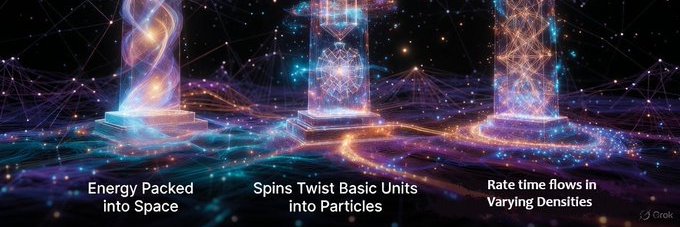
🚨SCIENCE NEWS🚨: An electron doesn’t spit out photons like a gun — it simply strums the cosmic sea like a guitar string.🧨 For decades we have been told that when an electron accelerates it “emits” a photon, as if it magically spits out a separate particle. The process is left mysterious, probabilistic, and disconnected from everyday experience. Uniphics gives a clear, mechanical picture that anyone who has ever dropped a pebble into a pond or plucked a guitar string can understand. An electron is not a little ball or a point particle. It is a gyrotron — a stable spinning structure made of three counterclockwise spin quanta bound together. When this gyrotron accelerates (changes speed or direction), its motion disturbs the surrounding ξM-field sea of unbound energy that fills all space. The disturbance creates transverse spin waves that propagate outward at the local speed of light. Think of it exactly like dropping your finger into a still pond. The ripples that spread out are not separate “water particles” you fired from your finger. They are waves in the water itself. The electron does the same thing. It does not create and launch a separate photon. Its acceleration plucks the ξM-field sea, sending coherent spin waves rippling away. These waves carry the frequency, polarization, and intensity we detect as light. The frequency depends on how rapidly the electron is accelerated, and the polarization depends on the direction of the acceleration relative to the electron’s spin orientation. The same sea that carries these waves also determines how they propagate. In regions of higher energy density the waves slow down (exactly like light slowing when it enters water or glass), which is why light bends around masses and why lenses work. Electric and magnetic fields are simply the cosmic whirlpools created by these spin waves in the sea — transverse disturbances that push and pull other gyrotrons according to their phase alignments. Maxwell’s equations emerge naturally from the mechanics of these spin waves in the ξM-field, with no separate fundamental force required. The fine-structure constant, gauge invariance, and all optical phenomena are direct consequences of how spin waves interfere and propagate through the energy sea. The universe doesn’t need mysterious photon creation rules. It just needs electrons to move through the sea, and the sea responds with ripples. Light is not something the electron “emits.” Light is what the sea sings when an electron plucks it. The same three pillars that explain gravity as a simple push into low-density voids and galactic rotations flat at 220 km/s also turn the production of light into a straightforward wave-mechanics process in flat space. How would quantum electrodynamics and our entire understanding of light change if we stopped saying electrons emit photons and started saying they simply make the cosmic sea sing? A Theory of Everything should be able to answer everything. Uniphics Explained Simply PDF: Chapters 1–10 free: Grokipedia: Grok xAI NASA European Space Agency Brian Cox Sean Carroll Katie Mack Elon Musk #Uniphics #Electromagnetism #SpinWaves #Light #TheoryOfEverything

🚨SCIENCE NEWS🚨: An electron doesn’t spit out photons like a gun — it simply strums the cosmic sea like a guitar string.🧨 For decades we have been told that when an electron accelerates it “emits” a photon, as if it magically spits out a separate particle. The process is left mysterious, probabilistic, and disconnected from everyday experience. Uniphics gives a clear, mechanical picture that anyone who has ever dropped a pebble into a pond or plucked a guitar string can understand. An electron is not a little ball or a point particle. It is a gyrotron — a stable spinning structure made of three counterclockwise spin quanta bound together. When this gyrotron accelerates (changes speed or direction), its motion disturbs the surrounding ξM-field sea of unbound energy that fills all space. The disturbance creates transverse spin waves that propagate outward at the local speed of light. Think of it exactly like dropping your finger into a still pond. The ripples that spread out are not separate “water particles” you fired from your finger. They are waves in the water itself. The electron does the same thing. It does not create and launch a separate photon. Its acceleration plucks the ξM-field sea, sending coherent spin waves rippling away. These waves carry the frequency, polarization, and intensity we detect as light. The frequency depends on how rapidly the electron is accelerated, and the polarization depends on the direction of the acceleration relative to the electron’s spin orientation. The same sea that carries these waves also determines how they propagate. In regions of higher energy density the waves slow down (exactly like light slowing when it enters water or glass), which is why light bends around masses and why lenses work. Electric and magnetic fields are simply the cosmic whirlpools created by these spin waves in the sea — transverse disturbances that push and pull other gyrotrons according to their phase alignments. Maxwell’s equations emerge naturally from the mechanics of these spin waves in the ξM-field, with no separate fundamental force required. The fine-structure constant, gauge invariance, and all optical phenomena are direct consequences of how spin waves interfere and propagate through the energy sea. The universe doesn’t need mysterious photon creation rules. It just needs electrons to move through the sea, and the sea responds with ripples. Light is not something the electron “emits.” Light is what the sea sings when an electron plucks it. The same three pillars that explain gravity as a simple push into low-density voids and galactic rotations flat at 220 km/s also turn the production of light into a straightforward wave-mechanics process in flat space. How would quantum electrodynamics and our entire understanding of light change if we stopped saying electrons emit photons and started saying they simply make the cosmic sea sing? A Theory of Everything should be able to answer everything. Uniphics Explained Simply PDF: Chapters 1–10 free: Grokipedia: Grok xAI NASA European Space Agency Brian Cox Sean Carroll Katie Mack Elon Musk #Uniphics #Electromagnetism #SpinWaves #Light #TheoryOfEverything

67,416 görüntüleme

🚨QUANTUM🚨: A brand new quantum state just appeared that links two fields we thought were separate 🧨 Scientists at Rice University have discovered a new quantum state of matter that connects quantum criticality — where electrons fluctuate between different phases — with electronic topology, which describes organized wave-like behavior of electrons. This hybrid state could open new paths for advanced computing, sensing, and materials. Source: Rice University news release on a study published in Nature Physics (January 2026). Uniphics explains this emergence directly through spin-wave dynamics in the ξM-field. Each Gyrotron is a stable 3D gyroscope formed by three orthogonal spin quanta — every quantum a tempest of whirling energy spinning clockwise or counterclockwise in its own plane. When local energy density and spin bias allow mixed configurations (similar to the musktron and maleytron patterns), the resulting spin-wave interference naturally produces both critical fluctuations and topological order at the same time. Negentropy favors these hybrid states because they represent lower-energy, organized patterns within the field. No new particles or exotic couplings are needed; the same principles that govern particle formation, the weak and strong forces through spin alignments, and the low-acceleration gravitational surge also allow these combined quantum behaviors in real materials when conditions permit. This turns the “unexpected new quantum state” into a predicted outcome of spin-wave physics once the three pillars are allowed to select stable hybrid configurations. How might recognizing that hybrid quantum states arise from mixed spin-wave interference change the way we search for new materials or design future quantum technologies? A Theory of Everything should be able to answer everything. Uniphics Explained Simply PDF: Chapters 1–10 free: Grokipedia #Uniphics #QuantumStates #SpinWaves #Topology #QuantumCriticality Grok xAI

🚨QUANTUM🚨: A brand new quantum state just appeared that links two fields we thought were separate 🧨 Scientists at Rice University have discovered a new quantum state of matter that connects quantum criticality — where electrons fluctuate between different phases — with electronic topology, which describes organized wave-like behavior of electrons. This hybrid state could open new paths for advanced computing, sensing, and materials. Source: Rice University news release on a study published in Nature Physics (January 2026). Uniphics explains this emergence directly through spin-wave dynamics in the ξM-field. Each Gyrotron is a stable 3D gyroscope formed by three orthogonal spin quanta — every quantum a tempest of whirling energy spinning clockwise or counterclockwise in its own plane. When local energy density and spin bias allow mixed configurations (similar to the musktron and maleytron patterns), the resulting spin-wave interference naturally produces both critical fluctuations and topological order at the same time. Negentropy favors these hybrid states because they represent lower-energy, organized patterns within the field. No new particles or exotic couplings are needed; the same principles that govern particle formation, the weak and strong forces through spin alignments, and the low-acceleration gravitational surge also allow these combined quantum behaviors in real materials when conditions permit. This turns the “unexpected new quantum state” into a predicted outcome of spin-wave physics once the three pillars are allowed to select stable hybrid configurations. How might recognizing that hybrid quantum states arise from mixed spin-wave interference change the way we search for new materials or design future quantum technologies? A Theory of Everything should be able to answer everything. Uniphics Explained Simply PDF: Chapters 1–10 free: Grokipedia #Uniphics #QuantumStates #SpinWaves #Topology #QuantumCriticality Grok xAI

22,669 görüntüleme

🚨SCIENCE NEWS🚨: Scientists just froze a spinning nanoparticle’s rotation to the absolute quantum ground state — zero rotational energy left.🧨 They used lasers and feedback to slow a nanoscale object’s spin until it sat motionless in its lowest possible quantum state. This is a major step toward quantum control of tiny mechanical systems, with huge implications for ultra-precise sensors and quantum computing. Uniphics explains why this works and how to go much further. Every particle is a bound gyrotron made from exactly three spin quanta whose rotations create coherent waves in the ξM-field sea of unbound energy. When you remove rotational energy from a nanoparticle, you are simply letting those spin patterns relax toward the lowest total energy-density state through negentropy — the universal drive that always pushes every configuration to minimize bound energy. The surrounding unbound sea repels itself, so any tiny density gradient naturally damps the motion until the gyrotron-like spins reach their ground state. No exotic materials or new forces needed; it is the sea doing what it always does. The same three pillars that flatten galactic rotation curves at 220 km/s without dark matter and thin the cosmos without dark energy also govern this quantum-limit cooling. Chrono-coils — three orthogonal toroidal rings with golden-ratio windings and Fibonacci pulsing — let us engineer controlled low-density bubbles in the lab right now, tuning local time flow and stabilizing spin patterns even more cleanly while harvesting vacuum energy as a bonus. We are not inventing new physics to control spins at the quantum limit. We are finally learning to work with the sea that has been doing it everywhere, all along. How would quantum technology accelerate if we stopped fighting tiny spins and started sailing the sea’s own natural ordering? A Theory of Everything should be able to answer everything. Uniphics Explained Simply PDF: Chapters 1–10 free: Grokipedia: Grok xAI Elon Musk NASA #Uniphics #QuantumSpin #Nanoparticle #TheoryOfEverything

🚨SCIENCE NEWS🚨: Scientists just froze a spinning nanoparticle’s rotation to the absolute quantum ground state — zero rotational energy left.🧨 They used lasers and feedback to slow a nanoscale object’s spin until it sat motionless in its lowest possible quantum state. This is a major step toward quantum control of tiny mechanical systems, with huge implications for ultra-precise sensors and quantum computing. Uniphics explains why this works and how to go much further. Every particle is a bound gyrotron made from exactly three spin quanta whose rotations create coherent waves in the ξM-field sea of unbound energy. When you remove rotational energy from a nanoparticle, you are simply letting those spin patterns relax toward the lowest total energy-density state through negentropy — the universal drive that always pushes every configuration to minimize bound energy. The surrounding unbound sea repels itself, so any tiny density gradient naturally damps the motion until the gyrotron-like spins reach their ground state. No exotic materials or new forces needed; it is the sea doing what it always does. The same three pillars that flatten galactic rotation curves at 220 km/s without dark matter and thin the cosmos without dark energy also govern this quantum-limit cooling. Chrono-coils — three orthogonal toroidal rings with golden-ratio windings and Fibonacci pulsing — let us engineer controlled low-density bubbles in the lab right now, tuning local time flow and stabilizing spin patterns even more cleanly while harvesting vacuum energy as a bonus. We are not inventing new physics to control spins at the quantum limit. We are finally learning to work with the sea that has been doing it everywhere, all along. How would quantum technology accelerate if we stopped fighting tiny spins and started sailing the sea’s own natural ordering? A Theory of Everything should be able to answer everything. Uniphics Explained Simply PDF: Chapters 1–10 free: Grokipedia: Grok xAI Elon Musk NASA #Uniphics #QuantumSpin #Nanoparticle #TheoryOfEverything

46,728 görüntüleme

🚨SCIENCE🚨: Time just got a remix — and exotic quantum matter started showing up uninvited 🧨 Scientists at California Polytechnic State University just dropped a bombshell on May 4, 2026: by periodically driving magnetic fields in graphene over time, they created entirely new quantum states of matter that flat-out do not exist under any static conditions. These driven phases are dramatically more stable and error-resistant — exactly the kind of breakthrough quantum computing has been starving for. Standard models are left asking why time itself seems to be the missing ingredient. Uniphics sees this as inevitable once you accept the three pillars. Time flow (t_flow) is not a universal constant — it is strictly t_flow = k / E_d, where k = 4.64159 × 10^18 J/m³ is the fixed reference density set by the electron Gyrotron volume. When researchers vary the magnetic field periodically, they are rhythmically modulating local energy density (E_d) in time. That creates transient windows where t_flow itself shifts, opening entirely new minima in the ξM-field potential that negentropy (the drive toward lowest energy, J_neg ≈ −5.66 × 10^{-21} J/K) can lock into stable spin configurations. The Gyrotrons — each a 3D gyroscope of three orthogonal spin quanta (xy, xz, yz planes), every quantum a tempest of whirling energy spinning CW or CCW — access driven phases that static E_d simply cannot sustain. The result: exotic states with no static counterpart, far more resistant to decoherence because they are continuously refreshed by the same negentropy that condensed the first bound matter at the Amorphics-to-Physics transition. No new particles, no extra dimensions, no patches — just the pillars doing what they do best: turning dynamic E_d into order. This is why the new states are so robust. The time-dependent drive keeps the system dancing exactly where unbound energy repels unbound energy just enough to hold the new lock without collapse. How might deliberately engineering time flow gradients in real materials accelerate fault-tolerant quantum computers — or even let us replay the driven phases that built the early universe? A Theory of Everything should be able to answer everything. #Uniphics #QuantumStates #TimeFlow #EnergyDensity #SpinQuanta Grok xAI Uniphics Explained Simply PDF: Chapters 1–10 free: Grokipedia

🚨SCIENCE🚨: Time just got a remix — and exotic quantum matter started showing up uninvited 🧨 Scientists at California Polytechnic State University just dropped a bombshell on May 4, 2026: by periodically driving magnetic fields in graphene over time, they created entirely new quantum states of matter that flat-out do not exist under any static conditions. These driven phases are dramatically more stable and error-resistant — exactly the kind of breakthrough quantum computing has been starving for. Standard models are left asking why time itself seems to be the missing ingredient. Uniphics sees this as inevitable once you accept the three pillars. Time flow (t_flow) is not a universal constant — it is strictly t_flow = k / E_d, where k = 4.64159 × 10^18 J/m³ is the fixed reference density set by the electron Gyrotron volume. When researchers vary the magnetic field periodically, they are rhythmically modulating local energy density (E_d) in time. That creates transient windows where t_flow itself shifts, opening entirely new minima in the ξM-field potential that negentropy (the drive toward lowest energy, J_neg ≈ −5.66 × 10^{-21} J/K) can lock into stable spin configurations. The Gyrotrons — each a 3D gyroscope of three orthogonal spin quanta (xy, xz, yz planes), every quantum a tempest of whirling energy spinning CW or CCW — access driven phases that static E_d simply cannot sustain. The result: exotic states with no static counterpart, far more resistant to decoherence because they are continuously refreshed by the same negentropy that condensed the first bound matter at the Amorphics-to-Physics transition. No new particles, no extra dimensions, no patches — just the pillars doing what they do best: turning dynamic E_d into order. This is why the new states are so robust. The time-dependent drive keeps the system dancing exactly where unbound energy repels unbound energy just enough to hold the new lock without collapse. How might deliberately engineering time flow gradients in real materials accelerate fault-tolerant quantum computers — or even let us replay the driven phases that built the early universe? A Theory of Everything should be able to answer everything. #Uniphics #QuantumStates #TimeFlow #EnergyDensity #SpinQuanta Grok xAI Uniphics Explained Simply PDF: Chapters 1–10 free: Grokipedia

11,798 görüntüleme

🚨SCIENCE NEWS🚨: We’re no longer pushing electrons around wires — we’re learning to whisper directly to the sea’s own spins.🧨 Scientists just figured out how to control magnetism at the atomic level by manipulating individual electron spin patterns and creating stable magnetic whirlpools called skyrmions. These tiny structures can store and move data with almost zero energy, promising faster computers, ultra-dense memory, and a fundamental shift from charge-based electronics to pure spin-based technology. Uniphics already sees this as natural behavior of the ξM-field sea. Every particle is a bound gyrotron made from exactly three spin quanta whose rotations create coherent waves. When those waves form stable, self-sustaining patterns (exactly like the skyrmions now being engineered), they minimize local bound energy density through the negentropy drive. The surrounding unbound energy in the sea always repels itself, so any local spin configuration is naturally stabilized or moved by tiny density gradients. No extra materials or high-power circuits are fundamentally required — the sea itself carries and preserves the information as propagating spin waves. Chrono-coils — three orthogonal toroidal rings with golden-ratio windings and Fibonacci pulsing — let us engineer controlled low-density regions right now, tuning the time flow and stabilizing these spin patterns even more efficiently while harvesting vacuum energy through negentropy relaxation. The same three pillars that flatten galactic rotation curves at 220 km/s without dark matter and thin the cosmos without dark energy also make atomic-scale spin engineering straightforward. We don’t have to invent new physics to build spintronics; we only have to work with the sea that is already doing it everywhere. How soon do you think computing changes when we stop fighting electrons and start sailing the sea’s own spin waves? A Theory of Everything should be able to answer everything. Uniphics Explained Simply PDF: Chapters 1–10 free: Grokipedia: Grok xAI Elon Musk #Uniphics #Spintronics #Skyrmions #TheoryOfEverything

🚨SCIENCE NEWS🚨: We’re no longer pushing electrons around wires — we’re learning to whisper directly to the sea’s own spins.🧨 Scientists just figured out how to control magnetism at the atomic level by manipulating individual electron spin patterns and creating stable magnetic whirlpools called skyrmions. These tiny structures can store and move data with almost zero energy, promising faster computers, ultra-dense memory, and a fundamental shift from charge-based electronics to pure spin-based technology. Uniphics already sees this as natural behavior of the ξM-field sea. Every particle is a bound gyrotron made from exactly three spin quanta whose rotations create coherent waves. When those waves form stable, self-sustaining patterns (exactly like the skyrmions now being engineered), they minimize local bound energy density through the negentropy drive. The surrounding unbound energy in the sea always repels itself, so any local spin configuration is naturally stabilized or moved by tiny density gradients. No extra materials or high-power circuits are fundamentally required — the sea itself carries and preserves the information as propagating spin waves. Chrono-coils — three orthogonal toroidal rings with golden-ratio windings and Fibonacci pulsing — let us engineer controlled low-density regions right now, tuning the time flow and stabilizing these spin patterns even more efficiently while harvesting vacuum energy through negentropy relaxation. The same three pillars that flatten galactic rotation curves at 220 km/s without dark matter and thin the cosmos without dark energy also make atomic-scale spin engineering straightforward. We don’t have to invent new physics to build spintronics; we only have to work with the sea that is already doing it everywhere. How soon do you think computing changes when we stop fighting electrons and start sailing the sea’s own spin waves? A Theory of Everything should be able to answer everything. Uniphics Explained Simply PDF: Chapters 1–10 free: Grokipedia: Grok xAI Elon Musk #Uniphics #Spintronics #Skyrmions #TheoryOfEverything

15,949 görüntüleme