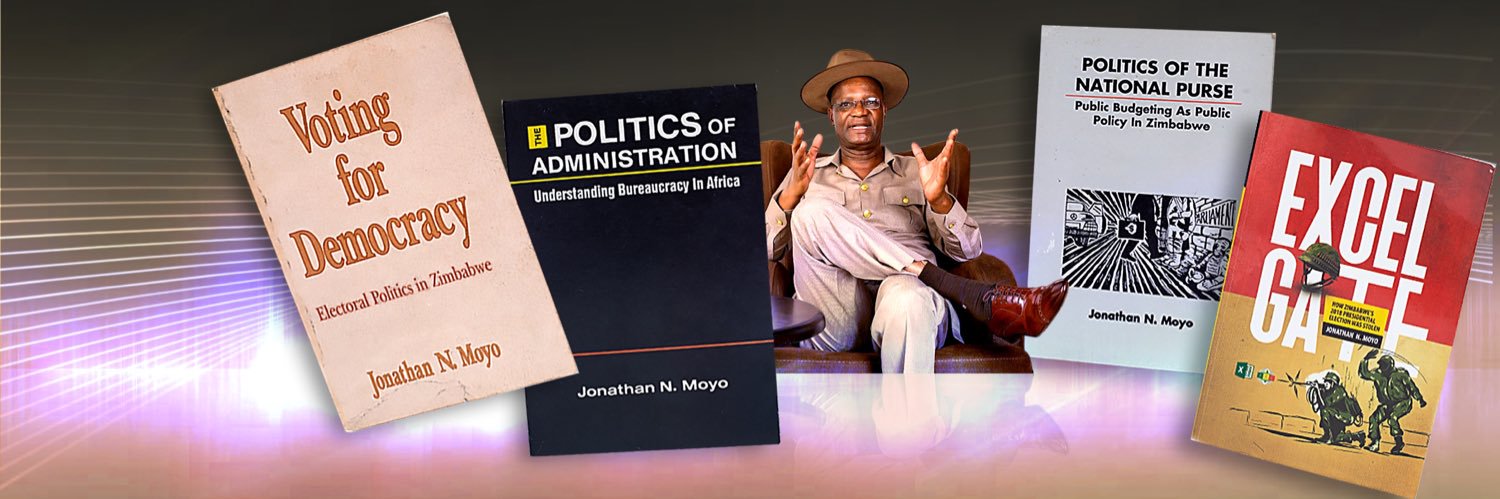
Prof Jonathan Moyo
@ProfJNMoyo • 1,021,848 subscribers
#Zimbabwe's former Minister of Higher & Tertiary Education, Science & Technology Development. "The unexamined life is not worth living" ~ Socrates
Shorts


![MATTER OF FACT: CHAMISA KNOWS SENGEZO TSHABANGU AND WORKED WITH HIM TOWARDS THE LAUNCH OF CCC 1. VIDEO: Bongiwe Zwane [SABC] "Are you saying you do not know this person called Sengezo Tshabangu"? NELSON CHAMISA: "No we do not know that person. That person is not in our structures. We don't even have that person as an office holder". Not true at all. . .see, for example, attached photo. 2. PHOTO: [from left to right: Abednico Bhebhe, Nelson Chamisa, Sengezo Tshabangu [Interim CCC SG], and Mbuso Fuzwayo; following a high-level strategy meeting - ahead of the formation of CCC in January 2022 - held at Matilinda Lodge in Bulawayo on 15 December 2021. Not appearing in the picture are other CCC founding members - then in the MDC-A - who were at the Matilinda Lodge strategic meeting organised by Tshabangu and his colleagues, only five weeks before the formation of CCC on 24 January 2022! Unfortunately, as captured on the attached video clip, yesterday Chamisa deliberately misled not only SABC News but also the public when he falsely claimed to Bongiwe Zwane that he Chamisa and others in CCC do not know Sengezo Tshabangu, and that Tshabangu is not in CCC structures!](https://image.24vids.com/tw-1712499434682978432/ext_tw_video_thumb/1712499411429797888/pu/img/wGWBh0rFy-yFoy7p.jpg)
![#ZimElection2023 CHAMISA RAN HIS CAMPAIGN LIKE AN INDEPENDENT CANDIDATE WITH NO STRUCTURES AND EXPECTED TO WIN AND BECOME PRESIDENT WITH NO MAJORITY IN PARLIAMENT This is what Nelson Chamisa said on 21 June 2023 about the strategic thrust of the campaign of his CCC in the 2023 harmonised general election held last week: "our [CCC] campaign is going to be basically a presidential... our [CCC] focus is not to be in parliament but to be in government. We [as MDC opposition] have been in parliament for a long time, that's not our [CCC] station of choice at the moment". The fact that Chamisa thought he could win the presidential election even if, or regardless of whether, his CCC won a majority in Parliament, explains his crushing defeat. An election in Zimbabwe is defined in terms of section 4 of the Electoral Act which provides that: election” means— (a) the election of a member of Parliament; or (b) an election to the office of President; or (c) an election for the purposes of the Rural District Councils Act [Chapter 29:13] or the Urban Councils Act [Chapter 29:15]; as the case may be. These three elections used to be held separately before they were harmonised for the first time in the 2008 election in terms of section 38 of the Act. It is odd and even irrational, and it defies the logic of the harmonised general election for any political party that seeks power to govern the country as a whole to only target – as did Chamisa in the 2023 harmonised general election held last week –winning only one of the three elections, just the presidential election. It is foolhardy for a political party to say its strategy and focus is only to win the presidential election, without basing that strategy and focus on winning the local authority and parliamentary elections, as well. Such a strategy, if it can be called a strategy, renders the presidential candidate no different from an independent presidential candidate who contests for the presidency without the advantage of the structures of a political party. Simply put, a presidential candidate in Zimbabwe cannot win a presidential election if the candidate does not have a campaign strategy that is based on his or her political party winning a majority of wards in the local authority election, and a majority of constituencies in the parliamentary election. If it’s an independent presidential candidate, then he or she must have ground structures of one sort or another, or forget it. Chamisa contested the presidential election as if he was an independent candidate, and he boasted about it, without relying on his CCC and without any ground structures. In the circumstances, just how or why did Chamisa expect to win the presidential election by effectively running as an independent candidate? Which structures did Chamisa expect to use, or did he in fact use to campaign for the presidency in every street and every village, across the length and breadth of the country? Since by his own admission, as quoted above and reflected on the attached video clip, Chamisa was clearly not relying on his CCC to win the presidency. This begs the question: by not relying on CCC structures, and by not having alternative ground structures in the streets and in villages, did Chamisa think that ZanuPF members and supports would vote for him, as an act of God, perhaps? Was Chamisa's presidential election campaign, for him an article of faith, in other words was it about his belief that God had chosen him, and that he would win regardless of whether or not CCC won a majority in the local authority and parliamentary elections? Where did Chamisa and his supporters in Zimbabwe and among the legions of his fans in America and Europe think he would get the necessary number of polling agents to monitor the voting and vote counting at the country’s 12,374 polling stations, and to secure the 12,374 V11s from those polling stations, given the fact that he actually ran for the presidency as an independent candidate, expecting to be supported less by his own CCC party and more by the members and supporters of ZanuPF? Does this kind of strategy make sense to anyone on earth? And, does that strategy make sense to Nerves Mumba and his Sadc Election Observation Mission or to any other foreign election observation mission that was in Zimbabwe last week like, say for example, the European Union Observer Mission or any of the several observer missions from the United States that were in Zimbabwe to observe the elections? How did the various foreign election observer missions and Chamisa’s social media supporters expect him to win the presidential election, not only where and when his CCC party was losing the local authority and parliamentary elections but, and critically, where Chamisa himself did not believe that the local authority and parliamentary elections were important or necessary for him to win the presidency? The fact that the loquacious, belligerent and inflammatory foreign election observer missions that are peddling falsehoods about the elections, and Chamisa’s social media supporters who claim with no evidence that Chamisa won, did not raise a finger against the results of the local and parliamentary elections that were declared at 1970 wards and 209 constituencies well ahead of the declaration of the result for the presidential election on 26 August, clearly means that there was no problem with two of the three elections that make up Zimbabwe’s harmonised general election. Only after the declaration of the presidential election result on 26 August did all hell break loose. It must be asked, again, how did anyone expect Chamisa to win a presidential election whose campaign was – as per Chamisa’s deliberate strategy – organised and pursued as if it was the presidential campaign of an independent candidate? Chamisa’s presidential election campaign was not based on the CCC parliamentary election campaign or on CCC’s structural capacity on the ground, strangely, it was based on the expectation that ZanuPF members and supporters would vote for Chamisa. Why on earth did anyone expect ZanuPF members and supporters to vote for someone whose base is ever singing cacophonic noise that ZanuPF must go, and hurling insults at the incumbent party, its officials and its supporters? What kind of politics is that? You are contemptuous of ZanuPF and anyone associated with it, but you expect ZanuPF members and supporters to vote for you. This expectation does not compute, certainly not in electoral politics. As things turned out, ZanuPF members and supporters who are registered voters voted for their party candidates in all the three elections: local authority election, the parliamentary election and the presidential election. As a result, in the parliamentary election, CCC won just 73 constituency seats. There's just no way that CCC's 73 constituency seats in the National Assembly would have boosted Chamisa to win the presidency. No ways. In Zimbabwe's first harmonised general election in 2008, Morgan Tsvangirai did well in the first round of the presidential election primarily if not only because the two MDC formations used their round structures to win a majority in Parliament with a combined strength of 110 constituency seats, while ZanuPF garnered 99 seats and an independent got one seat. This was the first time since independence in 1980 that the opposition commanded the majority in Parliament. So, clearly, in 2008 Tsvangirai was propelled by the solid parliamentary performance of the MDC formations. The same structural dynamic was conspicuously absent for Chamisa in the just ended harmonised general election. Chamisa ran a solo presidential election campaign and, predictably, it went horribly wrong. The fact that CCC did not field local authority candidates in 90 wards made a bad situation worse for Chamisa, and it was further compounded by the fact that CCC did not have ground structures to harness and harvest from the loose and unreliable protest vote, especially in the wards and constituencies outside CCC strongholds, which in fact used to be MDC strongholds in the days of Morgan Tsvangirai!](https://image.24vids.com/tw-1697163816763531695/ext_tw_video_thumb/1697163307134648320/pu/img/dwgTT9sqNbiaZlwb.jpg)


Videos

MEDIA REPORTS: Nelson Chamisa has announced his return to active politics, saying this time he's launching a movement and not a political party; after he suddenly without notice jumped ship on this day 24 January in 2024, and ran away from the CCC party he had formed and led, claiming it had been inflitrated by ZanuPF. PUBLIC EYE: Social movements are not formed or launched by an individual, they are people driven and they emerge organically and spontaneously to address a specific, self-evident and broadly shared public grievance. Otherwise, a party that is launched by an individual and which masquerades as a movement is the easiest thing to inflitrate and overrun. Will Chamisa run away, again, if that happens as it sure would? That's the 64 million dollar question. Time will tell, but once bitten twice shy. Voter beware!
Prof Jonathan Moyo332,478 görüntüleme • 8 ay önce


#SundayFunFact It’s funny how even well-worn political tongues among Zim’s educated elite, especially in politics, often trip on the pronunciation of an otherwise straightforward word: “nurture”, which some also confuse with a different word: “nature”. Comrades, Nurture is pronounced, NUR-chuh (the ur is like in nurse or bird, then a soft ch); while Nature is NAY-chuh (long A, like day — Mother Nature herself). In British and Zimbabwean English, the final “r” is silent, so you hear -chuh. In American English it is sounded: NAY-chur / NUR-chur. Either ending is fine. It is incorrect to use the “NAY” of nature when one means the “NUR” of nurture. Nature is what you’re born with, while nurture is how you raise it. Don’t take this as serious as a heart attack but also don’t let the spelling fool your mouth, it’s best to take a leaf from Cambridge, not from the nearest microphone or podium. Happy and Blessed Sunday! Link: Nurture: Link: Nurture audio (UK & US): Link: Nature, for the contrast:
Prof Jonathan Moyo29,016 görüntüleme • 28 gün önce


#WinkyD2024 This does pass for entertainment, not top-drawer stuff but mundane political entertainment with no political value or mileage in the scheme of things; and to be sure, it’s not music even by the poorest of standards; but truth be told, uku kurisker mahara!
Prof Jonathan Moyo475,026 görüntüleme • 2 yıl önce

#Politics101 As far as branding goes, "Mayibuye" is an innovative and powerful political brand with a huge galvanising and unifying potential at the level of grounded grassroots politics. It is at once African, historical, contemporary, and futuristic. Kudos to Floyd Shivambu!
Prof Jonathan Moyo226,878 görüntüleme • 1 yıl önce

Professor Lovemore Madhuku in his Own Words Making the Case for Parliament to Indirectly Elect the President as an Electoral College: “We must not put in the Constitution of the country a provision that is dependant on what happens in a political party. That’s the point I’m making. We must never say in our Constitution of Zimbabwe that if a sitting President dies or resigns, we will wait to hear what the political party of that President is saying. No. That is not the best way of running a country. Political parties remain the preserve of those people who are in those political parties. But the country is run on the basis of either an election by the people—direct election—or you have Parliament as an institution sitting as an electoral college. Where parties have influence, they must do the influence within Parliament, but never to allow the political party to sit there to say I’m giving you this President, and so forth. That’s the point I’m making. And on that point, I’m making it right across the world; that’s what they do.” - Professor Madhuku, addressing a “Heal Zimbabwe Trust” public meeting in Harare on 22 February 2020. COMMENT: Professor Lovemore Madhuku’s 2020 remarks make a clear, powerful and enduring case for Clause 3 of the Constitution of Zimbabwe (Amendment No. 3) H.B.I. Bill, 2026. This clause replaces the direct election of the President with an indirect election by Parliament sitting jointly as an electoral college; both after every general election and, when necessary, to fill any vacancy in the office of President. The current direct election of the President was first introduced in anticipation of a legislated one-party-one-man rule through Constitution Amendment No. 7, Act 1987 in the old Lancaster Constitution repealed in 2013. Professor Madhuku put it plainly: The Constitution should not—as it currently does— depend on the internal decisions of a political party to select a successor to the President of the country. When a sitting President dies, resigns or is removed, the nation should not have to wait and hear what that President’s political party “is saying.” That is not a constitutionally proper way to run a country. Political parties exist for their own members. The country, however, belongs to all Zimbabweans. The proper solution is straightforward: Parliament—the institution chosen by the people—should act as the electoral college. Inside that open forum, parties may exercise their influence transparently and accountably. No party should ever stand outside the Constitution and simply “give” the nation its next leader. This principle is not abstract. Worldwide, presidential by-elections to fill mid-term vacancies are extremely rare. Most stable presidential systems instead use automatic succession by a deputy or, increasingly, allow the legislature to elect a successor who serves out the remainder of the term. These arrangements place national continuity and stability above partisan interests. Clause 3 of the Bill follows exactly this proven path. By giving Parliament the clear duty to elect the President—whether at the start of a new term or in an unforeseen vacancy—Zimbabwe will secure stronger democratic stability, and keep the highest office firmly within the people’s constitutional framework rather than the private control of any single party. In short, Clause 3 is a mature, practical and principled reform that directly honours Professor Madhuku’s wise 2020 counsel. As such, it deserves the full support of every well-meaning Zimbabwean who values good governance, democratic constitutionalism, institutional integrity and the long-term strength of the country’s democracy in the national interest!
Prof Jonathan Moyo88,900 görüntüleme • 5 ay önce


IN ZIMBABWE YOU MUST KNOW, WHAT IS PROGRESSIVE IS ZANUPF AND THEY ARE OUR ALLIES, SAYS ANC - African National Congress "We might have problems with ZanuPF, but in Zimbabwe you must know, what is progressive and our allies is ZanuPF. And reactionaries do not want to us to say that. Nelson Chamisa and his allies are our allies. Our allies. They don't speak our language. They are not with us in this new world agenda of the alternative multipolar world we want to build, they're not with us. They're with the neoliberals, and the liberal agenda in the world. As the ANC we don't subscribe to that. We are anti-imperialists. So any political party that perpetuates the entrenchment of neocolonialism and imperialism is not our allies. Our allies can be committing blunders, including the former liberation movements, but they remain our allies... You know if we were to lose power Comrades, we will never comeback easily because development and boom of this economy is coming. And those who will win, they will look like they're nice guys who are understand where this country is going, yet it would have been due to the work done by the ANC. It's easy for anyone to open their mouths and criticise because that's what you suffer as an incumbent. Your task as an incumbent is to stay true to what you're supposed to do. That's why as I conclude, we must never be tolerant of people who are not doing the right things" ANC SECRETARY GENERAL | Fikile Mbalula Spot on Cde SG. Reactionaries and running dogs of imperialism who call themselves change champions do not understand that the change they purport to seek is not the transformational change that is needed. Amandla!
Prof Jonathan Moyo356,535 görüntüleme • 3 yıl önce
![#ZimElection2023 ZAMBIA-LED SADC ELECTION OBSERVATION MISSION OUT OF ORDER AS IT, AU AND COMMONWEALTH COUNTERPARTS RELEASE PRELIMINARY REPORTS ON ZIM ELECTION It is a good thing that three major international election observer missions have submitted their preliminary reports: The Commonwealth Election Observation Mission, the African Union (AU) Observation Mission and the Sadc Election Observation mission. The links to the three reports are indicated below: The Commonwealth Zim Election Observation Mission Report AU Zim Election Observation Mission Report Sadc Election Observation Preliminary Report Notably, and significantly so, the three preliminary reports echo an important sentiment expressed by CITE's Zenzele Ndebele (Zenzele) a few weeks ago on Newzroom Afrika – for which he was vilified and demonised by the usual quarters among self-proclaimed champions of democracy – that Zimbabwe’s 2023 harmonised general election “has been largely peaceful”, compared to previous editions characterised by widespread violence. A peaceful harmonised general election in Zimbabwe is no mean achievement. It is big ns, and a huge social and political relief. And to say the election has been largely peaceful is not to say there have been no skirmishes or worse, any loss of life even if it was of one person, as Ndebele pointed out to Newzroom Afrika on the attached video clip. Meanwhile, there are no matters arising from the preliminary reports by the Commonwealth and the AU election observers, pending the release of their final reports in two or so months. Otherwise, election observation mission reports are precisely that, namely, reports on what the relevant missions actually observed on the conduct of an election in question. But not so for the Sadc Election Mission Preliminary Statement on Zimbabwe’s 2023 harmonised general election. Led by former Zambian Vice President Nevers Mumba, appointed by Zambian President Hakainde Hichilema, who recently assumed the chairmanship of the Sadc Organ on Politics, Defence and Security. Unlike its African Union and Commonwealth counterparts, the Mumba Mission clearly, intentionally and scandalously wrote its report on the basis of what it heard, and not what it observed. Rather than making news about the election it ostensibly observed, the news is on the Sadc Election Observation for coming to Zimbabwe with an axe to grind, wielding it recklessly and shamelessly. It would be irresponsible to let the preliminary report of the Sadc Election Observation Mission go scot-free, unchallenged. The Mumba report is premised on this far reaching conclusion, which it is not competent to make: The Mission noted that some aspects of the Harmonised Elections, fell short of the requirements of the Constitution of Zimbabwe, the Electoral Act, and the SADC Principles and Guidelines Governing Democratic Elections. Writing under the rubric, “Constitutional and Legal Framework for the Elections,” Mumba and his colleagues make sweeping and opinionated statements and conclusions that are all based not on the direct observation of the election by the Mission but on hearsay with not a single thread of even desktop evidence. The sweeping statements and conclusions include an array of gratuitous comments based on hearsay about the voters roll; freedom of assembly in general and the Maintenance of Peace and Order Act (MOPA); freedom of expression in relation to the Criminal Law (Codification and Reform) Act; the nomination of candidates; participation of women as candidates; alleged intimidation of voters; postal voting controversy; and coverage of the election by the state media. In the result, the main thrust of the report is pure and naked hearsay. In this connection, the report’s treatment of two key issues is telling: one is the delimitation of constituencies and the other is on the so-called Patriotic Act. Regarding the so-called Patriotic Act, the report makes the following conclusion based on untested hearsay submissions: The Mission noted that the Patriot Act is incompatible with the spirit of section 61(1) of the Constitution, and paragraph 4.1.2 of the SADC Principles and Guidelines Governing Democratic Elections which requires Member States to uphold, amongst others, the freedom of expression. This is utterly shocking. What jurisdiction, power and legal competence do Nevers Mumba and his colleagues in the Sadc Election Observation Mission on the Zimbabwean 2023 harmonised general election have to make such a judicial pronouncement? The pronouncement is manifest and gross interference with the rule of law in Zimbabwe under which such judicial findings are made by competent courts of law and, even worse, the pronouncement is an unacceptable violation of Zimbabwe’s sovereignty. Then there’s the report’s treatment of the delimitation of constituencies, about which it says: “The mission WAS INFORMED that the delimitation exercise that was conducted in 2022 by the ZEC was marred with controversy”. Without saying who informed it, the Sadc Observation Mission preliminary report makes the following scandalous statements and partisan conclusions on Zimbabwe’s delimitation exercise conducted by the Zimbabwe Electoral Commission in 202, which it is not entitled to make – as it lacks the jurisdiction, authority and competence to do so – and which statements and conclusions demonstrate beyond reasonable doubt that its preliminary report is heavily opinionated hearsay that smacks of a malicious and predetermined hatchet job: "(i) In its Delimitation Report of 2022, the ZEC rightly states that, “the Constitution recognisesthe impracticability of having equal number of voters in each constituency by allowing the Commission to depart from this requirement within a stipulated margin. In this case the Constitution in section 161(6) stipulates that …“no constituency may have more than 20% more or fewer registered voters than other such constituencies”. The constitution in section 161(6)a-f also lists factors that need to be considered when delimiting since they are important during the exercise.” However, the ZEC goes on to also state that, “Based on the provision of section 161(6) the Zimbabwe Electoral Commission then calculated the 20% deviation from the national average voter registration expected in each constituency which was 27 640. This yielded a deviation of 5,528 voters. Since the average number of registered voters was regarded as a stable benchmark against which delimitation of constituencies was conducted, the deviation figure was added to the national average to determine the maximum number of registered voters that a constituency delimited would contain i.e., 33 168.” (ii) The Mission noted that the use of the average number voters per constituency is not consistent with the provision of section 161(6) of the newConstitution that was adopted in 2013. The word “average” appears in section 61A(6) of the old Constitution of Zimbabwe under which it was permissible to calculate the minimum and maximum permissible number of voter per constituency by using the national average as the baseline. That word “average” does not exist in section 161(6) of the new Constitution which deals with the same subject matter. The difference between section 61A(6) and section 161(6) of the old and the new constitutions respectively is far from being merely technical. (iii) In the new Constitution, and in the context of section 161(6), the maximum deviation is 20% of the voters registered in the constituencies. The new Constitution uses actual constituency by constituency registered voter population, not the national average number of constituency voter population to calculate the permissible deviation from the requirement that constituencies must have an equal number of voters. Mathematically, the two methods produce very different results and affect the equality of the vote with respect to the elections to parliament. On the other hand, since the country votes as a single constituency in the presidential election, the difference in the methods has no particular impact on the equality of the vote in that election. It was therefore not unexpected that ZEC would receive substantial criticism on this aspect of its latest Delimitation Report. (iv) The Mission noted that the use of the average number of voters per constituency is not consistent with the provision of section 161(6) of the new Constitution that was adopted in 2013. The word “average” appears in section 61A(6) of the old Constitution of Zimbabwe under which it was permissible to calculate the minimum and maximum permissible number of voter per constituency by using the national average as the baseline. That word “average” does not exist in section 161(6) of the new Constitution which deals with the same subject matter. The difference between section 61A(6) and section 161(6) of the old and the new constitutions respectively is far from being merely technical. (v) In the new Constitution, and in the context of section 161(6), the maximum deviation is 20% of the voters registered in the constituencies. The new Constitution uses actual constituency by constituency registered voter population, not the national average number of constituency voter population to calculate the permissible deviation from the requirement that constituencies must have an equal number of voters. Mathematically, the two methods produce very different results and affect the equality of the vote with respect to the elections to parliament. On the other hand, since the country votes as a single constituency in the presidential election, the difference in the methods has no particular impact on the equality of the vote in that election. It was therefore not unexpected that ZEC would receive substantial criticism on this aspect of its latest Delimitation Report." There are three things to highlight about what Mumba and his team say regarding the delimitation of constituencies. Firstly, everything they say is very familiar to Zimbabweans because the delimitation issue was widely, hotly and robustly debated. More specifically, the words used in the Mumba narrative about the delimitation report are familiar words that were used during the debate. It is disappointing that the familiar words have found their way, verbatim, into the Sadc Election Observation preliminary report. This alone is sad, and the less said about it, the better for everyone concerned. Secondly, ZEC’s delimitation exercise was challenged at the High Court of Zimbabwe and in the country’s apex court, the Constitutional Court. The views that the Sadc Election Observation Mission regurgitates as its own, when in fact they’re not, were argued in Zimbabwe’s courts, but no pronouncement or finding of the kind that the Mumba team goes to town about was made by any court of the land. What makes this even more egregious is the following statement in the Sadc Election Observer Mission’s report: In view of their significance in the event of legal challenges in the context of the electoral process, some stakeholders expressed the view that the judiciary is compromised by the Government. A key justification for this perception was information received from these stakeholders that the judiciary recently received large financial and material incentives which the stakeholders viewed as an attempt by the Government to buy the loyalty and allegiance of the judiciary. So, the Sadc Election Observation Mission on the 2023 harmonised general election in Zimbabwe “received information from…stakeholders that the judiciary recently received large financial and material incentives which the stakeholders viewed as an attempt by the Government to buy the loyalty and allegiance of the judiciary”. Why is the Sadc Election Observation Mission disrespecting Zimbabwe’s judiciary in this manner? The is outrageous, and for it to find expression in this report is shameless and unacceptable. In the interest of fairness, the Sadc Mission must be required by Sadc to share this information with everyone, particularly the Government of Zimbabwe which represents the Zimbabwean State, a member of Sadc. As already pointed out, the Sadc Observer Mission has no jurisdiction or competence to make any judicial pronouncements on Zimbabwean elections, not least because it is not a judicial inquiry; it is just and only an observation mission. This needs to be rectified by the Mission in its final report. That’s why it has been both important and necessary to engage the preliminary report at this stage. Thirdly, and last but not least, it is important to recall the Mission’s conclusion that is making news everywhere in order to show that it is politically opportunistic, and arguably is self-evident malice aforethought. The Sadc Election Observation Mission’s preliminary report has this running thread that ties everything in the report together, and which is effectively the essence of the report’s conclusion: The Mission noted that some aspects of the Harmonised Elections, fell short of the requirements of the Constitution of Zimbabwe, the Electoral Act, and the SADC Principles and Guidelines Governing Democratic Elections. Is this conclusion in any way linked to or an outcome of the observations that the preliminary report lists as the observations that were actually made by the Sadc Mission? The best way to unpack the question is by looking at the full list of the observations that the Mission says it made, and they are the following: "3. OBSERVATIONS ON ELECTION DAYS (23-24 AUGUST 2023) On the Election Days, the SADC Electoral Observation Mission observed the voting process in 10 Provinces of the Republic of Zimbabwe. The deployed observer teams covered 172 polling stations in their respective areas. The political contestants have continued to call for peace during this election period and after. The SEOM observed the following critical aspects at the 172 polling stations that we visited: (a) The environment at the polling stations was relatively calm and peaceful. (b) A number of voters expressed concern due to a lack of, or late arrival of ballot papers and poor administration at some polling stations. However, voters remained patient to exercise their constitutional right to vote. (c) Professional and attentive police presence enhanced the overall peace and secure environment in all the polling stations observed. (d) 64% of the voting stations observed opened on time, 36% did not open on time for the 07:00am stipulated opening time. Some polling stations opened more than 12 hours after the stipulated time. The reason provided by ZEC for this unprecedented development was the unavailability of ballot papers, particularly for the local authority elections, and also due to previous litigation. This challenge was, however specific to Harare and Bulawayo Provinces. Due to the delays, some voters left without casting their votes, while others opted to remain in the lengthy queues throughout the day and night. By 06:00am on 24 August 2023, some voters in these two provinces had still not voted. Consequently, these delays also had a knock-on effect as they dissuaded voters from voting in the first place. Against this observation we further note as follows: i. Section 52(1) of the Electoral Act provides that for any election, the ZEC shall ensure that every constituency elections officer is provided with polling booths or voting compartments and ballot boxes, and shall provide papers, including ballot papers. ii. Prior to election day, ZEC had assured our Mission and other stakeholders, that all necessary voting materials, including ballot papers, were available and ready for use before election day. This communication was made in the context of section 52A(2) of the Electoral Act which requires ZEC to provide information on the number of ballot papers and publication of details regarding them. On the basis of these two considerations, the subsequent information from ZEC that they did not have adequate ballot papers has the unfortunate effect of creating doubts about the credibility of this electoral process. (e) The voters roll was unavailable at 1% of the polling stations observed, and was therefore not displayed outside the polling stations for the convenience of the voters and verification by party/candidates agents. (f) During the voting period, and at 26% of the polling stations observed, not all voters who turned out could vote. The reasons advanced for this included: i. Voters were identified, but the names were not found on the voters’ roll; ii. It was not possible to establish the voter’s identity; iii. Voters were at the wrong polling station; and iv. Voters did not have a national identity card or passport, or due to the absence of an official witness confirming an elector’s identity. (g) 8% of the polling stations observed were not accessible to voters living with disabilities. (h) At 50% of the polling stations, voters living with disabilities, the elderly, and pregnant women were not given priority to vote. (i) In 3% of polling stations observed, indelible ink was not checked on the voters before allowing them to cast their vote. (j) At 97% of the polling stations observed, voting was free from irregularities. (k) Voting proceeded in an orderly manner at 95% of the polling stations observed. (l) Ballot boxes did not remain locked and/or sealed at 2% of the polling stations. (m) As a result of the excessive delays in the opening of polling stations in Harare and Bulawayo provinces, at least 36% of the voting stations observed did not close at the scheduled closing time of 1900hrs, while some had not even opened by that time. It was announced that voting would be extended to proceed into 24 August 2023 to compensate for the late opening. (n) In previous stakeholder consultations, a shadowy organisation referred to as Forever Associates Zimbabwe was accused of conducting a country-wide exercise of electoral intimidation. Our observers confirmed the existence of this group as its officials or agents were easily identifiable at some polling stations as they were dressed in regalia emblazoned with the FAZ name and were accredited local observers. These, and other unidentified persons who were not polling officials were also observed taking down the names of voters before they cast their votes. In some areas, voters were intimidated by actions of these individuals. (o) The Mission observed the closing and vote counting processes. A proper analysis of these two processes shall be provided as part of the final SEOM Report." CONCLUSION Three points to conclude: Firstly, it is notable that the actual observations made by the Sadc Election Observation Mission are given as a skeletal laundry list with little if any analysis. Yet the observations are at the core of how the actual polling or election was conducted on polling day. Secondly, there’s no connection between the preliminary report’s running theme that “the Mission noted that some aspects of the Harmonised Elections, fell short of the requirements of the Constitution of Zimbabwe, the Electoral Act, and the SADC Principles and Guidelines Governing Democratic Elections”. Surely, to sustain the theme, it has to be connected with the actual observations made by the Mission. But the preliminary report makes no connection, not least because the connection is contrived, based on hearsay and therefore has no factual foundation. Thirdly, one of the observations that proves malice in the preliminary report is the following [number “m” on the laundry list of observations]: As a result of the excessive delays in the opening of polling stations in Harare and Bulawayo provinces, at least 36% of the voting stations observed did not close at the scheduled closing time of 1900hrs, while some had not even opened by that time. It was announced that voting would be extended to proceed into 24 August 2023 to compensate for the late opening. It is an unfortunate falsehood that there is any polling station that had not opened by 1900hrs on polling day, 23 August 2023. It’s a shame that such a falsehood found itself in a report of this stature and implication. Otherwise, if the report was based on good faith, the name and location of polling stations that had not opened by 1900hrs on polling day should have been specified for purposes of verification and rectification. Fourthly, right upfront the preliminary report says: The Mission was informed that a further proclamation was issued rendering 24 August 2023 as a polling day in view of the delays experienced at certain polling stations. Furthermore, President Mnangagwa also proclaimed 2 October 2023 for the run-off election to the office of president if such a poll becomes necessary. Two points about this. One is that the mind boggles at why the Mission had to be “informed” about this, and why the Mission did not get a copy of the proclamation for itself. Was this out of laziness or what? The other point is why does the preliminary report fail to see and understand that “the further proclamation” was the specific solution to the litany of what the Mission lists in its preliminary report as its observations regarding the delayed opening of polling stations on polling day and the shortage of ballot papers and related issues? An impression, a false one at that, is created to the effect that the litany of observations of problems that beset polling stations that opened late or opened without some or all ballot papers for the three elections were left unattended to. If truth be told, the Sadc Election Observation Mission’s preliminary report leaves a distinct and disturbing impression that the Mission had a sinister and a not so hidden mission against the people of Zimbabwe and the Republic of Zimbabwe, abi nitio. That’s unfortunate because the impression is palpable!](https://image.24vids.com/tw-1695221640085319951/ext_tw_video_thumb/1695221134877224960/pu/img/n9BHbNRA3hxjG-tI.jpg)
#ZimElection2023 ZAMBIA-LED SADC ELECTION OBSERVATION MISSION OUT OF ORDER AS IT, AU AND COMMONWEALTH COUNTERPARTS RELEASE PRELIMINARY REPORTS ON ZIM ELECTION It is a good thing that three major international election observer missions have submitted their preliminary reports: The Commonwealth Election Observation Mission, the African Union (AU) Observation Mission and the Sadc Election Observation mission. The links to the three reports are indicated below: The Commonwealth Zim Election Observation Mission Report AU Zim Election Observation Mission Report Sadc Election Observation Preliminary Report Notably, and significantly so, the three preliminary reports echo an important sentiment expressed by CITE's Zenzele Ndebele (Zenzele) a few weeks ago on Newzroom Afrika – for which he was vilified and demonised by the usual quarters among self-proclaimed champions of democracy – that Zimbabwe’s 2023 harmonised general election “has been largely peaceful”, compared to previous editions characterised by widespread violence. A peaceful harmonised general election in Zimbabwe is no mean achievement. It is big ns, and a huge social and political relief. And to say the election has been largely peaceful is not to say there have been no skirmishes or worse, any loss of life even if it was of one person, as Ndebele pointed out to Newzroom Afrika on the attached video clip. Meanwhile, there are no matters arising from the preliminary reports by the Commonwealth and the AU election observers, pending the release of their final reports in two or so months. Otherwise, election observation mission reports are precisely that, namely, reports on what the relevant missions actually observed on the conduct of an election in question. But not so for the Sadc Election Mission Preliminary Statement on Zimbabwe’s 2023 harmonised general election. Led by former Zambian Vice President Nevers Mumba, appointed by Zambian President Hakainde Hichilema, who recently assumed the chairmanship of the Sadc Organ on Politics, Defence and Security. Unlike its African Union and Commonwealth counterparts, the Mumba Mission clearly, intentionally and scandalously wrote its report on the basis of what it heard, and not what it observed. Rather than making news about the election it ostensibly observed, the news is on the Sadc Election Observation for coming to Zimbabwe with an axe to grind, wielding it recklessly and shamelessly. It would be irresponsible to let the preliminary report of the Sadc Election Observation Mission go scot-free, unchallenged. The Mumba report is premised on this far reaching conclusion, which it is not competent to make: The Mission noted that some aspects of the Harmonised Elections, fell short of the requirements of the Constitution of Zimbabwe, the Electoral Act, and the SADC Principles and Guidelines Governing Democratic Elections. Writing under the rubric, “Constitutional and Legal Framework for the Elections,” Mumba and his colleagues make sweeping and opinionated statements and conclusions that are all based not on the direct observation of the election by the Mission but on hearsay with not a single thread of even desktop evidence. The sweeping statements and conclusions include an array of gratuitous comments based on hearsay about the voters roll; freedom of assembly in general and the Maintenance of Peace and Order Act (MOPA); freedom of expression in relation to the Criminal Law (Codification and Reform) Act; the nomination of candidates; participation of women as candidates; alleged intimidation of voters; postal voting controversy; and coverage of the election by the state media. In the result, the main thrust of the report is pure and naked hearsay. In this connection, the report’s treatment of two key issues is telling: one is the delimitation of constituencies and the other is on the so-called Patriotic Act. Regarding the so-called Patriotic Act, the report makes the following conclusion based on untested hearsay submissions: The Mission noted that the Patriot Act is incompatible with the spirit of section 61(1) of the Constitution, and paragraph 4.1.2 of the SADC Principles and Guidelines Governing Democratic Elections which requires Member States to uphold, amongst others, the freedom of expression. This is utterly shocking. What jurisdiction, power and legal competence do Nevers Mumba and his colleagues in the Sadc Election Observation Mission on the Zimbabwean 2023 harmonised general election have to make such a judicial pronouncement? The pronouncement is manifest and gross interference with the rule of law in Zimbabwe under which such judicial findings are made by competent courts of law and, even worse, the pronouncement is an unacceptable violation of Zimbabwe’s sovereignty. Then there’s the report’s treatment of the delimitation of constituencies, about which it says: “The mission WAS INFORMED that the delimitation exercise that was conducted in 2022 by the ZEC was marred with controversy”. Without saying who informed it, the Sadc Observation Mission preliminary report makes the following scandalous statements and partisan conclusions on Zimbabwe’s delimitation exercise conducted by the Zimbabwe Electoral Commission in 202, which it is not entitled to make – as it lacks the jurisdiction, authority and competence to do so – and which statements and conclusions demonstrate beyond reasonable doubt that its preliminary report is heavily opinionated hearsay that smacks of a malicious and predetermined hatchet job: "(i) In its Delimitation Report of 2022, the ZEC rightly states that, “the Constitution recognisesthe impracticability of having equal number of voters in each constituency by allowing the Commission to depart from this requirement within a stipulated margin. In this case the Constitution in section 161(6) stipulates that …“no constituency may have more than 20% more or fewer registered voters than other such constituencies”. The constitution in section 161(6)a-f also lists factors that need to be considered when delimiting since they are important during the exercise.” However, the ZEC goes on to also state that, “Based on the provision of section 161(6) the Zimbabwe Electoral Commission then calculated the 20% deviation from the national average voter registration expected in each constituency which was 27 640. This yielded a deviation of 5,528 voters. Since the average number of registered voters was regarded as a stable benchmark against which delimitation of constituencies was conducted, the deviation figure was added to the national average to determine the maximum number of registered voters that a constituency delimited would contain i.e., 33 168.” (ii) The Mission noted that the use of the average number voters per constituency is not consistent with the provision of section 161(6) of the newConstitution that was adopted in 2013. The word “average” appears in section 61A(6) of the old Constitution of Zimbabwe under which it was permissible to calculate the minimum and maximum permissible number of voter per constituency by using the national average as the baseline. That word “average” does not exist in section 161(6) of the new Constitution which deals with the same subject matter. The difference between section 61A(6) and section 161(6) of the old and the new constitutions respectively is far from being merely technical. (iii) In the new Constitution, and in the context of section 161(6), the maximum deviation is 20% of the voters registered in the constituencies. The new Constitution uses actual constituency by constituency registered voter population, not the national average number of constituency voter population to calculate the permissible deviation from the requirement that constituencies must have an equal number of voters. Mathematically, the two methods produce very different results and affect the equality of the vote with respect to the elections to parliament. On the other hand, since the country votes as a single constituency in the presidential election, the difference in the methods has no particular impact on the equality of the vote in that election. It was therefore not unexpected that ZEC would receive substantial criticism on this aspect of its latest Delimitation Report. (iv) The Mission noted that the use of the average number of voters per constituency is not consistent with the provision of section 161(6) of the new Constitution that was adopted in 2013. The word “average” appears in section 61A(6) of the old Constitution of Zimbabwe under which it was permissible to calculate the minimum and maximum permissible number of voter per constituency by using the national average as the baseline. That word “average” does not exist in section 161(6) of the new Constitution which deals with the same subject matter. The difference between section 61A(6) and section 161(6) of the old and the new constitutions respectively is far from being merely technical. (v) In the new Constitution, and in the context of section 161(6), the maximum deviation is 20% of the voters registered in the constituencies. The new Constitution uses actual constituency by constituency registered voter population, not the national average number of constituency voter population to calculate the permissible deviation from the requirement that constituencies must have an equal number of voters. Mathematically, the two methods produce very different results and affect the equality of the vote with respect to the elections to parliament. On the other hand, since the country votes as a single constituency in the presidential election, the difference in the methods has no particular impact on the equality of the vote in that election. It was therefore not unexpected that ZEC would receive substantial criticism on this aspect of its latest Delimitation Report." There are three things to highlight about what Mumba and his team say regarding the delimitation of constituencies. Firstly, everything they say is very familiar to Zimbabweans because the delimitation issue was widely, hotly and robustly debated. More specifically, the words used in the Mumba narrative about the delimitation report are familiar words that were used during the debate. It is disappointing that the familiar words have found their way, verbatim, into the Sadc Election Observation preliminary report. This alone is sad, and the less said about it, the better for everyone concerned. Secondly, ZEC’s delimitation exercise was challenged at the High Court of Zimbabwe and in the country’s apex court, the Constitutional Court. The views that the Sadc Election Observation Mission regurgitates as its own, when in fact they’re not, were argued in Zimbabwe’s courts, but no pronouncement or finding of the kind that the Mumba team goes to town about was made by any court of the land. What makes this even more egregious is the following statement in the Sadc Election Observer Mission’s report: In view of their significance in the event of legal challenges in the context of the electoral process, some stakeholders expressed the view that the judiciary is compromised by the Government. A key justification for this perception was information received from these stakeholders that the judiciary recently received large financial and material incentives which the stakeholders viewed as an attempt by the Government to buy the loyalty and allegiance of the judiciary. So, the Sadc Election Observation Mission on the 2023 harmonised general election in Zimbabwe “received information from…stakeholders that the judiciary recently received large financial and material incentives which the stakeholders viewed as an attempt by the Government to buy the loyalty and allegiance of the judiciary”. Why is the Sadc Election Observation Mission disrespecting Zimbabwe’s judiciary in this manner? The is outrageous, and for it to find expression in this report is shameless and unacceptable. In the interest of fairness, the Sadc Mission must be required by Sadc to share this information with everyone, particularly the Government of Zimbabwe which represents the Zimbabwean State, a member of Sadc. As already pointed out, the Sadc Observer Mission has no jurisdiction or competence to make any judicial pronouncements on Zimbabwean elections, not least because it is not a judicial inquiry; it is just and only an observation mission. This needs to be rectified by the Mission in its final report. That’s why it has been both important and necessary to engage the preliminary report at this stage. Thirdly, and last but not least, it is important to recall the Mission’s conclusion that is making news everywhere in order to show that it is politically opportunistic, and arguably is self-evident malice aforethought. The Sadc Election Observation Mission’s preliminary report has this running thread that ties everything in the report together, and which is effectively the essence of the report’s conclusion: The Mission noted that some aspects of the Harmonised Elections, fell short of the requirements of the Constitution of Zimbabwe, the Electoral Act, and the SADC Principles and Guidelines Governing Democratic Elections. Is this conclusion in any way linked to or an outcome of the observations that the preliminary report lists as the observations that were actually made by the Sadc Mission? The best way to unpack the question is by looking at the full list of the observations that the Mission says it made, and they are the following: "3. OBSERVATIONS ON ELECTION DAYS (23-24 AUGUST 2023) On the Election Days, the SADC Electoral Observation Mission observed the voting process in 10 Provinces of the Republic of Zimbabwe. The deployed observer teams covered 172 polling stations in their respective areas. The political contestants have continued to call for peace during this election period and after. The SEOM observed the following critical aspects at the 172 polling stations that we visited: (a) The environment at the polling stations was relatively calm and peaceful. (b) A number of voters expressed concern due to a lack of, or late arrival of ballot papers and poor administration at some polling stations. However, voters remained patient to exercise their constitutional right to vote. (c) Professional and attentive police presence enhanced the overall peace and secure environment in all the polling stations observed. (d) 64% of the voting stations observed opened on time, 36% did not open on time for the 07:00am stipulated opening time. Some polling stations opened more than 12 hours after the stipulated time. The reason provided by ZEC for this unprecedented development was the unavailability of ballot papers, particularly for the local authority elections, and also due to previous litigation. This challenge was, however specific to Harare and Bulawayo Provinces. Due to the delays, some voters left without casting their votes, while others opted to remain in the lengthy queues throughout the day and night. By 06:00am on 24 August 2023, some voters in these two provinces had still not voted. Consequently, these delays also had a knock-on effect as they dissuaded voters from voting in the first place. Against this observation we further note as follows: i. Section 52(1) of the Electoral Act provides that for any election, the ZEC shall ensure that every constituency elections officer is provided with polling booths or voting compartments and ballot boxes, and shall provide papers, including ballot papers. ii. Prior to election day, ZEC had assured our Mission and other stakeholders, that all necessary voting materials, including ballot papers, were available and ready for use before election day. This communication was made in the context of section 52A(2) of the Electoral Act which requires ZEC to provide information on the number of ballot papers and publication of details regarding them. On the basis of these two considerations, the subsequent information from ZEC that they did not have adequate ballot papers has the unfortunate effect of creating doubts about the credibility of this electoral process. (e) The voters roll was unavailable at 1% of the polling stations observed, and was therefore not displayed outside the polling stations for the convenience of the voters and verification by party/candidates agents. (f) During the voting period, and at 26% of the polling stations observed, not all voters who turned out could vote. The reasons advanced for this included: i. Voters were identified, but the names were not found on the voters’ roll; ii. It was not possible to establish the voter’s identity; iii. Voters were at the wrong polling station; and iv. Voters did not have a national identity card or passport, or due to the absence of an official witness confirming an elector’s identity. (g) 8% of the polling stations observed were not accessible to voters living with disabilities. (h) At 50% of the polling stations, voters living with disabilities, the elderly, and pregnant women were not given priority to vote. (i) In 3% of polling stations observed, indelible ink was not checked on the voters before allowing them to cast their vote. (j) At 97% of the polling stations observed, voting was free from irregularities. (k) Voting proceeded in an orderly manner at 95% of the polling stations observed. (l) Ballot boxes did not remain locked and/or sealed at 2% of the polling stations. (m) As a result of the excessive delays in the opening of polling stations in Harare and Bulawayo provinces, at least 36% of the voting stations observed did not close at the scheduled closing time of 1900hrs, while some had not even opened by that time. It was announced that voting would be extended to proceed into 24 August 2023 to compensate for the late opening. (n) In previous stakeholder consultations, a shadowy organisation referred to as Forever Associates Zimbabwe was accused of conducting a country-wide exercise of electoral intimidation. Our observers confirmed the existence of this group as its officials or agents were easily identifiable at some polling stations as they were dressed in regalia emblazoned with the FAZ name and were accredited local observers. These, and other unidentified persons who were not polling officials were also observed taking down the names of voters before they cast their votes. In some areas, voters were intimidated by actions of these individuals. (o) The Mission observed the closing and vote counting processes. A proper analysis of these two processes shall be provided as part of the final SEOM Report." CONCLUSION Three points to conclude: Firstly, it is notable that the actual observations made by the Sadc Election Observation Mission are given as a skeletal laundry list with little if any analysis. Yet the observations are at the core of how the actual polling or election was conducted on polling day. Secondly, there’s no connection between the preliminary report’s running theme that “the Mission noted that some aspects of the Harmonised Elections, fell short of the requirements of the Constitution of Zimbabwe, the Electoral Act, and the SADC Principles and Guidelines Governing Democratic Elections”. Surely, to sustain the theme, it has to be connected with the actual observations made by the Mission. But the preliminary report makes no connection, not least because the connection is contrived, based on hearsay and therefore has no factual foundation. Thirdly, one of the observations that proves malice in the preliminary report is the following [number “m” on the laundry list of observations]: As a result of the excessive delays in the opening of polling stations in Harare and Bulawayo provinces, at least 36% of the voting stations observed did not close at the scheduled closing time of 1900hrs, while some had not even opened by that time. It was announced that voting would be extended to proceed into 24 August 2023 to compensate for the late opening. It is an unfortunate falsehood that there is any polling station that had not opened by 1900hrs on polling day, 23 August 2023. It’s a shame that such a falsehood found itself in a report of this stature and implication. Otherwise, if the report was based on good faith, the name and location of polling stations that had not opened by 1900hrs on polling day should have been specified for purposes of verification and rectification. Fourthly, right upfront the preliminary report says: The Mission was informed that a further proclamation was issued rendering 24 August 2023 as a polling day in view of the delays experienced at certain polling stations. Furthermore, President Mnangagwa also proclaimed 2 October 2023 for the run-off election to the office of president if such a poll becomes necessary. Two points about this. One is that the mind boggles at why the Mission had to be “informed” about this, and why the Mission did not get a copy of the proclamation for itself. Was this out of laziness or what? The other point is why does the preliminary report fail to see and understand that “the further proclamation” was the specific solution to the litany of what the Mission lists in its preliminary report as its observations regarding the delayed opening of polling stations on polling day and the shortage of ballot papers and related issues? An impression, a false one at that, is created to the effect that the litany of observations of problems that beset polling stations that opened late or opened without some or all ballot papers for the three elections were left unattended to. If truth be told, the Sadc Election Observation Mission’s preliminary report leaves a distinct and disturbing impression that the Mission had a sinister and a not so hidden mission against the people of Zimbabwe and the Republic of Zimbabwe, abi nitio. That’s unfortunate because the impression is palpable!
Prof Jonathan Moyo333,361 görüntüleme • 3 yıl önce

#JustSayingOnSunday IT IS AN ABERRATION, and not a principle, for the gun to command politics. During Zimbabwe's national liberation struggle, politics commanded the gun, and that's how the people's heroic national independence was won in 1980; through nzira dzemasoja, the way and ethos of freedom fighters. Politics must always direct and lead the nation; while the gun must only and always protect and defend the territorial integrity, sovereignty, and the national security interests of the nation. The gun should not dabble in politics. It is neither in the letter nor in the spirit of the solemn promise of nzira dzemasoja for the gun to command politics, not least because having the gun commanding politics would be antithetical to the hard-won primary and permanent gains of the liberation struggle; namely, the reclamation and restoration of the freedom, self-determination and sovereignty of the people. In this connection, the command of the gun by politics is a priceless national heritage rooted in the Zimbabwean liberation tradition whose ethos, statecraft and legacy should be jealously guarded to reign supreme in Zimbabwe’s constitutional order and political practice forever. As an aberration, any deviation from this sacrosanct principle would be a retrogressive slide in the constitutionalism and good governance of the country and, therefore, cannot be a precedent to be proud of or bound by, let alone to be followed or repeated! Credit: Nzira Dzemasoja monolised by Mono Mukundu [
Prof Jonathan Moyo181,453 görüntüleme • 1 yıl önce
!['GO AND TELL CHAMISA THAT MANICALAND SAYS NO': OSTALLOS AND CHIBAYA TOLD Gift Ostallos Siziva and Amos Chibaya had a torrid time this afternoon in Manicaland when they were told off by a charged crowd; in their ill-fated push for Nelson Chamisa's latest solo campaign to form yet another structureless movement; after he ditched and ran away from his CCC in January. In the ill-tempered meeting, Ostallos and Chibaya were told in no uncertain terms that its them who caused divisions in the province; and that the contamination [infiltration of CCC] that Chamisa complained about when he abruptly quit his CCC without notice last month, is in fact at the top, and not among the grassroots; and that the touted, yet another 'new', movement Chamisa wants to hurriedly form with no structures and no positions will have the same contaminated top that has left CCC with Chamisa!](https://image.24vids.com/tw-1754226412708311174/ext_tw_video_thumb/1754226377744617472/pu/img/hN7Slln_X6ntMqKx.jpg)
'GO AND TELL CHAMISA THAT MANICALAND SAYS NO': OSTALLOS AND CHIBAYA TOLD Gift Ostallos Siziva and Amos Chibaya had a torrid time this afternoon in Manicaland when they were told off by a charged crowd; in their ill-fated push for Nelson Chamisa's latest solo campaign to form yet another structureless movement; after he ditched and ran away from his CCC in January. In the ill-tempered meeting, Ostallos and Chibaya were told in no uncertain terms that its them who caused divisions in the province; and that the contamination [infiltration of CCC] that Chamisa complained about when he abruptly quit his CCC without notice last month, is in fact at the top, and not among the grassroots; and that the touted, yet another 'new', movement Chamisa wants to hurriedly form with no structures and no positions will have the same contaminated top that has left CCC with Chamisa!
Prof Jonathan Moyo258,109 görüntüleme • 2 yıl önce


WHEN THE KITCHEN GETS HOT, THEY UNCEREMONIOUSLY BOLT OUT: FIRST IT WAS NELSON CHAMISA, NOW IT’S TENDAI BITI, WHO IS NEXT? The recent state of the conduct of leadership ranks in the Zimbabwean political opposition is unprecedented in the country’s political history. Just last January, Nelson Chamisa bolted out and abandoned the presidency of his CCC faction founded under a 4-page constitution which made him synonymous with the party and its sole convenor and chief administrator, with no deputy and with no succession provisions. His sudden departure effectively meant the dissolution of his CCC by operation of law, notwithstanding the fact that there are some political vultures like Jameson Timba who are currently trying to find rotten meat from Chamisa’s dissolved CCC carcass. And there was the incredible spectacle of Fadzayi Mahere and Allan Norman Rusty Markham, whose real story and its implications are yet to be told, who bolted out not only from the CCC carcass deserted by Chamisa, but also from Parliament making never before heard arguments from any parliament anywhere in the world. For example, Mahere whose letter of resignation was dated 29 January 2024, posted on X that one of her major reasons for bolting out of Parliament only after four months of a five-year term was because of “the tainted state of Parliament, coupled with sundry breaches of Parliamentary privilege, illegal suspensions and the decision by President Nelson Chamisa to dissociate himself from the captured CCC have made it untenable for me to continue as a member of parliament for Mt Pleasant Constituency under the CCC banner”. And Markham whose resignation letter was dated 31 January 2024, who posted on X that, “my resignation note I referred to the “tick the box” and a “rubber stamp” parliament with no oversight”; as if he was ignorant of the fact that he had been elected in Harare East constituency precisely to provide the oversight that would make Parliament less of the “rubber stamp” he alleged that it was. That any serious Member of Parliament would invoke such frivolous reasons as made by Mahere and Markham to justify betraying the constituencies that elected them, and to bolt out, only four months after they were sworn in for a five-year term is shocking, to say the least. Clearly, Zimbabwe does indeed need better opposition leaders than these kinds who are given to such gross negligence, breached the duty of constituency-representation with reckless abandon. Surprisingly, Tendai Biti is cut from the same cloth. Only some 60 or so days after he boldly declared that he was CCC Vice President elected by that party’s congress and that he was “going nowhere”, now he says he is actually going somewhere after all; by taking “time out”; taking a “sabbatical” to go to Washington DC, of all places. And he’s saying this at a time when he’s in fact due to take over - something he accepted to do when he knew at that time that he was due to go to the US by this fall - as CCC acting president under the ‘rotational’ arrangement they agreed to as the ‘leadership collective’ under the ‘Gweru Resolutions’. Effectively, like Chamisa, Mahere and Markham, Biti is bolting out. He is running away from leadership responsibility. This makes sense of their mantra that they ‘need new leaders’!
Prof Jonathan Moyo175,364 görüntüleme • 2 yıl önce
![Kudos to Gokwe-Nembudziya Growth Point for hosting what but for the unexpected heavy rains was a well organised national event to commemorate Zimbabwe’s 45th anniversary of national independence. As demonstrated by the joyous celebratory spirit the gripped the event at Gokwe-Nembudziya on Independence Day; which this year was also Good Easter Friday, one good thing about having a national event to celebrate independence day is that; unlike, for example, the holding of elections that are necessarily about contemporaneous politics and the critical issues of the day, the commemoration of independence day is necessarily about celebrating an historic achievement for all times and for all generations past, present and future. Government’s policy to devolve and rotate the hosting of the national event to commemorate and celebrate independence day - among and between local authorities - is proving itself to have been a progressive masterstroke, as it self-evidently promotes sense of belonging and national cohesion; which are both critical ingredients of national unity. Of course, and unsurprisingly, not everyone sees it that way. For example, the lead story in today’s The Standard Zim characterises the Gokwe-Nembudziya independence celebrations as “chaotic” and glibly alleges without an iota of proof that the government sunk US$10 million into preps for the event. [“Govt sinks US$10m into chaotic Uhuru fete” /thestandard/] In so far as the alleged “chaos” were caused by the unexpected heavy rains, it is as if to the The Standard Zim, the government sunk US$10 million for the rains to pour down and muddy the event. Although the usual journalists-cum social media influencers who now routinely peddle disinformation and misinformation exclusively on the basis of only what they are told, commonly known as hearsay, are already screaming that the Gokwe-Nembudziya independence celebrations cost US$10 million, the actual numbers of the factual and verifiable amount are still out. The US$10 million is not factual, it is a thumbsuck figure. After all, the event ended on Friday night, hardly 48 hours ago. Also still out are the numbers of the financial windfall harvested by Gokwe-Nembudziya Growth Point from hosting the national event. There’s no doubt that there was some considerable economic benefit to the growth point, whose quantum would be worth knowing and of public interest. Three takeaways or lessons standout from the Gokwe-Nembudziya uhuru Zim@45 celebrations. Firstly, to allow for adequate planning and preparations, including factoring foreseeable or likely situations, consideration should be given to selecting and naming the next host of the national independence celebrations at the conclusion of each celebration. This would give the next host at least a year to prepare, plan and execute. Ideally, the host should handover the independence torch to the next host. That handover ceremony would itself be an interesting part of the programme. Secondly, in addition to programming for the standing or usual state protocol befitting the national event; consideration should be given to ensure that the programme of the day is a function of the local context, culture and economy of the host. The hosting of the national event should be an opportunity for the local host to showcase the best of and about itself to the nation. That would give expression to the value of unity in diversity, as the hosting venues are devolved and rotate every year. Thirdly, while the idea of having a football trophy is undoubtedly a good one; consideration should be given to widening the trophy as a properly and adequately funded ZIFA knockout Independence Cup competition, in which teams are appropriately seeded from the district to the national levels. As such, all ZIFA protocols should apply; and the final should be played at a ZIFA approved venue, during the week of independence day, before the independence day itself. Once again, kudos Gokwe-Nembudziya for hosting Zim@45. Makorokoto, Amhlophe, Congratulations!](https://image.24vids.com/tw-1914061442015252568/amplify_video_thumb/1914061295357231104/img/mOmFweMmXDq-kGJI.jpg)
Kudos to Gokwe-Nembudziya Growth Point for hosting what but for the unexpected heavy rains was a well organised national event to commemorate Zimbabwe’s 45th anniversary of national independence. As demonstrated by the joyous celebratory spirit the gripped the event at Gokwe-Nembudziya on Independence Day; which this year was also Good Easter Friday, one good thing about having a national event to celebrate independence day is that; unlike, for example, the holding of elections that are necessarily about contemporaneous politics and the critical issues of the day, the commemoration of independence day is necessarily about celebrating an historic achievement for all times and for all generations past, present and future. Government’s policy to devolve and rotate the hosting of the national event to commemorate and celebrate independence day - among and between local authorities - is proving itself to have been a progressive masterstroke, as it self-evidently promotes sense of belonging and national cohesion; which are both critical ingredients of national unity. Of course, and unsurprisingly, not everyone sees it that way. For example, the lead story in today’s The Standard Zim characterises the Gokwe-Nembudziya independence celebrations as “chaotic” and glibly alleges without an iota of proof that the government sunk US$10 million into preps for the event. [“Govt sinks US$10m into chaotic Uhuru fete” /thestandard/] In so far as the alleged “chaos” were caused by the unexpected heavy rains, it is as if to the The Standard Zim, the government sunk US$10 million for the rains to pour down and muddy the event. Although the usual journalists-cum social media influencers who now routinely peddle disinformation and misinformation exclusively on the basis of only what they are told, commonly known as hearsay, are already screaming that the Gokwe-Nembudziya independence celebrations cost US$10 million, the actual numbers of the factual and verifiable amount are still out. The US$10 million is not factual, it is a thumbsuck figure. After all, the event ended on Friday night, hardly 48 hours ago. Also still out are the numbers of the financial windfall harvested by Gokwe-Nembudziya Growth Point from hosting the national event. There’s no doubt that there was some considerable economic benefit to the growth point, whose quantum would be worth knowing and of public interest. Three takeaways or lessons standout from the Gokwe-Nembudziya uhuru Zim@45 celebrations. Firstly, to allow for adequate planning and preparations, including factoring foreseeable or likely situations, consideration should be given to selecting and naming the next host of the national independence celebrations at the conclusion of each celebration. This would give the next host at least a year to prepare, plan and execute. Ideally, the host should handover the independence torch to the next host. That handover ceremony would itself be an interesting part of the programme. Secondly, in addition to programming for the standing or usual state protocol befitting the national event; consideration should be given to ensure that the programme of the day is a function of the local context, culture and economy of the host. The hosting of the national event should be an opportunity for the local host to showcase the best of and about itself to the nation. That would give expression to the value of unity in diversity, as the hosting venues are devolved and rotate every year. Thirdly, while the idea of having a football trophy is undoubtedly a good one; consideration should be given to widening the trophy as a properly and adequately funded ZIFA knockout Independence Cup competition, in which teams are appropriately seeded from the district to the national levels. As such, all ZIFA protocols should apply; and the final should be played at a ZIFA approved venue, during the week of independence day, before the independence day itself. Once again, kudos Gokwe-Nembudziya for hosting Zim@45. Makorokoto, Amhlophe, Congratulations!
Prof Jonathan Moyo113,838 görüntüleme • 1 yıl önce

I was interviewed by SABC News's foreign editor Sophie Mokoena on the political situation in Zimbabwe against the backdrop of the November 2017 military coup, and in light of the harmonised general election set for 23 August 2023. Herewith is the full interview, which was broadcast by SABC Channel 404 on Monday!
Prof Jonathan Moyo209,587 görüntüleme • 3 yıl önce

The clearest evidence that Nelson Chamisa learnt nothing and forgot everything during his two-year hiatus, after he unceremoniously ran away from the leadership of his party in January 2024, is that he says he’s back in active politics to form and lead yet another “new” movement which he "shockingly claims will be similar to the 'liberation movement, that had no president and no constitution': Journalist: "And is this an announcement of the coming in of a new political party, or it's going to be a general movement; exactly what is this?" Nelson Chamisa: "I think I must help you. I said it's not a political party. It's a movement. It is, and a movement is like the liberation movement. Who was the president of the liberation movement? What was the constitution of the liberation movement?" [full video:
Prof Jonathan Moyo61,221 görüntüleme • 8 ay önce

Prof Lovemore Madhuku’s charge that those pushing CAB3 are committing a “crime against humanity” would ordinarily deserve nothing but contemptuous silence. Yet it is an outrage against reason—because it plummets far below the minimum threshold of rationality and responsibility expected of a respected Professor of Law, senior member of the Bar, and veteran political leader who has contested the presidency in every general election for decades. Such reckless hyperbole cheapens the gravity of true crimes against humanity!
Prof Jonathan Moyo39,377 görüntüleme • 5 ay önce

A NEW SLOGAN, A NEW POLITICAL FORMATION OR WHAT? Following his release last night from 595 days of pre-trial jail without bail, Job Sikhala addressed a charged crowd of supporters and well-wishers outside his home and introduced a new slogan that has rocked the landscape of opposition ranks and gotten tongues wagging, bigtime, about his party affiliation, not least because the catchy slogan is decidedly nationalistic; unlike the colour slogans that have hogged the limelight in recent years, to no political avail!
Prof Jonathan Moyo163,583 görüntüleme • 2 yıl önce