
RadiantFilm
@RadiantFilm • 5,028 subscribers
Directors Talk Directors and more. Catching a glimpse into the minds behind the films we love.
Shorts

Videos
![David Lynch on using Roy Orbison's "In Dreams" in Blue Velvet (1986), and Roy Orbison's reaction to the film: Chris Rodley: "I’ve always assumed that ‘In Dreams’ was conceived as an integral part of the movie from the beginning. It seems conceptually essential to the story’s intentions and mood. Is that true?" Lynch: "‘In Dreams’ came about while we were in production for Blue Velvet. Kyle MacLachlan and I were on our way down to Wilmington, North Carolina, from New York City. We were going through Central Park on our way to the airport when over the cab’s radio came ‘Crying’ by Roy Orbison, and I’m listening to this song and I said, ‘That! I’ve got to get that for Blue Velvet. When I got to Wilmington I sent somebody out to get Roy Orbison’s greatest hits. I played ‘Crying’ and then I played ‘In Dreams’, and as soon as I did, I forgot ‘Crying’. ‘In Dreams’ explained to me so much of what the film was all about. I immediately called Dennis Hopper and told him about the scene I had in mind and that he had to memorize this song. Dennis and Dean Stockwell are old friends. Dean got together with Dennis to help him work out the song and memorize the lyrics. I wonder why! [Laughs.] So we finally got to the day we were going to shoot the scene in Ben’s apartment where Dennis was going to sing the song. We were rehearsing and Dean said, ‘I’ll stand here and kind of help Dennis if he needs it.’ So we started playing the music and both Dennis and Dean began to sing ‘In Dreams’. All of a sudden Dennis stops singing and looks at Dean — who’s continuing to sing. Dennis is solidly in character and he is moved by Dean’s (Ben’s) singing. There was the scene in front of me. It was so perfect. Once it was decided Dean would be singing ‘In Dreams’, another strange thing happened. I was going to use a small candle-style table lamp as the microphone. Dean knew the microphone was going to be a lamp of some sort and when he went over to the area of Ben’s apartment where we were going to set the song, thinking he saw the prop light, he picked up a work light that was hanging on a nail on the wall. He turned it on and flipped the long cord like a microphone cord and obviously it couldn’t have been more perfect. The strange thing is no one on the crew put that work light there. No one knew where it came from. Who can say how it happens?" Rodley: "The use of ‘In Dreams’ in that scene revived Roy Orbison’s career, but what did he think of the movie and the use of his music in it?" Lynch: "When Roy first saw the movie he didn’t like it. His song ‘In Dreams’ meant another whole thing to him, and it was, like, a precious thing. I think some people he respected must have gotten him to see the movie again and reconsider his feelings. Roy told me that when he saw the movie the second time, he got past what the song was for him and then could appreciate the fact that it was working in another way." — "Lynch on Lynch" (1997), edited by Chris Rodley](https://image.24vids.com/tw-2017709819717627913/ext_tw_video_thumb/2017709721981988864/pu/img/ZcGhR1Tq4i4KV9XN.jpg)
David Lynch on using Roy Orbison's "In Dreams" in Blue Velvet (1986), and Roy Orbison's reaction to the film: Chris Rodley: "I’ve always assumed that ‘In Dreams’ was conceived as an integral part of the movie from the beginning. It seems conceptually essential to the story’s intentions and mood. Is that true?" Lynch: "‘In Dreams’ came about while we were in production for Blue Velvet. Kyle MacLachlan and I were on our way down to Wilmington, North Carolina, from New York City. We were going through Central Park on our way to the airport when over the cab’s radio came ‘Crying’ by Roy Orbison, and I’m listening to this song and I said, ‘That! I’ve got to get that for Blue Velvet. When I got to Wilmington I sent somebody out to get Roy Orbison’s greatest hits. I played ‘Crying’ and then I played ‘In Dreams’, and as soon as I did, I forgot ‘Crying’. ‘In Dreams’ explained to me so much of what the film was all about. I immediately called Dennis Hopper and told him about the scene I had in mind and that he had to memorize this song. Dennis and Dean Stockwell are old friends. Dean got together with Dennis to help him work out the song and memorize the lyrics. I wonder why! [Laughs.] So we finally got to the day we were going to shoot the scene in Ben’s apartment where Dennis was going to sing the song. We were rehearsing and Dean said, ‘I’ll stand here and kind of help Dennis if he needs it.’ So we started playing the music and both Dennis and Dean began to sing ‘In Dreams’. All of a sudden Dennis stops singing and looks at Dean — who’s continuing to sing. Dennis is solidly in character and he is moved by Dean’s (Ben’s) singing. There was the scene in front of me. It was so perfect. Once it was decided Dean would be singing ‘In Dreams’, another strange thing happened. I was going to use a small candle-style table lamp as the microphone. Dean knew the microphone was going to be a lamp of some sort and when he went over to the area of Ben’s apartment where we were going to set the song, thinking he saw the prop light, he picked up a work light that was hanging on a nail on the wall. He turned it on and flipped the long cord like a microphone cord and obviously it couldn’t have been more perfect. The strange thing is no one on the crew put that work light there. No one knew where it came from. Who can say how it happens?" Rodley: "The use of ‘In Dreams’ in that scene revived Roy Orbison’s career, but what did he think of the movie and the use of his music in it?" Lynch: "When Roy first saw the movie he didn’t like it. His song ‘In Dreams’ meant another whole thing to him, and it was, like, a precious thing. I think some people he respected must have gotten him to see the movie again and reconsider his feelings. Roy told me that when he saw the movie the second time, he got past what the song was for him and then could appreciate the fact that it was working in another way." — "Lynch on Lynch" (1997), edited by Chris Rodley
RadiantFilm96,565 просмотров • 7 месяцев назад

Quentin Tarantino on Sergio Leone: "People sometimes think that Leone was the first Italian to make spaghetti westerns. But of course he wasn’t. Sergio Corbucci was doing a spaghetti western in 1964, the same time Leone was doing Fistful of Dollars. But he wasn’t trying to do something different at that time — he was actually trying to be more like the American westerns, and this is reflected in the music, which isn’t operatic at all. It was Leone who put the music to task and turned it to opera. I know there are examples that will be contrary to what I am saying, but it feels as if Leone is the first guy ever to cut picture to music in that way. Before him it just happened by accident where somebody thought it would be cool for a little sequence, but didn’t think they should do it for the rest of the movie. But the way we cut to music now: you pick some rock song and you cut your scene to that song. That all started with Leone and Morricone, and particularly with The Good, the Bad and the Ugly." — excerpt from Quentin Tarantino's forward to “Once Upon a Time in the West: Shooting a Masterpiece” by Christopher Frayling, published in 2019
RadiantFilm100,797 просмотров • 8 месяцев назад

Martin Scorsese on The Red Shoes (1948): "I’ve said and written so much about this picture over the years; for me it’s always been one of the very greatest ever made, and every time I go back to look at it—about once a year—it’s new: it reveals another side, another level, and it goes deeper. What is it that’s so special about The Red Shoes? Of course, it’s beautiful, one of the most beautiful Technicolor films ever made; it has such an extraordinary sense of magic—look again at the scene where Moira Shearer is walking up the steps to Anton Walbrook’s villa, especially in the new restoration: it seems like she’s floating on currents of sparkling light and air. And there’s no other picture that dramatizes and visualizes the overwhelming obsession of art, the way it can take over your life. But on a deeper level, in the movement and energy of the filmmaking itself, is a deep and abiding love of art, a belief in art as a genuinely transcendent state." — "Martin Scorsese’s Top 10", published by The Criterion Collection in 2014
RadiantFilm108,052 просмотров • 9 месяцев назад

Edward Yang on the impact of watching Aguirre, the Wrath of God (1972): "I found a job in Seattle at a research laboratory that contracted to do classified defense projects in microcomputers. I was among the first generation of designers and applicators for microcomputers and microprocessors. By the time I turned thirty I was pretty well established, with a team of seven or eight guys working on some very interesting projects. Later on I made the association that designing is like writing, and I realized that this background helped me a lot. After a couple of years as an engineer, of course, the routine bored me. One night, I was driving after work in downtown Seattle, and I saw a billboard outside a movie theater with the words, German New Wave, and the title, Aguirre: The Wrath of God. It made me curious, so I went in. I was fortunate. I came out a different person. That two hours just blew me away. It restored my sense of competence that I could be a filmmaker. This is what I thought a film should be. Film school would never teach you to make those kind of shots. That was one of the crucial moments of my life. I had turned thirty, I thought I was getting old, and three more years passed before I got the chance to work on a film project with a friend who asked me to write a script for him. I went back to Taipei, and also visited Hong Kong for the first time, and the film was shot in Japan. I got an offer to write and direct a made-for-TV movie in Taiwan, so I didn't go back to Seattle." — The Engineer of Modern Perplexity: An Interview with Edward Yang by Robert Sklar, published in Cineaste, Vol. 25, No. 3 in 2000
RadiantFilm97,385 просмотров • 10 месяцев назад


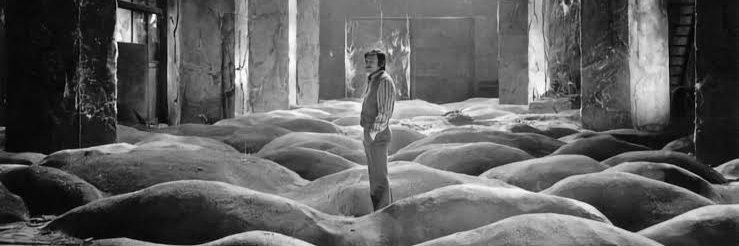
Andrei Tarkovsky on Ingmar Bergman's Shame (1968): "Let us look at Bergman's Shame. The film doesn't contain a single 'actor's piece' for the performer to 'give away' the director's purpose, to play the conception of the persona, his attitude to it, to assess it in relation to the overall idea; and the latter is entirely hidden within the dynamic of the characters' lives, at one with it. The people in the film are crushed by circumstances; they act only in accordance with their situation, to which they themselves are subordinate; they make no attempt to proffer us any idea, any perspective on what is happening, or to draw any conclusion. All of that is left to the film as a whole, to the director's vision. And how superbly it is accomplished! You cannot say in simple terms who amongst them is good or bad. I could never say that von Sydow is a bad man. They are all partly good and partly bad, each in his own way. No judgements are passed, because there is no hint of tendentiousness in any of the actors, and the circumstances of the film are used by the director to explore the human possibilities which they test, and not for a moment in order to illustrate a thesis. Max von Sydow's character is developed with masterly power. He is a very good man; a musician; kind and sensitive. It turns out that he is a coward. But by no means every bold man is a good human being, and cowards are not always scoundrels. Of course, he is weak and irresolute. His wife is far stronger than he, so much so that she can overcome her fear. The hero lacks that strength. He is tormented by his own weakness, vulnerability, lack of resilience; he tries to hide, to cower in a corner, not to see and not to hear; and he does this like a child, naively and with complete sincerity. But when circumstances nevertheless force him to defend himself, he instantly turns into a scoundrel. He loses all that was best in him; but the drama and absurdity of his situation is that as he is now he becomes necessary to his wife, who, in her turn, looks to him for protection and succour instead of despising him as she always had. When he beats her about the face and says 'Get out!' she goes crawling after him. There is something here of the age-old idea of passive good and active evil; but its expression is immensely complex. At the beginning of the film the hero cannot even kill a chicken, but as soon as he has found a way of defending himself he becomes a cruel cynic. He has something of Hamlet: my view is that the Prince of Denmark perishes not as a result of the duel, when he dies physically, but immediately after the 'rat' scene, when he understands how irreversible are those laws of life which have forced him, a man of humanity and intellect, to act like the inferior people who inhabit Elsinore. Von Sydow is now a sinister character, afraid of nothing: he kills; will not raise a finger to save his fellows; pursues only his own interests. The point is that you have to be a person of great integrity to feel fear in the face of the foul necessity to kill and humiliate. And by shedding that fear and apparently acquiring courage, a person in fact loses his spiritual strength and intellectual honesty and parts from his innocence. War is the obvious catalyst for the cruel, anti-human elements in people. Bergman uses the war in this film exactly as he uses the heroine's illness in Through a Glass Darkly: to explore his view of man." — "Sculpting in Time" by Andrei Tarkovsky (translated by Kitty Hunter-Blair, 1987)
RadiantFilm27,723 просмотров • 7 месяцев назад


Robert Bresson on the power of sound: "The eye is lazy. The ear, on the contrary, is inventive—it’s much more attentive, whereas the eye is content to receive, other than in exceptional cases when it too invents, but by fantasizing. The ear is, in some sense, far more evocative and profound. The whistle of a train, for example, can call to mind the image of an entire station: sometimes of a precise station you know, sometimes of the atmosphere of a station, or of tracks with a stopped train... The possible evocations are innumerable. What’s good about this, this sound, is that it leaves the viewer free. And that’s what we must strive toward: leaving the viewer as free as possible. And at the same time, you have to make him learn to love it. You have to make him love the way you render things. That is: show him the things in the order and in the way in which you want to see them and feel them; make him see them, by presenting them, the way you see them and feel them yourself; and do all of this while leaving him a very great liberty, while making him free. Now, this freedom is greater with sound than it is with imagery." — Robert Bresson interviewed by Jean-Luc Godard for Cahiers du Cinéma in 1966 ⬇️ Pickpocket (1959).
RadiantFilm26,500 просмотров • 11 месяцев назад

Werckmeister Harmonies (2000) Directed by Béla Tarr (co-directed by Ágnes Hranitzky) Music by Mihály Víg
RadiantFilm20,466 просмотров • 8 месяцев назад
![Wim Wenders on the "camera movement and blocking" in Wings of Desire (1987): Filmmaker Magazine: "What was your philosophy about camera movement and blocking in Wings of Desire?" Wenders: "As we very often had to “translate” the angels’ point of view, so to speak, we were extremely keen on moving the camera as much as possible. In the absence of Steadicam equipment we worked a lot on tracks, with dollies, cranes, jib-arms etc. But we also built ourselves devices so we could move through the air from one house to the next, for instance, and we shot the opening sequence on a helicopter, which was highly difficult in West Berlin at the time, as there were no private companies flying, just the Allies with their respective army pilots. We ended up shooting with a British pilot in an army helicopter without a proper camera mount. Today, you would do these things with gyroscopes and such. Blocking has always been my department. Henri [Alekan] kept out of it completely, and I did it with his operator, Agnès Godard. I have done shot lists for complicated sets, but usually I decide on location in the morning how we design the shots. I prefer to see the actors rehearse it, before I commit to any blocking. Camera moves weren’t the real challenge, though, for finding the angels’ points of view. It dawned on me early on that our camera had to do a more complex job. I told it to Henri. “Those angels have a very loving look at us humans. We have to find a way to teach our camera to look more lovingly.” Henri just stared at me as if I was out of my mind. “How do we do that?” Well, I didn’t know of course. But I figured we had to invest more care and love ourselves into every shot that represented what the angels saw. And that’s it, in the end. A camera can reflect on what you invest into its act of seeing. That sounds pretty lofty, I guess. But it does rub off, I tell you, if you try to imagine how angels would look at us. After all, they were some sort of metaphor for me for the better persons we carry inside ourselves, or for the children we somehow preserved in ourselves." — "“Imagine How Angels Would Look at Us”: Wim Wenders on Restoring Wings of Desire" by Jim Hemphill (Filmmaker Magazine, 2018)](https://image.24vids.com/tw-2021376328629444683/ext_tw_video_thumb/2021376143727689729/pu/img/NUOdIZHl00m9N4Wf.jpg)
Wim Wenders on the "camera movement and blocking" in Wings of Desire (1987): Filmmaker Magazine: "What was your philosophy about camera movement and blocking in Wings of Desire?" Wenders: "As we very often had to “translate” the angels’ point of view, so to speak, we were extremely keen on moving the camera as much as possible. In the absence of Steadicam equipment we worked a lot on tracks, with dollies, cranes, jib-arms etc. But we also built ourselves devices so we could move through the air from one house to the next, for instance, and we shot the opening sequence on a helicopter, which was highly difficult in West Berlin at the time, as there were no private companies flying, just the Allies with their respective army pilots. We ended up shooting with a British pilot in an army helicopter without a proper camera mount. Today, you would do these things with gyroscopes and such. Blocking has always been my department. Henri [Alekan] kept out of it completely, and I did it with his operator, Agnès Godard. I have done shot lists for complicated sets, but usually I decide on location in the morning how we design the shots. I prefer to see the actors rehearse it, before I commit to any blocking. Camera moves weren’t the real challenge, though, for finding the angels’ points of view. It dawned on me early on that our camera had to do a more complex job. I told it to Henri. “Those angels have a very loving look at us humans. We have to find a way to teach our camera to look more lovingly.” Henri just stared at me as if I was out of my mind. “How do we do that?” Well, I didn’t know of course. But I figured we had to invest more care and love ourselves into every shot that represented what the angels saw. And that’s it, in the end. A camera can reflect on what you invest into its act of seeing. That sounds pretty lofty, I guess. But it does rub off, I tell you, if you try to imagine how angels would look at us. After all, they were some sort of metaphor for me for the better persons we carry inside ourselves, or for the children we somehow preserved in ourselves." — "“Imagine How Angels Would Look at Us”: Wim Wenders on Restoring Wings of Desire" by Jim Hemphill (Filmmaker Magazine, 2018)
RadiantFilm18,101 просмотров • 7 месяцев назад


Today marks the 100th anniversary of the premiere of Battleship Potemkin, which took place at the Bolshoi Theatre in Moscow on December 21, 1925. Sergei Eisenstein on the film's premiere: "APPLAUSE LIKE THE CRACKLE of rifle shots echoes through the semi-circular corridors of the Bolshoi Theater. I am in the corridor, nervous not only about the fate of Potemkin, but about its . . . spittle. For, indeed, its last reel revolved around spittle. Climbing higher and higher, from the orchestra to the dress circle, from the mezzanine to the balcony, driven upward by the growth of excitement, I hungrily and anxiously drink in every sound of the applause. Then, like a thunderclap, it bursts from the entire audience. One — that is the scene with the red flag. Two — that’s the one of the guns of the Potemkin firing at the generals' headquarters in reply to the Odessa massacre. I continue to wander through the empty concentric halls. Not a soul. Even the ushers have gone inside, a most unusual event: here, in the State Academic Bolshoi Theater, for the first time in its history — the showing of a film. Now it will come — the third burst of applause as the Potemkin passes through the admiral’s squadron “flying the victorious flag of freedom." I am suddenly in a cold sweat. All other sensations are shocked out of existence. Spittle! My God! Spittle! Spittle! In the last-minute rush in the cutting room we had forgotten to splice the final reel. The sequence of the meeting of the squadron was made up of extremely short cuts. To make sure they would not be lost or get mixed up, I stuck them together by licking them with my tongue, and gave the reel to the assistant to splice. Then I took a look at the first version. Tore it apart. Looked at the second. Tore and changed that one, too. Suddenly I remember that my assistant did not have the time to splice up the final version. And by now it is out of the can and being threaded for projection. Film cement has not been substituted for spittle. Yes — I can tell by the music — the last reel has already started! How can I prevent disaster? In utter confusion I race through the semicircular hallways and spiral down the corkscrew stairs, possessed by a single desire, to bury myself in the cellar, in the earth, in oblivion. The break will come at any moment now! Bits of film will come flying out of the projector. The finale of the picture will be choked off, murdered. But then . . . unbelievable . . . a miracle!! The spittle holds! The film races through to the very end! Back in the cutting room we couldn't believe our own eyes — in our hands the short cuts came apart without the slightest effort, and yet they had been held together by some magic force as they ran, in one whole piece, through the projector . . ." — "Immoral Memories: An Autobiography" by Sergei Eisenstein, translated by Herbert Marshall, published in 1983
RadiantFilm15,911 просмотров • 8 месяцев назад
Больше нет контента для загрузки