
Refugees In Libya
@RefugeesinLibya • 27,737 subscribers
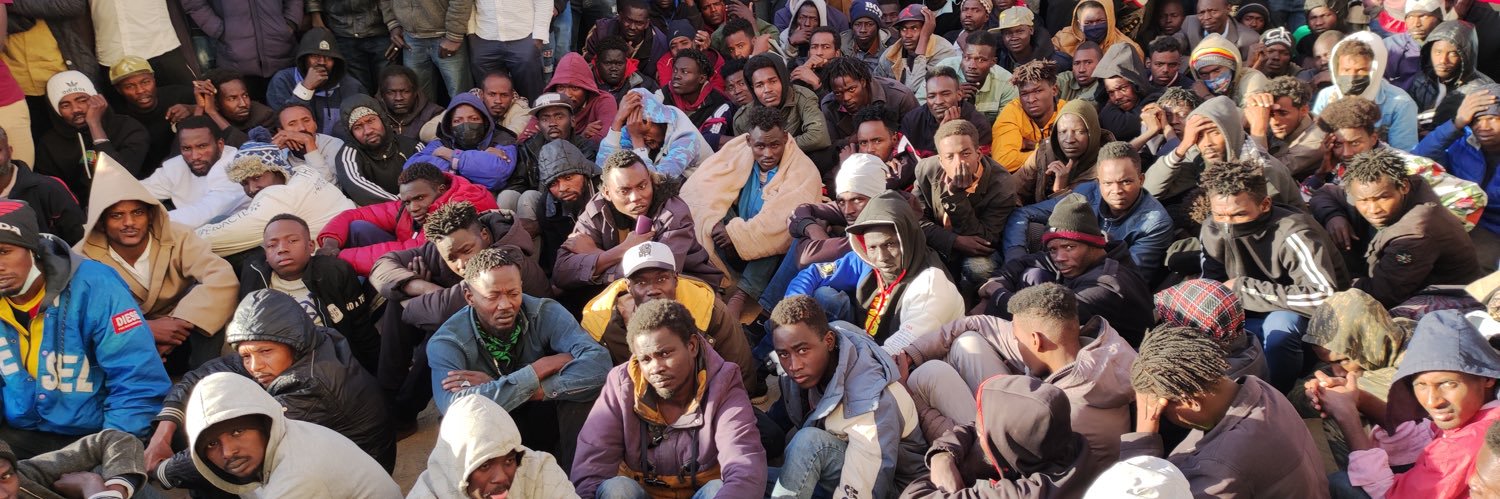
We are a self-organized refugee-led movement exposing crimes in Libya, Tunisia, Niger and other parts of world. We demand accountability & Justice.
Shorts


Videos

Sensitive content
This media may contain sensitive content.
In Sudan, the gunmen are our own and, yes, they are the problem. But the real gunmen are the suppliers of these weapons—the manufacturers of these evil machines—who supply them in exchange for our natural resources, rendering our countries uninhabitable. Suppose we follow what people who’ve never known war in the West say: “Don’t run away; defend your country; take up arms and fight.” Who do we fight? The poor gunman who has been brainwashed? The poor gunman who is one of our own? The poor gunman who speaks our tongue, identifies as Sudanese, and claims he would do anything to make the country livable? “Fight imperialism,” they say; “fight capitalism; fight corruption; fight the subjugating West whose hands arrive via Egypt, Turkey, the UAE, CAR, Libya, Kenya,” etc. This genocide is not only the wrongdoing of the executioner in the field.
Refugees In Libya1,419,268 görüntüleme • 10 ay önce

House to house manhunt for black Africans takes toll in Tunisia 🇹🇳. In the last two weeks a door to door and street collection of any dark skinned persons even those identified as Tunisians are crammed into police vans & deported to the eastern border regions. Women, men and children are caught and deported without any of their possessions, documents, savings and other materials they have worked for and accumulated over the years. Most of those arrested during the house to house raids are legally entitled to stay in Tunisia, they are students, workers and refugees. These people have committed no crimes but the Tunisian government have taken it as his political power to scapegoat Refugees and Sub-Saharan Africans for his failed dictatorial regime under the pretext of demographic change and great replacement theory. The African Union is silent while the so—called democratic European countries with their values for human rights are the very ones supporting and financing Kaïs Saeid to act as the border guard of the Fortress Europe. This must STOP🛑
Refugees In Libya3,765,890 görüntüleme • 2 yıl önce

THROWN IN THE DESERT OF ALGERIA 🇩🇿 AND LEFT TO DIE OF THIRST, STARVATION AND HEAT 🇹🇳 IMPORTANT 🛑 PLEASE SHARE WITH YOUR ALGERIAN AND TUNISIAN NETWORKS INCASE THEY HAVE SEEN OR HEARD OF THESE PEOPLE: ON JULY 9, 2024, 52 people, including 3 children and 4 women, were captured at sea by the Tunisian National Guards. The captured were pulled back to the port of Sfax, beaten, handcuffed, and robbed of their phones and personal belongings. They spent the whole day at Sfax port, each in handcuffs. In the evening, they were taken into a concentration camp surrounded by barbed wire. They were later loaded into big buses and thrown into the Algerian desert without food, water, or shelter. On the 12th of July, we heard from 25 of them who, with visual evidence, reached out to us asking to be rescued but shortly ran out of battery, and to this day, the 19th of July, we have not heard from them or received any information about them. The people were captured while trying to escape Tunisia thanks to boat information provided by Frontex to the Libyan and Tunisian coast guards. For this reason we together and front-LEX have launched a legal action against Frontex.
Refugees In Libya2,931,315 görüntüleme • 2 yıl önce

Sensitive content
This media may contain sensitive content.
Breaking News: Dozens kidnapped for Ransom in Kufra, Libya. Naima Jamal is among dozens of victims of Libya’s modern slave trade. Naima Jamal, a 20-year-old Ethiopian woman from Oromia, was abducted shortly after her arrival in Libya in May 2024. Since then, her family has been subjected to enormous demands from human traffickers, their calls laden with threats and cruelty, their ransom demands rise and shift with each passing week. The latest demand: $6,000 for her release. This morning, the traffickers sent a video of Naima being tortured. The footage, which her family received with horror, shows the unimaginable brutality of Libya’s trafficking networks. Naima is not alone. In another image sent alongside the video, over 50 other victims can be seen, their bodies and spirits shackled, awaiting to be auctioned like commodities in a market that has no place in humanity but thrives in Libya, a nation where the echoes of its ancient slave trade still roar loud and unbroken. “This is the reality of Libya today,” writes activist and survivor David Yambio in response to this atrocity. “It is not enough to call it chaotic or lawless; that would be too kind. Libya is a machine built to grind Black bodies into dust. The auctions today carry the same cold calculations as those centuries ago: a man reduced to the strength of his arms, a woman to the curve of her back, a child to the potential of their years.” Naima’s present situation is one of many. Libya has become a graveyard for Black migrants, a place where the dehumanization of Blackness is neither hidden nor condemned. Traffickers operate openly, fueled by impunity and the complicity of systems that turn a blind eye to this horror. And the world, Yambio reminds us, looks the other way: “Libya is Europe’s shadow, the unspoken truth of its migration policy—a hell constructed by Arab racism and fueled by European indifference. They call it border control, but it is cruelty dressed in bureaucracy.” The $6,000 ransom demanded for Naima is not just a price for her life; it is a price for the silence of a global community that allows this horror to happen to the black child. And yet, for many, this is not survival, it is a cycle of endless suffering. Naima’s fate, and that of the 50 other victims in Kufra, remains uncertain. Their cries are met with indifference by those who could intervene but choose not to. Meanwhile, their families are left to battle with the impossible, raising the funds demanded by traffickers or risking the loss of their loved ones forever. The world must confront the uncomfortable truth: the slave trade is alive and thriving in Libya. It thrives in the silence of nations, in the shadows of complicit systems, and in the unchecked racism that dehumanizes Black lives. Naima’s story, as Yambio writes, is not an anomaly, it is the legacy of a history that refuses to end. X1
Refugees In Libya1,247,052 görüntüleme • 1 yıl önce

🚨 BREAKING NEWS — Shipwreck off Sfax, Tunisia 🚨 A boat carrying 47 people, including babies and children, has just shipwrecked near Louza after leaving yesterday. They are caught between life and death. We have already contacted the Tunisian National Guard demanding immediate intervention. But this is not enough and not safe. We call on everyone to share this urgently and put pressure on the Italian government to ensure these lives are not abandoned to the sea but brought to safety in Italy. ⏱️ The video evidence is less than two hours old. Time is running out.
Refugees In Libya463,730 görüntüleme • 1 yıl önce

Sensitive content
This media may contain sensitive content.
*Denouncing human trafficking is everyone's responsibility. Human trafficking is a heinous crime that must be stopped* . Faysal Adam Somo is from Ethiopia. He's 40 years old. He arrived in Al-Kufra city (Libya) on 1st of April 2025. Since his arrival in Al-Kufra he got caught by human traffickers. They detained him and started torturing him until today and asking him for a ransom of 9000 US dollars. The videos that you're watching are taken by the traffickers and sent to the family of the victim threatening either they can pay the a mount they asked or the man will be killed 😢 We must protect the vulnerables and bring traffickers to justice. Let's stand against this inhuman act that continuously taking place in Libya against the migrants and refugees.
Refugees In Libya584,820 görüntüleme • 1 yıl önce


GERMANY 🚨 💀 What you see in this vague video is the police unjustly taking the life of black man. Lamin Touray 37 from Gambia lived in Nienburg, Hannover with his girlfriend. On the 29th March 2024 Lamin is alleged to have threatened his girlfriend who later called the police. Police arrived and claimed that Lamin was armed white knife and did not comply. They shot him 2 times and distanced a bit then followed by another 6 shots which killed Lamin immediately. #EndPoliceBrutality
Refugees In Libya629,187 görüntüleme • 2 yıl önce

Sensitive content
This media may contain sensitive content.
It is hard to look away from these scenes of parents dying alongside their children. A few days ago it was Fati Dosso and Marie, today it is yet a faceless father, his son and two more companions whose lives have been unjustly stolen. This video was released yesterday by the Libyan Border Guards of 19th Unit alongside the Libyan Emergency medical service operated by 1412 hotline.
Refugees In Libya507,302 görüntüleme • 3 yıl önce

🛑 STATEMENT | Racist Attacks in Tripoli 🛑 The capital, Tripoli, is witnessing attacks and racist practices against refugees, unfolding amid a clear disregard by the Tripoli Security Directorate and the Ministry of Interior. This is not an isolated incident. On multiple occasions, dozens have taken to the streets under the banner of a so-called movement claiming to fight the “resettlement of refugees,” holding gatherings in the city center that appear to have occurred with official approval from security authorities. The Tripoli Security Directorate and the Ministry of Interior bear full responsibility for these violations and for any escalation, hate speech, and violence that may result within the capital.
Refugees In Libya115,616 görüntüleme • 7 ay önce

This is a circulating clip of a Somali teenager who was dumped in the desert of Southern Libya towards Niger by the Libyan authorities. Could our Somali followers translate what he’s saying? Black people in Libya continue to suffer beyond imagination, why are Africans silent?
Refugees In Libya200,998 görüntüleme • 1 yıl önce

Sensitive content
This media may contain sensitive content.
If we experience it on our bodies as a result of policies and mechanisms drawn by your authorities, you all should at least have the courage to see it and decide what world you want to live in. Nathaniel Gidesha from Eritrea is now held in Kufra, Libya , in this current state where he suffers tortures for a wild ransom of 7500$. His families, colleagues and common people like us are forced to watch this all days on our screens and one would wonder what terror can bring forth, either tenderness or a great deal of vengeances towards such policies.
Refugees In Libya189,649 görüntüleme • 2 yıl önce

Mass expulsions of migrants from Tunisia 📌 Migrants in #Sfax has seen unrest in the last 24 hours as the government and the common people take laws into their hands and are expelling vulnerable women, children and men to the Sahara Desert They are dumped without food and water
Refugees In Libya178,843 görüntüleme • 3 yıl önce

Sensitive content
This media may contain sensitive content.
IF RACISM DOESNT HAVE EYES TO SEE PREGNANT WOMEN THEN IT IS A MASSACRE! SFAX, TUNISIA 🇹🇳 ☠️ On the 17th of July, the Garde Nationale launched violent attacks on people living in the olive-farms in Sfax KM-34. Men, children and women were hunted down to death. At least two pregnant women were wounded. If you are racist, at least recognise pregnant women and children, but we know it’s no longer a racism issue but a dirty job done for the European governments in exchange of millions of Euros. The videos that follow in the send thread shows the attack.
Refugees In Libya126,129 görüntüleme • 2 yıl önce

‼️The Italy–Libya Memorandum of Understanding leads to the daily rape, torture, detention, enslavement, and killing of thousands of people. By early November, this agreement will be automatically renewed by the Italian and Libyan governments — both of which are, and will continue to be, responsible for this suffering. In October 2021, we took to the streets of Tripoli to denounce this shameful agreement and show the world its true impact on us: people on the move, migrants, refugees, and asylum seekers. ⛔️ We won’t stop until this Memorandum is abolished and all those responsible are brought to justice!
Refugees In Libya50,694 görüntüleme • 1 yıl önce

THEY BEAT HIM DAILY, NO ONE HAS MOVED, HIS LIFE COST $10,000 IN CASH: Tesfay Hagos Alemayehu There are men whose names will never touch headlines not because they are unworthy, but because the world has chosen a hierarchy of whose pain is worth hearing, whose screams can be dismissed, whose body may be bartered. Tesfay Hagos Alemayehu is such a man. He was born on the 15th of March, 1994, in Hagere Selam, a town in the northern highlands of Ethiopia, Tesfay grew up as one of many→a son of soil, of war, of withered promises. But today, he is something else: a man stripped of dignity and caged in Kufra, Libya, where his Black skin is a currency in the economy of human trafficking. He was not searching for riches. He was not chasing dreams built on illusions. He fled Ethiopia because the land from which he emerged was bleeding→Tigray, a region devoured by war and starvation. And so he ran. As many do. As many must. But in this world, the Black man’s journey toward dignity is a crime punished before it is understood. We are often told that men must endure. That we must not weep. That we must clench our teeth through the breaking of our bones. And so, when Tesfay’s captors lash his body with black pipes, when they fasten his limbs into impossible knots and pin his skull to the cement floor with their boots, some may whisper→“he should have known better than to go to Libya.” This world, so fragile to the Black body, so hostile to Black men who dare to gamble their survival, still manages to judge them when they fall into the trap. For nearly a month now, Tesfay has been held in Kufra, tortured daily. Beaten until blood replaces sweat, denied food, deprived of water. And for what? A $10,000 ransom demanded by his captors, criminal Libyans, backed by transnational rings of Ethiopian and Eritrean traffickers. In the videos, men who speak in Arabic, flog with metal rods, and press his head into the dirt while the camera rolls. The videos sent to his family are not threats; they are proof of cruelty so normalized it now functions as a business model. In these images, Tesfay appears bound, shirtless, bruised, shaved bald and bleeding. And where is the state? Ethiopia? Libya? The international community? Twice, not once, but twice Tesfay’s family knocked on the doors of the local police in Ethiopia, bearing the unbearable news that their son had been kidnapped, held for ransom in Libya, and tortured daily. Twice, the police turned them away. Twice they were told, in unambiguous tones, “There is nothing we can do. Every day people are trafficked to Libya.” This is not ignorance, it is the institutional shrug of Black suffering. The state tasked with protecting its citizens has chosen not even to file a report. Not even to issue a slip of paper that might have enabled us→Refugees in Libya→to trigger Interpol protocols. When a government refuses to document its citizens’ disappearance, it is not just abandoning them→it is erasing them, but how can it erase us from its conscience?. Tesfay is bleeding, and the Ethiopian police cannot even find ink to write his name. 1/2
Refugees In Libya51,563 görüntüleme • 1 yıl önce

We have been alerted 🚨 by a group of 18 people who have been abandoned for 6 days in the desert. 4 of them are infants 8 women and 3 are pregnant 6 men. They have no water, food or energy to walk. 34°36'00.2"N 8°29'57.2"E OIM Tunisie - IOM Tunisia - المنظمة الدولية للهجرة Alarmephone Sahara @alarmphone
Refugees In Libya59,249 görüntüleme • 1 yıl önce

Mauritania 🇲🇷 🆘 Over 200 Gambians are locked up in a warehouse off the border of Mauritania and Senegal. They were captured at sea by the Mauritanian navy acting with the help of EU financial and technical support. They have been here for ten days with little to eat. @IOMMauritania doesn’t move a toe to help them. Embassy says they have no resources to facilitate their return. New Libya and Tunisia in the making!!!
Refugees In Libya57,211 görüntüleme • 1 yıl önce

For a day we lost contacts to our comrades who were kicked out of #Sfax But Al Jazeera English brings horrible accounts from there as over 1200 people are stuck between two borders where neither of them are wanted. Some with serious wounds Children under scorching sun No water, no food. European migration policy speaks for itself. Full video here by Al Jazeera English
Refugees In Libya83,798 görüntüleme • 3 yıl önce