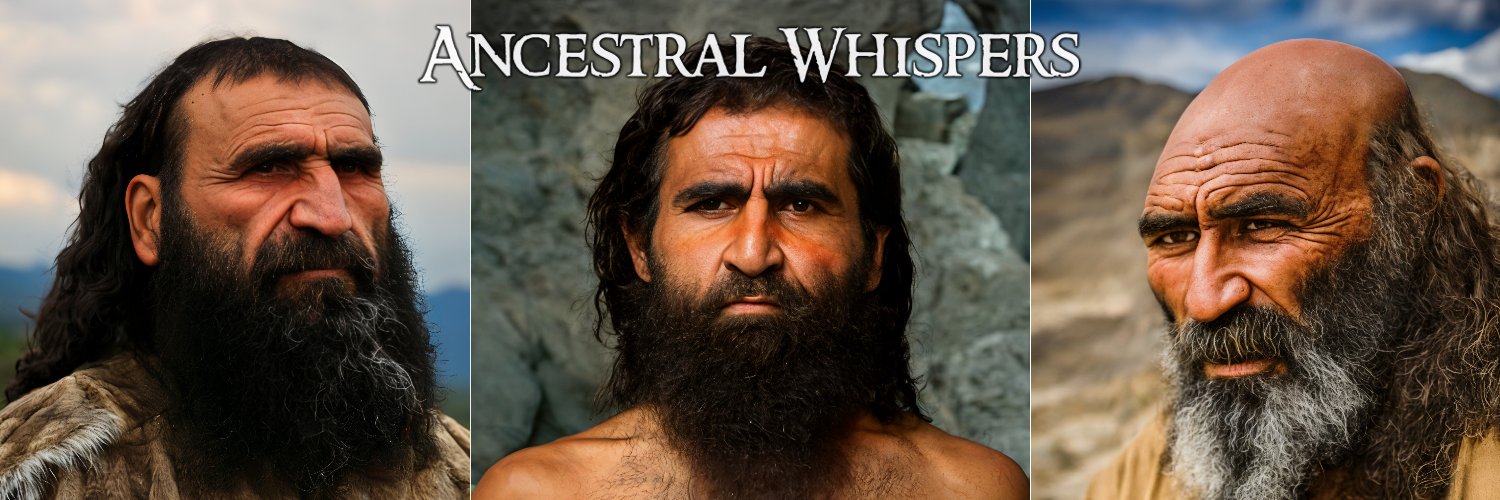
Ancestral Whispers
@Sulkalmakh • 30,547 subscribers
Facial reconstructions, Anthropology, Archaeogenetics, Archaeology, Ethnography.
Shorts


![Facial reconstruction of a 5,100-year-old Afanasievan from Mongolia with Yamnaya-like auDNA He carried Y-DNA haplogroup J1a2b and mtDNA U5a1. His maternal lineage, associated with European hunter-gatherers, was widespread among Indo-Europeans. His paternal lineage, J1a2b, has been previously detected in the Khvalynsk culture; a downstream of this haplogroup also dominates the Y-DNA of the Kura-Araxes culture, possibly suggesting a dispersal of J1a2b from the Caucasus into the Steppe, where a related branch persisted and became the main haplogroup of the Kura-Araxes culture. The man, belonging to the Paleoeuropoid/Protoeuropoid type, stood roughly 180 cm tall (498mm femur length) and possessed a notably massive and robust skull, with a very long cranial length of 193 mm, massive cranial width of 151 mm, and a very broad cheekbone width of 147 mm. In Inner Asia, the Bronze Age begins with the emergence of the Afanasievo culture, which spread across vast regions of southern Siberia and Central Asia. Its sites are known from western and central Mongolia, eastern Kazakhstan, the Dzungarian Basin, and even the Middle Zarafshan, though the highest concentration lies in the Altai and the Minusinsk Basin. AMS radiocarbon dates place the Afanasievo horizon between 3300–2500 BCE. Both anthropological and ancient DNA evidence indicate that the Afanasievo culture arose from a migration of populations from Eastern Europe, specifically from the Yamnaya cultural sphere (Solodovnikov et al. 2023). The Altai Afanasievo individuals rank among the tallest ancient populations of Eurasia (Solodovnikov et al. 2018). A similarly tall stature is seen among Afanasievo individuals from central Mongolia, based on limited material from the Shatar-Chuluu cemetery (where the reconstructed individual was found) near the Khangai range (Tumen 1978; Solodovnikov, Erdene 2022). Two published Afanasievo individuals have been identified as fifth-degree relatives. One was buried at Inskaya Dol in the northwestern Altai (I11752, BARN-039) [Narasimhan et al. 2019], and the other at the Shatar-Chuluu cemetery in central Mongolia (SHT002, AT-25 (I6221, the reconstructed individual)) [Jeong et al. 2020; Ringbauer et al. 2023]. Although these sites lie 1,410 km apart, both individuals share the characteristic Afanasievo/Yamnaya genetic profile and cluster closely with other Afanasievo samples. Their biological relationship implies that at least one ancestor in their family line must have traveled several hundred kilometers within their lifetime.](https://image.24vids.com/tw-1996144455372382600/amplify_video_thumb/1996142241337704448/img/xDuA2ZqQ25ja7T65.jpg)


![Facial reconstruction of a 6,800-year-old man from the Middle Volga The individual (Khvalynsk II, Burial 26), who carried Y-DNA J1-CTS1026, belonged to the Khvalynsk culture. The Khvalynsk cemeteries (201 burials) are the largest Eneolithic burial grounds in the Don–Volga–Ural region. They were initially regarded as likely precursors of the Yamnaya culture because of shared features such as shell-tempered pottery, similar burial positions, the use of ochre, and comparable decorative motifs. However, Khvalynsk is a flat cemetery rather than a kurgan cemetery, differs in its tools and material culture, and predates the Yamnaya culture by over 1,000 years. The cemeteries contained an exceptional number of copper artifacts (373) and numerous sacrificial domestic animals, including goats (the same goat lineage identified at Khvalynsk has also been found in Eneolithic Dagestan). Genetic, anthropological, and archaeological evidence indicates that the population combined ancestry from the Forest-Steppe, the Lower Don, and the North Caucasus, forming a genetically diverse community with extensive marriage networks. Khvalynsk was an important ritual and exchange center connected to the Balkan-Carpathian Metallurgical Province, which supplied copper from Balkan cultures such as Karanovo, Gumelnița, and Trypillia. The people of the Khvalynsk culture may have spoken a very archaic form of a Para-Indo-European language. The physical appearance of the bearers of the Khvalynsk culture was the result of admixture processes that took place throughout the Eneolithic between representatives of different Europoid populations: on the one hand, a hypermorphic western anthropological type, and on the other, a hypomorphic, gracile eastern type (Yablonsky 1990, p. 78; Yablonsky 1996, pp. 127–128). Based on the material from the Khvalynsk II cemetery, at least three morphological variants can be distinguished (Khokhlov 1998b): The first is dolicho-mesocranial, with a large facial skeleton and a well-profiled face, resembling the Nadporozhye–Azov cranial complex that was widespread among Neolithic populations of the Dnieper-Donets area (Ukr_N, Golubaya Krinitsa, Rakushechny Yar clusters). However, this complex appears in a more attenuated form. The second variant is characterized by a certain gracility, dolicho-mesocrany, and a moderately flattened facial skeleton. This complex finds its closest analogies among the Neo-Eneolithic skulls of the forest and forest-steppe regions of the Volga–Ural area and the Middle Volga (EHG cluster). The third variant is dolichocranial, with a narrow and strongly profiled face, and is close to the ancient Mediterranean type. This type show affinities with populations of the Trypillia culture, the Caucasus, and the Near East, with the closest parallels coming from the Caucasus. Although most comparative Caucasian series (such as the Kura-Araxes culture) are later in date, a contemporaneous Eneolithic female skull from Nalchik (genetically Mesopotamian/Lower Don 50/50) closely resembles the Khvalynsk material, it demonstrates a pronounced dolichocranial europoid type [Debets, 1948, p. 107], and in general dimensions it is quite close to Khvalynsk skulls. Another similar Southeuropoid skull comes from Koskuduk I in the eastern Caspian, where the local Oiuklin culture has been linked to interactions between Khvalynsk migrants and Kelteminar (Sarazam, Anau cluster) culture groups. However, the origin of this southern Europoid component in the Khvalynsk population remains uncertain because Eneolithic anthropological evidence is sparse. (Khokhlov, 2010a, 2017) Burial 26 contained the remains of an individual that was originally identified as female, aDNA revealed that the individual was genetically male. He was buried supine, with his head facing northwest, tightly flexed legs turned to the right, bent arms, and the skull tilted slightly forward and to the left. The skeleton was covered with ochre, with the heaviest staining on the feet and elbows. An ochre patch was found beside the skull, and shell beads were recovered from the skull, left shoulder, pelvis, and waist area. The individual’s (I6735) Y-DNA belongs to a lineage upstream of the main Kura-Araxes lineage, which was widespread in the EBA South Caucasus and Dagestan. A related lineage has also been found in the Afanasievo culture. His mtDNA, U4a, is a common EHG maternal lineage. Autosomally, he was roughly half EHG half Steppe Eneolithic.](https://image.24vids.com/tw-2073350938601910351/amplify_video_thumb/2073347844681986049/img/mGPz4jvdcDEr3HmZ.jpg)


Videos

Facial reconstruction of a 4,200-year-old Sintashta-Aryan “Romeo and Juliet” from Samara The ~21-year-old man and his ~14-year-old wife were buried in an embrace in Utevka VI, Kurgan 6, Grave 2, which contained six individuals: the couple and four children and infants, who were too old and too numerous to have been their offspring - perhaps siblings. The grave contained horse sacrifices, shield-shaped studded bone cheekpieces interpreted as chariot-driving gear, weapons (three copper daggers, a flat copper axe, and 16 flint projectile points), copper beads and rings, and other objects. Utevka VI is a distinctly Sintashta burial ground in Samara Oblast, although its excavator, P. F. Kuznetsov, classified it as belonging to the “Potapovka cultural type.” The circular arrangement of burials around central graves is characteristic of Sintashta sites. The grave goods at Utevka VI are abundant and varied, including numerous metal tools and weapons (knives, daggers, and spearheads), ornaments (bracelets, pendants, and beads), and stone tools for sharpening. Some objects show Near Eastern connections, while rare silver and gold ornaments were also found. Burials often included complete quivers containing flint arrowheads, with up to 16 per grave. Arrows were approximately 50 cm long, while bows could reach 1 m, with an estimated range of around 300 m. Clothing was decorated with beads made of metal, faience, and stone. A distinctive feature is the presence of antler cheekpieces (psalia), associated with horse gear and sometimes elaborately decorated, with parallels across the Eurasian Steppe. Bone artifacts - including arrowheads, beads, combs, and discs - were also common and diverse (Vasiliev I. B., Kuznetsov P. F., Turetski M. A., 2000). The male (I0246) was genetically a mixture of Steppe_MLBA and an ANE/WSHG-rich substrate. He carried Y-DNA haplogroup R1a-Z2124 and mtDNA haplogroup C1.
Ancestral Whispers250,074 次观看 • 25 天前

Facial reconstruction of a man from a nomadic burial of the Golden Horde period in the Bukey Steppe, Kazakhstan As a complex political formation, the Golden Horde was by no means characterized by ethnic homogeneity. Its urban populations, in particular, were exceptionally diverse. Anthropologist Georgy Debets (1948) describes the Mongolid component among its Tatars as potentially comprising South Siberian (Turanid) and Central Asian types, but notes that the small sample of only six or seven crania, many showing Europoid admixture, makes such distinctions uncertain. He therefore considers it preferable to characterize the Mongolid component primarily by its brachycranic form. For the Europoid component, Debets notes that Trofimova identified a predominantly Pamir-Fergana type. Although Central Asian brachycephals are morphologically closest to these crania, Debets argues that this does not necessarily indicate a Central Asian origin, since a similar type was present in the Lower Volga during the Sarmatian period, roughly a millennium earlier. Regarding the nomadic populations of the Golden Horde period, Debets writes that their ethnic composition was far from homogeneous and included various Turkic and Mongol tribes. He further notes that dating the burials of Turkic nomads presents considerable difficulties. When a burial contains no coins, the state of archaeological research on these cultures often makes it impossible to distinguish the crania of nomads dating to the Golden Horde period from those of earlier nomads, dating from the 10th–12th centuries. In the statistical calculations, Debets considered the crania from the burial mounds of the Bukey Steppe separately, as they differ sharply from the others. He describes these crania as characterized by a pronounced predominance of Europoid features and as virtually identical to the brachycephalic Sarmatian type found in burial grounds of the Volga delta and along the Ural River. In all probability, he concludes, they are descendants of these Sarmatians.
Ancestral Whispers62,451 次观看 • 27 天前

Facial reconstruction of a 5,400-year-old man from the Ipatovo kurgan, Stavropol Krai One of the central problems of the Early Bronze Age in the lowland regions of the Western and Central North Caucasus is the formation of the Maikop-Novosvobodnaya cultural community, associated with the penetration of bearers of the Maikop culture into the North Caucasus and as far as the steppes of Kalmykia. Of no less importance is determining the nature of the contacts between the Maikop population and the indigenous population of the southern Russian steppes, as well as identifying the nature of Maikop influences on the bearers of the Yamnaya culture. Among the steppe populations with whom the Maikopians interacted, was a group distinct from the typical Steppe_EMBA population, instead forming a cline between an ANE-rich population and Steppe Eneolithic. This population adopted the material culture of the main Caucasus Maikop cluster and frequently mixed with Caucasus Maikop groups. The partially preserved skull (Ipatovo 5, kurgan 4, burial 6) is unequivocally male, with strongly developed supraorbital relief, mastoid processes, and pronounced muscular markings. The condition of the sutures, dental wear, and postcranial changes indicate a late-mature age of approximately 45-55 years. The skull is exceptionally large and hyperdolichocranial, with a very large braincase, broad forehead and occiput, and a cranial index of 66.8. Despite the massive neurocranium, the facial skeleton is relatively small, particularly in height. The face is broad but very low, with small nasal and orbital heights. The nasal breadth and orbital breadth are large to very large, and the nose projects strongly. The face is strongly profiled in the horizontal plane, with a nasomalar angle of 119.6° and a zygomaxillary angle of 120.1°. The nasal root is strongly projected and profiled, with a very high simotic index (82.0), while the canine fossa is deep. The mandible has very large bigonial breadth and symphyseal height, with laterally everted gonial angles. Overall, the skull is characterized by extreme hypermorphosis and a combination of metric and structural features indicating an exceptionally archaic morphology. Several discrete traits are also present, including a right supraorbital notch associated with a foramen, a left frontal foramen, and a left mastoid foramen (M. M. Gerasimova, D. V. Pezhemsky, L. T. Yablonski, 2007). The Maikop culture-associated Ipatovo samples with sequenced DNA, IV3005 and IV3002 (Ipatovo 3), show two different genetic profiles. IV3005 belonged to the main “Steppe Maikop” cluster, a mixture of ANE and Steppe Eneolithic ancestry, and carried Y-DNA Q1b. IV3002 was a mixture of “Steppe Maikop” and “Caucasus Maikop” ancestry and carried Y-DNA T-Y8614 and mtDNA X1'2'3. The reconstructed individual was likely genetically similar to one of these two samples.
Ancestral Whispers16,054 次观看 • 15 天前

Facial reconstructions of 14,000-year-old Oberkassel WHGs The Magdalenian culture, which followed the Solutrean, dates to the end of the Ice Age. Initially, the climate was cold and humid, resembling modern tundra, with mammoths, reindeer, musk oxen, hares, and ptarmigans. During the Middle Magdalenian, conditions became colder and drier as steppe expanded northward. Mammoths disappeared, reindeer retreated north, and horses, saiga antelopes, jerboas, and Asiatic wild asses became the dominant fauna. People increasingly occupied caves, while polychrome cave art reached its peak at sites such as Altamira and Font-de-Gaume. Flint tools became more specialized, serving mainly as components of composite implements, while bone technology flourished with the production of harpoons, spear points, needles, and fishing gear. The diversity of tools reflects growing craft specialization, organized hunting, and increasingly complex social organization. In 1914, two Magdalenian skeletons - a 40-year-old man and a 20-year-old woman - were discovered at Oberkassel near Bonn, Germany. Buried about one meter apart, both had been covered in red ochre and capped with basalt slabs. Animal bones and carved bone artifacts accompanied the burials, including a polished bone spatula with a carved predator-head handle and carved horse-head ornaments. Although direct descendants of the Cro-Magnons, both individuals were short but strongly built. The man was particularly robust, with a powerful chest and broad shoulders. His height was only slightly over 1.60 m, while the woman was even shorter, standing at approximately 1.55 m. (Gerasimov 1955) The anthropologist Mikhail Gerasimov described the Oberkassel man as follows: The Oberkassel man had a very large, massive, elongated skull, with a cranial length of 198 mm, a breadth of 142 mm, and an exceptionally broad cheekbone width of 155 mm. His face was large, broad, and pentagonal, with massive cheekbones, a narrow forehead, a strong lower jaw, a broad projecting chin, and a narrow, high, protruding nose. His orbits were rectangular with prominent brow ridges. It is evident that he was exceptionally strong and undoubtedly handsome in a rugged, masculine way. As a typical Europoid, he almost certainly had a thick beard and mustache, along with straight or slightly wavy hair. The Oberkassel woman is described by Mikhail Gerasimov as follows: Her skull was large and massive, with well-developed relief. It measured 184 mm in length, 132 mm in width, and 131 mm in cheekbone breadth. The brow ridges were well developed, while the nasal bones were large and broad, with only weakly expressed nasal prominences. The occipital bone was broad and almost without curvature. The face was pentagonal, broad, and relatively high, with a massive lower jaw, a broad strongly projecting nose, a slightly prognathic alveolar region, and a projecting chin. The orbits were rectangular with prominent upper margins. Gerasimov noted that the Oberkassel woman lacked typical Cro-Magnon features. Compared with the man, her skull was lighter and less massive. His reconstruction showed some similarities to the Cro-Magnon woman, such as a sloping forehead and deep-set eyes, but differed in having a broader, shorter nose, less facial projection, and a weaker chin. While the Oberkassel man showed more exaggerated facial proportions, the woman retained more ancestral traits. Observations of Late Paleolithic and Mesolithic skulls in Europe show that some exhibit facial flattening as pronounced as that of the most strongly expressed modern Mongolid populations, affecting both the orbital and subnasal regions. The Oberkassel male and female are notable examples: their nasomalar angles measure 143° and 146°, and their zygomaxillary angles 137° and 133°, respectively. Both the absolute values and the relationship between these angles indicate a "harmonious" or "complete" degree of facial flattening comparable to that seen in the most pronounced modern Mongolid populations (V. P. Yakimov, 1956, 1960; I. I. Gokhman, 1958). The Oberkassel individuals were short but robust and, according to Gerasimov, were neither primitive nor unattractive. Their short stature, like that of other late Cro-Magnons, was attributed to the harsh conditions of the Magdalenian period. The Oberkassel Man carried Y-DNA haplogroup I2-V4921 and mtDNA haplogroup U5b1. The Oberkassel Woman shared the same mtDNA haplogroup (Posth et al 2023).
Ancestral Whispers38,097 次观看 • 2 个月前

Facial reconstructions of three 2,500-year-old Scythians from the Dogehe-Baary II site in Tuva The Scythians, also known as the Saka, were an Iranic-speaking people who originated in the regions of Minusinsk, the Altai, Tuva, Mongolia, and Xinjiang. Dogehe-Baary II is located on the right bank of the Biy-Khem (Bolshoy Yenisey), 5 km upstream from its confluence with the Kaa-Khem, and 8 km north of Kyzyl. It belongs to the early stage of the Scythian Uyuk-Sagly culture (6th–4th century BC). The site was excavated between 1990 and 2000 by the Central Asian Expedition from the St. Petersburg Institute for Cultural and Natural Legacy, led by K.V. Chugunov (Chugunov, 1994, 1996, 1999a, 2001, 2007; Chugunov, 1998). Most Uyuk-Sagly males carry either R1a-PH1397 or Q1b-L330. Physically, they differed somewhat from earlier nomads in the region. Their skulls were generally longer in shape, and their faces were narrower, though still fairly tall. Their noses tended to project more and had more defined shape, suggesting a shift in facial structure compared to earlier groups. Overall, men and women looked more similar to each other than in some earlier populations, where differences between the sexes were stronger. (T.A. Chikisheva, 2008) The men, on average, had a medium-large cranial length/width/cheek width of 186/141/135 mm, and large nasomalar and zygomaxillary angles of 139.7° and 134°. The women, on average, had a medium-large cranial length/width/cheek width of 180/140/125 mm, and large nasomalar and zygomaxillary angles of 143° and 136°. At the Dogehe-Baary burial, an individual with likely pituitary dwarfism was found. Standing about 127 cm tall, he likely had a limping gait, a barrel-shaped chest, scoliosis, chronic joint pain, reduced mobility, and obesity. His skull bears healed injuries, indicating repeated violence, and he may have died from a traumatic brain injury. Despite these challenges, he lived to at least 45 years of age - an exceptional lifespan for someone with pituitary dwarfism complicated by epiphyseal dysplasia, even by modern standards (Aristova, E.S., Chikisheva, T.A., Seidman, A.M. et al., 2006).
Ancestral Whispers40,318 次观看 • 3 个月前
![Reconstructions based on 6,300-year-old early Proto-Indo-European elites from the Lower Don (Krivyanski I11828/I31755, Y-DNA J-M319, mtDNA T2a1b), and from Hungary—the first known horse rider (Csongrád I5124, Y-DNA Q-Y6802, mtDNA K1b2) The Krivyanski individual was buried in a round pit with a concave bottom, its floor covered in red ochre. The adult male lay on his back with knees raised, skull oriented NNE; the left arm was extended and the left thigh disturbed by a later grave cut. The burial position, grave goods, and date are characteristic of the Sredny Stog culture. The inventory included a retouched flint blade (its broken tip found deeper in the grave), two bifacial projectile points, and a bifacial axe-shaped blank. Additional displaced finds included another blade and the missing blade tip. The tools are patinated brown to gray flint with fine retouch and use-wear. He carried Y-haplogroup J2a (J-M319), linked to Caucasus populations such as the Maikop culture and Aknashen, but showed only older Mesolithic CHG ancestry. His mtDNA (T2a1b) was common among steppe groups. On PCA, he clustered close to the Yamnaya culture (Lazaridis et al. 2025). The Csongrád individual from Hungary, attributed to the Suvorovo culture, represents one of the earliest known cases showing osteological evidence consistent with riding, well before the classic Yamnaya horizon. He exhibited clear skeletal markers of habitual horseback riding, especially in the lower trunk and pelvic region, consistent with “horseman syndrome” (Trautmann et al. 2023). He carried Y-haplogroup Q-Y6802, linked to Khvalynsk. Autosomally, he was primarily Steppe Eneolithic, with a Khvalynsk grandparent—likely the source of his Y-DNA (Lazaridis et al. 2025). Culturally, some Steppe Eneolithic groups such as Berezhnevka are also attributed to the Khvalynsk culture (Khokhlov A.A., Gromov A.V., Grigoriev A.P., Kazarnitsky A.A., Kapinus Yu.O., Kitov E.P., 2024). In addition, horses were sacrificed and buried alongside cattle, sheep/goats, and humans at Khvalynsk, where no obviously wild mammals were included. Polished stone mace-heads shaped like horse heads proliferated across the steppes and spread into the Lower Danube valley between 4400–4000 BCE. Eneolithic horses, even if more skittish than modern ones, may have been ridden in quiet settings such as herding, allowing a mounted shepherd to oversee three times more sheep than a pedestrian one, producing a surplus useful for hosting feasts (Lazaridis et al. 2025). He is depicted with a “composite sword” from a related Giurgiulești burial in Moldova, which belonged to another Early Proto-Indo-European elite individual with Q1a Y-DNA (Blagoje Govedarica and Igor Manzura, Eurasia Antiqua 22, 2016 [2019]). The two individuals belonged to the Protoeuropoid type, a robust type that was widespread among the Ukr_N/Dnieper–Donets/Mariupol culture. This type is also documented in the early phase of the Rakushechny Yar culture in the Lower Don. This culture showed some similarities with the Mariupol culture, but also distinct differences, such as the absence of ochre (T.D. Balanovskaya, 1972, “Paleolithic and Neolithic of the USSR,” Volume 7). Samples from north of Rakushechny Yar, in the Middle Don (e.g., Golubaya Krinitsa, attributed to the Mariupol culture), show a substantial increase in CHG ancestry. This may indicate that the Neolithic Lower Don Rakushechny Yar culture (often linked by archaeologists to the Caucasus) was a possible source of CHG ancestry in Proto-Indo-Europeans, contributing, alongside the Dnieper-Donets/Mariupol culture, to the Protoeuropoid strain in early Steppe group, as well as to the majority of Proto-Indo-European ancestry. The migration of this Don population to the North Caucasus foothills, where they mixed with Mesopotamian-derived Caucasus farmers at Nalchik and its surroundings, and then to the Volga, where they mixed with local EHGs of the Ancienturalic strain, resulted in the Steppe Eneolithic proper genetic profile, which, after returning to the Don, formed the Proto-Indo-European Sredny Stog culture.](https://image.24vids.com/tw-2042181999817875782/amplify_video_thumb/2042178973975666688/img/rGGZE1qq39TXSLfQ.jpg)
Reconstructions based on 6,300-year-old early Proto-Indo-European elites from the Lower Don (Krivyanski I11828/I31755, Y-DNA J-M319, mtDNA T2a1b), and from Hungary—the first known horse rider (Csongrád I5124, Y-DNA Q-Y6802, mtDNA K1b2) The Krivyanski individual was buried in a round pit with a concave bottom, its floor covered in red ochre. The adult male lay on his back with knees raised, skull oriented NNE; the left arm was extended and the left thigh disturbed by a later grave cut. The burial position, grave goods, and date are characteristic of the Sredny Stog culture. The inventory included a retouched flint blade (its broken tip found deeper in the grave), two bifacial projectile points, and a bifacial axe-shaped blank. Additional displaced finds included another blade and the missing blade tip. The tools are patinated brown to gray flint with fine retouch and use-wear. He carried Y-haplogroup J2a (J-M319), linked to Caucasus populations such as the Maikop culture and Aknashen, but showed only older Mesolithic CHG ancestry. His mtDNA (T2a1b) was common among steppe groups. On PCA, he clustered close to the Yamnaya culture (Lazaridis et al. 2025). The Csongrád individual from Hungary, attributed to the Suvorovo culture, represents one of the earliest known cases showing osteological evidence consistent with riding, well before the classic Yamnaya horizon. He exhibited clear skeletal markers of habitual horseback riding, especially in the lower trunk and pelvic region, consistent with “horseman syndrome” (Trautmann et al. 2023). He carried Y-haplogroup Q-Y6802, linked to Khvalynsk. Autosomally, he was primarily Steppe Eneolithic, with a Khvalynsk grandparent—likely the source of his Y-DNA (Lazaridis et al. 2025). Culturally, some Steppe Eneolithic groups such as Berezhnevka are also attributed to the Khvalynsk culture (Khokhlov A.A., Gromov A.V., Grigoriev A.P., Kazarnitsky A.A., Kapinus Yu.O., Kitov E.P., 2024). In addition, horses were sacrificed and buried alongside cattle, sheep/goats, and humans at Khvalynsk, where no obviously wild mammals were included. Polished stone mace-heads shaped like horse heads proliferated across the steppes and spread into the Lower Danube valley between 4400–4000 BCE. Eneolithic horses, even if more skittish than modern ones, may have been ridden in quiet settings such as herding, allowing a mounted shepherd to oversee three times more sheep than a pedestrian one, producing a surplus useful for hosting feasts (Lazaridis et al. 2025). He is depicted with a “composite sword” from a related Giurgiulești burial in Moldova, which belonged to another Early Proto-Indo-European elite individual with Q1a Y-DNA (Blagoje Govedarica and Igor Manzura, Eurasia Antiqua 22, 2016 [2019]). The two individuals belonged to the Protoeuropoid type, a robust type that was widespread among the Ukr_N/Dnieper–Donets/Mariupol culture. This type is also documented in the early phase of the Rakushechny Yar culture in the Lower Don. This culture showed some similarities with the Mariupol culture, but also distinct differences, such as the absence of ochre (T.D. Balanovskaya, 1972, “Paleolithic and Neolithic of the USSR,” Volume 7). Samples from north of Rakushechny Yar, in the Middle Don (e.g., Golubaya Krinitsa, attributed to the Mariupol culture), show a substantial increase in CHG ancestry. This may indicate that the Neolithic Lower Don Rakushechny Yar culture (often linked by archaeologists to the Caucasus) was a possible source of CHG ancestry in Proto-Indo-Europeans, contributing, alongside the Dnieper-Donets/Mariupol culture, to the Protoeuropoid strain in early Steppe group, as well as to the majority of Proto-Indo-European ancestry. The migration of this Don population to the North Caucasus foothills, where they mixed with Mesopotamian-derived Caucasus farmers at Nalchik and its surroundings, and then to the Volga, where they mixed with local EHGs of the Ancienturalic strain, resulted in the Steppe Eneolithic proper genetic profile, which, after returning to the Don, formed the Proto-Indo-European Sredny Stog culture.
Ancestral Whispers53,844 次观看 • 6 个月前

Facial reconstruction of a 5,700-year-old EEF from Nezvisko, Ukraine This 60-65-year-old man lived during the peak of the Trypillia culture. At the age of 50, he took part in a battle in which he was wounded three times in the head: two blows from a stone axe struck his forehead, while a third hit him in the mouth and knocked out all the teeth of the upper jaw. At the moment of the injury, the man was most likely shouting with his mouth open, as the lower jaw and the soft tissues of the face were unaffected. The Trypillians were an Early European Farmer culture largely descended from Anatolian farmers, with some genetic contributions from populations of the Dnieper and Don regions. In 1957, the man's burial was discovered at a multilayered settlement near Nezvisko, Ivano-Frankivsk Region, among dwellings dating to the end of stage B/II. He was buried supine with his head to the northeast, arms alongside the body, and legs bent outward at the knees. The feet appear to have been tied. A painted vessel placed at his feet confirms the dating of the burial to the end of Trypillia B/II. The Nezvisko man was about 60-65 years old. His skull was unusually preserved, with complete resorption of the upper alveolar ridge after the loss of all upper teeth around 10-12 years before death. The lower teeth showed severe, uniform wear without dental disease. Three injuries were identified: two blows to the forehead and one to the upper teeth, apparently inflicted during the same battle with a narrow-bladed stone axe. The mouth was likely open when struck, as only the upper teeth were damaged. Debets and Gerasimov considered his cranial morphology unusual for the Trypillians, describing it as “Armenoid”-type. The skull was short and broad (173 × 148 mm; index 85.6), with a high braincase, very narrow nasal aperture (22.5 mm), and strongly developed face and mandible. His morphology was considered closer to the Near Eastern Europoid type than the Dinaric. The skull differs markedly from the Mediterranean-like pattern observed in the better-represented Bilche Zlota series. Gerasimov considered these features primarily individual rather than evidence of a distinct racial type, cautioning against drawing historical conclusions from isolated traits. Interpreting them as evidence of an Armenoid component among the Trypillians is problematic: brachycranial Armenoid forms appear considerably later, while ancient West Asian populations remained predominantly dolichocranic until at least the end of the 1st millennium BC. The poorly preserved nasal region also prevents a detailed assessment of specifically Armenoid facial traits. Despite these uncertainties, the Nezvisko skull is significant as an example of a marked deviation from the anthropological features generally considered characteristic of the Trypillian population. Both his reconstructed pre-injury appearance and his actual post-injury appearance were reconstructed.
Ancestral Whispers17,821 次观看 • 1 个月前

Facial reconstructions of 2,700-year-old Hurro-Urartian women from Van and Urmia The Hurro-Urartians were an ancient people who inhabited parts of Anatolia, the Levant, Mesopotamia, and the Zagros Mountains. The Urartian individual was a noblewoman from Chavushtepe in eastern Turkey, also known as Sardurihinili. The site is located approximately 25 kilometers southeast of Van. Sardurihinili consists of fortification walls and the remains of an Urartian royal palace, built between 764 and 735 BC during the reign of King Sarduri II, at the height of the Urartian Empire's power. According to Assyrian sources from the 9th–8th centuries BC, the state of Urartu gradually emerged in the Armenian Highlands. Early texts mention the "lands of Uruatri," a tribal confederation that resisted Assyrian expansion and was linked to the Hurrians and Subarians. Urartu was a vast but ethnically diverse state that united many peoples by force; the Urartians themselves likely constituted only the ruling elite. During the Iron Age, the Urartians became a major regional power. The territory of the Kingdom of Urartu encompassed parts of present-day Turkey, Iran, Iraq, and Armenia. They were closely related to the Hurrians and spoke a language belonging to the same family. The Urartians were a sophisticated people, renowned for their craftsmanship, military prowess, and durable fortifications that have withstood the test of time. Urartu was also noted for its military campaigns against neighboring states. The second individual, also known as "SK59", was found in Hasanlu, an archaeological site of an ancient city located in northwestern Iran, in the province of West Azerbaijan, just south of Lake Urmia. The settlement was likely associated with the Mannaeans, a people inhabiting the region who likely spoke a Hurrian language. The site is best known for its catastrophic destruction. At the end of the 9th century BC, Hasanlu was violently sacked and burned, preserving a single moment in time much like Pompeii. Buildings, artifacts, and even human remains were sealed beneath layers of ash and collapsed debris. The attackers were most likely the Urartians. Excavations uncovered the remains of more than 285 people, many of whom were killed during the assault or executed afterward. Several bodies showed signs of mutilation, while the positions of others revealed desperate attempts to escape. Among the thousands of objects discovered in situ were weapons, ornaments, and household items, all abandoned amid the chaos. This destruction layer is one of the most important archaeological contexts of the early Iron Age Near East. Following the devastation, the city's High Mound was repurposed as the site of a Urartian fortress. Reconstructions commissioned by 𒁍𒊑 𒋗𒊑𒌍 Buri Šoreš 𓄂❤️☀️💚
Ancestral Whispers30,759 次观看 • 4 个月前

Facial reconstructions of Iron Age Koban culture individuals from Georgia, Ossetia, and Ingushetia The Koban culture was a major Late Bronze Age and Early Iron Age culture of the Central Caucasus, renowned for its advanced bronze and iron metallurgy and craftsmanship. The Koban culture was divided into three regional variants: central, western, and eastern. The western variant became increasingly syncretic with Post-Dolmen Horizon and Proto-Maeotian groups associated with the Northwest Caucasians, while the eastern variant interacted closely with the Kayakent-Kharachoy/Zandak culture, possibly linked to the ancestors of Nakh-speaking peoples. The language of the Koban population remains unknown. Some scholars, including Valentina Ivanovna Kozenkova, have proposed a Kartvelian affiliation based on the culture's origins in the Great Liakhvi Basin (such as the site of Tlia in Georgia, the prototypical and one of the longest-inhabited Koban site, which has archaeological parallels with the even older site of Brili to the west), although no direct linguistic evidence has survived. Genetic studies reveal high levels of CHG ancestry and a predominance of Y-DNA haplogroup G2a1 within the main Koban genetic cluster. Similar genetic profiles are found among populations associated with the Late Bronze Age expansion of Kartvelian-speaking groups into eastern Georgia. Together with archaeological parallels, particularly similarities between Colchian and Koban axe forms, this evidence supports a possible Kartvelian connection. The Koban population maintained extensive contacts with neighboring societies. To the south, they interacted with tribes of the Colchian cultural-historical sphere, including groups inhabiting present-day Svaneti. To the north, they engaged with the Scytho-Cimmerian world. Anthropologically, the Kobanians are characterized by a relatively homogeneous Europoid morphology, including dolichocrany, a narrow face, low nasomalar and zygomaxillary angles, and a strongly projecting, narrow nose.
Ancestral Whispers27,611 次观看 • 4 个月前

Facial reconstructions of 2,500-year-old Maeotians from Northwest Caucasus The Maeotians and related tribes such as the Sindi and Kerketi were Northwest Caucasian peoples ancestral to the modern Circassians, Abkhazians, Abazins, and Ubykh. They developed from the Proto-Maeotian culture of Krasnodar - likely a syncretism of the Post-Dolmen Horizon with the Koban culture. The Maeotians played a role in the politics of the Bosporan Kingdom, and were tightly knit with the Scytho-Sarmatian world. The male was buried in the Tsemdolina necropolis in Krasnodar, which contained elite burials of the local administrative and military aristocracy who oversaw the Bosporan presence on the Abrau Peninsula. The site yielded numerous Scythian-style bronze artifacts, including zoomorphic pieces, and featured large underground pit-type tombs with horse burials. Horse burials were widespread in the Iron Age Caucasus, a custom either introduced by Scytho-Cimmerians or developed locally, and persisted long after disappearing in the western Steppe. This practice helps distinguish Maeotians from the later Iranic Steppe nomads. He is depicted with a bronze cuirass bearing the Gorgon Medusa, found in a Maeotian kurgan of the Kuban steppe, Elizavetsky burial ground. Although often viewed as a Greek motif, the golden gorgoneion from the Ulyap sanctuary suggests a local interpretation. Its resemblance to the Chechen and Ingush goddess Tusholi, worshiped as a fearsome mask, may indicate that the Maeotians saw the gorgoneion as a form of the Great Goddess. Among Caucasian peoples, including the Maeotians, who practiced ritual decapitation and venerated human heads, the gorgoneion likely carried additional cultic significance. The woman was buried at Lobanovaya Shchel, an Iron Age cemetery 9.9 km west of Abrau-Dyurso. The community practiced stone-cist burials that continue Bronze Age funerary traditions. Lobanovaya Shchel contained iron weapons, including spearheads and knives; locally made pottery alongside imported vessels and diverse ornaments including bronze sinusoidal pendants, torcs, signet rings, silver lunula pendants, glass, jet, and bone beads, and cowrie-shell pendants; and tools such as iron knives, an awl, a bronze needle, and ceramic and lead spindle whorls. She is depicted with a headdress associated with finds from the Karagodeuashhe kurgan, which reflects a high-status Maeotian burial tradition. In such elite graves, the deceased was placed in a prepared multi-chamber stone tomb, accompanied by ceremonial attire, weapons, a funerary wagon with horses, and additional horse sacrifice in a nearby dromos, with the chieftain and his wife buried in separate chambers.
Ancestral Whispers27,867 次观看 • 4 个月前

Facial Reconstruction of a 4,000-Year-Old couple from Gatyn-Kale, Chechnya The Gatyn-Kale burial ground lies about 3 km northwest of Aslanbek-Sheripovo (formerly Gatyn-Kale), near the road connecting Shatoy and Sharoy-Argun. The site is located on a small plateau that slopes eastward toward a stream valley. South of the burial ground, beyond a narrow rise, lies a broad hollow containing the medieval village of Gatyn-Kale and the steep canyon of the Verdy-Akhk. The reconstructed individuals, a young warrior and likely his wife, were buried in a paired burial no. 7. The young man stood approximately 179 cm tall, while the young woman was about 160 cm in height. The warrior had suffered a fatal blow to his head. Burial 7 contained more than sixty objects, including ceramic vessels, bronze items such as ornaments, amulets and weapons, beads, arrowheads, and ornaments made from Caspian Sea shells (Krupnov, E. I., 1961). The population of Gatyn-Kale engaged in pastoralism and agriculture. The society was patriarchal: research has shown that paired burials (men and women) appear with the emergence of patriarchy. At the Gatyn-Kale site several such graves have been discovered - in these cases the woman was sacrificed so that she could accompany her husband in the afterlife. (Markovin, V. I., 1969) The individuals whose DNA was sampled at Gatyn-Kale carried the Y-DNA haplogroup J1-Z1842 and autosomally belonged to the Kura-Araxes cluster (Ghalichi, 2024). Anthropologically, the Gatyn-Kale skulls are relatively gracile for the Bronze Age. They are characterized by small cranial dimensions, a medium cranial index, a moderately high cranial vault, a medium-height face, narrow cheekbones, and low orbits. Culturally and anthropologically, the burial ground appears to represent a contact zone between the tribes of North Caucasus and Dagestan. Comparisons with cranial series from Dagestan, Georgia, the South Caucasus, and the Trans-Volga region show that the Gatyn-Kale skulls resemble the Volga series in cranial indices, while in their gracile morphology they correspond more closely to the southern (Indo-Mediterranean) type. These features may represent either a gracilized Proto-Europoid type, a southern variant, or the result of interaction between northern and southern anthropological types. However, the absence of medium cheekbone breadth (which would have resulted from admixture between a wide-faced northern population and a narrow-faced southern population) argues against significant admixture, suggesting instead a local southern variant or influence from populations of the Northcaucasian cultural sphere (“Antiquities of Dagestan”, Makhachkala, 1974).
Ancestral Whispers33,403 次观看 • 7 个月前

Facial reconstructions of a 3,200-year-old likely Para-Armenic man and a 2,600-year-old likely Proto-Georgian/Iberian man from Samtavro in Mtskheta, Georgia The Bronze Age in East Georgia marked several periods of population replacement. Starting from the Early BA, East Georgia was inhabited by the people of the Kura-Araxes culture, associated with Northeast Caucasian speakers. In the Middle BA, following a cataclysmic environmental event, people of the Catacomb culture migrated from the steppes into the eastern Caucasus, mixing with the previous Kura-Araxans and playing a major role in the formation of the Trialeti culture, associated with Armenic speakers. By the Late BA, the genetic cluster associated with the Trialetians spread throughout most of eastern Transcaucasus, with the inhabitants of Mtskheta belonging to this genetic cluster. who are known in the archaeological record to favor distinct leaf-shaped daggers and swords. At this period, a new wave of people from West Georgia and Samtskhe began migrating into Kartli and other parts of East Georgia, bringing new metallurgical technologies and their distinct Colchian and Koban-style axes, associated with Kartvelians. A few centuries later, these Kartvelian invaders imposed themselves as the dominant population, conquering the preceding inhabitants in what later would be known as Mtskheta, the capital of Kartli. Anthropologist Malkhaz Abdushelishvili described the 3,300-year-old Samtavro man as brachycephalic, with weakly expressed relief and a narrow, high face. In contrast, the 2,600-year-old man was described by Malkhaz Abdushelishvili as dolichocephalic, with a moderately developed brow ridge, relatively large cranial dimensions and massive cranial features, and a wide face. The initial LBA population of Mtskheta associated with the Trialeti cluster is generally gracile, and the deeper it goes into the Iron Age, the more massive and robust the population becomes, correlating with an increase in CHG ancestry brought by Kartvelian tribes.
Ancestral Whispers30,183 次观看 • 9 个月前


Facial reconstructions of two 4,000-year-old individuals from Abkhazia, Georgia The Dolmen culture was a Middle Bronze Age archaeological horizon in Abkhazia and Krasnodar, succeeding the Novosvobodnaya (late Maykop) culture and continuing traditions of megalithic tombs, ceramics, and settlement patterns. Some theories have been postulated that the Dolmen culture tradition of building dolmens was a cargo cult of Maykop culture burial practices. Settlements were typically near water, with wattle-and-daub houses and some cave use. The economy mixed animal husbandry (notably pigs), hoe agriculture, hunting, and fishing, alongside crafts such as pottery, stoneworking, weaving, and arsenical bronze metallurgy. Trade is evidenced by imported carnelian and faience beads. Dolmen ceramics likely reflect influences from Proto-Colchian and Ochamchire cultures via eastern Black Sea interactions. Regional variation is evident, including a possible distinct southern Sochi variant and limited dolmen presence in Abkhazia, suggesting brief or localized adoption of the tradition (M. I. Kudin, 2016). In Krasnodar, the culture was followed by the Post-Dolmen horizon (later linked to the EIA Proto-Maeotian development - a likely proto-Northwest Caucasian culture), while in Abkhazia it was replaced by the EIA Colchian culture, associated with Kartvelian tribes. From 1999 to 2000, an expedition led by V. Bzhania carried out surveys and excavations of cave sites in the Bzyb River gorge, including the Kaldakhvara Cave, the shelter near Blue Lake, and the Yupsy grotto. The work revealed important evidence about the succession and interaction of ancient cultures in the Caucasian Black Sea region during the 4th–2nd millennia BC. Of particular interest were two Bronze Age burials discovered in the Yupsy grotto, among the earliest human remains of this period found in Abkhazia. The bones were collected and initially studied in the field by anthropologist P. Kvitsinia. The burials were secondary, and the site itself is preliminarily dated to the late 3rd–early 2nd millennium BC. The first Yupsy skull is well preserved and identified as female based on gracile morphology, including weak brow ridges, small mastoid processes, and reduced muscle attachment areas. The individual is estimated to be 50–60 years old, indicated by extensive tooth loss, complete alveolar resorption, and advanced cranial suture closure. The cranium is strongly dolichocranial (185.3 × 137.5 mm), with a high vault, and prominent occipital projection. The face is low and broad (127.5 mm), orthognathic, and flattened in the midface, with high zygomaxillary and nasomalar angles. Orbits are low and wide, and the nose is moderately broad but projecting. The maxilla shows severe resorption, and only two premolars remain in the mandible; the chin is strongly projecting. Postcranial remains are fragmentary, with a gracile femur, weak clavicular curvature, and an eurycnemic tibia, consistent with female sex estimation. Estimated stature is 150–160 cm. The second Yupsy skull is largely complete but lacks parts of the cranial base and left temporal/zygomatic regions. It shows clear asymmetry, especially in the occipital area, and moderate cranial relief. It is long-headed (cranial index 73.1) with large absolute dimensions (195.5 mm length, 143 mm width). The frontal bone is strongly developed with a vertical forehead, prominent supraorbital ridges, and a flattened glabella. The occipital region is asymmetrical with pronounced relief, while the parietals and temporal lines are weakly expressed. The face is low and very wide (hypereuryprosopic), with large zygomatic breadth - 138 mm, low facial height, square low orbits, and a wide interorbital distance. The nasal aperture is mesorrhine, and the maxilla and mandible show severe alveolar resorption. Age is estimated at 50-55 years, with extensive dental loss and suture closure. Postcranially, the skeleton is robust, with strong muscle attachments, some asymmetry, and degenerative changes in the pelvis and upper limbs. Estimated height is 166–182 cm, likely around 170 cm.
Ancestral Whispers13,026 次观看 • 4 个月前

Facial reconstructions of a 2,500-year-old Sarmatian priestess and a Sarmatian warrior from the Filippovka kurgans in Orenburg region of Russia The first investigations of this site began in 1986, conducted by the Ufa Archaeological Expedition under the direction of Anatoly Kharitonovich Pshenichnyuk. Excavations of the central burial and nearby cache pits surrounding the main grave yielded a large number of objects made from precious metals, including the famous gold deer. In 2013, the study of this kurgan was completed by the Cis-Ural Expedition of the Institute of Archaeology of the Russian Academy of Sciences, led by L. T. Yablonsky, who effectively saved the site through his rescue excavations. It was during the excavation of the remaining portion of the mound that he discovered a unique burial of a female priestess. Beneath the unexcavated eastern slope of the mound, an undisturbed female burial was found, untouched by looters and containing an exceptionally rich and diverse funerary assemblage comprising more than 1,200 objects. Among these were approximately 850 items made of precious metals and around 650 high-quality works of toreutics, Scytho-Siberian animal-style art, decorative and jewelry pieces, as well as a tattoo kit. The collection of artifacts from Burial 2 clearly indicates the extraordinarily high social status of the woman interred. The social role of women among the Sarmatians was so significant that Greek authors described them as “ruled by women.” Women fulfilled the roles of family and tribal priestesses, performing magical functions in rituals associated with pagan cults. The male remains, found with fragments of lamellar armor, originate from the central burial of the kurgan, which had already been looted in antiquity. The individual was a mature adult male. Minor postmortem deformation is visible in the occipital region, without affecting the facial skeleton. A well-developed muscular macrorrelief indicates strong physical development. The face is broad, relatively high, and flattened, with moderately projecting nasal bones. From a racial-anthropological perspective, this skull belongs to a brachycephalic, maturized Europoid type with facial flattening at the orbital level and a relatively weakly projecting nose. This represents a variant of the so-called “Eastern Europoid” type, with a minor Mongolid admixture, characteristic of part of the nomadic population of the Eurasian steppes during the Early Iron Age. (Aleksey Nechvaloda, 2015) The reconstructions were created and updated in collaboration with Alexey Nechvaloda for the Russian Scientific Conference with International Participation, “The Southern Urals in the Early Iron Age and the Great Migration Period: Cultural Connections and Interactions,” held in honor of the 90th anniversary of the birth of Anatoly Kharitonovich Pshenichnyuk (
Ancestral Whispers15,659 次观看 • 9 个月前

Facial reconstructions of 2,850-year-old Hurrians from Urmia The people of Iron Age Hasanlu were genetically a mixture of Zagrosians, Upper Mesopotamians, and Proto-Armenics. Hasanlu is an archaeological site of an ancient city located in northwest Iran, in the province of West Azerbaijan, just south of Lake Urmia. The settlement was likely associated with the Mannaeans, a Hurro-Urartian people with a possible Indo-European substrate related to the Armenic branch. The Hasanlu man was laid on his back beneath a hypogeum wall, head west, facing south with flexed legs. He had Rich grave goods - bronze and iron weapons, an iron armlet, jewelry, a decorated bronze belt, and ceramic vessels, indicating a high-status individual. The style of his belt and ornaments links his material culture to the South Caucasus and early Urartian cultural sphere, showing close artistic and technological connections between these regions around 900–850 BCE. The people of Dinkha III were likely Hurrian, and closely related to the Hasanlu Iron Age cultural horizon of the Urmia region. Dinkha III burials are primarily recognized by their associated grave goods, which are quite similar to those found in the Hasanlu excavations. The dead were buried in individual graves without markers; the brick tombs generally opened to the east. Men, women, and children were interred in the same area and apparently received the same burial rites. All burials were placed within pits, which were then refilled. The Dinkha Tepe individual was a mature adult, buried flexed on his back in a north-south orientation, with the head to the south. The right arm was bent back to touch the shoulder. He was buried with a plain bracelet with overlapping tapered ends on the right wrist; a stone button with drilled designs by the left foot; and assorted beads at the throat, including coarse faience, fine faience (possibly glass), paste, carnelian, and a lotus-bud-shaped bead of fine faience or glass. A socketed spear was placed along the left leg, such that the shaft must have passed over the body. At the feet were a dark gray burnished spouted vessel and a gray IIC worm bowl with two holes. Reconstructions commissioned by 𒁍𒊑 𒋗𒊑𒌍 Buri Šoreš 𓄂❤️☀️💚
Ancestral Whispers10,944 次观看 • 8 个月前
没有更多内容可加载