
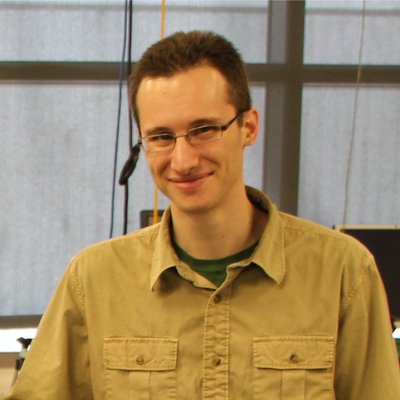
Sergey Levine
@svlevine • 132,938 subscribers
Associate Professor at UC Berkeley Co-founder, Physical Intelligence
Videos

Flow reversal steering allows "steering" diffusion-based VLAs with high-level actions, for example from VLM reasoning. This also lets us run RL in the diffusion noise space with exploration guided by high-level reasoning: think through a task, then practice it! 👇
Sergey Levine74,956 views • 2 months ago


If you want a robot to do something well, you need to know how to talk to it. If you don't, you can learn, with Semantic Action RL! In our paper, Jagdeep Bhatia, Andrew Wagenmaker, Will Chen show how RL over VLA prompts enables new tasks and learns blazing fast in the real world!
Sergey Levine31,286 views • 2 months ago

We finished evaluating π0.7, our new model at Physical Intelligence. What I'm most excited about with π0.7 is that it's starting to show some surprising emergent compositional generalization, being able to both perform complex tasks and learn new tasks just from instructions.
Sergey Levine61,198 views • 4 months ago

If you have a policy that uses diffusion/flow (e.g. diffusion VLA), you can run RL where the actor chooses the noise, which is then denoised by the policy to produce an action. This method, which we call diffusion steering (DSRL), leads to a remarkably efficient RL method! 🧵👇
Sergey Levine153,073 views • 1 year ago


Really excited to share what I've been working on with my colleagues at Physical Intelligence! We've developed a prototype robotic foundation model that can fold laundry, assemble a box, bus a table, and many other things. We've written a paper and blog post about it. 🧵👇
Sergey Levine114,997 views • 1 year ago


Diffusion models make great images. But can they drive robots? Usually that gets complicated really fast. We figured out how to get a Stable Diffusion model (based on Instruct pix2pix) to drive robotic instruction following. Simple recipe, works on a wide range of tasks. Thread👇
Sergey Levine126,572 views • 2 years ago

At Physical Intelligence, we teamed up with Weave Robotics and Ultra to stress-test our models in real-world deployments. This was a really fun collaboration that saw our latest pi06 model running in production at Sea Breeze Cleaners and a real warehouse! More below.
Sergey Levine31,910 views • 6 months ago


Watch this robot dog learn to walk from scratch in real time! Our new method, APRL, dynamically adjusts exploration constraints to enable fast and performant RL directly in the real world. APRL can also adapt to changes in the terrain. No simulation, no demos. A thread 👇
Sergey Levine105,579 views • 2 years ago


Language following is a tough problem for VLAs: while these models can follow complex language, in practice getting datasets that enable language following is hard. We developed a method to counterfactually and automatically label data to improve language following! 🧵👇
Sergey Levine44,236 views • 1 year ago


![If we train VLAs to respond to diverse multimodal prompts, then we can steer them better: [grasp the carrot]/[move to x,y,z]/[put the carrot on the plate]. With many levels of detail, powerful VLMs can step in and steer the model to success much more often! More below 👇](https://image.24vids.com/tw-2023446823483122086/amplify_video_thumb/2023445238883512321/img/Fv_SQ8bd7-_Z4k1T.jpg)
If we train VLAs to respond to diverse multimodal prompts, then we can steer them better: [grasp the carrot]/[move to x,y,z]/[put the carrot on the plate]. With many levels of detail, powerful VLMs can step in and steer the model to success much more often! More below 👇
Sergey Levine21,049 views • 6 months ago
