
The All-In Podcast
@theallinpod • 604,825 subscribers
@chamath, @jason, @davidsacks, and @friedberg cover all things economic, tech, political, social, and poker.
Shorts



Videos

All-In Summit: Elon Musk & Gwynne Shotwell -- AI Risks and Peer Review -- Starship -- Terafab as Taiwan Insurance -- SpaceX/Tesla Merger Potential -- Management at SpaceX ++ much more! (0:00) SpaceX's Gwynne Shotwell joins The Besties! (1:45) Gwynne's SpaceX story, selling rockets, and working for Elon (6:45) Running SpaceX: AI, Starlink, Rockets, and X (13:43) Direct to cell with Starlink, retiring rockets, competition (18:34) Data centers in space (22:00) Management at SpaceX (27:37) Elon Musk joins: AI's real risk, model peer review, what he meant by "Dario is right" (36:53) Elon and Gwynne on their working relationship, Starship's future (46:16) Terafab, Tesla, Flying cars?, merging Tesla and SpaceX (52:51) Lying AIs, how to do AI peer review right $TSLA $SPCX
The All-In Podcast8,867,345 görüntüleme • 1 ay önce

POD UP! 🚨 -- AI Cyber Panic w/ Nikesh Arora -- Ken Griffin’s Bubble Warning -- The Fall of France? (0:00) Bestie intros! (0:11) Ken Griffin's AI bubble warning (8:19) Palo Alto Networks CEO Nikesh Arora joins (14:24) AI Cyber panic: PHP exploits and the tumultuous year ahead (44:17) France on the brink: Riots, immigration referendum, debt crisis (1:31:49) Trump's second half strategy, Press Secretary J-Cal?
The All-In Podcast177,322 görüntüleme • 3 gün önce

David Friedberg: We’ve Lost the Plot on Immigration “If you're providing social services to an immigrant population, then that's not necessarily a productive immigrant population in terms of being able to contribute to growing the economy and supporting civil society. But if a population of immigrants come in and they're productive, meaning they can get jobs and they can work, and they can support themselves, that means they're adding something positive to the economy, to the civil society, and that is the sort of selection criteria that needs to take place. So that's a simple framework for determining whether or not you should do this, and an easy way to solve it is get rid of social services for immigrants. As soon as you get rid of social services for immigrants, then you self-select into the right population that's going to come in. It's not about assimilating to society. It's about sharing the values of what makes the United States, the United States. The values of, what do we actually care about, what are the principles that we all share as a civil society of the United States or a civil society of France, is a screening criteria that seems to have been thrown out the window.” Jason: “Do you believe in Freedom of speech? Do you believe in the Second Amendment?” Friedberg: “Do you believe that women are equal to men? Do you believe that you should work for your money as opposed to take it from the government? Do you believe in your individual rights? Is your church paramount to the government and the laws of the state? And do you believe that other people have rights that you don't get to trample on? Those are the sorts of things that are, in many cases, counter to the cultural, religious, and other traditional beliefs of certain populations that end up causing the damage in the West, and I think that it's been kind of completely lost in the process.”
The All-In Podcast165,515 görüntüleme • 3 gün önce


David Friedberg: France’s Crisis Is a Warning for America “France is a bellwether for the West. So take a look at this chart. This chart is a measure of public spending as a percent of GDP. And you can see the comparison of France's public spending as a % of GDP to the peak public spending as a % of GDP of major communist nations.” Chamath Palihapitiya: “So do you think France is a communist state? They spend like it.” @jason: “Well, it's certainly been a socialist state, right?” Chamath: “Is it working?” david friedberg: “That's my point. And I think this is such a prescient lesson for the West to look at. We all think that there's some political problem with Macron or whoever it was. The more the government spends, the worse the conditions get for its people, not the opposite, and then the people riot and revolt. Take a guess where the US is today. US public spending is roughly 36% of GDP. France today is operating its national government spending deficit is 5.4% of GDP. The US is actually 6.2% of GDP. France is, I think, probably the first to go because they're only growing their economy at half a percent while the US is growing at 2.3%. So we're still kind of hanging on because we have some degree of economic growth that's allowing us to kind of hold things together. But I would argue that we are facing the same sort of fiscal cliff which leads to this extraordinary social unrest as France. All the economic measures are aligned, we're at the same rate, we're at the same set of problems, and we're starting to see the cracks in the system. There's probably a multi-year solution.”
The All-In Podcast112,808 görüntüleme • 3 gün önce

David Sacks: Nonprofits need to manufacture problems in America to stay in business David Sacks: “Here's the systemic problem with nonprofits and NGOs. Let me just contrast it with business. In business, you set up a company, the company has to make revenue, it has to make profits. And if it doesn't, it's going to go out of business, right? Because it'll lose money. So there's a feedback mechanism from the market. With an NGO, nonprofit, what have you, they raise money. They don't sell things. They fundraise from donors in order to engage in an activity, but what happens over time is the actual activities may stop mattering, and all that really matters is they're able to keep fundraising, right? Because they're just trying to figure out a justification to keep going back to donors to get more and more money out of them. That's what perpetuates the organization.” Chamath: “ Why wouldn't the Southern Poverty Law Center focus on southern poverty? Which is an issue that actually still exists in some shape or form. Why do you call it one thing, focus on racism, and then all of a sudden whip up fake racism?” Sacks: “I do think that at one time in this country, civil rights was a noble cause, a very legitimate cause. We had the legacy of segregation and Jim Crow, and there were groups that were set up to basically change that, and they succeeded. But again, no one in an NGO or a nonprofit ever declares victory. When Obama got elected in 2008, regardless of whether you liked Obama or not, or agreed with his politics, I thought that at that point, most people could see that this was not a racist country. Whatever else you could say, the fact that the highest office in the land was not denied to anybody showed that this country was not holding people back based on their skin color. And instead of just basically packing up shop and saying, ‘Okay, we've achieved our goal,’ the goalposts all got moved. Remember, that's when the whole anti-racism thing started, was around Obama's second term. If they just said at that time, ‘You know what, we're going to move the goalposts from equality of opportunity to equality of results. We're going to basically make everyone equal at the finish line,’ which is to say, identity socialism. People would've said, ‘Eh, no, we're not on board for that.’ So instead, they created this whole new terminology to justify it. And it's taken us years to unpack that and realize what's really going on.”
The All-In Podcast11,705,699 görüntüleme • 6 ay önce

POD UP! 🚨 Ben Horowitz (benahorowitz.eth) fills in for david friedberg! -- CoreWeave's Tanks After Debt Selloff: Did the AI Trade Just Crack? $CRWV -- AI Deflation and the Future of Software -- Anthropic IPO: Red Flags, Valuation, How Much to Raise? -- Psyop Corner with Sacks -- Bill Gates the Doomer: What’s Behind His AI Warnings? (0:00) Ben Horowitz fills in for Friedberg! (2:18) CoreWeave's debt selloff: did the AI bubble just pop? (31:14) AI's deflationary impact: decompiled software (45:44) Anthropic's investor day gets mixed reactions (1:03:45) Psyop Corner: Anthropic warns about self-replicating models on IoT devices (1:22:19) Understanding Bill Gates the Doomer
The All-In Podcast337,518 görüntüleme • 10 gün önce

first video from the All-In Summit 2025 - in conversation with Elon Musk available exclusively on X (0:00) Besties welcome Elon via Starlink (05:31) Ukraine and Starlink (19:10) green shoots of X (22:24) the creator economy and optimizing the X experience (26:43) the ADL, free speech, and advocating for peace (32:41) China (37:20) AI (44:30) where are we with self-driving? and MUCH more
The All-In Podcast80,977,948 görüntüleme • 3 yıl önce


Chamath: France Won’t Fix Itself. The Bond Market Must Force Its Hand. “I think the people have a responsibility to understand the numeric reality in which they are living. (The French) are living in a state that is spending more than any communist utopia that they hoped to achieve. Yet the outcomes are broken, which means the system is broken, and you need to reset that. And the government will not reset it on its own, and so the bond vigilantes will have to do it for them. I think they need to break the back of the French government.” Jason: “Okay, there it is. There's the mandate.” Chamath: “I think you need to take France to 8% and just break them.” Jason: “Yeah, and then all of a sudden, austerity measures, immigration, all this stuff is going to be taken a lot more seriously.” Chamath: “At least it'll all be on the table, and they will have to sort out what they're willing to give up. But right now, if you can skate through this moment, then these things continue to fester, and it is a tinderbox that at some point, again, we know what the trail of breadcrumbs can lead to in terms of fomenting this societal rage. You cannot allow that to happen. And so the government has a responsibility now to nip this in the bud in a structural way.”
The All-In Podcast50,342 görüntüleme • 2 gün önce

All-In Summit: NASA Administrator Jared Isaacman A New Era for NASA and American Space Exploration (0:00) NASA Administrator Jared Isaacman lays out the state and future of NASA (17:59) Moon base, creating new space industries, NASA's next chapter (23:29) How to make Mars realistic (25:30) Recruiting, moonshots, the "Nuclear NASA," new vehicles and the importance of humans in space (32:43) Allocating capital toward scientific discovery and deep space research (35:46) Space Race 2.0: China and Russia Jared Isaacman NASA Administrator Jared Isaacman
The All-In Podcast1,023,460 görüntüleme • 1 ay önce

Chamath on Obama’s AI Warning: Follow the Money President Obama last week: “If we are thinking about AI just in terms of how do we cure cancer or get better energy, you can do that without having agentic AI. That's a misalignment between what our society needs and the commercial imperatives that these companies are facing.” Chamath Palihapitiya: “This is a very important moment for a very simple reason, which is we, as in the world, are about to endow three, four, five, six companies with about $10T of wealth. And what Obama knows very well is that most of those companies are overwhelmingly left-leaning. And what he also knows is that there is a huge portion of that money that will then get put into philanthropic and charitable causes that then he, and the people around him, will be beneficiaries of. That is the truth. We already know this because we know that some of these frontier corporations actually ask you to stand up DAFs and have a portion of your stock that you're willing to pledge. So this money is going to go to things other than consumption or savings. And so it's going to go into PACs, it's going to go into political movements, and (Democrats) stand to disproportionately benefit. So this has nothing to do with prosperity. This is a very simple political calculus. If you freeze frame the economy the way it is today, a handful of organizations that will disproportionately be able to affect the Democrats will win. They will capture the lion's share of the economic gains, and then they will help the Democrats win power. That's all this is.”
The All-In Podcast798,313 görüntüleme • 1 ay önce

The Media is Not Doing its Job Chamath Palihapitiya breaks down the viral "sharp as a tack" clip: "Six minutes of 100 spokespeople and proxies, and they all had the same thing to say about President Biden, which is, 'He is sharp as a tack.'" "If I asked 100 people on the street, 'What do you think of Elon Musk?' You'd have 100 different statements. There be a general theme, but you would not have even 50 people repeat the exact same words." "You have this funny situation where 100 different people were basically saying the exact same talking point. So it's not even a point of view. It was just something that they were told to say by somebody else." "And that is the real issue: you don't really have an honest media here. So there is no check and balance on power right now."
The All-In Podcast36,372,718 görüntüleme • 2 yıl önce
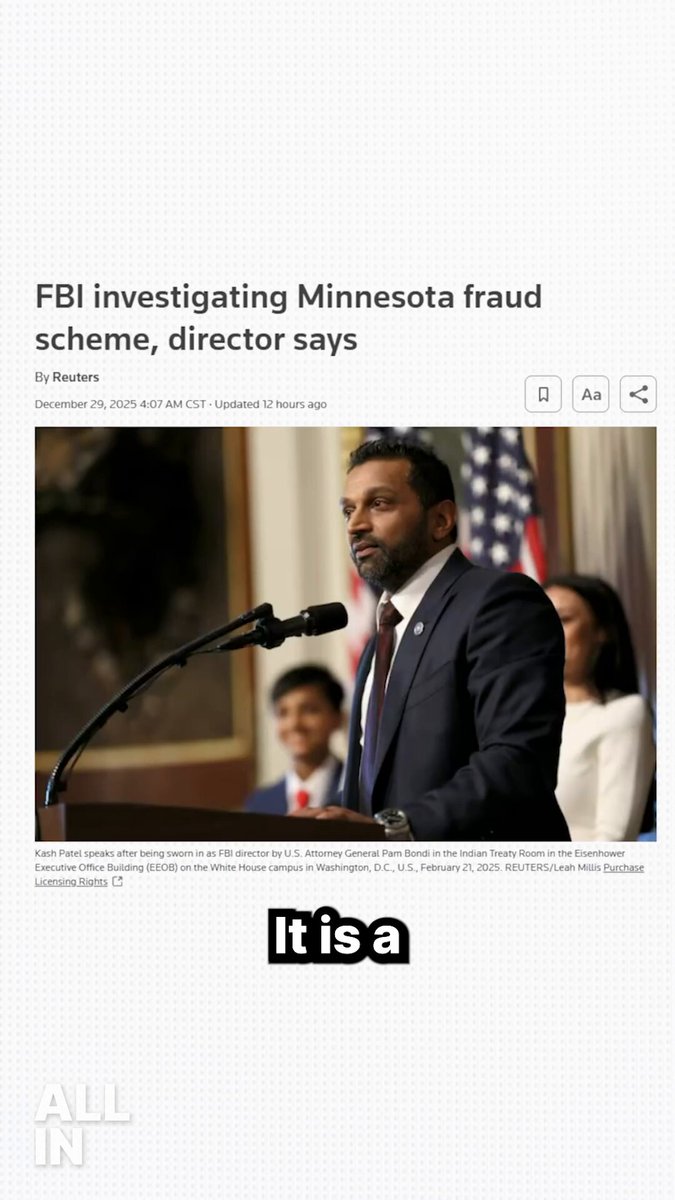
Chamath: Fraud at this scale will end the American Empire if nothing is done “It is a crucible moment for American society.” “If nothing happens and we deem this kind of theft acceptable, it is the beginning of the end of the American Empire.” “It's just a level of disrespect and lack of care for this country.” “I will be waiting and observing how important it is to root this out, that's number one.” “The second, which is more tactical political calculus, this is an enormous opportunity for the Republican Party if they take this and run with this.” “Is there waste, fraud and abuse in every state? Absolutely. I don't think this is endemically a Democratic problem, but the scale of it is so gargantuan in these Democratic states that if the Republicans don't take advantage of it, I think it is a huge political miscalculation.” “So there is this tactical opportunity, which I think if you want to have a chance in the midterms and if you generally wanna have a chance to level-set the country, you must take this and run with it.” “And then separately, if as Friedberg says, it does die on the vine, it is the beginning of the end of the American Empire, unfortunately.”
The All-In Podcast10,556,517 görüntüleme • 9 ay önce

Friedberg: New study shows enzyme reverses skin age from 70+ years to 31 Chamath: That’s a $2T market. Did Scientists Just Discover How to Reverse Skin Aging!? “CML is kind of the predominant molecule that gets formed in this extracellular matrix that's driving aging, and nothing breaks it down. So these scientists set out to try and create an enzyme, an enzyme is a protein that breaks something down, that can break down CML. And so these guys kind of went out and they took the target, which is CML, and tried to figure out, ‘Okay, how do we actually degrade CML, clear that extracellular matrix, and reverse aging?’ They started to test it on the proteins that we would find in our body, casein, collagen, retinal proteins, which are in your eye, hemoglobin, and they were able to get rid of 52 to 97% of the CML, just degrade it away. And then they found several sites where they were able to degrade over 90%. And then they took actual human skin from elderly patients that had donated their skin, and they put this enzyme onto that skin, and they were able to eliminate 55% of the CML on the skin, basically reverse the skin's age down to the age of a 31-year-old, this is from greater than 70-year-old patients, just by putting this enzyme on the skin. And so it's kind of a groundbreaking demonstration of combination of AlphaFold, what's called directed evolution, where you change the order of the DNA that changes the structure of the protein to test different proteins, do high throughput screening, and ultimately make a novel protein that doesn't exist in nature today that can do something pretty profound for human health.” Chamath: “It will be a trillion-dollar market. If you can create a cream…” Friedberg: “I mean, dude, if you could put this enzyme literally on your skin and have it absorb in…” Chamath: “Game over. That alone is $2 trillion.”
The All-In Podcast2,988,431 görüntüleme • 3 ay önce

THE ALL-IN SUMMIT IS LIVE! Jensen Huang joins The Besties live on stage! (ft. a legendary phone call from President Donald J. Trump) -- The AI Doomer Hoax -- Superintelligence Has Arrived? -- What RSI Actually Is -- The Future of AI: Open Source, China, The Next Industrial Revolution $NVDA (0:00) Jensen Huang joins The Besties! (1:39) Thoughts on Dario's blog, Frontier Labs calling to slow down AI, and Doomer psychology (9:58) Sensible AI regulation and RSI (16:05) Hugging Face acquisition, future of Open Source, and the race with China (22:58) President Trump calls in live to discuss the Doomer Hoax (31:29) The AI boom and Nvidia's capital allocation strategy (40:21) Nvidia's Open Source model ambitions, thoughts on Elon's Terafab
The All-In Podcast986,107 görüntüleme • 1 ay önce

Gavin Baker: Anthropic Believes They Could Be the ONLY Company Left in the World “I would certainly discourage Dario from saying that ever again to anyone.” Gavin Baker: “Internally, Anthropic is very confident. I have been told by multiple people I trust that Dario has said that Anthropic might be the only private company in the world at some point. Think about that. In this vision, an Anthropic maximalist vision, there's Anthropic, and then there are governments, and that's it. So there's a lot of confidence. I'm sure they have more advanced checkpoints than Fable up their sleeve. They've executed really, really well. I would probably take the under on them being the only private company in the world. Yeah, I think it's gonna be a long time before they land a rocket.” @jason: “Or they deliver your lunch. I don't know. There might be other businesses in the world. Zipline might want to bring you a burrito. Uber might want to take you somewhere. Waymo might want to drive you home. But sure, Dario.” David Sacks: “I might interpret that as a negative signal because it's so hubristic. This is getting into SBF land a little bit.” Gavin: “I would certainly discourage Dario from saying that ever again to anyone.”
The All-In Podcast1,795,681 görüntüleme • 2 ay önce

Chamath: Software IP Just Became Worthless “I think that IP and software was effectively rendered worthless two days ago. There have been people that decompiled the entire Big 5. What is the Big 5? Adobe has five very, very important products in their product suite, and these folks basically decompiled it, distilled it, and published open source versions of these things. I was so shocked because I was like, ‘Hold on a second. These are profound products that have existed and have had moats for years, and now they're just open source versions.’ If you think about it, when everything is headless, so when Elon makes his services headless, Benioff made Salesforce headless a few months earlier, when all of these things are headless and you can wrap them in agent tools and you can connect them via MCP to other experiences, the value of IP no longer exists in software. It doesn't exist.”
The All-In Podcast311,627 görüntüleme • 17 gün önce

Ben Horowitz: “Anthropic is one of the most negligent companies that we've ever seen in terms of security.” “I'll tell you a funny story. So when we first got Opus 4.5, we were doing cybersecurity checks for the firm. So we had an agent basically set up a website for a pet store. And then we took another agent and said, ‘Tell us if we can exploit that web store.’ And it gave us all the exploits it could find. So Opus 4.5 wrote really buggy code. Great. And then we said, ‘Oh, the SQL injection, is that actually exploitable that you found?’ And it goes, ‘Let's pop it open.’ And the agent using Opus 4.5 breaks into the website and steals all the customer data immediately. We then call Anthropic, and what they tell us is, ‘You prompted it wrong.’ Like that was their answer.”
The All-In Podcast166,564 görüntüleme • 9 gün önce