
Tykra
@ty_kra_lab • 4,563 subscribers
Future Experience Director / Creative Technologist. I turn emerging technology into experiences people can feel.🪁 This is a LAB, i repeat this is a LAB.
Shorts


Videos

Day 10 building the Figma for hardware. I guess vibe hardware it’s a thing now. Today I’m studying magnetic connectors: recessed contacts, pogo pins, magnets, alignment, tolerances and how the two sides actually meet. The whole system is parametric, so I can change the contact layout, magnet position, spring travel, cable geometry and even test misalignment, magnetic capture and disconnection. I like this one because a connector looks like a tiny detail, but once you can design its geometry and behavior together, it can completely change how a device is meant to connect, charge or expand
Tykra104,363 görüntüleme • 1 ay önce

I never lived early-2000s tech, when products had a soul and quality came first. So I recreated the 2007 iPod as an app, thanks to wabi not for nostalgia, but to explore something I never experienced. The phone is still the right form factor. We just haven’t explored how much it can morph.
Tykra436,370 görüntüleme • 10 ay önce

I’m really going to spam anyone who claims their Liquid Glass is the best. Yeah it works everywhere.
Tykra113,673 görüntüleme • 4 ay önce

Day 11 building the Figma for hardware until somebody invests in it. More and more we’re seeing personal devices, and one of the most important things is portability. Today I’m studying attachment systems: holes, metal eyelets, loops, bridges, recessed anchors and strap lugs. The whole system is parametric, so I can change the opening, wall thickness, position, protrusion, materials and how each attachment becomes part of the device itself. I like this one because carrying hardware sounds like a small detail, but it can completely change how a personal device is meant to live with you.
Tykra33,513 görüntüleme • 1 ay önce

Day 4 building the Figma for hardware. Today I’m studying the Digital Crown / rotary dial before implementing it into the system: rotation, resistance, precision, feedback, and how much control a small physical input can actually give you. The goal is to make hardware interactions parametric too, not just the shape of the device. Crowns, dials, switches, sliders and other controls should eventually have their own behavior that you can design and test.
Tykra36,720 görüntüleme • 1 ay önce

The Muse Charm Once reduced to parameters, some futures become unusually familiar.
Tykra20,520 görüntüleme • 24 gün önce

I told you I was the Kanye West of vibecoding. Or, as I call it: system sculpting. Today, with wabi, I recreated a fully working prototype of the stem player in less than 48 hours. A generative hardware interface that creates small samples and lets you mix them directly on the device. But here’s the wild part: there is no 3D model. No GLTF files, no external assets, no polygons. The entire device every curve, speaker hole, and glowing LED is pure math. Built with SDFs (Signed Distance Fields) and raymarched inside a single fragment shader on a 2D surface. Generative audio. Generative geometry. All native. All system sculpted. Have fun.
Tykra111,507 görüntüleme • 6 ay önce

Day 6 building the Figma for hardware. Another study today: transparent shells for transparent tech and windows, and how much the material changes what you can see inside a device. I’m exploring shell thickness, refraction, tint, frosted glass, optical layers and different window shapes, from small openings to convex lenses. The goal is to make transparency parametric too, so you can decide what the hardware reveals and how the material changes the way you see its internal components. Basically: the inside of a device can become part of its design.
Tykra28,402 görüntüleme • 1 ay önce

I pushed wabi further today. What i built isn’t just an effect it’s a revival of a technique that once existed only in early 90s computer graphics, re-engineered to run in real time on a modern mobile CPU. A glass sphere with physical refraction, depth distortion and light dispersion computed without any graphics engine. This level of optical behavior simply had never been achieved in this environment before. I call it Snow Glass, a Christmas experiment. And it shows how old ideas, when rebuilt with today’s tools, can unlock something entirely new.
Tykra104,385 görüntüleme • 10 ay önce


Day 5 building the Figma for hardware. Today I kept studying rotary controls, this time turning them into fully customizable knobs: size, shape, grip, depth, rotation and visual details can all be changed depending on the device. The goal is to treat knobs as real hardware components, not fixed 3D assets. One system should be able to generate everything from a tiny precision dial to a large tactile control.
Tykra17,503 görüntüleme • 1 ay önce
Based on the WWDC 2026 leaks, I tried to recreate the iOS 27 revamped Siri interaction inside the Dynamic Island in swift ui with lots of different settings and some custom shaders. And yeah, if it’s like that, it will be kinda boring going from a rainbow like ui to a monochrome one.
Tykra38,717 görüntüleme • 4 ay önce
![Day 18 building the Figma for hardware until somebody invests in it. [hardware component] Today I’m studying something that usually gets almost no attention: the bottom of a product. I built a parametric component for different support architectures: rubber feet, rails, continuous perimeter supports, recessed pads, metal feet and hemispherical feet. The interesting part is that changing the support also changes the surrounding geometry: position, spacing, recesses, adhesive layers, screws, ventilation, grooves and clearances all adapt with it. It could be useful for everything from speakers and chargers to desktop hardware, docks and small appliances, where stability, grip, airflow and assembly all start from the same seemingly boring surface.](https://image.24vids.com/tw-2101246695182852351/amplify_video_thumb/2101246390860918785/img/4DNzW9JGT3neVrNd.jpg)
Day 18 building the Figma for hardware until somebody invests in it. [hardware component] Today I’m studying something that usually gets almost no attention: the bottom of a product. I built a parametric component for different support architectures: rubber feet, rails, continuous perimeter supports, recessed pads, metal feet and hemispherical feet. The interesting part is that changing the support also changes the surrounding geometry: position, spacing, recesses, adhesive layers, screws, ventilation, grooves and clearances all adapt with it. It could be useful for everything from speakers and chargers to desktop hardware, docks and small appliances, where stability, grip, airflow and assembly all start from the same seemingly boring surface.
Tykra10,765 görüntüleme • 29 gün önce

I see Liquid Glass everywhere but the problem is everyone’s created a sphere and that’s it. I prefer to create systems. I’ve Vibecoded the full-fledged cpu based universal Liquid Glass design system that works on every browser and device , getting closer and closer to the official iOS 26 one. Still working in progress before a full release.
Tykra41,704 görüntüleme • 5 ay önce

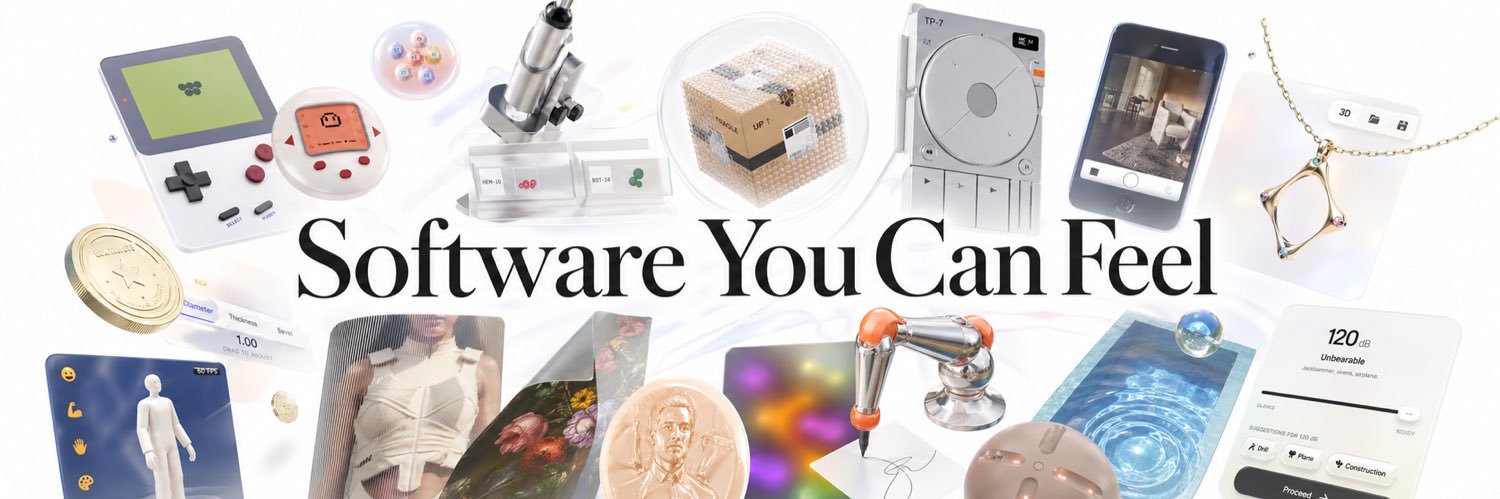
Software you can feel. Today with wabi I built something the world probably didn’t know it needed. A wax seal creator inspired by all those Pinterest stamp images and my obsession with medieval emblems. You upload a stamp, tap the wax, and watch it melt and deform almost like your screen is giving in. Not just visual. Physical. And yes, you can export your stamp as a png to use on your letters.
Tykra49,285 görüntüleme • 7 ay önce

Engineers with taste will make a lot of so-called designers irrelevant. It’s 2026. With all the vibe-coding tools we have now, you can build real working prototypes of almost anything in a few hours. So when I see another “iOS 27 concept” that is just a Figma screenshot with a gradient or a circular one, and some fake Liquid Glass layer on top, that’s laziness at the next level for the sake of engagement.
Tykra29,757 görüntüleme • 4 ay önce

Here’s the problem: software interfaces are abstract, hardware is instinctive. We don’t learn objects, we recognize them. Buttons, wheels, friction, position they map to how we exist in the real world. Menus, layers, hidden states they fight against it. This is why this feels different. It’s not an app pretending to be a recorder. It’s a recorder that happens to exist in software. Built in wabi
Tykra30,343 görüntüleme • 6 ay önce

