
Untold War Stories
@UntoldWarFacts • 22,644 subscribers
The stories they don't teach you in the history books, daily. Check out the highlights for previous stories.
Shorts

Videos

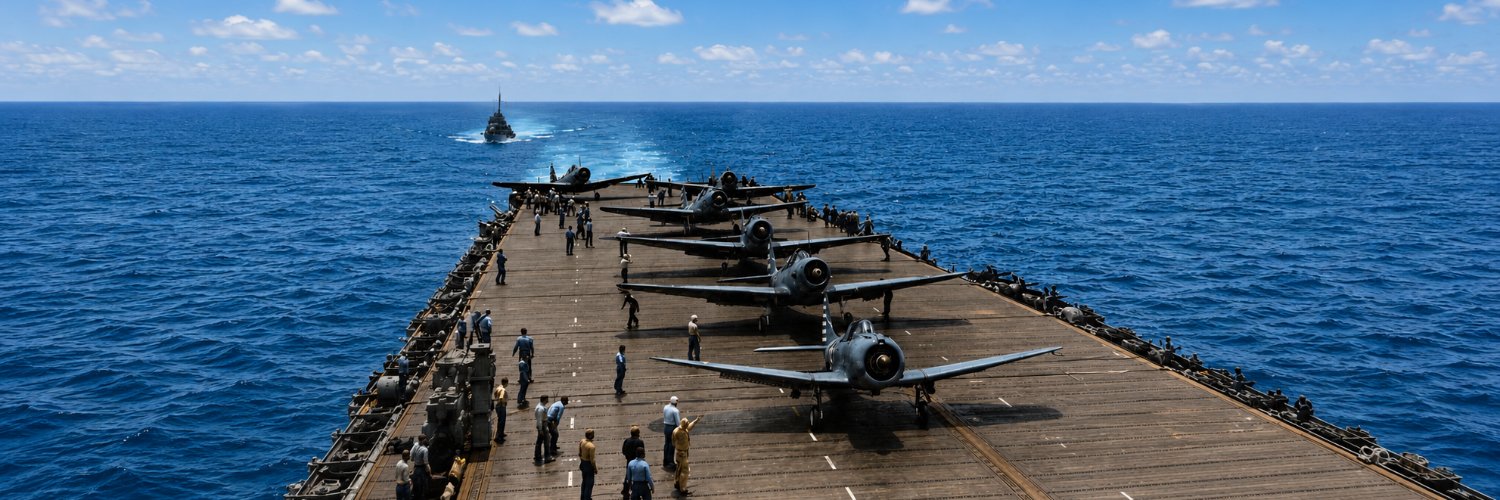
This is restored footage of a F6F Hellcat belly-landing on a carrier in 1944, with no landing gear, sliding down the deck. Watch what the crew does. They do not run away from the crashing plane. They run toward it. This is the story of the men on the deck.. A Controlled Crash Landing an aircraft on a carrier has been called one of the most difficult and dangerous things in all of aviation. Some pilots described it as a controlled crash. Think about what it involves. A fighter comes screaming toward a tiny strip of deck on a ship that is itself moving through the ocean, pitching on the swell. The pilot has only a few feet of margin. He has to slam his aircraft down onto a precise spot, at exactly the right speed and angle, again and again, every time he comes home. To stop the plane in the short space of the deck, each aircraft had a hook mounted under its tail. As it touched down, that tailhook had to catch one of several steel cables stretched across the deck, called arresting wires. The cable would snatch the speeding fighter and drag it to a halt in about two seconds. But what happened when it went wrong? When Things Went Wrong That is where the danger truly began. If a pilot came in with damaged landing gear, or no gear at all like the Hellcat in this footage, or if his tailhook missed every wire, the aircraft became a several-ton object sliding down a steel deck out of control. And the front of that deck was not empty. It was often packed with other aircraft, fueled and armed, and crowded with men working. A plane that slid all the way forward could plow straight into parked aircraft and deck crews, and turn the whole deck into an inferno. So the carriers had a last line of defense. A crash barrier, a wall of heavy steel cable raised across the middle of the deck, designed to catch a runaway aircraft and stop it before it reached the crowd at the bow. Time and again, that barrier was all that stood between one bad landing and a catastrophe. The Landing Signal Officer Guiding every one of those landings was one man in an incredibly exposed position. He was the Landing Signal Officer, and he stood on a small platform at the aft port side of the flight deck, close to where the aircraft came in. Holding a bright paddle in each hand, he signaled to each incoming pilot, telling him he was too high, too low, too fast, lined up wrong, or clear to land. The pilot trusted those paddles with his life. A good Landing Signal Officer could talk a shaken pilot and a shot-up aircraft safely down onto the deck. It was a job that demanded total calm and split-second judgment, over and over, with lives riding on every signal. One young officer who served as a Landing Signal Officer early in the war, David McCampbell, would go on to become the US Navy's top-scoring ace. The Men Who Ran Toward the Fire Then there were the men who ran toward the fire. The flight deck of a wartime carrier was a storm of spinning propellers, roaring engines, live bombs, high-octane fuel, and steel cables under enormous tension that could snap and cut a man in half. To manage the chaos, the crews wore jerseys in different colors, each color marking a job, so that in the deafening noise everyone could tell at a glance who did what. Men in one color directed the aircraft, another handled the arresting gear, another fueled the planes, another the bombs. And among them were the men in heavy asbestos suits, nicknamed the Hot Papas. Their job, when an aircraft crashed and burst into flames, was to run directly into the fire and pull the pilot out. That is what you are watching in this footage. As the Hellcat grinds to a stop, the men who rush toward it are not spectators. They are doing their job, closing on a possible fire and a trapped pilot without hesitating. The Forgotten Crew Landing accidents like this happened constantly. Belly landings, missed wires, barrier crashes, and deck fires were so common that they were simply accepted as part of the price of operating aircraft at sea. For every dramatic dogfight in the sky, there were thousands of these tense, dangerous moments on the deck, handled by young men in colored shirts who are almost never remembered. The pilots got the glory, and they earned it. But they could not have flown at all without the deck crews who launched them, guided them home, caught them when they came in wrong, and ran into the flames when it all went bad. The next time you see footage like this, do not just watch the plane. Watch the men around it. They worked one of the most dangerous jobs of the entire war, and most of the world never knew their names. This was the story of the carrier deck crews. I post a story like this every single day. Most people never see them. Follow so you don't miss the next one.
Untold War Stories145,990 Aufrufe • vor 1 Monat

Two air forces started the Pacific war. One trained its pilots, then kept them fighting until they died. The other trained its pilots, then often pulled many of its experienced combat pilots out to teach everyone else. This is one of the reasons America won the Pacific air war, let's dive in.. Japan's Elite Aviators At the start of the war, Japan had some of the finest fighter pilots in the world. The aviators who attacked Pearl Harbor were elite. Many had hundreds of hours in the cockpit and real combat experience from the fighting in China. Flying the nimble A6M Zero, they cut through Allied opposition in the early months of the war and earned a fearsome reputation. But Japan made a fateful choice about these men. It kept them in combat, more or less indefinitely. Japanese pilots flew mission after mission with no real system to rotate them home. They fought until they were shot down, crippled, or killed. It seemed ruthless and efficient. In reality, it was a slow-motion disaster. The Difference in Philosophy Because every time Japan lost one of those veterans, everything he knew died with him. America did the opposite. It regularly rotated many of its experienced combat pilots back home once they had done their share of fighting. There, they became instructors, pouring everything they had learned in real air combat directly into the next generation of pilots. So the two systems pulled in opposite directions. Japan's pool of skill drained away with every ace it buried. America's pool of skill grew, as each returning veteran multiplied his knowledge across hundreds of students. One nation was teaching. The other was simply dying. The Training Gap The gap became a chasm, and it was made worse by sheer scale. By 1944, the United States was training around 8,000 new aviators every month, each of them getting well over a year of instruction and hundreds of hours in the air before they ever saw combat. Japan could not come close. As its veterans vanished, its training program collapsed, and it was crippled by something else, too. Fuel. Japan was running so short of it that many trainees could barely fly enough hours to learn their trade. By the later part of the war, Japanese pilots were being rushed into battle with barely 100 hours of flying time, and sometimes far less. They were teenagers with almost no training, being sent up against American veterans who had been taught by the best combat pilots in the fleet. The outcome was no longer a contest. It was a slaughter. The Great Marianas Turkey Shoot Nowhere was that clearer than in the skies over the Mariana Islands in June 1944. When the Japanese launched hundreds of aircraft against the American fleet, they flew into a wall of Hellcat fighters, guided by radar and expert fighter direction that positioned the Americans at the perfect height and moment to strike. The green Japanese pilots in their now outdated Zeros never had a chance. In and around that battle, Japan lost nearly 480 aircraft, while the Americans lost only a few dozen. It was so one-sided that the American aviators nicknamed it the Great Marianas Turkey Shoot. Japan's naval air power, once the terror of the Pacific, was broken in a matter of days. Better Aircraft, Better Technology It was not only the pilots. It was the machines too. America kept producing better and better aircraft, like the tough, heavily armed F6F Hellcat, designed after studying a captured Zero and built to beat it. It could take punishment, out-dive and out-gun its opponent, and it was forgiving enough that even a less experienced pilot could survive his first fights and become a veteran. Over the war, Hellcat pilots claimed more than 5,000 enemy aircraft for a tiny fraction of that in losses. Japan, meanwhile, kept sending men up in the aging Zero, a plane that had been revolutionary in 1941 but was now underpowered, fragile, and outclassed. It was fast and agile, but a single burst of American fire could tear it apart, because it had traded armor and protection for maneuverability. Better pilots, in better planes, backed by better technology. The advantages stacked on top of one another. The Spiral Ends By the end, Japan had reached the final, desperate stage of the spiral. With almost no trained pilots left, and no way to make more in time, it turned to the kamikaze. A pilot did not need 500 hours of training to crash his aircraft into a ship. He only needed to take off, aim, and die. It was the last resort of an air force that had run out of the one thing it could never mass produce. Experienced men. America won the Pacific air war for many reasons. Its factories out-built the enemy. Its radar and intelligence gave it eyes the Japanese lacked. Its aircraft grew deadlier every year. But underneath all of it was something simpler. America treated its best pilots as a resource to be protected and passed on. Japan treated them as fuel to be burned. One of those choices built an air force that kept getting stronger. The other burned brightly, and then burned out. This was why America won the Pacific air war. I post a story like this every single day. Most people never see them. Follow so you don't miss the next one.
Untold War Stories155,561 Aufrufe • vor 1 Monat

This is real footage of a kamikaze attack. Here is the terrifying part. Even if the gunners hit the plane, it often kept coming. Even if the pilot was killed, the aircraft could still continue on its dive toward the ship. To survive, they didn't just have to hit it. They had to blow it out of the sky. This is the story of the men behind those guns.. A NEW KIND OF NIGHTMARE By the last year of the war in the Pacific, the men on American warships faced a new kind of nightmare. The Japanese had begun sending pilots to deliberately crash their bomb-laden aircraft into Allied ships. These were the kamikaze. A conventional attacking plane could be driven off or made to miss. A kamikaze could not. The pilot was not trying to survive. He was aiming his entire aircraft, like a guided missile made of metal and fuel and one human being, straight at the deck of your ship. This changed everything for the gunners. Against a conventional attack, damaging the aircraft or forcing the pilot to break off was often enough. Against a kamikaze, that could be useless. Even a mortally wounded pilot, even a dead one, could keep falling on the same deadly path. The only reliable way to stop him was to destroy the aircraft or knock it off its attack path before it reached the ship. THE WALL OF FIRE To do that, an American aircraft carrier bristled with anti-aircraft guns, layered from the biggest down to the smallest, so that an attacker had to survive one killing zone after another to reach the deck. Farthest out, the larger 5-inch guns firing radar-directed, proximity-fuzed shells could begin engaging attackers miles away. These shells did not even need a direct hit. They were designed to explode automatically as they passed close to an aircraft, and they made the fleet's heavy guns dramatically deadlier late in the war. Closer in came the workhorse, the 40mm Bofors, a hard-hitting automatic cannon that fired explosive shells fast enough to shred an aircraft. It was so effective that during the peak kamikaze months, this one weapon accounted for around half of all the aircraft shot down by US Navy ships. And closest of all was the 20mm Oerlikon, the last line of defense before a plane reached the ship. THE MEN BEHIND THE GUNS The men who fired those close-in guns were among the most exposed human beings in the entire war. The gunner on a 20mm Oerlikon had little protection, often just a small shield, and he aimed the weapon by physically swinging the gun with his own strength, firing over simple sights. There was no turret to climb inside, no armor to hide behind. That meant he was looking directly down the flight path of the plane trying to kill him. As a kamikaze dove, the gunner had to stand his ground in the open, hold his aim, and keep firing straight into the face of an enemy pilot who was diving to his death and trying to take as many Americans as he could with him. He could not run. He could not hide. He could only keep firing and hope he stopped the plane before it arrived. WHEN HITTING WASN'T ENOUGH And here was the cruelest part. Often, even hitting the plane was not enough. The 20mm guns in particular proved increasingly inadequate against the fast, heavily loaded kamikazes of the late war. Gunners would hit the diving aircraft, watch pieces fly off it, and see it keep coming anyway, continuing its dive even after the pilot had been killed. Unless the plane was actually broken apart or knocked off its path, its momentum carried it home. This was exactly why, as the war went on, many ships stripped off some of their smaller guns and packed on more of the harder-hitting Bofors. The volume of fire this demanded was staggering. When a raid came in, a carrier under attack became a floating volcano of tracer and flak, every barrel firing at once, throwing up a wall of fire that an attacker had to fly straight through to reach the deck. Yet the Navy knew even that was not always enough, and kept racing to improve, with better radar, better proximity-fuzed ammunition, and plans for more powerful guns. THE LAST LINE OF DEFENSE So it came down to the men. To the gunners standing at their mounts, firing continuously, sometimes with a plane coming apart in the air right in front of them, sometimes with one that would not come apart no matter how many rounds they poured into it. They stood in the open with little protection and did not leave their guns, because the hundreds of men below deck, and the ship itself, depended on them holding their aim in the last few seconds before impact. Some of those gunners were killed at their posts, still firing, when a plane they could not stop finally struck home. The footage of a kamikaze diving on a carrier is dramatic to watch from a distance. But every one of those attacks was decided by young men standing behind those guns, in the open, with only seconds to stop an enemy from killing them all. This is the story of the men behind the guns. I post a story like this every single day. Most people never see them. Follow so you don't miss the next one.
Untold War Stories158,378 Aufrufe • vor 1 Monat

This is real footage of Zeros taking off from the deck of the Akagi. For half a year, this single ship was the most successful aircraft carrier on Earth. Its planes struck Pearl Harbor, Darwin, and Ceylon, and it never lost. Then, in a few minutes, she was doomed. This is the story of the Akagi.. ⠀ From Battlecruiser to Flagship The Akagi, named after Mount Akagi in Japan, was not even meant to be a carrier. She was laid down as a massive battlecruiser, but a naval treaty in the 1920s halted her construction. Rather than scrap the enormous hull, Japan rebuilt her into an aircraft carrier, one of the largest in the world. By 1941 she had become the flagship of the Kido Butai, the First Air Fleet. This was the most powerful concentration of naval air power on the planet, six aircraft carriers operating together as a single striking fist, something no other navy had ever done. From her deck, Admiral Chuichi Nagumo commanded the whole force. When Japan decided to open the war with a knockout blow against the United States, it was the Akagi that led the way. The Carrier That Led Japan's Offensive On the morning of December 7 1941, the Akagi sat in the dark waters north of Hawaii, and launched her aircraft toward Pearl Harbor. Her torpedo bombers helped tear apart the American battleship fleet as it lay at anchor. The man who led the entire air attack, Mitsuo Fuchida, flew from her deck. The Akagi was, quite literally, the ship from which America's war began. And she was just getting started. Over the next several months, the Akagi and her sister carriers went on a rampage across a third of the globe. In January they struck Rabaul. In February they fell upon the Australian city of Darwin, launching a devastating surprise raid that sank eight ships and became known as Australia's Pearl Harbor. ⠀ Across the Indian Ocean Then they turned west, into the Indian Ocean. In the spring of 1942 the Kido Butai swept toward Ceylon, hunting the British Eastern Fleet. Akagi's aircraft helped sink British warships, including the heavy cruisers Cornwall and Dorsetshire, and sent the Royal Navy reeling out of the eastern Indian Ocean entirely. In just half a year, the aircraft launched from that deck had struck Hawaii, the Dutch East Indies, Australia, and Ceylon. They had helped sink American, British, and Australian ships across thousands of miles of ocean. The Akagi had not lost a single battle. She was the most successful and most feared aircraft carrier in the world, the flagship of a force that seemed unstoppable. It would all end on one morning in June. The Battle of Midway In June 1942, the Akagi led the Kido Butai toward a tiny American outpost called Midway. The plan was to seize the island and destroy what was left of the American carrier fleet. But the Americans had broken the Japanese codes. They knew the Akagi and her sisters were coming, and they were waiting. On the morning of June 4, the battle turned into chaos. The Japanese carriers had just fought off waves of American attacks, and below the flight deck the Akagi's hangars were packed with aircraft being frantically rearmed and refueled, fuel lines and bombs lying everywhere. It was the most dangerous possible moment to be caught. And at that exact moment, American dive bombers rolled in out of the sky, unseen until it was too late. ⠀ One Bomb A lookout screamed a warning. Then the bombs fell. The Akagi was struck by a single bomb from an American dive bomber, dropped by Lieutenant Richard Best, while near misses battered her hull and jammed her rudder. Just one direct hit. But it struck in the worst possible place, punching down into the hangar deck packed with armed, fueled aircraft. The explosion set off a chain reaction. Fires roared through the ship, feeding on the fuel and detonating the bombs stacked among the planes. Within minutes the pride of the Japanese fleet was doomed, a spreading inferno no one could control. The flagship that had conquered half an ocean was mortally wounded by one well-aimed bomb. Admiral Nagumo was forced to abandon his burning flagship and transfer his command to another ship. The Akagi was left blazing, unnavigable, circling helplessly. The End of the Akagi The Akagi burned all day and into the night. Unable to save her, and unwilling to let her fall into American hands, the Japanese ordered her own destroyers to sink her. In the early hours of June 5 1942, torpedoes from her escorts sent her to the bottom. She went down bow first. 267 of her crew died with her. She did not go alone. All four Japanese carriers at Midway, every one of them a veteran of Pearl Harbor, were sunk in the same battle, taking with them their irreplaceable aircraft and elite crews. It was the turning point of the entire Pacific war. Japan would never recover the initiative. For over 75 years, the Akagi lay lost in the dark. Then in 2019 her wreck was finally found, more than 17,000 feet down, and in 2023 a robot submarine descended to look upon her for the first time since she sank. The most successful carrier in the world, resting in the deep, where a few fatal minutes sent her. This was the story of the Akagi. I post a story like this every single day. Most people never see them. Follow so you don't miss the next one.
Untold War Stories69,588 Aufrufe • vor 1 Monat

This is a real US Army Air Corps recruiting film, the kind shown in movie theaters during World War II. Young men watched it between features, and on the way out, they were told to stop at the box office and sign up. And thousands of them did, knowing exactly how dangerous it was. This is the story of the generation that answered.. A Night at the Movies Picture the moment. A young man sits in a darkened theater in 1943, somewhere in small-town America. Between the newsreel and the feature, this film flickers onto the screen. Sleek fighters rolling through the clouds. Great bombers thundering into the sky. Men with silver wings on their chests. For a generation of boys who had grown up watching aircraft pass overhead and dreaming of flight, it was everything. The chance to fly, to serve, to be part of the greatest fight of their lives. At the end came the invitation. Stop by the box office on your way out for complete information. One famous recruiting film of the era led more than 150,000 young men to sign up to fly. All across the country, ordinary young men walked out of a movie theater and toward a recruiting desk. Farm boys, factory workers, students, clerks. Most had never flown in their lives. Many had never left their home state. They were about to enter the most dangerous skies on Earth. They Knew the Risks They did not go in blind. By 1943, the young men signing up had a fair idea of what they were choosing. They had read the casualty lists in their local papers. They knew boys from their own towns who had gone up and not come back. Word traveled. Everyone understood that flying in combat was among the most dangerous things a person could do in the entire war. The numbers behind that feeling were staggering. The Eighth Air Force, flying from England, would lose more than 26,000 men killed. That is more fatal casualties than the entire United States Marine Corps suffered in all of World War Two. For the men in the bombers, the air crews, the death rate climbed higher than in almost any other branch of the service. In the darkest stretch of 1943, only about one in four Eighth Air Force bomber crewmen completed a full tour of missions. They knew. And they signed up anyway. The Most Dangerous Skies on Earth What waited for them was a kind of combat no generation had ever faced before. The bomber crews flew in daylight, deep into enemy territory, often before long-range fighter escorts could protect the whole way. They climbed to 25,000 feet, where the air was so thin they needed oxygen to breathe and so cold, around forty below, that exposed skin could freeze in moments. And then the enemy came. German fighters slashing through their formations. Anti-aircraft shells, called flak, bursting all around them, filling the sky with jagged steel. One airman described it as being trapped in a game of Russian roulette. You were going to be hit, he said. It was only a question of where, and when. The fighter pilots faced their own trials, dueling enemy aces, nursing shot-up aircraft home over the sea, taking off again and again knowing the odds caught up with almost everyone eventually. These were boys, many of them still teenagers, doing all of this miles above the earth. They Kept Going Up And here is the thing that should stay with us. They kept going up. A bomber crew might watch the plane beside them explode, see friends fall from the sky, land with their aircraft torn to pieces, and then be told they were flying again the next morning. And they went. Not because they were fearless, but because they had a job to finish and men beside them who were counting on them. They wrote calm letters home so their mothers would not worry. They gave their aircraft cheerful names and painted them on the nose. They found ways to laugh between missions that might kill them. And when the call came, they climbed back into the cockpit. That quiet, stubborn courage, repeated by hundreds of thousands of young men, is what won the war in the air. The Generation That Answered When you watch that old recruiting film now, it is easy to see only the polished images and the confident narrator. But remember what it really was. An invitation, offered to a generation of ordinary young Americans, to step out of a movie theater and into history. And remember that they took it, freely, knowing the price might be everything. Many of them never came home. They are buried under white crosses in England, in France, in Italy, and beneath the seas they flew over. The boys who did come home rarely bragged about it. They went back to their farms and factories and families and quietly built the country we live in now. They were not born heroes. They were just young men in a movie theater, who stood up when their country asked, and answered. This was the story of the generation that answered. I post a story like this every single day. Most people never see them. Follow so you don't miss the next one.
Untold War Stories12,454 Aufrufe • vor 1 Monat
Keine weiteren Inhalte verfügbar