
Voyageurs Wolf Project
@VoyaWolfProject • 52,437 subscribers
The official Twitter account of the Voyageurs Wolf Project, which studies wolves in the Greater Voyageurs Ecosystem, MN.
Shorts


Videos

Without a doubt, our best trail camera capture yet: the first documented observation of a cougar with kittens in Minnesota in modern history. Turn up the volume to hear all the vocalizations. The footage, which was captured on March 25, shows a cougar with 3 large kittens while they feed on a deer they killed just south of Voyageurs National Park. We captured this surreal footage because we started a study to understand the survival and mortality patterns of deer in our area this winter. As part of that work, we GPS-collared several deer in the area in January. In late March, we received a mortality signal from a GPS-collared deer and found the carcass buried under a pile of leaves on a hillside—a tell tale sign of feline predation. We suspected it was likely a bobcat but thought, just possibly, it could be a cougar. So we put up two trail cameras on the cached deer carcass and 4 hours later, two cougar kittens returned to the kill. The entire family showed up that evening and spent hours in front of our cameras. In total, we captured 7.3 hr (435 minutes) of video footage of these animals. We will share more footage soon! Huge thanks to the Minnesota Environment and Natural Resources Trust Fund for supporting the Voyageurs Wolf Project and the recent effort to understand deer survival in the area. Their support was critical to this observation—without it, we would never have captured this footage. And huge thanks to the >10,600 donors who have supported our project and enabled us to purchase trail cameras supplies. The cameras (and batteries, SD cards, mounts) we set at this kill were purchased with funds from donations.
Voyageurs Wolf Project1,091,665 views • 4 months ago

1:55
Sensitive content
This media may contain sensitive content.
In all our years of research, there was one behavior we could never observe, one event we just couldn’t capture on camera, our 'white whale' you might say. But after years of meticulous preparation and planning. studying footage, reading animal tracks and sign, and becoming one with the forest, we have finally captured that which we sought: raccoons doing it. And we did not just get a glimpse—we captured a whopping 101 minutes of unfettered copulation spread across 3 days. Well, take that back, there was, what appeared to be, a 3rd wheel that interrupted some lovemaking on a beautiful sunny March day. But now that we think about it, it is more likely a youngster that walked in on its parents and is now scarred for life by what it saw. But this pair did not let that interruption deter them, they just did it for 66 minutes straight a few days later. The life of a raccoon...
Voyageurs Wolf Project937,254 views • 8 months ago

Some ethereal footage from this summer. This wolf is a lone wolf passing through the area as there are no black wolves in the 19 packs in the Greater Voyageurs Ecosystem, which is not atypical. There have not been any black wolves in any packs in the area for over a decade. Although resident black wolves in our area are rare, we do generally document 1 or 2 transient lone black wolves passing through every year.
Voyageurs Wolf Project55,087 views • 17 days ago

From early May: cougar grooming himself after feeding on a GPS-collared deer he killed. We have routinely captured this male on camera over the past 3 months now suggesting he has taken up residency in the area and is occupying a territory (i.e., not wandering like dispersing males typically do). Note: we have had folks ask to see more of the footage we have captured of cougars over the past few months so we will try to share more footage in the coming weeks. We captured many hours of footage at the kill where we documented the female with 3 kittens as well as at the kill in early May by this male. In addition, we have captured many videos of this male over the past few months just walking down roads and trails. All this to say, more footage to come! Huge thanks to the Minnesota Environment and Natural Resources Trust Fund for supporting the Voyageurs Wolf Project and the recent effort to understand deer survival in the area. Their support was critical to this observation—without it, we would never have captured this footage. And huge thanks to the >10,600 donors who have supported our project and enabled us to purchase trail cameras supplies. The cameras (and batteries, SD cards, mounts) we set at this kill were purchased with funds from donations.
Voyageurs Wolf Project164,558 views • 2 months ago

Time has taken its toll on this old lone wolf who has wandered our area by himself for the past 3 years (footage from this past winter). He looks battered and weather from an intense and rugged lifestyle. Aside from just being old, the wolf has a significant limp because he is missing his two front right toes. You can see this in the first sequence well.We don’t know how that injury happened. How a wolf in this condition survives year after year is certainly intriguing. In particular, how he keeps himself fed is fascinating because it is hard to imagine him chasing down deer by himself but possible he is capable of it. We suspect he is likely an expert scavenger, finding morsels of food here and there, but can a wolf like this persist just by scavenging all year? More specifically, is there enough food lying around on the forest floor year round for a wolf to exist solely on scavenging? Seems hard to imagine but perhaps. Anyway, many years ago, we captured this wolf on camera once or twice when he was part of a pack that lived just outside of our study area. The pack made a few forays into our area which is when we observed him. At that time, the wolf was in his prime, though he still had the distinctive largely white face, and appeared to be the breeding male of that pack. But such times would not last for this fella. And now after many years on his own, it seems this wolf likely doesn’t have many years left. "Time the conqueror", as Jackson Browne put it, has taken its toll.
Voyageurs Wolf Project35,749 views • 13 days ago

A fascinating interaction between a wolf and a bear at a bait pile put out by a local bear hunting guide. The bear initially chases the wolf away, but 5 minutes later, the wolf and bear are feeding at the bait pile a few feet from each other. We are currently in the 2nd week of the bear baiting season, and the hunting season opens tomorrow. Starting in mid-August, hunters maintain bait piles stocked with foods such as nuts, candies, donuts, and dried fruit to get bears visiting the area before the season opens on Sept. 1. All in all, bear hunting is a boon for wolves because it happens at their leanest time of year. As a result, wolves quickly find the bait piles in their territories and spend considerable time eating the bait (as you can see here). Once bear hunting season begins, the situation gets even better for wolves for three reasons: The first is that bear season results in many gut piles which wolves will eat in a heartbeat (and they excel at finding them). The second is that hunters and guides discard the remains of bear carcasses they have butchered (we know this always surprises some but people eat bear meat…we have had it and it is pretty tasty). Wolves find these carcasses and spend a lot of time scavenging every last morsel. The third reason: some bears are wounded or killed but not recovered by hunters. Both scenarios create opportunities for wolves to get the biggest-ticket item of bear season: an entire bear carcass. When bears are killed but not recovered, wolves win the lottery: a 100 to 300+ pound buffet just sitting in the woods, ready to be consumed. For a 60- to 70-pound wolf at the leanest time of year, that is about as good as it gets. When bears are wounded, wolves almost certainly can and will kill and consume them if the bear is vulnerable enough. We have studied wolf predation for the past 12 years, and almost the only time we have documented predation on black bears is in September, and to a lesser extent, early October. Overall, bear hunting almost certainly increases the interactions between wolves and bears. Some interactions, such as this one, are chill—with both animals tolerating each other. Others are not so chill. Either way, wolves definitely benefit from bear hunting.
Voyageurs Wolf Project19,072 views • 7 days ago

The Blackstone Pack really liked our cameras this winter…
Voyageurs Wolf Project68,737 views • 1 month ago


Highlights from a year at the intersection of a remote hiking trail and a deer trail.
Voyageurs Wolf Project199,121 views • 5 months ago

Don’t be deceived! This wolf used its good looks and cute behavior to move in close, and then just when its victim had let down its guard, the wolf launched a vicious and merciless attack. Luckily, this victim is a survivor and only sustained some flesh wounds...nothing a little bit of plastic surgery can’t fix.
Voyageurs Wolf Project235,019 views • 6 months ago

Neat footage of a black wolf, a fairly rare observation in our area where 98-99% of wolves are gray. We actually collared this wolf (now dubbed Wolf G11E) later in the summer, the first black wolf we ever collared on our project. As we knew when we collared him, G11E was not part of a pack but rather a lone wolf wandering around, which is pretty common for 1-2 year old males like G11E.
Voyageurs Wolf Project146,899 views • 4 months ago

Probably one of the coolest moments we have had in the field…stumbling upon wolf pups sleeping at the entrance of their den which was a huge old beaver lodge. On this particular day in early May, we were searching clusters of GPS-locations from a collared wolf in this pack to find where it had killed prey. The wolf was a subordinate male wolf and had only spent a few hours on the edge of this beaver meadow so we assumed he was just resting here. I.e., there were no indications, based on the wolf’s movements, that this was a den. We hiked along the meadow edge for a bit and as we got close to where the GPS-locations from the wolf were, an uncollared wolf popped up out of the grass by the lodge about 50 meters away and ran into the forest. That seemed far too coincidental…what are the odds that the GPS-collared wolf had been in this spot a few days ago and now, when we arrive there was a different wolf here. As a result, we immediately started to think the lodge could be a den. We approached the lodge and pulled out our phone to record what we observed. We rounded a side of the lodge, approached the entrance, and we found these 4 pups sounds asleep. What a wild few moments. Of course, we thought this was especially interesting, in part, because the wolves were using a massive beaver lodge—i.e.., the home of one of their primary summer prey—as a den to raise their pups, which then would go onto to hunt and kill beavers as adults.
Voyageurs Wolf Project237,208 views • 7 months ago

Some incredible footage of two wolves killing a beaver this April in Estonia. Now, you might be wondering: why on earth are we sharing a video captured more than 4,000 miles away on a different continent? The reason is to illustrate that beavers are important prey for wolves in a variety of ecosystems across the Northern Hemisphere. When we share our research on wolf-beaver interactions, folks sometimes think wolves hunting beavers is a unique quirk of the wolves in our area, not something that happens in many other areas. But the reality is, across large expanses of North America and Europe, beavers are important prey. For instance, studies have found that beavers constituted a substantial portion of the diets of wolves in many areas including Poland, Latvia, Lithuania, Belarus, Northwest Territories, Alberta, Manitoba, British Columbia, Quebec, Ontario, and Alaska. Obviously, the extent to which wolves rely on hunting and killing beavers likely depends on many factors such as the size of beaver populations and other prey populations. However, the lack of research on the topic leaves the question unanswered. Indeed, the relationship between wolves and beavers has received very little attention because it is a difficult relationship to study, and because most wolf-prey studies focus on how wolves hunt, kill, and impact socially-important ungulate species like moose, deer, elk, and caribou. For more than a decade, a large focus of our research has been to understand the complex and fascinating relationship between wolves and beavers. Such work is without a doubt the most intensive research ever undertaken on this predator-prey relationship. Although our work has provided many insights, we have many questions to answer still, some that will take many more years to answer. The answers to these questions are not just relevant to our small little corner of Minnesota, but to a large swath of the northern hemisphere where wolves hunt and kill beavers routinely. To continue this research, we need donor support because donors are one of our biggest sources of funding. If you value this kind of research and want it to continue, please make a donation here: Lastly, huge thanks to Janek Joab who captured this incredible footage and allowed us to share it on our social media. Absolutely incredible stuff!
Voyageurs Wolf Project96,002 views • 3 months ago

We put a camera here over a year ago, unsure if it would be a good spot. Always lots of trial and error with cameras when trying to find good spots where wolves like to travel. But, it was a beautiful setting in some conifers along a small creek and we figured wolves would likely would travel through this more open terrain along the creek. Turns out, this was a pretty good spot. And it wasn’t just wolves that used this scenic stretch of forest as you can see. In total, we have captured more than 1,500 videos of wildlife on this camera in the past year or so (8.3 hours of footage). Most videos are of snowshoe hares and deer but wolves (the Half-Moon Pack) cruise through the area periodically as do most of the other forest predators. This 3 minute video is just a highlight reel of some of the most interesting footage. Big thanks to the Minnesota Environment and Natural Resource Trust Fund for their continued support of our work. That support allows us to share this footage and our findings with millions of people each year!
Voyageurs Wolf Project238,363 views • 9 months ago

Absolutely incredible trail camera capture of a coyote attacking a beaver in Connecticut. You might be wondering: “You study wolves in Minnesota, why are you posting this video from Connecticut?” The reason is because this footage illustrates why beavers are important prey for wolves in many forested areas but not coyotes…even though coyotes inhabit many areas with quite a few beavers. Why is that? The coyote tries for several minutes to kill this beaver but the beaver ultimately escapes. Unfortunately, the video was not captured on video but the beaver with his bloodied tail is on the trail only an hour after being attacked. Ultimately, this beaver is almost as large as the coyote and the coyote struggles to really move the beaver at will because of the beaver's size and strength. The coyote bites the beaver's tail repeatedly but virtually never lands a blow to the beaver's muscular body. Coyotes, unlike wolves, simply do not have the strength and size to routinely kill beavers, especially large adult beavers. Wolves, on the other hand, not only have the strength to yank beavers around but they also have the bite strength to grab the beavers body and deliver crushing blows. Killing beavers is harder than it seems because beavers have no obvious neck or easy place for a predator to latch one. They are just one large furry football-shaped hunk of muscle, which complicate the logistics of killing them with one’s mouth, especially for smaller predators like coyotes. Of course, coyotes and other small predators do occasionally kill beavers, especially smaller beavers, but it is not a common occurrence, and there is little evidence that beavers constitute a large portion of coyote diets. We want to extend our sincere thanks to the Traprock Ridge Land Conservancy in Connecticut for reaching out to us and sharing this incredible footage they captured. And big thanks to them for letting us share the footage with everyone here. Capturing an encounter like this on video is one in a million!
Voyageurs Wolf Project122,172 views • 4 months ago

2:51
Sensitive content
This media may contain sensitive content.
In the early morning of May 5, we received a mortality signal from a GPS-collar on a deer we had collared a few months earlier. We reached the deer carcass by 6 a.m., and immediately knew it had been killed by a cougar because the carcass had been dragged 117 meters and then buried under debris (i.e., cached). We set up cameras on the carcass, knowing the cougar would likely be back soon. Later that day, we captured hours of footage of this male cougar feeding on his kill. Capturing such footage (along with the female and kittens) in northern Minnesota has been surreal for us. And we cannot help but wonder could this be the beginning of a self-sustaining cougar population in the state? We don’t know but we want to find out by studying and documenting the cougars that appear to have recently settled (or been born!) in our area, including this male—but we need help. We literally have no budget to study cougars…frankly, we didn’t even expect this to be a possibility a year ago. BUT, it is too interesting and unique to not pursue but we need donations (link below!) to support this research. We want to purchase another 40-50 cameras to deploy in areas where we know cougars are (a camera set-up is ~$200). For perspective: the footage of this cougar was only possible because of the >10,600 donors who have supported our project and enabled us to purchase trail cameras supplies (cameras, SD cards, mounts, batteries)—HUGE thanks to everyone who has donated! We want to get more footage of this male, the female and her kittens, and of any other cougars out there. And we want funds to collect and analyze any genetic samples we encounter (scats, hair, etc.). We will use a portion of the donations made at the link below to do just that. Plus, all the cameras simultaneously help us study wolves of the area more intensively at the same time. So support our efforts and donate here: Lastly, huge thanks to the Minnesota Environment and Natural Resources Trust Fund for supporting the Voyageurs Wolf Project and the recent effort to understand deer survival in the area. Their support was critical to this observation—without it, we would never have captured this footage.
Voyageurs Wolf Project64,177 views • 3 months ago

This old, moss-covered log was a popular place in the fall! The allure of the log caused some bears to temporarily lose their minds and the log paid the price for it! The wolves and some other forest critters were not too far behind the bears! At one point, a bear thought about making a very naughty decision with our trail camera, but amazingly, the bear showed incredible restraint and maturity. In fact, it is plain to see that the bear, upon approaching our camera, entered a deep state of introspection, self-reflection, and clarity, during which the bear realized it needed to turn away from its former destructive habits and enter into a new life of peace and pacifism. Very rare behavior for its kind. The wolves in the video are the Whiskey Point Pack. The one missing part of its ear is the breeding female and the other one scent-rolling in the daylight is a subordinate wolf Anyway, we hope this video brightens your day just a smidge!
Voyageurs Wolf Project398,026 views • 2 years ago

From a remote trail in the Mithrandir Pack territory last summer. The camera survived vicious repeated maulings by bears but persisted nonetheless. A real fighter! A good look at several members of the Mithrandir Pack at the end of the video, including one pup who had a little fun with the camera too. The collared wolf in the video is Wolf B2L, the breeding male of the Mithrandir Pack, and one of the most proficient ‘beaver hunters’ we have studied thus far.
Voyageurs Wolf Project26,683 views • 1 month ago
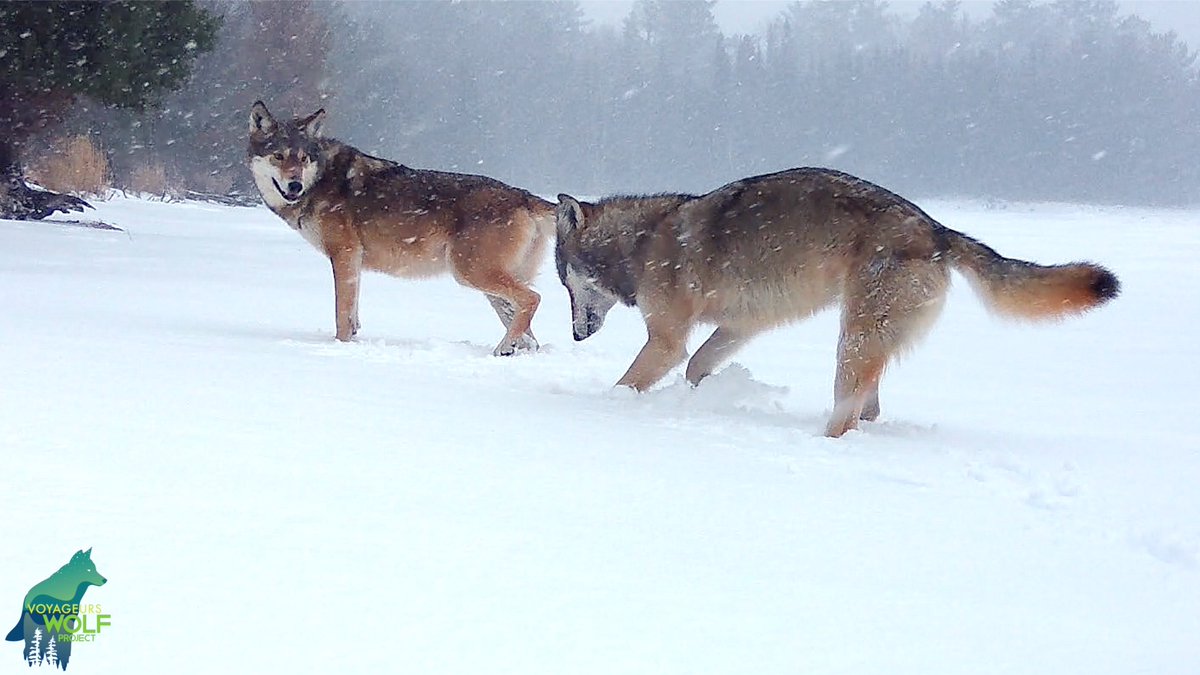

Sort of an epic scene of the Blackstone Pack hunting a deer on a frozen shoreline as the wind whips snow across the lake (turn on volume for the full wintry effect). The breeding male of the pack, who has a very distinctive appearance, was leading the chase as 5 pack members lagged a few minutes behind.
Voyageurs Wolf Project17,964 views • 26 days ago