
evo-devo
@Xiaojie_Qiu • 5,273 subscribers
Assistant Prof. @ Stanford BASE, Genetics & CS (courtesy). Lead the predictive genomics lab. Come to work with us to build the first AI virtual embryo model!
Videos

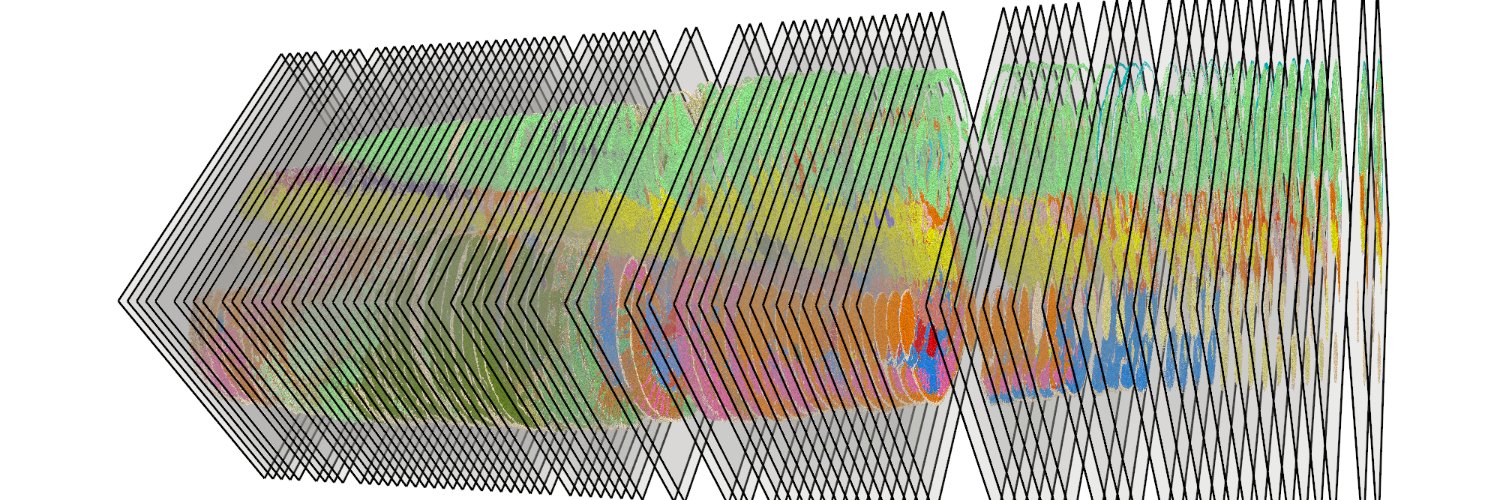
We’re thrilled to share that our MERFISH+ preprint is now live on bioRxiv!👉 In this work, the Bintu and Zhu labs (UCSD) developed MERFISH+, a next-generation spatial genomics platform that combines genome-wide RNA and epigenetic imaging over a large field of view. By introducing acrydite-modified probes covalently anchored to hydrogels, MERFISH+ achieves remarkable imaging stability and enables >1,800-gene, multi-modal, and multi-month experiments. With this platform, they, together with the Chi lab at UCSD, profiled a whole developing human heart at 12 post-conception week with merely two slides, resulting in a total of 53 slides, 3.1 million single cells and more than 30 cell types. Building upon our previous 3D reconstruction and modeling framework, Spateo ( we reconstruct the 3D human heart that nicely captures the anatomical structure of the heart, including the intricate vasculature network. Sophisticated analyses provide a holistic view of an entire organ and enable systematic characterization of 3D cellular neighborhoods and transcriptional gradients of substructures such as the descending arteries. Furthermore, using a generative integration framework for spatial multimodal data (Spateo-VI), we harmonized these MERFISH+ transcriptomic and chromatin data to reconstruct a 3D spatially-resolved multi-omics atlas of the developing human heart, shared at and MERFISH+ thus sets a new standard for large-format, multi-omic spatial profiling, enabling holistic, 3D characterization of organs at subcellular resolution. Huge congratulations to first authors Colin Kern, qingquan Zhang, Yifan Lu , and Jacqueline Eschbach, and to all collaborators from the Bintu, Zhu, Chi, and Qiu labs for this amazing team effort. Thanks for your diligence, creativity, and hard work on this project. We’re grateful for support from Arc Institute and our generous donors. Our lab is expanding—if you’re excited about building the next generation of single-cell and spatial genomics techniques and predictive single cell and spatial foundation models, we’re hiring! If you are interested, please reach out to me via direct message or email at [email protected]. We are excited for any potential collaborations along this line of research in Stanford, UCSF and Berkeley and other labs as well.
evo-devo42,327 views • 10 months ago

Exciting update on PantheonOS: Introducing Pantheon-Notebook & Pantheon-CLI — the first fully open-source, Python-based agentic tools that go beyond Claude Code in the field of data analysis. Pantheon-CLI runs entirely on your computer or server, supports 60+ tools and 50+ databases, and can call any Python, R, or Julia package alongside natural language. Chat with your data directly. It look like python-claude-code, but more appreciate for data analysis. Pantheon-Notebook brings the same agentic framework into Jupyter! Not just for writing code, it can also run and revise code automatically to generate the correct result, and even operate on files and study from website — beyond what any other tool can do! With Pantheon, you mix natural language + programming in one workflow, focusing on discovery instead of syntax barriers. We've applied Pantheon in some real-world cases: finance (customer explore), biology (Seurat, cell segmentation, annotation), sociology (survey analysis), and drug discovery (molecular docking). Pantheon is not just a CLI or a plugin — it's an agentic operating system for science, spanning both terminal and notebook. Why not try it now? We are actively preparing publications from this series of projects. Major contributors will be recognized in our GitHub repository and listed as key authors in these manuscripts. Feel free to reach out for collaborations, research assistant positions, visiting opportunities, rotation project or future PhD projects.
evo-devo45,652 views • 1 year ago

We are thrilled to share that our first paper from my new lab, Spateo ( for spatiotemporal modeling of molecular holograms, is now online in Cell: Spateo is a comprehensive analytical framework for 3D whole-embryo spatiotemporal modeling. Its advanced features include: • 3D alignment and reconstruction at the whole-mouse-embryo scale (see the animation). • 3D spatial domain digitization and cell-cell communication analysis to understand spatial gene expression gradients and both inter- and intracellular communication. • 3D morphometric and volumetric analyses along with 3D morphogenesis vector field modeling to quantify dynamics such as surface area, volume, and cell density across organs, and to dissect the interplay between morphogenesis factors and cell migration. • A “Google Earth”-like browser, Spateo-viewer ( and for interactive and intuitive exploration of 3D spatial data. • Additional features, such as RNA signal-based single-cell segmentation. We are also honored that Nature “News and Views” has highlighted this work as well: This is really an amazing outcome after two years' heroic revision process that rewrite the entire paper using a new data ( for whole mouse embryos.
evo-devo58,480 views • 1 year ago

PantheonOS allows any biologist to perform complex data analyses of emerging single cell, multi-omics and spatial transcriptomics datasets end to end through AI agent and human collaboration. We are releasing six replays of use cases trajectories. Each "trajectory" is a complete end-to-end run, from prompt to analysis, to figures, and finally to report, and in fully inspectable and reproducible manner. See the six user cases in our PantheonOS Gallery: 1. 3D mouse embryo analysis: Tangram deconvolution and PyVista-based 3D visualization of E6 mouse embryo spatial transcriptomics data 2. 3D human fetal heart analysis: Spatial mapping of heart disease gene patterns using MERFISH data 3. Multi-omics spatial integration: Single cell multi-omics-to-spatial mapping with MOSCOT optimal transport 4. Gene panel design: 1000-plex immune-oncology MERFISH gene panel optimization 5. Cell segmentation benchmarking: Comparative evaluation of Cellpose-SAM, InstanSeg, StarDist, and other tools 6. Spatial disease biology: Ligand–receptor analysis of disease-associated tissue microenvironments We would love to hear how you can use PantheonOS for your research! Got an interesting agent run of your own and want to share? In the Pantheon UI, click Export Bundle (top-right of any chat) to package the full trajectory — chat history, code, figures, report — then submit it here:
evo-devo13,429 views • 4 months ago
![🚀 Introducing PantheonOS ( A Fully Open-Source Agent OS for Science PantheonOS began as a research project in my Stanford lab and has since evolved into a vision to redefine data science in the era of AI—starting with computational biology, especially single-cell and spatial genomics. PantheonOS is a general agent platform built from the ground up. It is arguably the first distributed agent framework designed for scientific data analysis. 🔑 Key Features 1. Multi-Agent Collaboration – Built-in paradigms for distributed, cross-machine cooperation among agents and toolsets. 2. Native Toolset Support – Python, R, Julia, LaTeX, and more—designed for real scientific workflows. 3. Modular & Extensible – Developer-friendly design with shallow wrappers, plus LLM-driven toolset generation. 4. Evolvable Agents – Capable of evolving large-scale code projects to achieve superhuman performance (e.g., evolving upon the original Harmony [I Korsunsky, 2019, Nature Biotechnology] and Scanorama [BL Hie, 2019, Nature Biotechnology] implementations), and even evolving the system itself to adapt to new fields. 🎉 Stepwise Release Strategy We’re releasing PantheonOS in stages: Pantheon-CLI (today!), followed by Pantheon-Lab, Pantheon-Notebook, Pantheon-Slack, and more. 🌟 Pantheon-CLI Highlights - We're not just building another CLI tool. We're defining how scientists will interact with data in the AI era. - Open, Powerful, Python-First – The first fully open-source, endlessly extendable scientific “vibe analysis” framework. - Mixed Programming Magic – Combine Python, natural language, R, or Julia—seamlessly in the same environment. - PhD-Level Assistant – A command-line agent for complex real-world genomics and beyond, handling workflows at the PhD level. - Privacy by Design – Run entirely offline with local LLMs—your data never leaves your computer. ✅ Proven Applications (10 Demonstrations) Computational biology: 1. ATAC-seq: From raw reads to peak matrix 2. RNA-seq: From raw reads to expression matrix 3. Complex single-cell workflows (PhD-level) 4. Hybrid natural language + R for Seurat annotation 5. Learning from web tutorials + invoking single-cell foundation models 6. Cell segmentation on 10x Genomics HD Visium data And beyond: 7. Mixed Python & R programming examples 8. Molecular docking & structural analysis 9. Exploratory factor analysis for behavioral survey data 10. Customer segmentation & finance analytics 🌐 Learn More & Get Started Website: Pantheon-CLI Documentation: GitHub Repo: 💬 Join our community: PantheonOS Slack: PantheonOS Discord:](https://image.24vids.com/tw-1958631527837048962/amplify_video_thumb/1958631281228750848/img/Kr8A3F_dsHTk5AFG.jpg)
🚀 Introducing PantheonOS ( A Fully Open-Source Agent OS for Science PantheonOS began as a research project in my Stanford lab and has since evolved into a vision to redefine data science in the era of AI—starting with computational biology, especially single-cell and spatial genomics. PantheonOS is a general agent platform built from the ground up. It is arguably the first distributed agent framework designed for scientific data analysis. 🔑 Key Features 1. Multi-Agent Collaboration – Built-in paradigms for distributed, cross-machine cooperation among agents and toolsets. 2. Native Toolset Support – Python, R, Julia, LaTeX, and more—designed for real scientific workflows. 3. Modular & Extensible – Developer-friendly design with shallow wrappers, plus LLM-driven toolset generation. 4. Evolvable Agents – Capable of evolving large-scale code projects to achieve superhuman performance (e.g., evolving upon the original Harmony [I Korsunsky, 2019, Nature Biotechnology] and Scanorama [BL Hie, 2019, Nature Biotechnology] implementations), and even evolving the system itself to adapt to new fields. 🎉 Stepwise Release Strategy We’re releasing PantheonOS in stages: Pantheon-CLI (today!), followed by Pantheon-Lab, Pantheon-Notebook, Pantheon-Slack, and more. 🌟 Pantheon-CLI Highlights - We're not just building another CLI tool. We're defining how scientists will interact with data in the AI era. - Open, Powerful, Python-First – The first fully open-source, endlessly extendable scientific “vibe analysis” framework. - Mixed Programming Magic – Combine Python, natural language, R, or Julia—seamlessly in the same environment. - PhD-Level Assistant – A command-line agent for complex real-world genomics and beyond, handling workflows at the PhD level. - Privacy by Design – Run entirely offline with local LLMs—your data never leaves your computer. ✅ Proven Applications (10 Demonstrations) Computational biology: 1. ATAC-seq: From raw reads to peak matrix 2. RNA-seq: From raw reads to expression matrix 3. Complex single-cell workflows (PhD-level) 4. Hybrid natural language + R for Seurat annotation 5. Learning from web tutorials + invoking single-cell foundation models 6. Cell segmentation on 10x Genomics HD Visium data And beyond: 7. Mixed Python & R programming examples 8. Molecular docking & structural analysis 9. Exploratory factor analysis for behavioral survey data 10. Customer segmentation & finance analytics 🌐 Learn More & Get Started Website: Pantheon-CLI Documentation: GitHub Repo: 💬 Join our community: PantheonOS Slack: PantheonOS Discord:
evo-devo17,439 views • 1 year ago
No more content to load