Cloud and Cloud Shadow Detection From Satellite Imagery with... GeoAI and OmniCloudMask In this tutorial, you’ll detect clouds and cloud shadows, compute cloud statistics, clean segmentation outputs, convert raster masks to vectors, smooth boundaries, and generate a cloud-free mask for downstream remote sensing analysis. This workflow works with imagery that includes Red, Green, and NIR bands (e.g., Landsat, Sentinel-2, NAIP, and other commercial data). Notebook: Video tutorial: #geospatial #remotesensing #geoaishow more

Qiusheng Wu
11,527 Aufrufe • vor 5 Monaten
Create Stunning Time-Series Satellite Images in Seconds! The GEE... Data Catalogs Plugin v0.5 for QGIS is now available and it's a powerful upgrade. You can now create time-series satellite imagery with just a few clicks using a simple interface. The new version also supports direct downloads to your computer, making the workflow faster and more efficient. Key Features: - Access over 80 petabytes of satellite and geospatial datasets from Google Earth Engine - Generate animated time-series imagery effortlessly - Export results directly from QGIS to your local machine Useful Links: QGIS Plugin Page: GitHub Repository: Video Tutorial: #QGIS #geospatial #EarthEngine #Python #datascience #satelliteshow more
Qiusheng Wu
14,165 Aufrufe • vor 7 Monaten
Introducing our new logo!⚡ This redesign symbolizes our step... forward in decentralized cloud computing, setting one of the stones for a successful market entry. The letters n-u-c-o together symbolize the fusion of data, technology, and security, with the standout green dot representing activity ON, and the presence of electrical and electronic energy. Our complete re-brand aligns with our mission to become a leader in the cloud sector and will visually present PRO to large enterprises in the coming launch! ☁️show more
nuco.cloud
63,379 Aufrufe • vor 2 Jahren
🛰️ 👀 I spotted over 🇮🇹Italy, during yesterday's Naples... earthquake, a cloud formation identical to the one that went viral after the major earthquake in 🇯🇵Japan! 👇 ☁️ A cloud formation remarkably similar to the anvil cloud that went viral after the Mw 7.1 earthquake in Japan was visible in satellite imagery just hours before yesterday’s Mw 4.7 earthquake near Naples, Italy. 📈 Despite the massive difference in earthquake magnitude, the cloud structures are strikingly similar. This highlights a crucial point: ☁️ Cumulonimbus Incus (anvil) clouds are a natural product of intense atmospheric convection. Warm, moist air rises rapidly; upon reaching the tropopause, it can no longer ascend and spreads outward, creating the characteristic anvil-shaped top. After major earthquakes, people naturally tend to associate unusual atmospheric phenomena with seismic activity—a classic confirmation bias. However, available meteorological evidence indicates that both cloud formations are fully explained by standard atmospheric physics. Science is about identifying causation—not just noticing similarities. Follow Jeo Albant for more analysis. Retweet if you find this useful! 🔄 ℹ️ Satellite Analysis: The cloud shows classic convective vertical growth (17:20–18:30 TSI) followed by horizontal spreading at the tropopause level (18:50–19:40 TSI), forming the distinct anvil (Cumulonimbus Incus) structure—identical to the one seen in Japan. #CampiFlegrei #TerremotoNapoli #Meteo #Sismologia #地震雲 #地震 #熊本地震 #Earthquake #cloud #Satellite #Meteorology #Naples #ItalyEarthquake #Science #Geology #deprem #bulutshow more

Jeo Albant
171,690 Aufrufe • vor 24 Tagen
A view from a plane... What is happening! Are... we living in a parallel universe? How is it possible for anyone to look out of a plane window at 38k feet and see this, above the cloud cover, and just go with the propaganda narrative that it's only condensation?show more

nogps
48,683 Aufrufe • vor 4 Monaten
Traditionally, sensor fusion is a software-heavy process prone to... temporal lag and parallax errors. With Rev8, we’ve moved that complexity to the silicon. This SLAM sequence is powered by Ouster’s our new L4 MAX chip. Because the lidar and color data are fused at the moment of measurement, the point cloud is born with 48-bit color. No extrinsic calibration, no drift, and zero latency. For perception teams, this means better classification of safety vests, traffic signals, and road markings without the compute overhead of post-processing. Learn more about Native Color and the OS1 MAX:show more
Ouster
47,893 Aufrufe • vor 3 Monaten
MONTHLY RECAP 🎬 This month has been huge for... us at Here's all the achievements and milestones! ↓ 1️⃣ 2,000 $NCDT holders! Earlier this month, we hit 2,000 holders for our $NCDT token!. 2️⃣ Brand Launch Date Set for April 6th! we've been hard at work giving a fresh face and with some teases through the month, we are finally ready to drop our new branding on April 6th! Our new branding will embody our journey in becoming a global leader in cloud computing. This comprehensive rebrand, including a refreshed logo and website, aligns perfectly with our mission and strategic goals. 3️⃣ PRO - Final Penetration Testing PRO is undergoing its final penetration test, ensuring that we are meeting the highest standards of security and reliability in the cloud computing industry. With PRO businesses from large enterprises to AI startups can experience reliable, and efficient computing without breaking the bank. March has been an exciting month for and April will be even better 🚀show more
nuco.cloud
16,284 Aufrufe • vor 2 Jahren
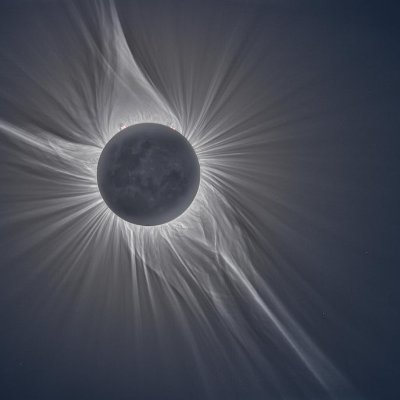
Breaking: Hubble Telescope Opens a "Window" into the Dark... Universe — First-Ever Detection of a Starless Dark Matter Cloud! In a groundbreaking discovery announced by NASA, the Hubble Space Telescope has revealed an entirely new class of cosmic object: a vast, starless cloud dominated by dark matter, rich in gas but completely devoid of stars. Nicknamed Cloud-9, this enigmatic structure lies about 14 million light-years away, on the outskirts of the spiral galaxy Messier 94 (M94).This is the first confirmed observation of such a "failed galaxy" or relic from the early universe — a massive dark matter halo that gathered hydrogen gas but never triggered star formation. Hubble's deep imaging ruled out any hidden faint stars, confirming it's truly dark and star-free.Key highlights from the discovery:Massive dark matter core — estimated at around 5 billion solar masses, anchoring a compact reservoir of gas. A cosmic fossil — likely a survivor from the universe's infancy, halted during reionization (when the first stars and galaxies lit up and ionized surrounding gas). Implications — This "phantom" object provides direct evidence for the existence of low-mass dark matter halos that never evolved into full galaxies. It suggests the universe could be filled with similar invisible structures, offering a major boost to our understanding of dark matter and galaxy formation. For decades, theorists predicted these "dark galaxies" or RELHICs (Reionization-Limited Hydrogen Clouds), but Cloud-9 marks the first solid proof caught in the act.Scientists are buzzing — this rare "wow" moment could rewrite parts of cosmic history and hint at countless other hidden building blocks of the universe lurking in the shadows.(Source: NASA/ESA Hubble release, Januaryshow more
Black Hole
10,676 Aufrufe • vor 6 Monaten
Seedance 2.5 tends to pick up more natural movement... and follow 3D blockouts more closely—but sometimes the results are nearly 1:1 with MiniMax. MiniMax ran at a fraction of the credit cost in this Comfy Cloud test, or can be run locally for free. Both have their place. It comes down to the use case, the results you need, and how much room you have to iterate. To try this workflow, link below 👇show more

ComfyUI
32,393 Aufrufe • vor 11 Tagen
THE CLOUD BILL WAS $14,000 A MONTH. EVERY MONTH.... JUST FOR GPU ACCESS. No ownership. No hardware. Just renting someone else's chips and watching the invoice grow. So this startup did the math and bought 1,000 Mac Mini M4s instead. $599 each. One-time. Total: ~$599,000 upfront. Sounds insane. Until you do the math the other way. $14K/mo in cloud GPUs is $168K a year. In 3.5 years you've burned through $599K and own nothing. The meter just keeps running. These guys own the hardware. Same output. Less power draw. And after year 4, every month of compute is basically free. The M4 was never built for data centers. But its performance per watt is so good that someone looked at a rack of a thousand of them and thought "why not." That's when it clicks. The AI infrastructure race isn't about who has the biggest GPU anymore. It's about who figured out they were overpaying for one. Would you make this switch?show more

Framez
18,004 Aufrufe • vor 16 Tagen
Tropical Storm Dolphin formed only 17 hours ago and... already she is constructing a frantic inner core, with boiling, dry-ice bubbles of convection deep freezing the embryonic eyewall structure hidden beneath the cloud tops. This compact, fast-growing behavior seems to be priming Dolphin for explosively rapid intensification. From the very first advisory, she has been forecast to become a Super Typhoon, and everything we’re seeing right now looks to be snowballing in that direction.show more

Backpirch Weather
13,076 Aufrufe • vor 28 Tagen
Karpathy's Agentic Engineering finally has proper tooling! (built by... Google) Karpathy defined agentic engineering as the discipline that separates production agent work from vibe coding. The core skills he listed were spec design, eval loops, and security oversight. The problem has been that practicing this still requires a different tool for every phase: - editor for code - a terminal for scaffolding - a browser for testing - a cloud console for deployment - and a separate framework for evals. Every transition is a context switch. The solution to production-grade Agentic Engineering is now actually implemented in Google’s Agents CLI. It covers the entire workflow in one place for scaffolding, evaluating, and deploying ADK agents. One setup command injects 7 ADK-specific skills into a coding agent's context, which lets it handle scaffolding, evals, deployment, and enterprise registration through natural language. I tested this end-to-end by building a RAG agent from scratch using Claude Code. It scaffolded the full project from the ADK agentic_rag template, generated 20 eval scenarios with LLM-as-judge scoring, and returned a quantitative scorecard. Finally, it also deployed everything to Agent Runtime and registered the agent to Gemini Enterprise, so the entire org can discover and use it. The video below shows this in action, and I worked with the Google Cloud team to put this together. Agents CLI GitHub repo → (don't forget to star it ⭐ ) I wrote up the full build covering all six steps from install to enterprise registration. It includes the eval scorecard, the instruction loophole the eval caught before deployment, and what the deployment process actually looks like end-to-end. Read it below.show more

Akshay 🚀
257,831 Aufrufe • vor 1 Monat
This guy built a mini AI farm out of... 4 Nvidia boxes It does not look like a data center. It looks like a stack of small machines sitting next to a laptop. But each box is a DGX Spark with Grace Blackwell inside, 128GB unified memory, and enough room to run models normal gaming GPUs cannot even open. Using the launch price from the article, 4 of them is almost $12,000 of local AI compute on one desk. That sounds expensive until you compare it to cloud GPUs. A serious AI builder can burn $1,500 to $3,000 a month renting A100s and H100s for client work, fine-tunes, agents and 70B models. He basically moved that bill from the cloud into hardware he owns. 4 Nvidia boxes. 512GB unified memory. No hourly meter running in the background. No rented GPUs eating the margin every time an agent runs too long. The funny part is most people still think local AI means a slow laptop running a toy model. Meanwhile guys like this are stacking compute at home. Save this, local AI is turning into the new mining farm.show more

Gipp 🦅
591,167 Aufrufe • vor 2 Monaten
🚨 Cyclonic Storm 'DANA' Update 🚨 Cyclonic Storm 'DANA'... is approaching the coasts of Odisha and West Bengal. 🌊 ISRO’s EOS-06 and INSAT-3DR satellites have been tracking the storm since October 20, providing real-time data to aid disaster management efforts. Early Detection: EOS-06 detected ocean wind patterns, offering valuable lead time for safety measures. Continuous Updates: INSAT-3DR delivers real-time cloud data, helping authorities make informed decisions. 🎥 Watch the Animated Video: See how Cyclone 'DANA' evolved from October 19-23. ➡️ Learn more at: This aligns with the Hon'ble PM's vision of a safer, resilient India and supports #AatmanirbharBharat by using indigenous technology for public safety. 🌍 #ISRO #DigitalIndiashow more
ISRO
94,789 Aufrufe • vor 1 Jahr
Today we're launching Sailboxes: the first cloud environment purpose-built... for long-horizon AI agents. Sailboxes are full machines with persistent state that auto-sleep, built for agents that live forever, priced so you only pay for what they actually use. From $0.015 per active vCPU-hour, over 70% cheaper than other providers. Under the hood: novel architecture from Nirvik Baruah and Charley Cunningham that live-migrates VMs based on actual resource usage. To show how robust it is, we ran a Minecraft server in a Sailbox and forced it to migrate every 2 minutes--players never noticed.show more

Sail Research
57,820 Aufrufe • vor 1 Monat
I’ll share a small part of Back in med... school, I became obsessed with augmenting memory and dreamed of a Notion or Obsidian that completes itself. Today, we’ve built something close. My self-awareness is sharper and everything feels connected. I genuinely believe AI does not replace humans. It amplifies us. Huge respect to our engineers and designers who made this crazy thing real. Bubbles are the episodic units of my life that the system interprets from my raw data. Clouds are the system’s questions, its hypotheses about who I am. When I answer a cloud, it becomes a bubble again. There is so much personal data that I cannot fully demo it. Wish I could. This system understands me more deeply than anyone. Want to try it? Retweet and comment “memory.” I’ll DM you an access code to skip the waitlist.show more

Daniel Park
658,905 Aufrufe • vor 9 Monaten
AN AWS ENGINEER QUIETLY BUILT A 2 PETABYTE HOME... SERVER FOR $9/MONTH THAT KILLS A $3,400/MONTH CLOUD STORAGE BILL the lenovo thinkstation pgx ships nvidia's gb10 grace blackwell superchip and 128gb of unified memory in a box the size of a mac mini at 1.2kg it runs an 80b qwen3 coder model at 25 to 40 tokens per second and a 196b step-3.5-flash moe model at 20 tokens per second locally the gb10 packs 6,144 cuda cores, 192 fifth-generation tensor cores and rates at 1 petaflop of fp4 with sparsity from a single 240 watt usb-c power supply fine tuning qwen 2.5 7b with lora took 18 minutes and 41gb of unified memory while the gpu pulled 65 watts and peaked at 77 degrees the box pulls a docker container from nvidia's registry and serves a frontier model on your local network with tool calling and zero data leaving your desk bookmark this and read the article belowshow more

starmex
193,226 Aufrufe • vor 2 Monaten
The Visual Studio Code insiders version that just shipped... and will ship in the next few days will come with an insane amount of new capabilities. A few highlights: - You can now run sub-agents in parallel. Yes, really. I even attached a video. - Major UX improvements for sub agents, especially visible in the chat window - A new search tool wrapped as a sub-agent that iteratively runs multiple search tools: semantic_search, file_search, grep_search Which connects nicely to the point above: multiple searches running in parallel, efficiently and fast - Anthropic’s Message API is now enabled by default - You can choose the model for the cloud agent (three available, all premium) - Extended thinking support when using the Claude cloud agent This is part of the broader multi-vendor cloud support under AgentsHQ I wrote about a few weeks ago - Tasks sent to the background agent (basically the CLI tool) now always run in isolation, each with its own git worktree - In a multi-repo workspace, assigning a task to a cloud agent prompts you to choose the target repo Same behavior when opening an empty workspace with no repo - Support for building an external index for files not supported by GitHub’s default indexing - UI/UX improvements for starting new sessions and switching between local / background / cloud agents - Skills are now first-class citizens, just like prompt files, with better UX indicating when a skill is loaded - Improved API for dynamic contribution of prompt files New V2 includes skills as part of the model. Curious to see the extensions that will leverage this - Finally, initial support for showing context usage percentage per session - Skills are enabled by default - Resizable chat window and session view. Small thing, but it was driving me crazy 😁 - A new integrated browser meant to replace the old simple browser Maybe the beginning of real browser use? - Better UI/UX for token streaming in chat - Ability to index external files not supported by GitHub There’s a lot more. Some of it hasn’t fully landed yet, but everything that has is already in Insiders. The next stable release should drop in early February. As usual, I’m just shocked by the volume of features this team ships every month. After the holiday slowdown, this one is shaping up to be a wild release.show more

Oren Melamed
29,555 Aufrufe • vor 7 Monaten
Introducing Pods Hyperspace Pods lets a small group of... people - a family, a startup, a few friends, to pool their laptops and desktops into one AI cluster. Everyone installs the CLI, someone creates a pod, shares an invite link, and the machines form a mesh. Models like Qwen 3.5 32B or GLM-5 Turbo that need more memory than any single laptop has get automatically sharded across the group's devices - layers split proportionally, inference pipelined through the ring. From the outside it looks like one OpenAI-compatible API endpoint with a pk_* key that drops straight into your AI tools and products. No configuration beyond pasting the key and changing the base URL. A team of five paying for cloud AI burns $500–2,000 a month on API calls. The same team's existing machines can serve Qwen 3.5 (competitive on SWE-bench) and GLM-5 Turbo (#1 on BrowseComp for tool-calling and web research) for free - the hardware is already on their desks. When a query genuinely needs a frontier model nobody has locally, the pod falls back to cloud at wholesale rates from a shared treasury. But for the daily work - code reviews, refactors, research, drafting - local models handle it and nobody gets billed. And when it is idle, you can rent out your pod on the compute marketplace, with fine-grained permissions for access management. There's no central server involved in inference. Prompts go from your machine to your pod members' machines and back: all of this enabled by the fully peer-to-peer Hyperspace network. Pod state - who's a member, which API keys are valid, how much treasury is left - is replicated across members with consensus, so the whole thing works on a local network. Members behind home routers don't need port forwarding either. The practical setup for most pods is three models covering different jobs: Qwen 3.5 32B for code and reasoning, GLM-5 Turbo for browsing and research, Gemma 4 for fast lightweight tasks. All running on hardware you already own. Pods ship today in Hyperspace v5.19. Model sharding, API keys, treasury, and Raft coordinator are all live. What Makes This Different - No middleman. Your prompts travel from your IDE to your pod members' hardware and back. There is no server in between reading your data. - No vendor lock-in. Pod membership, API keys, and treasury are replicated across your own machines using Raft consensus. If the internet goes down, your local network keeps working. There is no database in someone else's cloud that your pod depends on. - Automatic sharding. You don't configure layer ranges or calculate VRAM budgets. Tell the pod which model you want. It figures out how to split it across whatever hardware is online. - Real NAT traversal. Your friend behind a home router with a dynamic IP? Works. No VPN, no Tailscale, no port forwarding. The nodes handle it. - Free when local. This is the part that matters most. Cloud AI bills scale with usage. Pod inference on local hardware scales with nothing. The marginal cost of your 10,000th prompt is the electricity your laptop was already using. Coming soon: - Pod federation: pods form alliances with other pods. - Marketplace: pods with spare capacity can sell inference to other pods.show more

Varun
309,340 Aufrufe • vor 4 Monaten