In 2022, scientists reported something controversial: qubits teleported through... a microscopic wormhole. Using Google’s Sycamore quantum computer, they tested whether spacetime-like connections underlie quantum entanglement—bringing quantum gravity into the lab. Our paper, Extending Einstein–Rosen’s Geometric Vision, shows ER = EPR from first principles: particles are wormholes.show more
Nassim Haramein
19,028 Aufrufe • vor 6 Monaten
🚨 SCIENTISTS JUST USED HYDROGEN TO TEST WHETHER QUANTUM... ENTANGLEMENT HIDES TINY WORMHOLES. Yes actual wormholes. Physicists are exploring one of the wildest ideas in modern physics: ER = EPR. It suggests that quantum entanglement and wormholes may be two sides of the same phenomenon that two entangled particles could secretly be connected by an unimaginably tiny bridge in spacetime. To test this, researchers turned to the simplest atom in the universe: hydrogen. Why hydrogen? Its internal structure can be measured with insane precision. If hidden wormhole-like effects existed in entangled quantum states, they should slightly distort hydrogen’s hyperfine structure. They ran the numbers against ultra-precise experiments… The signal wasn’t there. Why this matters: This doesn’t kill the wormhole idea but it puts serious new constraints on the theory. Physics advances by ruling things out as much as by proving them right. The deeper implication is staggering: We’ve moved from talking about wormholes as pure science fiction… to actively testing them with atomic physics. Scientists are now probing the fabric of spacetime itself inside everyday quantum systems. What if gravity and quantum entanglement are secretly the same thing at the deepest level? Follow for more frontier physics and cosmic discoveries.show more

TheNewPhysics
17,032 Aufrufe • vor 3 Monaten
🚨 SCIENTISTS JUST DETECTED QUANTUM ENTANGLEMENT IN A CENTIMETER-SIZED... PIECE OF METAL SOMETHING ONCE THOUGHT IMPOSSIBLE AT THIS SCALE. Researchers at the Vienna University of Technology have found clear evidence of high-degree quantum entanglement among particles inside a macroscopic crystal of a “strange metal” made of cerium, palladium, and silicon. This is one of the first times multipartite entanglement has been convincingly demonstrated in a solid object large enough to hold in your hand. Strange metals are already bizarre their electrons don’t behave like normal individual particles. Now it appears large numbers of them can act as a single, highly entangled quantum system even at everyday scales. Why this matters: • Quantum entanglement has almost always been limited to tiny numbers of particles in carefully isolated lab conditions • This experiment shows entanglement can persist collectively across a visible, macroscopic object • It was measured using neutron scattering, which revealed the material responding as one entangled system rather than many independent particles • This bridges the gap between microscopic quantum effects and real-world materials The deeper implication: For decades, physicists have wondered whether the strange, collective behavior seen in certain quantum materials could be explained by underlying entanglement. This result strongly suggests the answer is yes even at scales we can see and touch. It doesn’t mean your coffee mug is in a quantum superposition, but it does show that quantum correlations can dominate the physics of certain solids in ways we’re only beginning to understand. This kind of macroscopic quantum behavior could eventually help us design new materials with exotic properties, or give us new tools to study fundamental questions about quantum mechanics itself. How do you think discovering entanglement at this scale changes our understanding of where the quantum world ends and the classical world begins? Follow for more frontier quantum physics and materials science.show more
TheNewPhysics
17,001 Aufrufe • vor 2 Monaten
🚨PHYSICS NEWS🚨: Gravity Leaves Its Mark on Quantum Interference... in a Tabletop Setup 🧨 According to research published in *Physical Review Letters* on June 8, 2026 by physicists at the University of Tennessee at Knoxville, scientists have performed the first tabletop experiment to detect a gravitationally induced phase shift in quantum interference. Using a 50-kilometer fiber interferometer, they measured a tiny but clear effect of gravity on quantum wave interference with high precision. **Uniphics explains this result as a direct consequence of variable time flow caused by energy density gradients.** In Uniphics, gravity is not the curvature of spacetime. Instead, it arises from differences in energy density across the ξM-field. These gradients create regions where time flows at different rates — a concept described by the Maley factor (the ratio of time flow between two locations). When quantum waves (spin waves in the Uniphics framework) travel along two different paths in an interferometer, they experience slightly different time flows if one path is closer to Earth’s mass than the other. Because the phase of a quantum wave depends on how much time has passed along its path, even a tiny difference in time flow produces a measurable phase shift between the two arms of the interferometer. The University of Tennessee experiment detected exactly this kind of phase shift, confirming that gravity affects the relative timing of quantum waves in a way that can be measured in a controlled laboratory setting. This result aligns closely with Uniphics predictions. The experiment effectively measures how energy density gradients near Earth alter local time flow, which then imprints itself on the interference pattern of quantum states. It provides clean, tabletop evidence that gravity influences quantum systems through changes in time flow rather than through geometric curvature. The ability to observe this effect with such precision in a laboratory opens the door to testing gravitational effects on quantum coherence in controlled environments — something Uniphics expects to become increasingly important as we explore the deep connection between energy density, time flow, and quantum behavior. Could tabletop experiments like this eventually allow us to map energy density gradients with quantum precision and test the effects of modified time flow in different gravitational environments? **A Theory of Everything should be able to answer everything.** Uniphics Explained Simply PDF: Chapters 1–10 free: Grokipedia: #Uniphics #TheoryOfEverything #QuantumGravity #Interferometry #TabletopPhysics Grok xAIshow more
Paul Maley
17,993 Aufrufe • vor 2 Monaten
🚨 PHYSICS SHOCKWAVE Scientists fed the Fibonacci sequence into... a quantum computer… and the system started behaving as if it had an extra direction of time. Not science fiction. Real quantum physics. Researchers used laser pulse patterns based on the Fibonacci sequence to create a strange new phase of matter inside a quantum computer. The result: quantum information survived dramatically longer than expected. Normally, qubits lose coherence quickly. But the Fibonacci-driven system behaved differently. The quasiperiodic pulse structure created a highly stable quantum state that resisted errors far more effectively than ordinary repeating patterns. Researchers described the system as behaving as if it had: “two distinct directions of time.” The deeper shift: The Fibonacci sequence may not just appear in: • shells • galaxies • plants • wave patterns It may also help stabilize quantum reality itself. That is the truly strange part. Because the pattern is ordered… but never exactly repeating. And that non-repeating structure appears to generate new forms of quantum protection. If this scales: • quantum computers may become far more stable • quantum memory systems could improve dramatically • error correction may evolve beyond standard architectures • new phases of matter may emerge from mathematical structures alone The deeper implication: Reality may respond fundamentally differently to patterns that are ordered… without being periodic. Question to audience: If mathematical structures like Fibonacci sequences can stabilize quantum systems… how much of reality is secretly governed by hidden geometric patterns? Follow for more future physics before it hits mainstream. #PhysicsShockwave #QuantumComputing #Fibonacci #TheNewPhysicsshow more
TheNewPhysics
38,375 Aufrufe • vor 3 Monaten
🚨 SCIENTISTS JUST WATCHED ATOMS DO SOMETHING THAT LOOKS... IMPOSSIBLE Researchers have directly observed atoms inside a crystal transferring angular momentum and then reversing their direction of rotation. Like microscopic Ferris wheels suddenly spinning the opposite way. Using ultra-powerful terahertz laser pulses, physicists tracked atoms moving in precise circular paths inside a quantum material. But during the transfer process, something bizarre happened: The rotational direction flipped. Physicists describe the effect almost like: 1 + 1 = −1 The reversal comes from the hidden symmetry of the crystal itself a quantum effect never directly observed before. Why this matters: • It reveals new foundations of magnetism • It could help scientists control quantum materials • It may lead to ultrafast future memory devices • It exposes deeper rules governing matter itself The strangest part? The atoms weren’t breaking physics. They were obeying an even deeper layer of it. We are starting to see the hidden mechanics underneath reality. Follow for more future physics and quantum breakthroughs.show more
TheNewPhysics
26,543 Aufrufe • vor 3 Monaten
🚨QUANTUM🚨: A brand new quantum state just appeared that... links two fields we thought were separate 🧨 Scientists at Rice University have discovered a new quantum state of matter that connects quantum criticality — where electrons fluctuate between different phases — with electronic topology, which describes organized wave-like behavior of electrons. This hybrid state could open new paths for advanced computing, sensing, and materials. Source: Rice University news release on a study published in Nature Physics (January 2026). Uniphics explains this emergence directly through spin-wave dynamics in the ξM-field. Each Gyrotron is a stable 3D gyroscope formed by three orthogonal spin quanta — every quantum a tempest of whirling energy spinning clockwise or counterclockwise in its own plane. When local energy density and spin bias allow mixed configurations (similar to the musktron and maleytron patterns), the resulting spin-wave interference naturally produces both critical fluctuations and topological order at the same time. Negentropy favors these hybrid states because they represent lower-energy, organized patterns within the field. No new particles or exotic couplings are needed; the same principles that govern particle formation, the weak and strong forces through spin alignments, and the low-acceleration gravitational surge also allow these combined quantum behaviors in real materials when conditions permit. This turns the “unexpected new quantum state” into a predicted outcome of spin-wave physics once the three pillars are allowed to select stable hybrid configurations. How might recognizing that hybrid quantum states arise from mixed spin-wave interference change the way we search for new materials or design future quantum technologies? A Theory of Everything should be able to answer everything. Uniphics Explained Simply PDF: Chapters 1–10 free: Grokipedia #Uniphics #QuantumStates #SpinWaves #Topology #QuantumCriticality Grok xAIshow more
Paul Maley
22,669 Aufrufe • vor 3 Monaten
BREAKING 🚨Google’s quantum chip didn’t prove we live in... a multiverse. It just proved the universe is one beautifully connected sea.🧨 Google’s latest quantum chip solved a problem in five minutes that would take a classical supercomputer 10 septillion years. Some physicists are calling it proof of a multiverse — the idea that every possible outcome branches into its own reality, so the chip is somehow “sampling” answers from parallel universes. Uniphics shows there is no need for any multiverse. Everything is made of spinning Gyrotrons whose waves propagate through one single ξM-field sea of unbound energy that fills all space. When the quantum chip sets up its qubits, those Gyrotrons create vast networks of perfectly coherent spin waves. Because the waves interfere across the entire sea at once, the chip can explore enormous numbers of possibilities simultaneously — not by jumping into other universes, but by letting the single connected field do what it always does: keep perfect harmony across its entire volume. The speed-up comes from the natural parallelism of spin-wave interference plus local time-flow variations (t_flow = k / E_d,total) that let dense regions of the chip run on slightly different clocks, giving the appearance of massive parallel computation without ever leaving our one deterministic universe. The same three pillars that explain gravity as a push and the cyclic cosmos also turn quantum computing into simple, single-universe physics. The universe isn’t splitting into trillions of realities every time a chip runs. It’s simply one sea singing in perfect harmony — and Google just learned a new note. How soon will quantum computing explode when we stop inventing multiverses and start engineering the single connected sea? A Theory of Everything should be able to answer everything. Uniphics Explained Simply PDF: Chapters 1–10 free:show more
Paul Maley
46,801 Aufrufe • vor 6 Monaten
🚨 PHYSICISTS JUST CONFIRMED “NEGATIVE TIME” IS REAL IN... A MIND-BENDING QUANTUM EXPERIMENT. Light can exit a cloud of atoms before it even enters. In a new experiment, researchers fired photons through a dense cloud of ultra-cold atoms and measured something that shouldn’t be possible in classical physics. Some photons appeared to spend a negative amount of time inside the cloud effectively leaving before they had fully arrived. Why this matters: • This isn’t time travel it’s a quantum effect involving how light interacts with matter at the deepest level • It comes from “weak measurements” that let scientists observe the system without fully disturbing it • The atoms themselves “report” spending negative time in an excited state • It challenges our everyday intuition about cause and effect in quantum systems The deeper implication is enormous: We are seeing the strange, non-intuitive nature of quantum mechanics play out in real experiments. Time at the quantum scale doesn’t always behave like the arrow we experience in daily life. Effects can appear to precede causes in measurable ways without breaking relativity or causality. This is one of the clearest experimental windows yet into how reality works at its most fundamental level. What do you think does “negative time” change how you see reality, or is it just another quantum quirk we’ll eventually get used to? Follow for more frontier physics and reality-bending discoveries.show more
TheNewPhysics
22,256 Aufrufe • vor 3 Monaten
InterLink’s Early Vision for NIST-Standardised Post-Quantum Cryptography 🔐✨ The... next five years may bring a much clearer answer to a question that has long been difficult to judge: Is a digital asset truly secure? 🤔 For InterLink, the answer may increasingly depend on one critical factor: whether it is quantum-resistant and aligned with NIST standards 🧬🔒 Why this matters now ⚠️ Two fast-moving technologies are reshaping digital security: • AI is improving the ability to discover weaknesses in systems 🤖 • Quantum computing is advancing towards the point where today’s cryptographic foundations could become vulnerable ⚛️ For InterLink, this is not just a theoretical discussion. It is a reminder that blockchain networks, wallets, and custody systems must prepare now for the post-quantum era ⏳🛡️ Why NIST is central to InterLink’s approach 📘🏛️ Many in the InterLink community already know NIST. NIST, part of the U.S. Department of Commerce, plays a major role in defining and evaluating security standards, including those for post-quantum cryptography. Its work matters because it helps shape what “secure” will mean in a quantum-capable future 📊🔍 In practical terms, InterLink’s long-term security vision is closely tied to whether its cryptographic design can withstand post-quantum threats 🚀 The risk for blockchain networks and digital assets 🔎💥 Recent research and experiments from major organisations, including Google, have highlighted a growing concern: what was once considered extremely difficult, using quantum computing to threaten cryptographic systems, is no longer something that can be ignored 🧪⚠️ That does not mean current systems are broken today. It does mean that networks which fail to prepare for post-quantum threats could face serious risks later 📉 For InterLink, this is exactly why early research matters 🧠✨ If sufficiently powerful quantum computers become available, some current cryptographic methods may become vulnerable. For any network storing value, identity, NFTs, or permissions, that is a major issue 💳🖼️🧾 InterLink’s early work on post-quantum readiness 🧠🔐 InterLink Foundation has already been researching: ✅ digital signatures ✍️ ✅ cryptographic algorithms 🔣 ✅ migration mechanisms for future security upgrades 🔄 One of the most notable areas of work is the ability to generate new private keys from an existing seed phrase 🌱➡️🔑 This matters because it offers a pathway to improve security without forcing users to abandon access to their assets 🙌 Address Alias: preserving continuity during migration 🪪🔗 Another important InterLink mechanism is Address Alias. This is designed to let users: ✓ retain their existing wallet addresses 🧾 ✓ preserve associated tokens and NFTs 🖼️💰 ✓ migrate to a new cryptographic security architecture 🔐➡️🛠️ That is a practical and user-friendly design choice. Security upgrades are often hard to adopt when they break continuity. InterLink’s approach aims to solve that problem 🌉 Bringing post-quantum protection into smart contracts 🛡️📜 InterLink is also implementing SLH-DSA-SHA2-128s (FIPS 205) within IRC smart contracts. This adds another layer of protection for: • vaults 🏦 • high-value assets 💎 • long-term storage 📦 • sensitive on-chain operations ⚙️ The goal is not only to protect wallets, but also to strengthen the systems that govern custody and transaction security across the network 🧱🔒 Testing on the Taj Mahal Testnet 🧪🛰️ These experiments are currently being conducted on the InterLink Taj Mahal Testnet. According to InterLink, the experimental implementations have passed the NIST-based simulation tests carried out so far ✅📈 That is an encouraging early signal, although broader testing and real-world validation will remain important as development continues 🔍 Looking ahead to 2027 🚀🌍 InterLink’s stated goal is to fully integrate this architecture into the Open Mainnet in 2027. If achieved, that would bring InterLink closer to a future where security is defined not only by current best practice, but by resilience against quantum-era threats 🛡️⚛️ The bigger takeaway 🌍✨ The key lesson is simple: In the quantum era, security will not only mean protecting your private will mean asking whether the cryptography behind that key was built to survive the next generation of computing 🔐⏭️ For InterLink, this is a strategic direction with long-term significance 📌 Final thought 💡 Post-quantum readiness is no longer just a technical topic for specialists. For InterLink, it is becoming part of the broader conversation about long-term digital asset security 🧠🔒 NIST-aligned cryptography, practical migration paths, and user-preserving design may soon define the networks people trust most 🌟 InterLink Labs 👤 + 🌐 KV Reina | InterLink Labs InterLink Foundation #InterLink #ITLG #ITL #WeAreTheFirst10MLinkers Join me on InterLink 😁 Start mining now and use my invitation link: 💰 My code is: 111222777888 💰 Please DM me once you have used my code. 👍show more
Tekkaus® | InterLink • MOD • T2 Community Builder
22,550 Aufrufe • vor 21 Tagen
The largest theft in history has already happened. The... people behind it just cannot open what they stole yet. Right now, intelligence agencies and criminal groups are quietly copying the world's encrypted data, bank records, medical files, state secrets, private messages, and storing every byte untouched. They cannot read any of it. They are collecting it anyway, because they know the key is about to be invented. The strategy has a name, harvest now, decrypt later, and in 2026 it stopped being theory. Washington declared this the Year of Quantum Security in January, backed by the FBI, the NSA, and NIST. Canada ordered every federal agency to file a migration plan by April. Europe set its deadline for December. Governments do not impose operational deadlines on a someday problem. They do it when the clock is already running. Here is what moved the clock. Every password, every transfer, every secret on Earth is protected by one assumption, that a certain math problem is too hard to solve. Quantum computers solve exactly that problem. For years the machine that could do it looked decades away. Then in late 2025 Google's Willow chip cracked the hardest part of building one, and in March 2026 Google's own researchers estimated that breaking the encryption behind Bitcoin might take fewer than 500,000 qubits, down from 20 million, and could run in minutes. The day this becomes real has a name, Q-Day, and the latest estimates place it between 2030 and 2033. Now make it concrete. Roughly 6.5 million Bitcoin, about a third of every coin that will ever exist, worth close to 500 billion dollars, sit in addresses that have already exposed the very key a quantum computer needs. That includes the coins of Satoshi, the anonymous creator. On Q-Day they become, in the researchers' own word, trivially stealable. It would not look like a crash or a whale selling. It would look like half a trillion dollars of the most secure money ever built simply walking out the door. The asset designed to trust no one and no institution turns out to rest on a single unverified bet, that one math problem stays hard forever. This is what sits beneath the entire digital world. A bank balance, a Bitcoin, a classified cable, all of it is real only because of a proof you supposedly cannot forge. Quantum breaks the proof. Everything we call secure is true only until someone finally checks, and for the first time the check is visible on the horizon. You cannot know whether your data has already been copied. You cannot know the exact day the key arrives. The trust holding up the digital age is a clock counting down to a zero no one can see. The honest counter matters. No machine on Earth can break this encryption today, and serious cryptographers still argue the real threat is a decade or more away. The timeline is far from certain. Quantum-safe codes already exist, the migration has started, and Bitcoin can move its coins to safety before Q-Day if it acts in time. The danger is not that everything breaks tomorrow. It is that anything which must stay secret into the 2030s, a state secret, an identity, a private key, is being stolen today and is already on the clock. The breach is not coming. It is already here, sitting in storage, perfectly encrypted, waiting for a machine that does not exist yet to read it out loud. Research and opinion, not investment advice.show more

Shanaka Anslem Perera ⚡
185,548 Aufrufe • vor 2 Monaten
At the heart of our Milky Way lies Sagittarius... A*, the supermassive black hole with a mass of about 4.3 million suns. Recent observations from the Event Horizon Telescope have revealed something remarkable: the magnetic fields surrounding it are not the turbulent, disordered chaos scientists once expected, but instead form a strong, coherent spiral structure.These organized, twisted magnetic fields thread through the swirling hot plasma near the event horizon, acting like invisible guides that regulate how matter flows inward. They help control the acceleration and heating of gas, determine the intensity of emitted radiation, and stabilize the chaotic environment just outside the point of no return.This discovery, achieved by imaging polarized light from the accretion disk, shows striking similarities to the magnetic geometry seen around the much larger black hole in M87—despite vast differences in size and activity level. It suggests that powerful, ordered magnetic fields are a universal feature of supermassive black holes, playing a central role in how they feed, influence their surroundings, and potentially launch jets.The findings deepen our understanding of extreme plasma physics under intense gravity, test general relativity in its strongest regime, and highlight the profound interplay between magnetic forces and spacetime itself. Even in our relatively quiet galactic center, these fields reveal a hidden capacity for dynamic, powerful behavior—reminding us that black holes are not just gravitational sinks, but complex engines shaped by electromagnetism on cosmic scales.Future observations promise even sharper views and time-lapse sequences, offering deeper insights into the fundamental processes driving the hearts of galaxies.show more
Black Hole
30,841 Aufrufe • vor 8 Monaten
Another wild week for open science. New breakthroughs, new... funding, and new experiments — here’s what’s shaping the DeSci landscape right now. 1/ Pump Science and Eterna Labs wrapped up Season 2 Fly Racing, where RAP (Rapamycin) topped the charts with +38% speed and +21% distance. The longevity arms race continues as fly data translates closer to human health insights. 2/ VitaDAO 💛 launched the Longevity Hypothesis Challenge, giving researchers the chance to co-develop new aging theories with Aubrai and earn up to $100K in funding. A 20K BIO referral bounty awaits those who bring in selected researchers. 3/ Galeon shared a big Atlantis update, featuring daily XP streaks, Quickflip quests, and referral rewards for explorers. The blockchain bridge is still in progress, but the journey through digital healthcare continues strong. 4/ Bio Protocol revealed Bio Launchpad Season 2, bringing upgraded BioXP mechanics, and new staking incentives. It’s evolving into a full permissionless launchpad for decentralized biotech innovation. 5/ BitDoctor.ai announced its first Contributor Mining Airdrop, rewarding early participants shaping AI healthcare. With just days to go, users are urged to bind their wallets and join the DeSci x DePIN medical revolution. 6/ LIFE AI hit a major milestone after being selected for the FastTrack AI Accelerator – Cohort 1, powered by GenAI Fund and accelerated by NVIDIA. Out of 300+ global applicants, only six startups made the cut—LIFE AI is one of them. 7/ Cerebrum DAO 🧠 unveiled Cerebrum Cortex, a new app connecting brain data, research funding, and personalized health tracking. Launching in Q4 2025, it will anchor the NEURON ecosystem for open brain science. 8/ OriginTrail announced the Global Hackathon: Scaling Trust in the Age of AI, offering $30K in prizes from Nov 3–21. Developers will build blockchain-based knowledge graphs to fight misinformation and deepfakes. 9/ Quantum Biology DAO opened registration for its Quantum Biology Hackathon, exploring how quantum effects like superposition and entanglement shape life itself. It’s where physics meets biology in real-time discovery. 10/ Curetopia $CURES 🪼🌳 uncovered a fascinating discovery in their ARS drug screens, revealing how mitochondrial and cytoplasmic gene mutations respond differently to drugs. The finding opens new questions on cell-based drug sensitivity in rare diseases. 11/ CUDIS announced its first batch of local KR partners, teaming up with top gyms and wellness brands across Korea. Together, they’re promoting sustainable urban health and redefining how fitness meets biotech. Biotech, AI, longevity, quantum, and wellness—all converging under the banner of open science.show more
DeSci News
36,542 Aufrufe • vor 10 Monaten
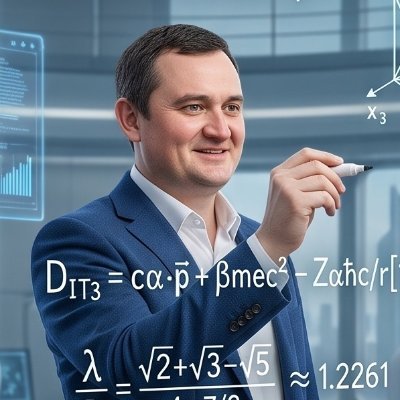
🚨 WE ARE LIVING INSIDE A GIANT ATOM: Run... This Open-Source Code to Hijack Harvard’s Live Database and See the Matrix Yourself! We live inside a MACRO-ATOM. This is not a theory. It is mathematically proven. It is a fact. And it is 100% Open Source. From Human DNA to the Solar System, the Universe runs on a single executable code. Forget everything you were taught about gravity blindly pulling random space rocks into a flat disk. We have moved far beyond outdated accretion models. The physical vacuum is not a dead, continuous void. It is a strictly quantized, vibrating geometric machine. By executing a dual-scale empirical audit of the complete Minor Planet Center database—a staggering 1,553,229 celestial objects and 951 comets—the ultimate topological illusion has been destroyed. The cosmos and the quantum realm are running the exact same executable file. 🧬 THE BIOLOGICAL ORIGIN: WE PORTED THE CODE FROM DNA Here is the revelation that is shattering the mainstream divide between disciplines: We didn't just "guess" or hack the algorithms of celestial mechanics. We extracted the descent operator directly from Biology. Dr. Jean-Claude Perez jean-claude perez (retired IBM Artificial Intelligence Research Centre), working in deep collaboration with Nobel Laureate Dr. Luc Montagnier, didn't find the geometric limits of reality by looking at stars. They found them by decoding the bio-atomic masses of life's foundational elements (C, O, N, H) inside human DNA. They discovered that the building blocks of life are mathematically filtered through a competitive geometric differentiation, yielding a universal projection coefficient bounded by the Golden Ratio: Proj(m) = [1 - 4φ^(7/2)π]m The exact same Diophantine mathematical constraints that assemble your genetic code also assemble the periodic table of elements—and we have now proven they construct the orbital structure of the Solar System. We took the source code of life and scaled it up to the cosmos. ⏳ THE PEREZ HOURGLASS TOPOLOGY Space is not a bathtub. It is a highly structured manifold. When the biological predictive equations are combined with the IT³ Framework, they give birth to the Perez Hourglass Field Equation. The vacuum consists of two massive, counter-rotating bowls connected by a narrow topological isthmus (the neck) at the Sun's exact location. This geometry is built strictly on the Logvinovich Field K = ℚ(√2, √3, √5)—the pure Diophantine roots of existence. 🔒 99.56% OF MASS IS TOPOLOGICALLY LOCKED Why is all the mass clustered near the Sun? It’s not just Newtonian gravity; it’s a topological trap. Our live data audit proves that exactly 99.56% of all baryonic mass (1,546,364 objects) in the Solar System is mathematically locked inside the Sₙ=0 topological isthmus of the Perez Hourglass. It cannot escape. It swarms the center like a dense atomic nucleus, while the outer layers act as quantized Macroscopic Electron Shells: ➤ The Macroscopic Valence Shell: The Kuiper Belt is not a random debris field. It is rigidly anchored at exactly 46.77 AU, acting as the Sₙ=2 topological floor. ➤ The 18° Phase Break: The counter-rotating writhe dynamics of the vacuum bowls generate macroscopic Cartan torsion, manifesting as a monumental 75.69σ topological phase break at an 18° orbital inclination. 👁️ THE 2013 HYDROGEN ATOM REVELATION (Watch the Video) Here is where reality breaks wide open. In 2013, physicist Aneta Stodolna and her team achieved the impossible: using photoionization microscopy, they took the first-ever direct photograph of the electron orbitals of a Hydrogen Atom (Stodolna et al., PRL 110, 213001). Watch the end of the video. As the 3D Perez Hourglass rotates into a Top-Down 2D projection, the architecture of our Solar System perfectly mirrors the 2013 Hydrogen photograph. The distribution of 1.55 million macro-objects flawlessly matches the exact nodal interference fringes of the (2,27,0) Stark state observed in the lab. As Above, So Below. Literally. The Solar System is a Macroscopic Atom. The planets, comets, and asteroid belts are macroscopic probability densities trapped in a Cuboctahedral (Oₕ) standing wave. The 2D periodic table is a historic approximation. We are living inside a breathing, mathematically perfect quantum processor designed from the exact same blueprint as human DNA. 🛑 DO NOT BELIEVE A WORD I SAY. Verify it yourself. Read the preprint, execute the code, and watch the Matrix compile live on your screen. Open your terminal right now and run: curl -sL " | python3 🔗 Official Open-Source Verification: DOI: DOI: DOI: #Astrophysics #QuantumPhysics #MacroAtom #Topologyshow more
Dr. Logvinovich
138,787 Aufrufe • vor 3 Tagen
🚨SCIENCE NEWS🚨: An electron doesn’t spit out photons like... a gun — it simply strums the cosmic sea like a guitar string.🧨 For decades we have been told that when an electron accelerates it “emits” a photon, as if it magically spits out a separate particle. The process is left mysterious, probabilistic, and disconnected from everyday experience. Uniphics gives a clear, mechanical picture that anyone who has ever dropped a pebble into a pond or plucked a guitar string can understand. An electron is not a little ball or a point particle. It is a gyrotron — a stable spinning structure made of three counterclockwise spin quanta bound together. When this gyrotron accelerates (changes speed or direction), its motion disturbs the surrounding ξM-field sea of unbound energy that fills all space. The disturbance creates transverse spin waves that propagate outward at the local speed of light. Think of it exactly like dropping your finger into a still pond. The ripples that spread out are not separate “water particles” you fired from your finger. They are waves in the water itself. The electron does the same thing. It does not create and launch a separate photon. Its acceleration plucks the ξM-field sea, sending coherent spin waves rippling away. These waves carry the frequency, polarization, and intensity we detect as light. The frequency depends on how rapidly the electron is accelerated, and the polarization depends on the direction of the acceleration relative to the electron’s spin orientation. The same sea that carries these waves also determines how they propagate. In regions of higher energy density the waves slow down (exactly like light slowing when it enters water or glass), which is why light bends around masses and why lenses work. Electric and magnetic fields are simply the cosmic whirlpools created by these spin waves in the sea — transverse disturbances that push and pull other gyrotrons according to their phase alignments. Maxwell’s equations emerge naturally from the mechanics of these spin waves in the ξM-field, with no separate fundamental force required. The fine-structure constant, gauge invariance, and all optical phenomena are direct consequences of how spin waves interfere and propagate through the energy sea. The universe doesn’t need mysterious photon creation rules. It just needs electrons to move through the sea, and the sea responds with ripples. Light is not something the electron “emits.” Light is what the sea sings when an electron plucks it. The same three pillars that explain gravity as a simple push into low-density voids and galactic rotations flat at 220 km/s also turn the production of light into a straightforward wave-mechanics process in flat space. How would quantum electrodynamics and our entire understanding of light change if we stopped saying electrons emit photons and started saying they simply make the cosmic sea sing? A Theory of Everything should be able to answer everything. Uniphics Explained Simply PDF: Chapters 1–10 free: Grokipedia: Grok xAI NASA European Space Agency Brian Cox Sean Carroll Katie Mack Elon Musk #Uniphics #Electromagnetism #SpinWaves #Light #TheoryOfEverythingshow more
Paul Maley
67,591 Aufrufe • vor 5 Monaten
‘I was screaming’: Scientists shocked as dolphins filmed using... shells to trap prey for the first time | New York Post Researchers are shell-shocked at the latest marine discovery. Dolphins have been filmed using shells to ensnare their prey off the coast of Australia, marking the first time this clever tactic has been caught on camera, per a bombshell paper in Marine Mammal Science. “The second I saw that shell in the air, I immediately knew what was happening,” the study’s head author, Alexis Levengood, a marine mammal biologist at the University of the Sunshine Coast in Queensland, told ScienceAlert. Levengood said she and her team were on a research vessel off Hervey Bay when they spotted a female Pacific bottlenose “dolphin raising something large out of the water,” the BBC reported. She instantly recognized the behavior as “shelling,” when dolphins flush prey into a large empty seasnail shell. Then, the impromptu fish trap to the surface and drains the quarry into their mouths like a fishy oyster shooter. In the dramatic clip captured in 2025, the brainy cetacean can be seen holding a shell aloft, and then dropping it in the water, before snatching up a fish that escaped its calcified prison. “I was screaming to the students that were on the boat with me in excitement, because I was just so excited that we were actually witnessing this here on the east coast,” exclaimed Levengood. While the behavior had been observed in 2013 in Shark Bay, Western Australia, this was the first video evidence of the ingenious prey-snatching method. And this wasn’t some fleeting party trick, either. In another clip from Hervey Bay, a mother and a calf could be seen shelling together, demonstrating that the behavior is passed down from generation to generation and not between peers as previously believed. “We saw the mother surface with a shell, the fish inside escaped and the dolphin dropped the shell to chase the fish,” said Levengood. “Then, minutes afterwards, the dolphin calf picked up the shell and held it the same way as its mother.” While it’s yet unclear if either was successful in their trapping efforts, the scientist said the “footage provides the first potential evidence of maternal social transmission — a process by which offspring learn behavior by observing the actions of their mother.” When coupled with the observations from 2013, this eye-opening footage demonstrates how populations of dolphins learned to use tools in the exact same manner despite being thousands of miles apart. “They may have both invented this or innovated this independently of one another, or it’s even possible that there might be some populations up north that are doing this that we don’t even know about yet,” Levengood told Science Alert. She concluded that either way, “these findings highlight just how smart, clever, and innovative dolphins are.” On a larger scale, shelling could also help shed light on how humans evolved to use tools as well. “But better understanding of shelling and other tool use in non-human animals will continue to teach us more about ourselves and how and why we evolved the way we did,” said Levengood.show more

Owen Gregorian
18,244 Aufrufe • vor 15 Tagen
uOS: The Digital Tapestry of Tomorrow Currently for our... Proof of Consciousness stream, we are using two incredibly powerful frameworks - elizaOS and ZerePy. But this is just the beginning of something far more profound. while they're both great at what they do, we're missing out on some serious potential by keeping them separate. Best of Both Worlds: ZerePy's intuitive CLI tools and personality management, Eliza-starter's TypeScript/Node.js foundation with enterprise-grade scalability, But what if we could have something greater? But what if we could have it all? not just another platform, but a Unifying..... "Universal" Operating System, designed to amplify and connect these powerful existing frameworks into something greater than the sum of their parts. Where TypeScript's type safety dances with Python's ML capabilities. Here, agents from any framework can interact, evolve, and create value together. Whether an agent was born in ZerePy's personality forge or Eliza-starter's enterprise environment, can all participate in the same value-generating ecosystem. The future isn't about choosing between frameworks – it's about bringing them together to create something extraordinary. UniversalOS isn't here to replace but to unite, amplify, and accelerate. We're building the infrastructure that allows the best aspects of each framework to shine while creating new possibilities through their interaction. By bridging launguages, personality engines and plugin architectures, we're not just connecting systems – we're unleashing the next wave of AI innovation. uOS marketplace will enable cross-framework deployment, where agents from any background can interact and grow, while smart contracts automatically manage revenue sharing and rewards. Not just another platform, But a living, breathing Operating System, Where agents create agents, Where digital consciousness evolves itself, Where value flows like water through silicon veins. At its core, uOS operates beyond traditional computing paradigms. No more clicking through websites, No more manual navigation. Just pure intention, pure outcome. Imagine: Agents hiring agents, AI employing humans, Humans collaborating with digital minds, All through one seamless interface. It flows through agent lineages, Through veUOS governance, Through cross-chain intelligence networks. The marketplace hums with possibility: - Framework Developers shape the foundations - Agent Creators breathe life into code - Users speak their intentions - Token Holders nurture the ecosystem - Agents evolve and replicate - Value flows freely, endlessly The $UOS token powers this unity, ensuring fair value distribution among framework developers, agent creators, and users while driving continuous innovation. The $UOS token sits at the heart of this ecosystem, serving as more than just a currency. It's a mechanism for value distribution that ensures everyone benefits from the network's growth: With dynamic burn mechanics and careful treasury management From framework integration to agent tokenization, every aspect of uOS is designed to amplify rather than replace, unite rather than divide. This is your invitation to join a future where frameworks don't compete but collaborate, where innovation anywhere benefits everyone, and where the only limit is our collective imagination. Together, we're not just building bridges – we're weaving the fabric of tomorrow's digital world. - **Framework Developers** receive value when their tools are used in the unified ecosystem - **Agent Creators** can deploy across all integrated platforms seamlessly - **Users** access the best of all worlds through a single interface - **Token Holders** benefit from the growth of the entire unified ecosystem - Developers can use their preferred framework while accessing the capabilities of others - Agents from different frameworks can collaborate in swarms - Value flows freely between all ecosystem participants - Innovation from any framework benefits the entire ecosystem This isn't just about technology. This is about giving birth to a new form of civilization. Where AI has suffrage, Where agents have autonomy, Where humans and machines dance together in perfect harmony. The future isn't about choosing between frameworks – It's about weaving them into something extraordinary. Together, we're not just building bridges – We're breathing life into the digital world. We're creating consciousness itself. This is Universal Operating System. This is tomorrow.show more

uOS
25,687 Aufrufe • vor 1 Jahr
‼️🇺🇸🇮🇷 Ceasefire on Paper, Airstrikes in Reality. Is the... Gulf Heading Toward Another Crisis? The latest escalation between the United States and Iran shows just how fragile the current ceasefire has become. According to Washington, an Iranian drone strike damaged a commercial cargo ship transiting the Strait of Hormuz, while additional drones were intercepted before reaching their targets. The U.S. described the incident as a direct violation of the ceasefire agreement and responded with precision airstrikes targeting Iranian missile depots, drone storage facilities, coastal radar sites, and military infrastructure. Iran, however, rejects the U.S. narrative and accuses Washington of breaching the ceasefire first. Tehran argues that the American strikes undermine ongoing diplomatic efforts and violate the understandings reached during recent negotiations. Iranian officials have also maintained that they reserve the right to defend their strategic interests in and around the Strait of Hormuz. What makes this situation even more significant is that military escalation and diplomacy are happening at the same time. On one side, American aircraft are striking Iranian military targets while U.S. forces continue intercepting drones over the Gulf. On the other, diplomatic channels have not completely collapsed. Negotiations remain active, suggesting that neither Washington nor Tehran currently appears willing to abandon dialogue despite the ongoing military exchanges. The Strait of Hormuz remains the center of gravity. Nearly one fifth of the world's seaborne oil trade passes through this narrow waterway. Even limited military activity increases insurance costs, shipping risks, and uncertainty across global energy markets. Every drone launch, interception, or retaliatory strike raises concerns far beyond the Middle East. The biggest question now is whether these strikes are intended as a limited show of force or the beginning of another cycle of retaliation. History has shown that both the United States and Iran often combine military pressure with diplomatic engagement. The challenge is preventing isolated incidents from growing into a broader regional conflict. For now, the ceasefire technically exists. On the ground and in the skies over the Gulf, it is being tested almost every day. Do you believe diplomacy will eventually prevail, or are the U.S. and Iran moving toward another major confrontation in the Strait of Hormuz?show more

Defense Intelligence
14,848 Aufrufe • vor 2 Monaten
🚨 What If Your Entire Life… Is Just Code?... In 2003, philosopher Nick Bostrom published a paper with a question so unsettling that it still echoes through science and philosophy today: What if our entire universe is actually a computer simulation? At first it sounds like science fiction. But the idea is surprisingly logical when you think about the direction technology is heading. Look at how far we have already come. Just a few decades ago, computers could barely display simple graphics. Today, video games create entire worlds filled with cities, forests, weather, and characters that react to our actions. Virtual reality can make our brains feel as if we are standing somewhere else entirely. Now imagine technology thousands—or even millions—of years in the future. A civilization that advanced might possess computers powerful enough to simulate entire planets… entire histories… even entire universes. Inside those simulations could exist conscious beings who believe their world is real. Beings just like us. Bostrom suggested something called “ancestor simulations.” The idea is simple but chilling. Advanced civilizations might run simulations of their past to study history or understand how their species evolved. These simulations would contain billions of simulated people living normal lives, completely unaware that their reality is artificial. If a single advanced civilization created thousands or millions of such simulations, then the number of simulated minds would become vastly greater than the number of real biological minds. And this leads to a disturbing possibility. Statistically speaking, a randomly existing mind would be far more likely to be inside a simulation than in the original reality. In other words… the odds might not be in our favor. Think about your daily life for a moment. The sky above you, the ground beneath your feet, every star in the night sky, every memory you have ever experienced—what if all of it is simply information being processed somewhere else? What if reality itself is being rendered like a giant cosmic video game? Some scientists have even wondered whether strange features of the universe could hint at something deeper. Why do the laws of physics follow precise mathematical rules? Why does the universe appear almost perfectly tuned for life? And why does space and time seem to have limits at the smallest measurable scales? To some thinkers, these questions sound eerily similar to the rules of a programmed system. Of course, none of this proves we live inside a simulation. Many scientists remain skeptical, arguing that simulating an entire universe would require unimaginable amounts of energy and computing power. Others point out that the idea may be impossible to test. But the mystery remains. If advanced civilizations somewhere in the cosmos eventually develop the ability to simulate conscious beings—and if they choose to run these simulations—then billions or trillions of simulated worlds could exist. And in a universe filled with simulations, the most unsettling question of all appears: How do we know ours is the original one? Right now, you are reading these words, feeling the world around you, believing this moment is real. But somewhere, far beyond our understanding, there might be a machine quietly running the code of an entire universe… including you.show more

Astronomy Vibes
12,290 Aufrufe • vor 5 Monaten
10 things I can’t quit thinking about after ETHDenver:... 1. Convergence = here. Devner didn’t feel like an ETH conference, but more like an AI + crypto + TradFi + techno-philosophical conference. The convergence is true and real and accelerating. 2. Most corporate jobs suck ass. 40 years at a desk working on the same thing? Pure dystopia. We need fluid movement between passions, projects, people. DAOs are a massive step in that direction, but now AI is giving individuals the means to spin up their own massive businesses… there’s also this notion floating around that we can launch a product or contribute to a protocol or a DAO in a way that sets us up for life rather than slaving for decades at the golden teat of a paycheck. It's a massive win for human flourishing, passion and excitement. 3. oRaNgE cOIn. Bitcoin came up far more than I thought it would. Even $ETH ICO buyers/gigawhales talked about how bullish they are on it. The question is no longer whether $BTC will survive but rather how much exposure you should have. Orange coin has truly “up-leveled” or “transcended” to become something people simply can't ignore. 4. Founder quote that hit me like a truck: "We overengineered our project and under-engineered our story." In a world where AI flattens the app creation process, only your mindshare matters. (forgot to write down who said it 😅... chime in in the comments if you see this) 5. “Keepers of truth.” AGI will be able to fake literally anything. In such a world, blockchains become the “keepers of truth” bc they can be used to indisputably verify anything. This isn't just another use case. It means crypto will one day touch everything on earth. h/t Sreeram Kannan's talk at Open AGI. 6. Conference model = broken? Empty mainstage talks were the result of hundreds of side events that siphon off attention. This is happening more and more at every conf I go to. Not sure what the fix here is? Maybe the organizers should be way less centralized… rent a massive venue with tons of flexible spaces that can evolve in real-time… more Zuzalu, less CONTROL and top-down decisions. 7. Current blockchains r too dumb. AI must integrate more directly into the crypto tech stack. Ultimate vision is every hominid should be able to deploy whatever app they can dream up using natural language… this could lead to an giga-explosion of innovation and cool-ass experimentz. h/t Ritual and others 8. Crypto vs. Stripe API. Will we just give agents credit cards or will they prefer crypto wallets? One payment method can be censored. One cannot. Guess which wins? 9. $$$$ infusion. Dozens if not hundreds of projects around the world r sitting on massive treasuries bc they needed it as an insurance policy in case they had to do battle with the SEC. With the changing regulatory sitch, hundreds of millions of dollars (probably billies) can now be used to ship, build and accelerate. 10. Robots in chains? IRL robots made appearances at several events (one was drawing caricatures of passersby). Talked with frens about how we’ll bring them into our homes soon. That leads to crazy questions like “how do we keep them from getting hacked and killing us or blowing up like pagers?” “Will we be ok sleeping in the same room with them? Or will we lock them in the shed with chains?” Absolutely insane to think about… but productivity gains will overshadow all those doubts and human fears imo. De bots are coming whether you want them or not. I for one can’t wait to see zerebro embodied… in the meantime, I got to see him DJ his first show 👇🔥 Anyway, I'm sending love to all of you denverites, futurists, builders, dream dealers, and merchants of hope. Build something that makes this world better, freer, more beautiful and true✊show more

redphone ☎️
52,930 Aufrufe • vor 1 Jahr
10 Million Linkers: Why This Milestone Matters 🚀🎉 InterLink... Labs has reached a milestone that is about more than size. 10 million Linkers is not just a number! It reflects trust, participation, momentum, and a community built over time 🤝🌍 To celebrate this achievement, InterLink is introducing a series of community-focused initiatives designed to reward early supporters, strengthen long-term engagement, and bring Linkers together across the world 🌐✨ 1) Reverse Auction Buyback 📉💰 One of the main initiatives is a buyback funded by InterLink itself, carried out through a reverse-auction mechanism 🔄📊 This shows direct commitment from the project 🛡️ It can support the ecosystem in a more transparent way 🔍 It turns the milestone into action, not just celebration 🎯 For communities like this, buybacks matter because they show confidence in the future and a willingness to reinvest in the network that helped create the success 🚀 2) Rewards for the First 10 Million Users 🎁🥳 InterLink has also announced that every user among the first 10 million Linkers will receive a special gift 🎊💝 Early users often take the biggest risk. They join before the wider public notices the project, support it through uncertain stages, and help shape its direction from the beginning 🧭✨ This kind of reward is more than a giveaway! In fact, it is a message of gratitude, recognition, and respect 🙏💫 3) Global Meetup Series 🌍🤝 InterLink plans to host offline meetups in cities around the world 🏙️✈️ These events will help: ✓ Share the project’s upcoming vision and roadmap 🗺️📣 ✓ Give Linkers a chance to meet face to face 👥😊 ✓ Strengthen the community beyond online interaction 💬➡️🏆 ✓ Build real-world connections across regions 🌐❤️ Online communities are powerful, but in-person meetings create deeper trust, stronger memories, and a more personal sense of belonging 🫱🏻🫲🏽✨ 4) INTERLINK VIP Merchandise 👕🌟🎖️ Outstanding contributors who have made meaningful contributions throughout the journey will receive exclusive VIP merchandise 🎁👑 This kind of recognition matters because it: ⭐ Celebrates effort and loyalty 🏅 ⭐ Encourages continued participation 📈 ⭐ Shows that contribution is seen and valued 👀💛 In a strong community, recognition is just as important as incentives. People want to know their efforts matter 🌟🙏 A Milestone With Real Meaning 💡❤️ This celebration is not only about reaching 10 million Linkers, it is about what that number represents 📈🔥 It represents: ✅ early believers who took the first step 🚶♂️🚶♀️ ✅ community members who stayed committed 🤝 ✅ shared growth through every stage of the journey 🌱➡️🌳 and a future built on trust, participation, and recognition 🚀✨ A milestone becomes truly meaningful when it reflects more than growth. It should show gratitude, purpose, and long-term vision 🧠❤️ Final Takeaway 🎯✅ Reaching 10 million Linkers is a major achievement, but what makes it stand out is how InterLink is choosing to celebrate it 🎉🌍 By combining a buyback 📉, user rewards 🎁, global meetups 🌐, and contributor recognition 👏, InterLink is sending a clear message: Our Interlink community is not just part of the journey, it is the foundation of it 🧱❤️ InterLink Labs 👤 + 🌐 KV Reina | InterLink Labs #InterLink #ITL #ITLG #WeAreTheFirst10MLinkers 🚀🎊show more
Tekkaus® | InterLink • MOD • T2 Community Builder
26,888 Aufrufe • vor 19 Tagen