Quantum locking looks exactly like how UFOs defy gravity... and propel themselves. This is the first clue that there's a connection between superconductivity and gravity. You're seeing a quantum effect at the macroscopic scale.show more

Ashton Forbes
224,163 просмотров • 1 год назад
🚨 SCIENTISTS SAY “MAGIC” MAY BE WHAT GIVES SPACE-TIME... ITS GRAVITY. For years, physicists have understood how entanglement can build the structure of space-time in holographic models. But something was missing: why does space-time curve in response to matter the essence of gravity? A team including Charles Cao and John Preskill now proposes the missing ingredient is a quantum property called “magic” a measure of how complex and non-classical a quantum state is (the kind that makes quantum computers hard to simulate classically). In their theoretical framework, adding this magic turns rigid space into something that can bend. Matter can now tell space how to curve. Why this matters: • It offers a new way to think about how gravity emerges from quantum information • It connects ideas from quantum computing (error correction, magic states) directly to fundamental physics • It suggests space-time itself may be one of the most quantum objects in existence The deeper implication: Gravity may not be a fundamental force at all. It may be what happens when quantum information becomes sufficiently complex and “magical.” This is still early theoretical work in specific holographic models. But it hints that the pliability of the universe might have quantum roots we are only beginning to understand. What do you think is gravity ultimately just extremely complicated quantum information, or do you think we’re still missing something much deeper? Follow for more frontier quantum gravity and quantum information research.show more

TheNewPhysics
15,329 просмотров • 2 месяцев назад
🚨PHYSICS NEWS🚨: Gravity Leaves Its Mark on Quantum Interference... in a Tabletop Setup 🧨 According to research published in *Physical Review Letters* on June 8, 2026 by physicists at the University of Tennessee at Knoxville, scientists have performed the first tabletop experiment to detect a gravitationally induced phase shift in quantum interference. Using a 50-kilometer fiber interferometer, they measured a tiny but clear effect of gravity on quantum wave interference with high precision. **Uniphics explains this result as a direct consequence of variable time flow caused by energy density gradients.** In Uniphics, gravity is not the curvature of spacetime. Instead, it arises from differences in energy density across the ξM-field. These gradients create regions where time flows at different rates — a concept described by the Maley factor (the ratio of time flow between two locations). When quantum waves (spin waves in the Uniphics framework) travel along two different paths in an interferometer, they experience slightly different time flows if one path is closer to Earth’s mass than the other. Because the phase of a quantum wave depends on how much time has passed along its path, even a tiny difference in time flow produces a measurable phase shift between the two arms of the interferometer. The University of Tennessee experiment detected exactly this kind of phase shift, confirming that gravity affects the relative timing of quantum waves in a way that can be measured in a controlled laboratory setting. This result aligns closely with Uniphics predictions. The experiment effectively measures how energy density gradients near Earth alter local time flow, which then imprints itself on the interference pattern of quantum states. It provides clean, tabletop evidence that gravity influences quantum systems through changes in time flow rather than through geometric curvature. The ability to observe this effect with such precision in a laboratory opens the door to testing gravitational effects on quantum coherence in controlled environments — something Uniphics expects to become increasingly important as we explore the deep connection between energy density, time flow, and quantum behavior. Could tabletop experiments like this eventually allow us to map energy density gradients with quantum precision and test the effects of modified time flow in different gravitational environments? **A Theory of Everything should be able to answer everything.** Uniphics Explained Simply PDF: Chapters 1–10 free: Grokipedia: #Uniphics #TheoryOfEverything #QuantumGravity #Interferometry #TabletopPhysics Grok xAIshow more

Paul Maley
17,993 просмотров • 2 месяцев назад
🚨 SCIENTISTS JUST DETECTED QUANTUM ENTANGLEMENT IN A CENTIMETER-SIZED... PIECE OF METAL SOMETHING ONCE THOUGHT IMPOSSIBLE AT THIS SCALE. Researchers at the Vienna University of Technology have found clear evidence of high-degree quantum entanglement among particles inside a macroscopic crystal of a “strange metal” made of cerium, palladium, and silicon. This is one of the first times multipartite entanglement has been convincingly demonstrated in a solid object large enough to hold in your hand. Strange metals are already bizarre their electrons don’t behave like normal individual particles. Now it appears large numbers of them can act as a single, highly entangled quantum system even at everyday scales. Why this matters: • Quantum entanglement has almost always been limited to tiny numbers of particles in carefully isolated lab conditions • This experiment shows entanglement can persist collectively across a visible, macroscopic object • It was measured using neutron scattering, which revealed the material responding as one entangled system rather than many independent particles • This bridges the gap between microscopic quantum effects and real-world materials The deeper implication: For decades, physicists have wondered whether the strange, collective behavior seen in certain quantum materials could be explained by underlying entanglement. This result strongly suggests the answer is yes even at scales we can see and touch. It doesn’t mean your coffee mug is in a quantum superposition, but it does show that quantum correlations can dominate the physics of certain solids in ways we’re only beginning to understand. This kind of macroscopic quantum behavior could eventually help us design new materials with exotic properties, or give us new tools to study fundamental questions about quantum mechanics itself. How do you think discovering entanglement at this scale changes our understanding of where the quantum world ends and the classical world begins? Follow for more frontier quantum physics and materials science.show more
TheNewPhysics
17,001 просмотров • 1 месяц назад
The Next Megacycle in Computing is Quantum—and Dynex is... playing a leading role! Today, we’re proud to announce the publication of our international patent (WO/2024/231907). This is a major step in advancing neuromorphic quantum computing. Dynex’s innovation shows method and system for large-scale computation of quantum algorithms using neuromorphic quantum computing. This milestone positions Dynex as a key player in the quantum era, empowering industries to solving real world problems at scale that will define this new megacycle of computing. 🔗 Learn more:show more

Dynex
12,928 просмотров • 1 год назад
In 2022, scientists reported something controversial: qubits teleported through... a microscopic wormhole. Using Google’s Sycamore quantum computer, they tested whether spacetime-like connections underlie quantum entanglement—bringing quantum gravity into the lab. Our paper, Extending Einstein–Rosen’s Geometric Vision, shows ER = EPR from first principles: particles are wormholes.show more

Nassim Haramein
19,028 просмотров • 6 месяцев назад
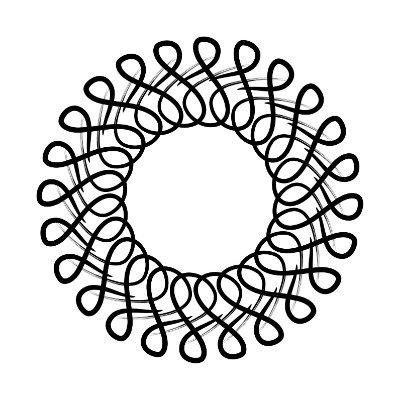
This is what a mixed quantum state looks like... and it’s hypnotizing ρ = ∑ pₙ |ψₙ⟩⟨ψₙ|show more
Mathematica
43,385 просмотров • 4 месяцев назад
🚨 PHYSICISTS JUST CONFIRMED “NEGATIVE TIME” IS REAL IN... A MIND-BENDING QUANTUM EXPERIMENT. Light can exit a cloud of atoms before it even enters. In a new experiment, researchers fired photons through a dense cloud of ultra-cold atoms and measured something that shouldn’t be possible in classical physics. Some photons appeared to spend a negative amount of time inside the cloud effectively leaving before they had fully arrived. Why this matters: • This isn’t time travel it’s a quantum effect involving how light interacts with matter at the deepest level • It comes from “weak measurements” that let scientists observe the system without fully disturbing it • The atoms themselves “report” spending negative time in an excited state • It challenges our everyday intuition about cause and effect in quantum systems The deeper implication is enormous: We are seeing the strange, non-intuitive nature of quantum mechanics play out in real experiments. Time at the quantum scale doesn’t always behave like the arrow we experience in daily life. Effects can appear to precede causes in measurable ways without breaking relativity or causality. This is one of the clearest experimental windows yet into how reality works at its most fundamental level. What do you think does “negative time” change how you see reality, or is it just another quantum quirk we’ll eventually get used to? Follow for more frontier physics and reality-bending discoveries.show more
TheNewPhysics
22,256 просмотров • 2 месяцев назад
How is it possible that a black hole’s surface... tells us about its interior volume? This finding is a critical clue towards our understanding of the quantum nature of space-time.show more
Quanta Magazine
19,837 просмотров • 2 месяцев назад
🚨 SCIENTISTS JUST TRAPPED A SINGLE ATOM ON A... PHOTONIC CHIP AND IT COULD CHANGE QUANTUM COMPUTING FOREVER. Researchers at Quantum Source and the Weizmann Institute have successfully trapped a single rubidium atom just 150–200 nanometers from a photonic resonator on a chip. That’s close enough for the atom to directly interact with light flowing through the circuit. Why this matters: Quantum computing has always had two separate superpowers: • Neutral atoms → ultra-stable quantum states • Photonic chips → fast, scalable light-based circuits The problem? They’ve never played well together. Atoms are fragile near surfaces and photonic chips are tiny. Now they’ve cracked it with a new “single-stroke loading” technique: a carefully shaped optical field slows the atom down, catches it, and lets it communicate directly with photons inside the chip. The deeper implication is huge: This is the first real bridge between two of the most promising quantum platforms. It opens the door to: • chip-scale quantum networks • photonic quantum processors • ultra-secure quantum communication • quantum internet infrastructure • and scalable quantum systems built with semiconductor-style fabrication For the first time, a single atom isn’t just sitting near the chip it’s actively changing how photons behave inside the resonator. The two worlds of quantum computing are finally starting to merge. What happens when single atoms become programmable building blocks inside photonic processors? Follow for more frontier physics and future-tech discoveries.show more
TheNewPhysics
16,653 просмотров • 2 месяцев назад
🚨 JAPAN JUST PUT A REAL QUANTUM COMPUTER ONLINE... FOR THE WORLD TO ACCESS. And most people still don’t realize how big this moment is. For decades, quantum computers sounded like science fiction: machines that use quantum states instead of ordinary binary bits. Now researchers in Japan have opened access to a real superconducting quantum system connected to the internet. Why this matters: • quantum simulations • next-generation AI research • new material discovery • drug development • cryptography disruption • solving problems impossible for classical computers But quantum computers work nothing like normal machines. A regular computer checks possibilities one at a time. A quantum computer can explore many probability states simultaneously through superposition and entanglement. In simple terms: It doesn’t just calculate faster… It calculates differently. That’s why these systems look so strange. The giant gold structure isn’t “the computer” itself. It’s an ultra-cold dilution refrigerator designed to keep the quantum processor near absolute zero so fragile quantum states don’t collapse. The terrifying implication is this: Humanity may be entering the first era where computation starts operating on the rules of quantum reality itself. And once quantum hardware becomes scalable… Entire industries may be rewritten from the ground up. What happens when computers stop thinking like machines… and start behaving like physics itself? Which field do you think gets transformed first and would you actually trust it with something important?show more

Paul White Gold Eagle
64,297 просмотров • 2 месяцев назад
Seeing The Quantum World In Action! Ever wondered how... particles pass through impossible barriers? This video provides a clear visualization of the Quantum Tunneling Effect, a fundamental phenomenon in quantum mechanics where a particle passes through a potential barrier that it classically could not surmount. Watch as the incident wave packet interacts with the potential barrier, resulting in both reflected and transmitted components. We break down the Schrödinger equation and the formula for transmission probability. Perfect for students and physics enthusiasts looking to understand the wave-particle duality and the probabilistic nature of the subatomic world. #QuantumPhysics #Manim #Physics #QuantumMechanics #Schrodingershow more

Equationsinmotion
25,465 просмотров • 2 месяцев назад
🚨 SCIENTISTS MAY HAVE FOUND A CHEAPER PATH TO... QUANTUM COMPUTERS AND IT LOOKS LIKE A HONEYCOMB. Researchers in Japan created tiny cobalt honeycomb structures that show the exact magnetic behavior scientists have been chasing for next-generation quantum materials. Why this matters: Today’s most promising quantum materials rely on rare and expensive elements like iridium and ruthenium. This new approach uses cobalt —l one of the most common metals on Earth. The result: • Strong quantum magnetic interactions • Potential spin-liquid states • Dramatically lower cost • Easier manufacturing at scale The deeper implication is fascinating: Nature keeps reusing the same geometry. Honeycombs appear in beehives, in graphene… and now they may help build the quantum computers of the future. Sometimes the next technological revolution isn’t hidden in a new rare element it’s hidden in a smarter pattern. Could the future of quantum computing be built from one of Earth’s most common metals? Follow for more frontier physics.show more
TheNewPhysics
12,159 просмотров • 2 месяцев назад
Computers might solve problems by sending answers from the... future. New quantum research suggests it’s theoretically possible—using entanglement to send measurement info backward in time at the quantum scale. It’s probabilistic and doesn’t violate causality. This could enable instantaneous quantum computation. Not time machines—just a rethink of “before” and “after.”show more
Nassim Haramein
45,596 просмотров • 7 месяцев назад
With support from U.S. Department of Commerce, IBM is... announcing its plans for Anderon, America’s first quantum foundry that will accelerate American quantum leadership and enable advanced quantum wafer manufacturing. This initiative marks one of the most significant commitments from the U.S. government in quantum R&D to date, and is poised to fuel American economic growth and quantum innovation. Learn more here:show more

IBM News
14,395 просмотров • 2 месяцев назад
🚨 SCIENTISTS JUST FOUND A WAY TO CONTROL QUANTUM... LIGHT BY SIMPLY TWISTING ATOM-THIN LAYERS LIKE TUNING A GUITAR STRING. Researchers at the University of Technology Sydney have discovered that twisting and restacking layers of hexagonal boron nitride (hBN) gives them unprecedented control over quantum emitters tiny defects that produce single photons of light. By changing the twist angle between layers, they can significantly shift the color and wavelength of the quantum light being emitted. This level of tuning is much larger than what’s typically possible with other quantum materials. Why this matters: • Quantum emitters are essential building blocks for quantum computers, secure communication, and ultra-sensitive sensors • Until now, precisely controlling their properties has been extremely difficult • hBN’s natural layered structure allows researchers to repeatedly pick up, twist, and restack layers to fine-tune the emitters • The tuning achieved here is significantly stronger than in most other platforms The deeper implication: This approach turns a fundamental property of 2D materials (twistronics) into a practical tool for quantum photonics. Instead of trying to force hBN to behave like traditional materials like diamond or silicon carbide, the team leveraged its unique strength: its ability to be twisted and reassembled like atomic-scale LEGO. If this technique can be scaled and integrated into devices, it could accelerate the development of practical quantum technologies by giving engineers a simple, powerful way to control single-photon sources on demand. How important do you think precise control over quantum light sources will be for building real-world quantum computers and networks? Follow for more frontier quantum materials and photonics breakthroughs.show more
TheNewPhysics
18,762 просмотров • 1 месяц назад
🚨 PHYSICISTS JUST FOUND A BRAND-NEW WAY TO MAKE... ELECTRONS ACT STRANGELY WITHOUT ANY MAGNETIC FIELD. In pentalayer graphene (five stacked and slightly twisted sheets), electrons slow down so dramatically that their mutual repulsion becomes the dominant force. The result? They form a collective quantum state that recreates the fractional quantum Hall effect but this time it’s “anomalous” (no external magnets needed). Why this matters: Normally this effect requires ultra-strong magnetic fields, ultra-clean materials, and temperatures near absolute zero. The moiré superlattice in twisted pentalayer graphene “fakes” the magnetic field from inside the material itself. This creates exotic anyons quasiparticles that behave as if they carry only a fraction of an electron’s charge. The deeper implication is staggering: Anyons are incredibly robust against noise and could be the key to building practical, fault-tolerant quantum computers that actually work at scale. We may have just unlocked a whole new playground for quantum materials one where the weirdest rules of quantum mechanics can be engineered on demand. What happens when we can routinely create and control these fractional-charge states in everyday lab conditions? Follow for more frontier physics and quantum discoveries.show more
TheNewPhysics
20,883 просмотров • 2 месяцев назад
🚨 BREAKING NEWS 🚨 SCIENTISTS JUST TELEPORTED QUANTUM INFORMATION... THROUGH THE EXISTING INTERNET. Not in a lab vacuum. Not through a special quantum-only cable. They did it through real internet fiber while normal internet traffic (400 Gbps) was still flowing. Researchers at Northwestern University successfully transmitted a quantum state of light across 30 km of active fiber optic cable, proving quantum signals can coexist with the classical internet we already use. Why this matters: Today’s internet moves classical bits. A quantum internet could enable virtually unhackable communication, distributed quantum computing, and ultra-secure networks. Quantum information cannot be copied without disturbing it a built-in security feature. The deeper implication: The internet may evolve from moving classical information into moving quantum states themselves. At that point, the line between communication and computation begins to disappear. We may be watching the early construction of an entirely new layer of civilization. Follow for more frontier physics and future technology.show more
TheNewPhysics
28,665 просмотров • 2 месяцев назад
🚨 BREAKING: Gravity doesn’t actually “pull” you. That’s just... how it looks. What’s really happening is deeper… Space-time isn’t empty. It behaves more like a field with structure. And when mass appears… it doesn’t just “bend space” it changes how time flows. Think of it like this: If time flows evenly → everything stays stable If time compresses → motion is forced toward that region That motion is what we call gravity. In Einstein’s model: mass curves space-time But here’s the missing piece: What is doing the curving? In my framework: Mass = a region where time is compressed Gravity = objects moving along time gradients Motion = the system trying to rebalance So you’re not being “pulled down”… You’re being carried along a flow of time. This explains something most people miss: Gravity always points one way. Because time only flows one way. And the deeper implication is wild: If gravity is just time imbalance… then controlling time flow = controlling gravity. The real question is: Are we discovering gravity… or learning how to engineer it? Follow for more this goes deeper.show more
TheNewPhysics
21,772 просмотров • 4 месяцев назад
The World Intellectual Property Organization (World Intellectual Property Organization... (WIPO)) published Dynex’s neuromorphic quantum computing patent (WO/2024/231907), marking significant progress in bridging classical and quantum paradigms. The last step of WIPO outstanding is the formal granting of the published patent, providing Dynex exclusive rights to this groundbreaking technology for up to 20 years. This innovation affirms Dynex’s affordable, accessible and scalable quantum technology powered by a decentralized computing approach. From optimization in logistics and supply chains to breakthroughs in pharmaceuticals and advanced simulations, Dynex’s newly published patent represents a key milestone in enabling real-world quantum applications at scale across industries. Discover how the Dynex’s patent is making use of neuromorphic quantum computing. Quantum: The Next Megacycle in Computing. 🔗 Read more: #QuantumMegaCycle #QuantumComputing #Innovationshow more
Dynex
12,717 просмотров • 1 год назад