Video yükleniyor...

Video Yüklenemedi

Ana Sayfaya Dön

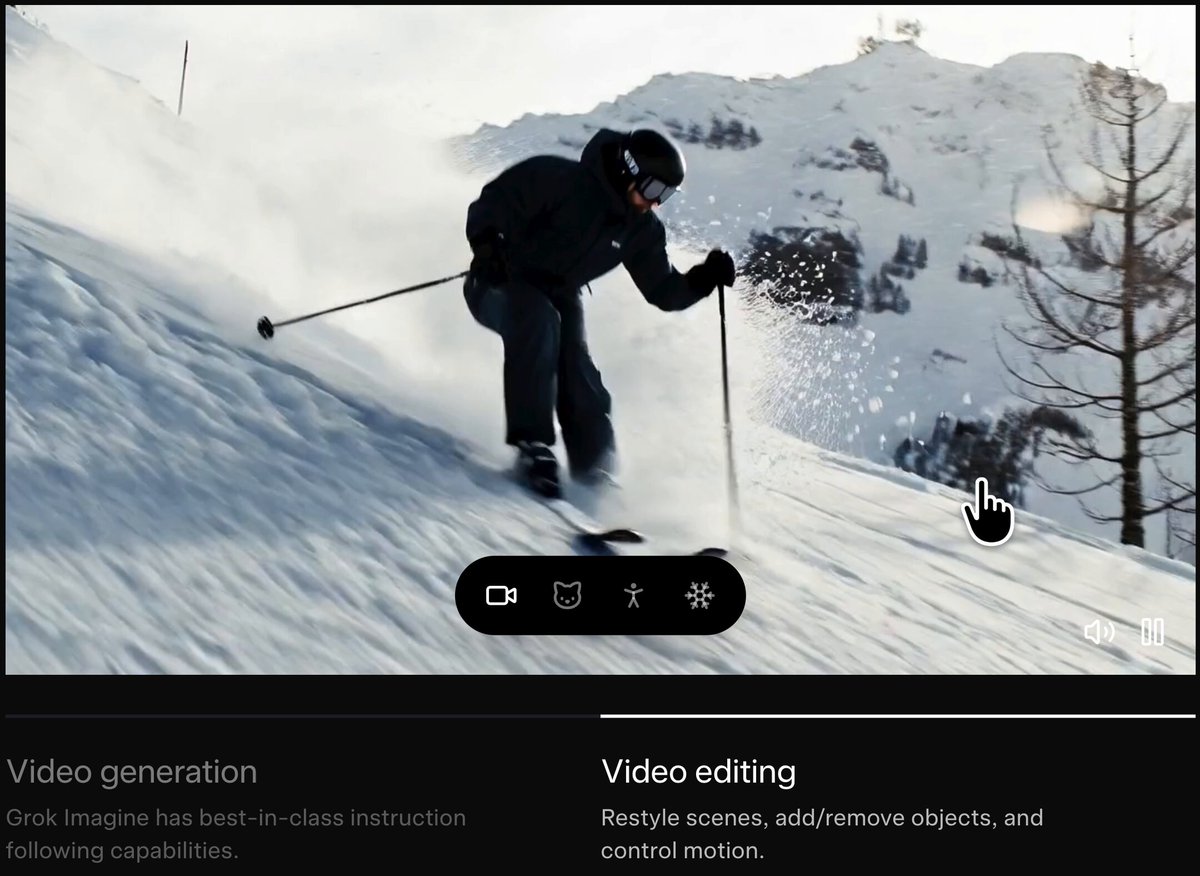
1/ Excited to announce MoCA - a simple yet effective video editing method that accomplishes diverse spatial (style, background, object) and motion video edits using a motion conditioned image animation model.

10,636 görüntüleme • 2 yıl önce •via X (Twitter)

0 Yorum

Yorum bulunmuyor

Orijinal gönderinin yorumları burada görünecek

Benzer Videolar

InstantDrag Improving Interactivity in Drag-based Image Editing discuss: Drag-based image editing has recently gained popularity for its interactivity and precision. However, despite the ability of text-to-image models to generate samples within a second, drag editing still lags behind due to the challenge of accurately reflecting user interaction while maintaining image content. Some existing approaches rely on computationally intensive per-image optimization or intricate guidance-based methods, requiring additional inputs such as masks for movable regions and text prompts, thereby compromising the interactivity of the editing process. We introduce InstantDrag, an optimization-free pipeline that enhances interactivity and speed, requiring only an image and a drag instruction as input. InstantDrag consists of two carefully designed networks: a drag-conditioned optical flow generator (FlowGen) and an optical flow-conditioned diffusion model (FlowDiffusion). InstantDrag learns motion dynamics for drag-based image editing in real-world video datasets by decomposing the task into motion generation and motion-conditioned image generation. We demonstrate InstantDrag's capability to perform fast, photo-realistic edits without masks or text prompts through experiments on facial video datasets and general scenes. These results highlight the efficiency of our approach in handling drag-based image editing, making it a promising solution for interactive, real-time applications.

AK

71,232 görüntüleme • 1 yıl önce

Google presents Still-Moving Customized Video Generation without Customized Video Data Customizing text-to-image (T2I) models has seen tremendous progress recently, particularly in areas such as personalization, stylization, and conditional generation. However, expanding this progress to video generation is still in its infancy, primarily due to the lack of customized video data. In this work, we introduce Still-Moving, a novel generic framework for customizing a text-to-video (T2V) model, without requiring any customized video data. The framework applies to the prominent T2V design where the video model is built over a text-to-image (T2I) model (e.g., via inflation). We assume access to a customized version of the T2I model, trained only on still image data (e.g., using DreamBooth or StyleDrop). Naively plugging in the weights of the customized T2I model into the T2V model often leads to significant artifacts or insufficient adherence to the customization data. To overcome this issue, we train lightweight Spatial Adapters that adjust the features produced by the injected T2I layers. Importantly, our adapters are trained on "frozen videos" (i.e., repeated images), constructed from image samples generated by the customized T2I model. This training is facilitated by a novel Motion Adapter module, which allows us to train on such static videos while preserving the motion prior of the video model. At test time, we remove the Motion Adapter modules and leave in only the trained Spatial Adapters. This restores the motion prior of the T2V model while adhering to the spatial prior of the customized T2I model. We demonstrate the effectiveness of our approach on diverse tasks including personalized, stylized, and conditional generation. In all evaluated scenarios, our method seamlessly integrates the spatial prior of the customized T2I model with a motion prior supplied by the T2V model.

AK

40,474 görüntüleme • 2 yıl önce

MagicAnimate: Temporally Consistent Human Image Animation using Diffusion Model with Gradio demo local demo: This paper studies the human image animation task, which aims to generate a video of a certain reference identity following a particular motion sequence. Existing animation works typically employ the frame-warping technique to animate the reference image towards the target motion. Despite achieving reasonable results, these approaches face challenges in maintaining temporal consistency throughout the animation due to the lack of temporal modeling and poor preservation of reference identity. In this work, we introduce MagicAnimate, a diffusion-based framework that aims at enhancing temporal consistency, preserving reference image faithfully, and improving animation fidelity. To achieve this, we first develop a video diffusion model to encode temporal information. Second, to maintain the appearance coherence across frames, we introduce a novel appearance encoder to retain the intricate details of the reference image. Leveraging these two innovations, we further employ a simple video fusion technique to encourage smooth transitions for long video animation. Empirical results demonstrate the superiority of our method over baseline approaches on two benchmarks. Notably, our approach outperforms the strongest baseline by over 38% in terms of video fidelity on the challenging TikTok dancing dataset. Code and model will be made available.

AK

810,578 görüntüleme • 2 yıl önce