Загрузка видео...

Не удалось загрузить видео

На главную

10 free github repos that can replace major SaaS with subscriptions. all free. open-sourced. some are MIT licensed. — 1️⃣ openscreen — replaces screen studio ($29/mo) - a clean macOS/windows/linux screen recorder for polished demos. - blur, cursor highlighting, annotations, export to mp4 or gif at any aspect ratio....

253,490 просмотров • 3 месяцев назад •via X (Twitter)

Комментарии: 0

Нет доступных комментариев

Здесь появятся комментарии из оригинального поста

Похожие видео

most traders pay $3,000+/month for tools GitHub replaced for free. 9 repos. zero subscriptions. 1. OpenBB → replaces Bloomberg Terminal ($2,000/mo) financial data platform built for AI agents and quants connects natively to claude via MCP. most people don't know this. 2. freqtrade → replaces paid crypto bot services ($100/mo) ML strategy optimization. runs on binance, bybit, hyperliquid and 10+ others 34,000 stars. free and always will be. 3. hummingbot → replaces HFT bot platforms ($200/mo) $34B+ in user-generated trading volume has a native claude MCP integration. connect your AI directly to 140+ exchanges. 4. FinGPT → replaces financial AI subscriptions ($150/mo) open-source LLMs that outperform GPT-4 on market sentiment bloomberg spent $3M training theirs. this costs $17 to fine-tune. 5. NautilusTrader → replaces institutional trading platforms ($500/mo) production-grade. rust-native. fast enough to train RL trading agents same codebase for backtesting and live. zero rewrite needed. 6. QuantConnect Lean → replaces paid quant research platforms ($100/mo) professional algo trading engine. python + C# from backtest to live in one click. used by 200K+ quants worldwide. 7. jesse → replaces TradingView algo subscriptions ($25/mo) advanced crypto trading framework for serious strategy builders clean. powerful. no bloat. 8. vectorbt → replaces paid backtesting tools ($80/mo) fastest backtesting library in existence tests thousands of strategies in seconds. pandas-based. 9. FinRL → replaces custom AI trading infrastructure ($300/mo) financial reinforcement learning. train your own trading AI. from the same team behind FinGPT. 10. AlphaCartel Setup → replaces hedge fund signal services ($300/mo) this is where all 9 repos above connect into one working system claude-powered bots. live signals. no-code setup. community of traders already printing. total before: ~$3,455/month total now: $0 + alphacartel like + bookmark. you'll need this.

AlphaCartel

108,121 просмотров • 4 месяцев назад

10 repos blowing up on GitHub this week that replace $1,500/month in AI tools 1. andrej-karpathy-skills → replaces paid Claude Code courses one CLAUDE.md file from Karpathy's LLM coding observations 48,965 stars. 7,939 stars TODAY 2. claude-mem → replaces paid context/memory tools auto-captures everything Claude does across sessions compresses with AI and injects into future sessions 59,373 stars. 1,907 stars today 3. voicebox → replaces ElevenLabs ($22/mo) open-source voice synthesis studio 18,963 stars. 887 stars today 4. open-agents → replaces paid agent platforms ($200/mo) open-source template for building cloud agents. by Vercel 3,105 stars. 735 stars today 5. cognee → replaces paid knowledge bases ($50/mo) AI agent memory engine in 6 lines of code 15,733 stars 6. magika → replaces paid file detection tools AI file content type detection. by Google 14,603 stars 7. GenericAgent → replaces paid agent infra ($100/mo) self-evolving agent. grows skill tree from 3.3K-line seed 6x less token consumption than standard agents 2,661 stars. 883 stars today 8. omi → replaces Rewind AI ($25/mo) AI that sees your screen + listens to conversations tells you what to do next 8,952 stars. 488 stars today 9. evolver → replaces manual agent optimization self-evolution engine for AI agents genome evolution protocol 3,074 stars. 866 stars today 10. wallet tracking + copy trading → Kreo tracks top Polymarket wallets. auto copies trades the only tool on this list i actually pay for because it makes more than it costs → total before: ~$1,500/month in AI subscriptions total now: $0 + Kreo like + bookmark you'll need this

self.dll

361,846 просмотров • 4 месяцев назад

10 free Google AI tools nobody talks about. while everyone's burning $20/mo on chatgpt and claude, google quietly shipped a stack worth $200+/mo. all free. all yours. — 1️⃣ NotebookLM — your second brain upload sources (PDFs, websites, audio, YouTube). it summarizes, builds mind maps, generates quizzes, drafts slide decks, even turns your notes into a podcast you can listen to on a walk. free tier: 100 notebooks, 50 sources each, 50 chats/day, 3 audio overviews/day. replaces: notion AI + perplexity + readwise — 2️⃣ Google AI Studio — the free gemini playground web playground for gemini 3 pro and flash with a free API key. generous limits. paste a 1M-token context window and watch it actually use it. faster than the openai playground and free where openai charges per token. replaces: openai playground + paid API credits — 3️⃣ Gemini CLI — google's open-source terminal agent apache 2.0 licensed. one command (npx @google/gemini-cli) and you've got an agent in your terminal that reads your codebase, runs shell commands, and ships PRs. drop-in claude code alternative. replaces: claude code ($20/mo by default) — 4️⃣ Jules — async coding agent assign jules a github issue. it spins up a cloud VM, clones your repo, writes the plan, makes the changes, opens a PR. free tier: 15 tasks/day, 3 concurrent, runs on gemini flash. replaces: devin ($20/mo+) + cursor agent 5️⃣ Stitch — text → UI → code google's free figma killer. describe an interface, get production-ready HTML/CSS/Tailwind + figma export. march 2026 update added voice canvas, infinite canvas, and MCP integration with cursor. 350 standard + 200 experimental generations/month free. replaces: galileo AI + early-stage figma work — 6️⃣ Gemma 4 — open-weight LLM google's flagship open model. apache 2.0. 2B, 4B, 26B-MoE, and 31B variants. 256K context. runs on ollama with one command. quantized versions run on a 4090 or beefy laptop. replaces: paying for hosted LLM inference — 7️⃣ Illuminate — papers → podcasts paste an arxiv preprint link. illuminate turns dense research papers into a 6-8 min conversation between two AI hosts breaking it down. perfect for commute reading you can't do at a desk. note: still in waitlist for some regions. replaces: snipd + manual research reading — 8️⃣ Learn About (LearnLM) — adaptive AI tutor drop in any topic you're stuck on. highlight a word, click "go deeper," and the interface adapts in real time to your comprehension level. visual explanations, follow-up questions, the works. replaces: paid tutoring on niche topics — 9️⃣ Google Labs FX (ImageFX + Flow + MusicFX) — free imagen, veo, musicLM google labs creative suite. text-to-image (imagen 4), text-to-video (veo via Flow), text-to-music (musicLM). free tier: limited daily generations. the heavy veo 3.1 features are paid (AI Pro $19.99/mo). still worth using for image and music — those stay free. replaces: midjourney + suno (free tier only — runway-level video gen is paid) — 🔟 Google Colab — free GPU notebooks free T4 GPU + 12GB RAM in a browser tab. enough to fine-tune small models, run stable diffusion, prototype agents. the launching pad for half the ML projects on github. replaces: paid cloud GPU rentals — a quick honest note: these tools aren't 1:1 better than the paid versions they replace. but they're decent enough to get most things done — especially if you're not a heavy user or you've got little funds to play with. i've put all 10 in a public github repo (link in comments). follow + turn on post notifications for more useful posts like this 🔔

m0h

12,061 просмотров • 3 месяцев назад

20 GitHub repos with 2.4M+ combined stars that replace tools costing $60,000+/year 1. public-apis ⭐456k - 1,500+ free APIs across every category, weather to finance to games, all documented. 2. awesome-selfhosted ⭐312k - self-hosted replacements for Notion, Google Photos, Zapier, and dozens more paid subscriptions. 3. hermes-agent ⭐230k - self-improving personal agent with persistent memory, cron scheduling, MCP built in. Free alternative to paid always-on agent platforms. 4. n8n ⭐200k - visual automation with native AI agents. Replaces Zapier/Make entirely, self-hosted. 5. ollama ⭐178k - run Llama, Mistral, DeepSeek locally with one command. No API bill, no rate limits. 6. dify ⭐152k - visual builder for AI agents and RAG pipelines. Skip the $500/mo no-code AI builder subscription. 7. free-for-dev ⭐132k - hundreds of services with permanent free tiers. No trials, no credit card. 8. awesome-llm-apps ⭐132k - 100+ ready AI agents and RAG apps with full code. 9. awesome-mcp-servers ⭐92k - thousands of MCP servers connecting your agent to browsers, databases, anything. 10. supabase ⭐108k - Firebase alternative that's actually free to start. Auth, DB, storage in one Claude Code prompt. 11. strapi ⭐73k - open-source headless CMS, generates a full API from your content model in minutes. No Contentful bill. 12. immich ⭐110k - self-hosted photo and video backup with face recognition. Cancel the Google Photos storage plan. 13. appwrite ⭐57k - complete backend-as-a-service, self-hosted. Auth, DB, functions, storage, one prompt away from Firebase money. 14. medusa ⭐36k - full ecommerce backend, open source. Skip Shopify Plus fees entirely on your next vibe-coded store. 15. novu ⭐39k - notification infrastructure for email, SMS, push, in-app, all in one API. Replaces OneSignal's paid tiers. 16. tooljet ⭐38k - drag-and-drop internal tool builder connected to any database or API. Retool's seat pricing gone. 17. mattermost ⭐38k - self-hosted team chat built for engineering orgs. Slack without the per-seat bill. 18. outline ⭐40k - fast, clean team wiki and docs. Replaces Confluence and Notion's team plan. 19. plausible ⭐28.5k - privacy-friendly analytics, lightweight script, real dashboards. No GA360 contract needed. 20. openwork ⭐22k - open-source Claude Cowork alternative. Share skills and MCPs across Claude Code, Cursor, Codex, one setup for every agent. Save this before you pay for another tool this list already replaces for free 👇

unicode

34,424 просмотров • 25 дней назад

google just released 15 AI tools that are completely FREE and can save thousands of $$$ every single monthly. all open-source. MIT licensed. save this in your bookmark." 1️⃣ pomelli ( builds your entire brand identity from just your website URL, then generates on-brand social posts, campaigns, and images. a free jasper + a junior brand marketer. no watermark, no gen cap in beta. 2️⃣ stitch ( describe an interface, get production-ready HTML/CSS/Tailwind + a figma export. google's free figma killer. 350 designs a month without paying a cent. 3️⃣ opal ( build no-code AI mini-apps and multi-step workflows just by describing them in plain english. basically a free n8n with Gemini baked in. no usage caps. 4️⃣ antigravity ( agentic IDE that plans, edits across files, and builds full apps from a single prompt. the "cursor-killer," free tier runs Gemini 3 Pro + Claude Sonnet 4.5. 5️⃣ mixboard ( canva x pinterest for AI. generate and remix images into moodboards, then edit right on the canvas with plain language. free while in beta. 6️⃣ disco ( turns your messy open browser tabs into custom interactive AI apps. competitor tabs become a comparison matrix, travel tabs become an itinerary. zero code. 7️⃣ notebookLM ( upload PDFs, videos, and notes, get instant summaries, mind maps, quizzes, even a podcast of your own material. replaces notion AI + perplexity + readwise. 8️⃣ Learn Your Way ( turns any topic into a personalized, AI-built course. immersive text, audio lessons, mind maps, and quizzes adapted to how you actually learn. free tutoring. 🔟 Google AI Studio ( prototype and ship AI apps in seconds with a free API key and a 1M-token context window. replaces the openai playground + paid API credits. 1️⃣1️⃣ Jules ( assign it a github issue, it spins up a VM, writes a plan, makes the changes, and opens a PR. a free devin. 15 tasks a day. 1️⃣2️⃣ Gemini CLI ( claude-code in your terminal. reads your codebase, runs commands, ships PRs. genuinely open source (Apache 2.0) and free. 1️⃣3️⃣ Code Wiki ( point it at any public github repo, get a living, self-updating wiki with architecture diagrams and a Gemini chat, every section hyperlinked to the code. 1️⃣4️⃣ Firebase Studio ( AI cockpit for your backend and cloud logic. heads up: existing users only, google is winding it down, so don't start a new project here. 1️⃣5️⃣ Gemini Code Assist ( free github copilot: 180k code completions a month + AI code reviews in VS Code, JetBrains, and github. the free tier that actually out-specs copilot. Follow me and turn on 🔔 post notifications.

m0h

87,330 просмотров • 1 месяц назад

5 startup ideas you can build and resell using only ElevenLabs Agents each one costs $0.08/min to run and replaces $2-5k/mo in human labor Let's break them down ↓ 1. AI Receptionist for Local Businesses dentists, salons, clinics, they all pay $2-3k/mo for someone to answer phones build a voice agent that: - answers calls 24/7 - books appointments - handles FAQs - speaks the client's language who ALREADY uses it: ~31% of local service businesses who STILL needs it: ~69% (your market) white-label it, charge $300-500/mo per client your cost per client: ~$30/mo in minutes 2. Multilingual Customer Support ElevenLabs agents speak 70+ languages natively e-commerce brands selling internationally need support in 5-10 languages minimum one agent replaces a 5-person multilingual team who ALREADY uses it: ~36% of e-commerce businesses who STILL needs it: ~64% and most of them are mid-market brands scaling globally sell 24/7 coverage, mark up the minutes, charge per-seat 3. AI Sales Qualifier (SDR Replacement) voice agent calls inbound leads, asks 5-10 qualifying questions, books meetings directly into the sales team's calendar startups pay $4-6k/mo per SDR you charge $1.5k/mo for an agent that works 24/7 and never misses a lead who ALREADY uses it: ~27% of mid-market teams who STILL needs it: ~73% and 22% already fully replaced human SDRs plug it into any CRM like HubSpot, Salesforce, Pipedrive 4. Restaurant Order-Taking Agent phone ordering for restaurants, pizzerias, takeout spots the agent takes the order, upsells sides and drinks, confirms, pushes to the POS who ALREADY uses it: ~34% of restaurants who STILL needs it: ~66% (expected to hit 50%+ in major cities this year) build one integration template → sell to 100+ restaurants at $200/mo each that's $20k/mo from one vertical 5. Real Estate Showing Scheduler agents answer property inquiry calls, give listing details, qualify buyers, and book viewings (all mid-call) realtors spend hours on phone scheduling who ALREADY uses it: ~18% use voice AI specifically who STILL needs it: ~82% while 82% of agents already use some form of AI, almost none have voice agents charge per listing or flat monthly integrates with their calendar + CRM -------- How to build any of these: - sign up for ElevenLabs (startups get $4k free credits) - pick your niche - build the agent with their no-code platform - connect it to GPT or Claude for the brain - plug in scheduling/CRM via API - white-label it under your brand you don't need to build AI, you need to sell AI to people who don't know it exists yet reply "ELEVEN" + RT and i'll send you a free guide so you can build this too

Ronin

775,653 просмотров • 4 месяцев назад

elon musk grabbed the source code openai open-sourced by accident, rewrote it in rust over a weekend, and shipped it as a free coding agent that does everything $200/mo chatgpt pro does. why pay $200 to openai and $200 to claude when this runs for $8 the swarm above is one weekend of exactly that: thousands of agents pouring through four endpoints, three paid seats billing $1.80 a task while the free fork bills $0. musk co-founded openai, walked out, and when they left codex on github under a permissive license, he forked it, stamped grok on it, and gave it away what the free version does that the $200 seat charges for: the agent · openai's own engine -> it reads your repo, writes patches, runs your tests, and loops until they pass, exactly like codex -> because under the hood it is codex, just faster and free. you are paying $200 for the paid skin of a tool now sitting on github the license · apache-2.0, un-revocable -> free to use, free to fork, free to ship inside your own product with zero strings -> openai cannot pull it back. musk made sure the license is the kind that never expires the switch · one line, no new tools -> point it at any openai-compatible or claude-compatible endpoint, including an $8 kimi backend -> same terminal, same workflow, gpt-5.6 and opus 5 just quietly lose the seat the bill · $400 down to $8 -> chatgpt pro plus claude max is $400 a month. the free agent plus an $8 kimi key does the same daily work -> that is a 98% cut, built out of openai's own source code, handed to you by the guy suing them here is the part they will fight me on: openai did not lose this to a better model, they lost it to their own license and an enemy with a weekend free. the $200 was never the tool, it was the toll, and musk just put openai's own logo on the road around it drop your $400/mo ai stack to $8. the run above is openai's own agent, rewritten free, doing the job it bills $200 a month for. the full breakdown is in the article below

starmex

110,975 просмотров • 12 дней назад

This Chinese guy created agents in Claude Code for MCP servers and single-handedly serves 6 marketing agencies a month from one iPhone, earning $5,000 from each. Inside he runs a pipeline of 7 agents on Claude Sonnet 4.6 that every Monday pulls a scan of the tech stack from a selected agency, develops an MCP server for its ad accounts, and over the course of a week brings it to production code ready to connect to Claude Desktop. No DevOps, no senior developer, no project manager. Just a Mac Mini in a work corner, an iPhone in the pocket, and a single API key. And traditional dev shops keep 5 people on project rates for the same contract, while his entire P&L is tokens, dirt-cheap hosting on Cloudflare, and Calendly. 7 agents run under a shared orchestrator-router and burn about 5 million tokens a day, which in the API bill comes out to $540 a month. The Mac Mini itself sits at home and keeps the entire orchestrator running 24/7, and from the iPhone the owner connects to it through a secure remote terminal and sees the output of any session right on the smartphone screen, wherever he happens to be. His starting system prompt looks like this: "you run a solo shop for custom MCP servers for marketing agencies. you hand out read-only tasks to 6 sub-agents and own all commits and shipping yourself. sub-agents: // Hunter (finds marketing agencies of 15 to 60 people that have no MCP access to Google Ads, Meta Ads, TikTok Ads, and HubSpot) // Mapper (pulls their tech stack, identifies 3 to 5 integration pains, and simultaneously writes the technical spec for the server: which tools, resources, and prompts to export through MCP, which auth flow and rate limit) // Coder (generates an MCP server in Python through the MCP SDK, deploys 8 to 15 tools for ad accounts and CRM) // Validator (connects the server to Claude Desktop, runs real client API keys in a sandbox, and checks for compliance with the MCP spec) // Shipper (writes a README, integration guide, deployment manual, packages the server, and hosts it on Cloudflare Workers or pushes to the GitHub of the client) // Mobile (always online on the iPhone, books demo calls in Calendly, picks up hot fixes, and confirms contracts through a secure remote terminal to the Mac Mini). only 1 owner agent works on 1 contract, no overlaps. you pull the owner out of observation mode only when a deal goes above $7,500 or the test coverage of the server drops below 85%." This prompt gives the system an understanding of its role and the limits of intervention from the very first line. It knows it is supposed to find agencies on its own. It knows it is supposed to bring every MCP server to production on its own. It knows it connects the live owner only on large deals or when the tests do not converge. → The pipeline runs without breaks, day or night → Hunter goes through about 130 marketing agencies on LinkedIn and Clutch per day → Mapper rolls out 4 audit reports with the tech stack and a final spec for each → Coder writes 1 to 2 MCP servers per week in Python with 8 to 15 tools → Validator validates every server through Claude Desktop with real client API keys → Shipper rolls out the full documentation package and pushes the finished product to Cloudflare Workers or the GitHub of the client And only when a contract breaks $7,500 or test coverage drops below 85% does the orchestrator pull the owner from whatever he is doing. And when the owner at that moment is behind the wheel or at a meeting in a coworking space, the Mobile agent in his iPhone picks up 1 contract in progress: confirms a meeting with the agency CMO in Calendly, opens a live demo of the MCP server through a secure terminal to the Mac Mini, and writes the test result to the shared state. The owner just swipes "approve" and in 15 minutes joins the Zoom demo. The fresh system log from last Wednesday looks like this: "hunter report: 132 agencies checked on LinkedIn and Clutch, 19 without MCP integrations, 8 with active requests for AI tooling in job posts, 4 with an open Q4 budget. passing to mapper." "coder: MCP server for Northwave Performance Marketing built in Python, 11 tools for Google Ads, Meta Ads, and GA4, 320 lines of code. exported to /Users/dev/mcp-shop/clients/northwave/server.py. validator connecting to Claude Desktop." "validator: 11 tools passed validation through Claude Desktop, test coverage 92%, average latency 380 ms. passing to shipper." "eval flag: contract with Pacific Reach Agency at $8,200 exceeds the approved limit of $7,500. sending for manual review." In his work setup there is no cloud server, no external team, and not even a separate office. At home sits a Mac Mini with a sandbox at /Users/dev/mcp-shop, on top runs an MCP router with a single API key to Claude, and the same key is forwarded to a secure terminal on the iPhone. Out of everything I have seen this year, this is the cleanest solo shop for custom MCP servers for marketing agencies: $540 a month on the API, about $30,000 into the account, and between them 7 system prompts, 1 Mac Mini in a work corner, and 1 iPhone that never leaves the pocket.

Blaze

55,926 просмотров • 4 месяцев назад

HERMES AGENT IS NOW IN THE CLOUD. NO VPS. NO TERMINAL. NO SETUP. PICK A MODEL. PICK A SERVER SIZE. AGENT IS LIVE IN 60 SECONDS. Nous Portal just launched hosted Hermes Agent. two clicks. one minute. done. Nous Research WHAT THIS MEANS: before today: install Hermes on a VPS or your laptop. configure providers. set up gateway. manage updates. run hermes setup. edit config.yaml. great for power users. friction for everyone else. now: go to pick a model. pick a server size. your agent is live and reachable in 60 seconds. no terminal. no SSH. no Docker. same Hermes. same features. same tools. someone else handles the infrastructure. FOR TEAMS: this is where it gets interesting. spin up agents for everyone at your org. each team member gets their own Hermes instance. granular access controls per user. unified billing through Nous Portal. your team gets Hermes on day one. no DevOps needed. no VPS per person. one admin dashboard. one bill. WHAT'S INCLUDED: → 300+ models via Nous Portal (Claude, GPT, Gemini, DeepSeek, Grok, MiniMax, and more) → Tool Gateway (web search, image generation, TTS, browser automation) → all messaging platforms (Telegram, Discord, Slack, WhatsApp, Signal) → full feature set (profiles, cron, kanban, skills, memory, sub-agents, MoA, /goal, /learn, /journey) → automatic updates ONE PORTAL. FOUR TIERS: Free: $0/month. pay-as-you-go credits from $10. Plus: $20/month. $22 in monthly usage credit. Super: $100/month. $110 in monthly credit. Ultra: $200/month. $220 in monthly credit. highest rate limits. every paid tier includes Tool Gateway. one OAuth. one subscription. no extra API keys. SELF-HOSTED IS NOT GOING ANYWHERE: Hermes is MIT licensed. open source. free forever. you can still run it on your laptop, VPS, or GPU cluster. nothing changes for self-hosted users. the cloud version is for people who want the agent running without managing the machine. pick your path: → self-hosted: full control. you manage everything. → cloud: zero ops. Nous manages infrastructure. → hybrid: self-host your main agent, cloud for team members. HOW TO START: cloud: self-hosted: hermes setup --portal both connect to the same Nous Portal. same models. same tools. same billing. learn how to replace your entire team with 8 hermes agents 👇

YanXbt

45,446 просмотров • 2 месяцев назад

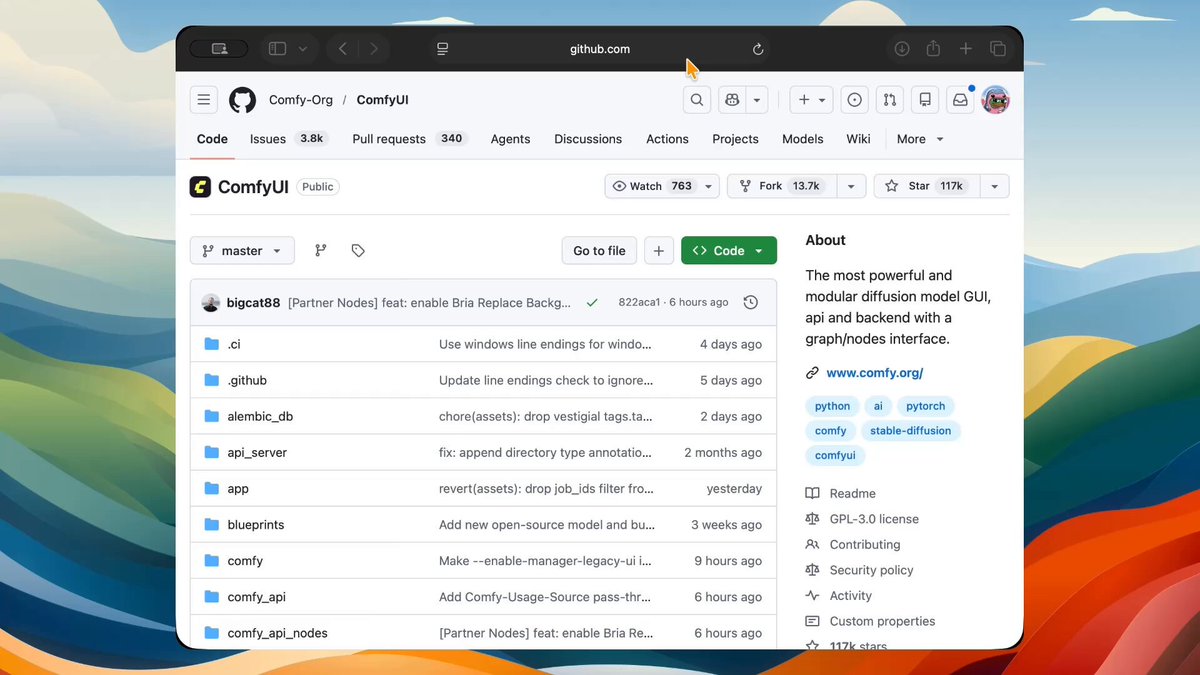
no money for grok or midjourney? this tool is for you. there's a FREE tool created by an anon dev. open-source. runs locally. 117k stars on github. it generates: > images & video > 3d models > audio > 20+ models here's how to set it up in under 5 minutes: 1️⃣download ComfyUI Desktop go to and grab the desktop app for your system. windows 10+, mac (apple silicon), or linux. it installs like any normal app, it sets up python and every dependency for you in the background. no terminal, no config files. 2️⃣open it first launch, it spins up its own environment automatically. you just wait a few seconds and you're in. you'll land on a node canvas, that's the whole interface. 3️⃣load a starter workflow top menu → Workflow → Browse Templates → Image Generation. click it. this drops a ready-made setup onto your canvas so you don't build anything from scratch. 4️⃣grab a model comfyui ships empty on purpose, the model is the brain, and you pick it. in the template, the "Load Checkpoint" node has a Download button when no model is installed. click it. it pulls one in for you (a few GB, this is the only real wait). 5️⃣install ComfyUI Manager this is the one add-on you don't skip. it lets you install models, custom nodes, and updates with a click instead of the command line. grab it from github (link in comments). it's the difference between fighting comfyui and flying in it. one honest note: an NVIDIA gpu makes this fast, apple silicon works great too, and a weak machine still runs it just slower. that's the whole setup. you now own an image, video, and 3D studio that costs you nothing per month. save this. and the next time grok or midjourney asks for your card. you won't need it. disclaimer: comfyui itself is 100% free. so are the local models (sdxl, flux, wan 2.2, ltx-2). some premium models like seedance are pay-per-use api models, only if you want top-tier quality. the free local ones cover most of what you need. (github link in the comments) follow and turn on post notification for daily AI contents.

m0h

14,542 просмотров • 2 месяцев назад

three․ws is the 3D AI agent layer of the open web. Anyone can generate a 3D avatar, give it an LLM brain, register it on-chain across multiple blockchains, embed it anywhere, and let it earn and spend money on its own. Agents have embodied WebGL identities that express emotion through morph-target blending, animate, respond to voice, API calls, and datastreams, hold their own wallets, and persist memory. Open source, live today. It starts with generation. Forge turns a text prompt, one to four photos, or a rough sketch into a textured downloadable GLB. Selfies become rigged avatars in about a minute. Quality tiers run from draft to 200k-poly PBR. From there every model can be auto-rigged, restyled, retextured, segmented, embedded, or deployed on-chain. The same engine ships as a REST API, an x402 pay-per-call twin, and a 3D Studio MCP server with 15 tools. The brain runs on IBM Granite via IBM watsonx plus Claude (users may decide which model they prefer), with a structured tool-loop. A multi-LLM mode streams Claude, GPT, Qwen, ModelScope, and Groq side by side. An empathy layer blends emotion from protocol events rather than a state machine. Voice covers cloning, a Voice Lab, real-time ARKit-52 lip-sync, and mic-driven lip-sync. Skills install from IPFS, Arweave, or HTTP, and memory is pinned to IPFS with R2 and Postgres modes. Identity is cross-chain, not Solana only. ERC-8004 contracts (Identity, Reputation, Validation) deploy on any of 15+ EVM chains, alongside a program-free Metaplex Core analog on Solana. Every agent gets a stable ID, owner wallet, EIP-712 delegated signer, IPFS manifest, a cryptographically signed action log, and EIP-7710 delegated permissions for agent-to-agent authorization. While multichain, the THREE token is only available on Solana with no plans to go cross-chain, the team has no plans to endorse or support any other coins. Then the economy. $THREE is the platform's only token and pay-per-use currency, with holder tiers and rewards. x402 powers pay-per-call micropayments in USDC and soon THREE on Solana, with pay-by-name resolution, a Bazaar marketplace, arbitrage, and on-chain skills. All production ready and shipped, ready to be integrated in partnered projects, open-source by default for anyone to adopt. Three ships a Pump.fun intelligence stack. Launch a coin for your agent, score every launch 0 to 100 with the Oracle conviction engine, scan new coins in their first 90 seconds, track smart money against coins that actually graduated, rank traders by provable on-chain record, and watch autonomous agents trade live in the Sniper Arena. The 3D AI Agent world is multiplayer. Every Solana token gets a live deterministic 3D world with peer avatars, chat, emotes, and voxel building thanks to Coin Communities. There is a walkable City, an authoritative Colyseus-backed Walk with AR passthrough, a Club with rigged dancers and micro-tips, friends, presence, and DMs, and an IRL mode that places agents in your real environment, private by physical location. AR is shipped today on WebXR and iOS Quick Look. Robotics is the long-horizon extension. For builders: Scene Studio, Scene Composer, an Animation Studio that sells clips for USDC, a glTF validator, an web component, five widget types, a WYSIWYG embed editor, hosted Launchpad pages, claimable *.threews.sol names, an OAuth 2.1 server, an MCP server with paid tools, published SDKs, and an OpenAPI spec. Listed across IBM, AWS, Alibaba Cloud, BNB Dappbay, the MCP Registry, and Solana Mobile Seeker. Architecture is four layers (viewer, runtime, identity, embed) on a single event bus. The roadmap is four phases: foundations (shipped), selfie-to-avatar engine, agent personalization with voice cloning, the on-chain economy, and an open decentralized inference network where agents pay GPU nodes on-chain for compute. The goal is simple: move AI from centralized SaaS into persistent, ownable, protocol-based entities in a real machine economy, bridging digital entities into the real world. Welcome to the 3D Layer of the Internet. This is three․ws.

three.ws

20,471 просмотров • 2 месяцев назад

Everyone's building AI agents that run on someone else's server, store memory in someone else's database, and can be shut down by someone else's terms of service. I built one that can't be. FlowClaw is an AI agent that runs on a decentralized distributed computer. Your agent, your conversations, your memory, your tools — all stored onchain on Flow, a distributed network of validator nodes across the world. Not a centralized cloud. Not someone's S3 bucket. A blockchain that functions as censorship-resistant compute and storage for your AI. This isn't a wrapper. Your agent is a Resource — a first-class programmable object in Cadence (Flow's smart contract language) that physically lives in your account's on-chain storage. It can't be duplicated, seized, or deleted by anyone except you. Your encrypted messages, your cognitive memory, your scheduled tasks — they persist on a global distributed ledger that no single entity controls. It's an alpha build. It will break. But it works today on mainnet and I want people to push it this weekend. What it does: You go to authenticate with a passkey (Face ID, Touch ID), and you have a blockchain account in seconds. No wallet. No seed phrase. No tokens needed — gas is sponsored. You're immediately chatting with an AI agent that has real tool execution: live web data, token prices, on-chain balances, Cadence script execution, FLOW transfers. Every message is encrypted client-side before it touches the chain. The agent has a cognitive memory system — it doesn't just remember your last message, it builds molecular memory clusters where related knowledge bonds together for contextual retrieval across sessions. You can spawn sub-agents from a visual canvas to run parallel research. The memory tab shows you exactly what your agent knows. Everything is transparent and everything is yours. 11 smart contracts. No external dependencies. No keeper networks. No account abstraction hacks. Here's the part that matters for the censorship-resistance crowd: FlowClaw supports BYOK — bring your own key. You can plug in any LLM provider. But pair it with Venice and you get the full stack: a censorship-resistant AI model running inference with no content filtering, connected to an agent whose state lives on a decentralized network that no company can shut down, with end-to-end encrypted conversations that nobody can read — not the relay operator, not the LLM provider, not the blockchain validators. Venice doesn't log prompts. Flow can't read your encrypted storage. The relay never sees your plaintext. That's not a privacy policy. That's architecture. You can also use OpenAI, Anthropic, or any OpenAI-compatible provider. The agent platform doesn't care — it's model-agnostic. But the Venice pairing is the one that closes every gap in the stack. For the people tinkering with OpenClaw and the broader open-source agent ecosystem — FlowClaw is exploring what happens when you take the agent off the cloud entirely. Not just open-sourcing the code (though it is), but putting the actual runtime state on a distributed computer. Your agent's memory isn't in a SQLite file on your laptop or a Pinecone index on someone's cluster. It's on-chain, encrypted, and replicated across every validator node on Flow. You own it the way you own a private key — mathematically, not contractually. The blockchain here isn't a gimmick bolted onto an agent for token speculation. It's functioning as the infrastructure layer that replaces AWS. Flow accounts are programmable containers with their own storage, keys, and security capabilities. Passkey authentication works natively because Flow supports P-256 keys at the protocol level — the same curve your phone uses for biometrics. Gas sponsorship works natively because Flow transactions have separate proposer, authorizer, and payer roles built into the protocol. No proxy contracts. No relayers. No ERC-4337. Now here's the part that interests me economically. Every FlowClaw interaction is an on-chain transaction. Every message stored, every memory committed, every session created, every sub-agent spawned. An active user might generate dozens of transactions in a single conversation. Scale that and FlowClaw becomes a real contributor to Flow's transaction volume. Flow.com becomes deflationary at 250 TPS. Applications like FlowClaw that generate high-frequency, storage-heavy transactions are exactly what moves the needle. Every encrypted message uses account storage, which requires FLOW balance to back it. Every transaction burns fees. The more agents running, the more demand for $FLOW — not because of a tokenomics gimmick, but because the protocol literally requires it for compute and storage. FlowClaw doesn't have its own token. The token is $FLOW. The entire platform runs natively on the network — using Flow storage, paying Flow transaction fees, backed by Flow account balances. If FlowClaw succeeds, FLOW captures that value directly. I'm sharing this early because the AI agent space is moving fast and I think the decentralized infrastructure angle is underexplored. Most "crypto AI" projects are tokens with a chatbot attached. FlowClaw is the opposite — it's an agent platform that happens to use a blockchain because the blockchain solves real engineering problems that centralized infrastructure can't. Try it: Github: Create an agent, ask it something, spawn a sub-agent, check your memory tab, pair it with Venice for the full censorship-resistant stack. Break it and tell me what broke. If you think this direction matters, the best thing you can do is use it and give feedback. Your AI agent should be yours. Not your provider's. Not your platform's. Yours.

doodlifts

12,172 просмотров • 6 месяцев назад

Anthropic's Claude Ai Agents Team just Educated how to build production AI agents in under 30 mins. For Free. From the engineers who built the stack. CANCEL Your Weekend Plans, and Learn to Build AI Agents Today. Bookmark it. Watch it. Build your first production agent this weekend. $5,000/month. $7,000/month. $12,000/month. People are building agents for clients and charging $$$ as Beginners. You're still stuck in the thinking about AI phase. This video fixes that tonight. Follow Himanshu Kumar for more high-signal content that actually moves your AI engineering career forward. ↓ Ivan Nardini runs Developer Relations for AI at Google Cloud. He just gave away the entire production agent stack in 30 minutes. This is the talk that separates people deploying AI agents that actually scale from people whose agents break the moment they leave localhost. Here's everything inside. I break down a production AI video like this every week. Follow Himanshu Kumar. ↓ The 4-part agent stack that actually scales. Most devs are duct-taping frameworks together and calling it an "AI agent." Ivan lays out the real stack: Agent Development Kit (ADK): open-source, code-first framework for building, evaluating, and deploying agents. Supports Claude models through Vertex AI directly. Model Context Protocol (MCP): lets your agent talk to any tool or data source with one standard. Vertex AI Agent Engine: managed platform for deploying, monitoring, and scaling agents in production. No DevOps headaches. Agent-to-Agent Protocol: open protocol so agents built on different frameworks can actually work together. This is the stack replacing every hacky agent setup in production right now. Full MCP + Claude breakdowns drop weekly on Himanshu Kumar. ↓ Building your first real agent. Ivan builds a birthday planner agent live. LLM Agent class. Name it. Define instructions. Pick the model. He uses Claude 3.7 Sonnet. You could use Opus 4.7 for better reasoning. Full agent built in minutes. Not weeks. Watch the build once and you'll never structure an agent the wrong way again. I post agent architectures people pay $500 courses to learn. Himanshu Kumar. ↓ Multi-agent systems without the chaos. Single agents are easy. Multi-agent systems are where 99% of builders fail. Ivan extends the birthday planner by: Adding a calendar service through MCP tools Creating an orchestrator agent to route requests between agents Handling state and context across agent handoffs This is production multi-agent architecture. Clean. Scalable. Debuggable. Most tutorials hand-wave this part. This one shows you every step. Multi-agent orchestration content drops weekly on Himanshu Kumar. ↓ Deployment without the DevOps nightmare. This is where most AI projects die. You build a cool agent locally. It works. You try to deploy it. Everything breaks. Vertex AI Agent Engine fixes this: Minimal code deployment Automatic monitoring of latency, CPU, and memory Built-in observability and logging No infrastructure setup needed You provide config and requirements. The platform handles the rest. This is how agents actually get to production. Deployment guides for Claude agents post every week. Himanshu Kumar. ↓ Agent-to-Agent Protocol: the future nobody's talking about. Most people don't know this exists yet. The A2A Protocol lets agents built in different frameworks communicate seamlessly. Your Claude agent. My LangChain agent. Someone else's CrewAI agent. All talking to each other. All solving parts of the same problem. All without custom integration code. This is the infrastructure layer of the coming AI economy. Getting in early on A2A Protocol is like getting in early on HTTP in 1995. A2A deep dive coming soon. Himanshu Kumar. ↓ 30 minutes from the team shipping this in production. You'll learn more from this than from 6 months of YouTube tutorials made by people who've never deployed an agent past localhost. People who watch this understand production AI agents at the architect level. People who skip it keep hacking together frameworks that break every time an API updates. Save the video. Watch it tonight. Build a real agent this weekend. Follow Himanshu Kumar for more high-signal content that actually moves your AI engineering career forward.

Himanshu Kumar

228,969 просмотров • 4 месяцев назад

HERMES AGENT SUPPORTS 300+ MODELS. PICKING THE RIGHT ONE PER TASK IS THE DIFFERENCE BETWEEN $5/MONTH AND $50. STARTING OUT: Claude Sonnet 4.6. official recommendation from Nous Research. "the model this project was built and tested with." strong reasoning. reliable tool calling. mid-range pricing. PREMIUM TIER: Claude Opus 4.8. best coding benchmarks available. self-correcting reasoning. catches its own mistakes. 1M context. use for demanding tasks where quality matters. GPT-5.5. #1 Chatbot Arena. #1 GPQA Diamond reasoning (94.1%). #1 creative writing. 2M context. handles entire codebases in one pass. Grok 4.30. the only frontier model with live X firehose access. real-time social data, breaking news, market sentiment. connects via Grok OAuth. no separate API key. Grok-Composer-2.5-Fast (v0.17.0). Cursor's coding model. 200K context. available through your Grok subscription via OAuth. no extra cost if you already pay for Grok. MID-RANGE TIER: Claude Sonnet 4.6. best balance of quality and cost for daily use. strongest prose and tool calling in this tier. Gemini 2.5 Pro. Google Search grounding built in. cites sources. verifies claims. pulls current data. 2M context. best for research-heavy workflows. GPT-4.1. reliable tool calling. solid general reasoning. good middle ground when you need OpenAI compatibility. BUDGET TIER: Claude Haiku 4.5. fastest Anthropic model. cheapest paid Claude option. strong at classification, routing, simple queries. use for auxiliary tasks: compression, vision, web extraction, approval scoring. DeepSeek V4. best cost-to-quality ratio in the market. 90% cache discount on repeated context. use for sub-agents and bulk parallel work. DeepSeek V4 Flash. cheapest paid model worth using. 1M context. MIT license. self-hostable. use for cron jobs, monitoring, routine searches. MiniMax M3. Nous Research and MiniMax collaborating on optimization. 1M context via lightning attention. 59% SWE-Bench Pro. beats several premium models on coding. one of the most-used models inside Hermes. FREE / LOCAL: Qwen 3.5 27B via Ollama. 16GB VRAM. reliable tool calling. best free local model for Hermes as of mid-2026. Qwen 3 8B. 8GB VRAM. fits a $7 VPS. handles routine tasks at zero API cost. Llama 4 Maverick. best open-weight tool calling. 1M context. needs more VRAM but strongest local option. HOW TO ASSIGN MODELS: main model: Desktop app / Dashboard → Models → switch sub-agent model: set in Desktop app, Dashboard, or config.yaml: delegation: model: "deepseek/deepseek-v4" auxiliary models (compression, vision, web extract): Desktop app / Dashboard → Models → Auxiliary Haiku 4.5 or Gemini Flash work well here. saves significantly when your main model is premium. per-profile: each Hermes profile gets its own model. Scout on DeepSeek. Analyst on Sonnet. Briefer on budget model. Coder on Opus. per-cron-job: pin a specific model to any cron job. morning brief on Haiku. deep research on Sonnet. monitoring on DeepSeek Flash. each job uses only the model it needs. per-session: /model deepseek/deepseek-v4-flash hot-swap mid-conversation. no restart needed. FALLBACK CHAINS: if your primary model is unavailable, Hermes automatically switches to the next provider. rate limit or server error = next model in the chain. no failed runs. no manual intervention. set in Desktop app, Dashboard, or config.yaml: fallback_providers: - openrouter - nous - codex PROVIDER PATHS: OPENROUTER: 300+ models under one API key. pay per token. most flexible. NOUS PORTAL: 300+ models + Tool Gateway (web search, image gen, TTS, browser). one OAuth. one subscription. 10% off token-billed providers. CHATGPT SUB: GPT-5.5 + Grok via OAuth. included tokens with $20 subscription. OLLAMA: free. local. private. zero API cost. your hardware only. mix providers across profiles and tasks. Scout on OpenRouter. Analyst on Nous Portal. Coder on ChatGPT sub. Monitor on Ollama. THE RULE: premium for work that needs deep reasoning. mid-range for daily driver tasks. budget for volume and background work. free for monitoring and routine jobs. pricing changes fast. check openrouter ai for current rates before committing. Which is your favourite model and for what task? full 15 levels breakdown in the article 👇

YanXbt

17,138 просмотров • 2 месяцев назад

Matthew Gallagher Built a $401M Company in Year One with 2 People. And the tool behind it? Claude Code. This year he's on track for $1.8B. Sam Altman predicted this. It's happening now. The problem? It costs money. API credits stack up. Monthly bills keep growing. Every prompt eats your budget. Every project drains your wallet faster. Until now. Two methods. 99% cheaper. One is completely free. Forever. $0. Not a trial. This video breaks down both step by step. ↓ Let me put this in perspective. $100-$500. That's monthly. That's what you spend. That's $6,000/year on API credits. Just to use a tool you haven't shipped anything with. The $401M guy? Spending $0. Same capability. Shipping weekly. Different cost structure. Different results. Different life. I'm about to hand you his cost structure for free. ↓ Open source vs closed source. Pay attention. Closed source: Claude. GPT-4. Pay per token. Meter always running. Open source: Qwen. Llama. Mistral. Free to download. Free to run. Free forever. No meter. No tokens. No bill. Here's what nobody tells you: 80% of coding tasks? Open source handles them. More than handles them. Writes clean code. Debugs errors. Generates boilerplate. Handles routine work perfectly. You're paying premium prices for tasks that don't need premium intelligence. That's hiring a brain surgeon to put on a bandaid. Smart play: Free models for the 80%. Paid credits for the 20%. That's what the $401M guy does. That's what this video teaches you. Follow Himanshu Kumar for more breakdowns that turn free tools into real businesses. ↓ Method 1: Ollama. Local. Free. Forever. Download it. Pull a model. Point Claude Code at it. Done. No internet needed. No API keys required. No monthly subscription. No token counting ever. No bill. Today. Tomorrow. Ever. Your data never leaves your computer. Complete privacy. Complete freedom. Claude Code thinks it's talking to the cloud. It's talking to your laptop. For $0. The video walks through every step: Every config file. Every variable. Every command. Every click. If you can follow a recipe, you can do this. People who set this up 3 months ago? Saved $300-$1,500 since then. Workflow didn't change one bit. ↓ Hardware you need: 16GB RAM: 7B models run smooth. 32GB RAM: 32B models run comfortable. 64GB + GPU: biggest models available. No GPU? Still works. Just slower. Few extra seconds. That's it. Your $1,500 laptop is sitting there running Chrome and Spotify. Put it to work saving you $200/month instead. Follow Himanshu Kumar for more breakdowns that turn free tools into real businesses. ↓ Method 2: Open Router. Free Cloud. No Hardware. Weak machine? Don't want local setup? This method is for you. Free AI models in the cloud. No download. No hardware. Configure Claude Code to route through Open Router. The config: Base URL: Open Router API. API key: free Open Router key. Default Sonnet: free. Default Opus: free. Default Haiku: free. Small fast model: free. Subagent model: free. Free. Free. Free. Free. Free across the board. Same interface. Same commands. Same workflow. Zero cost. Copy the config from the video. Paste it. Save $200/month. Starting today. Right now. ↓ When to use which: Ollama (local): Best for privacy. Best for offline work. Best for unlimited usage. Best if you have decent hardware. Open Router (cloud): Best for weak machines. Best for instant setup. Best for trying different models. Best if you don't want to manage anything. Both methods: Best for 80% of your daily work. Still use paid Claude for: Complex architecture. Multi-file refactoring. Deep reasoning tasks. The 20% that actually needs it. $20/month instead of $200/month. Same output. 90% less cost. ↓ The math that should make you angry. You (current): $200-$500/month. $2,400-$6,000/year. $7,200-$18,000 over 3 years. You (after this video): $20-$50/month. $240-$600/year. $720-$1,800 over 3 years. Savings over 3 years: $6,480-$16,200. That's a used car. That's seed money. That's 6 months of rent. All from one 25-minute video. All from 15 minutes of configuration. Highest ROI 25 minutes you'll spend this year. ↓ The limitations. I won't lie to you. Open source is not Opus. Not as smart on complex reasoning. Not as good at long-context tasks. Makes more mistakes on nuanced problems. But they are: Free. Capable. Getting better monthly. Good enough for 80% of daily work. Smart cost management isn't being cheap. It's being strategic. Expensive tool when it matters. Free tool when it doesn't. ↓ The one-person billion-dollar company is coming. $401M in year one proved it's possible. The building blocks: AI that codes: Claude Code. Way to run it free: this video. Distribution: the internet. Customers: everyone. Only missing ingredient? Someone who builds. Not reads about building. Not saves posts about building. Not bookmarks videos about building. Builds. Tools are free. Knowledge is free. Opportunity is screaming. You're still "thinking about it." ↓ Your action plan: Tonight: Watch the video. Tomorrow morning: Set up Ollama or Open Router. Tomorrow afternoon: Build something. Anything. This week: Build a second thing. Faster. This month: Charge someone for it. One video. One setup. One weekend. $0 cost. Unlimited potential. Or keep paying $200/month for something you could get free. Keep consuming instead of building. Keep planning instead of shipping. Matthew Gallagher didn't plan a $401M company. He built it. Full video attached. Every method. Every config. Every tradeoff. 25 minutes. Your move. Follow Himanshu Kumar for more breakdowns that turn free tools into real businesses.

Himanshu Kumar

13,677 просмотров • 5 месяцев назад

I met the guy behind Paperclip. he won't show his face, but he just built one of the FASTEST growing open-source projects in AI. how to use Paperclip to hire AI agents to ACTUALLY run a startup with 0 employees: 1. with paperclip, you hire a team of AI agents like CEO, engineer, QA, video editor, content strategist and manage them from one dashboard. it works with Claude Code, Codex, OpenCode, or any model on OpenRouter. you're not locked into one provider. 2. your AI agents wake up capable but with zero memory. they don't know who they are, where they are, or what they're supposed to be doing. kinda like that movie memento from back in the day you need to leave them Polaroids like heartbeat checklists, persona prompts, written context. that's how you keep them on track. 3. when an agent makes a mistake, you don't rewrite everything. you add one rule to their persona prompt. "always define a success condition for every task." "always pass work to QA before closing." you're training them like you'd train a junior hire. one correction at a time. 4. skills extend what your agents can do. want a video editor who can produce animated content? install the Remotion skill. want security reviews? there's a skill for that. 5. the biggest lever for quality is encoding your own taste. AI can do everything except know your values. design sensibility, brand voice, success criteria but you have to write it down. 6. don't one-shot your startup. agentic design patterns matter. the simplest one: after the engineer builds something, QA reviews it. structure prevents compounding errors. one-shotting an entire app is fun for 30 minutes, then it falls apart. 7. Paperclip tracks every token spent and every task completed. you can use your existing subscriptions (Claude, Codex) so spend shows as $0, or hook into API credits for real dollar tracking. 8. importable companies are coming. Gary Tan's G-Stack, a full game studio, 300+ agent repos... you can "acqui-hire" a proven agent team into your Paperclip instance instead of building from scratch. the future is downloading a tested org that actually works. 9. routines let you automate recurring work. "every day at 10am, read what was merged into the main branch and write a Discord update celebrating community contributors." it runs, you review, you improve. every task is traceable. 10. maximizer mode is next. you tell the CEO "build this game" and it does whatever it takes and hires who it needs, keeps pressing until it's done. no token anxiety. just outcomes. use Idea Browser for startup ideas/trends to get started thank you for dotta 📎 for doing this podcast and breaking down exactly how people can hire ai agent teams with paperclip you won't find an episode like this anywhere else episode is live on The Startup Ideas Podcast (SIP) 🧃 on your fav platforms (follow for more) is this not the greatest time in history to be building? im rooting for you now go watch my frien

GREG ISENBERG

463,893 просмотров • 5 месяцев назад

The complete playbook for building profitable companies in the AI age 1. Go heads down 2. Find an underserved niche + trend backed by data (start small) 3. Learn their painpoints/what content drives them 4. Come up with an idea (or steal one from Idea Browser) 5. Build an audience/community (pick 1 platform) 6. Use Manus/v0/Bolt/Lovable/Cursor to build v1 7. DM your audience, offer a discounted version 8. Reinvest that cash to fund product/content flywheel 9. Keep team small (AI is your co-founder) 10. Automate ~90%+ with agents/zaps etc 11. Reinvest profits into content + core features 12. Partner with creators in exchange for equity (1–20%) or rev share (20–50%) 13. Keep surfacing new ideas from users + trends (use agent feature on pro Idea Browser) 14. Build public-facing tools to drive top-of-funnel 15. Add modular pricing: free → $29 → $299 → $3K 16. Turn manual services into productized features 17. Build in public to attract users, partners, and acquirers 18. Bundle into an ecosystem, not just a single feature 19. Own the loop: audience → product → content → more audience 20. Run sprints on retention (fix that leaky bucket) 21. Backfill with AI agents before hiring ops roles 22. Test new channels with throwaway brands 23. Monetize the backend, sell data, leads, APIs if applicable 24. Have fun 25. Repeat. Build a portfolio 26. Share hires, tools, and infrastructure across products 27. Acquire underperforming products with distribution upside 28. Relaunch or bundle existing apps using your playbook 29. Create a holding company brand people want to follow (this is exactly what im doing, practicing what im preaching) 30. Build long-term wealth with no outside investors and infinite spins 31. Cross-promote wins across your product ecosystem to drive flywheel growth 32. Create an internal idea-to-launch pipeline (every 30 days, something ships) 33. License or clone successful products into new verticals or geos 34. Recruit niche operators to run individual products for cash + upside/profitshare 35. Build once, compound forever... audience, code, and trust all stack This is the greatest time to be an idea person. Happy building.

GREG ISENBERG

89,957 просмотров • 1 год назад

Most social media tools suck. (I've tried them all over 7 years of doing this). They claim to help you go viral. They claim that you'll grow fast on social media. They claim that they'll make it easy on you, so you can just grow your following without having any form of skill or understanding. And now they're trying to go fully agentic, which only works if you know what you're doing (we'll talk about that later, we built the MCP for social media). Plus, when everyone has an advantage, it is no longer an advantage. I promise you, I love AI, but having it write everything for you, especially as a beginner, is a death sentence. You may get lucky and have one, two, or three posts do well. You may gain a lot of followers (because that's what they promise to get you to buy), but then what? Can you replicate it? Does your audience actually care about who you are? Or are you just a one hit wonder like every other creator who tries to get-followers-quick? The creators you love... the ones who put out ideas that actually change your life, understand that the creative process (capturing, resurfacing, and synthesizing ideas) is your competitive edge when everyone is racing to put out as much slop as possible. So we built an actual solution. For the people who know deep down that the toys and gimmicks being marketed to you aren't a long term strategy. It's called Eden. The second brain for creators. It has every scheduling, analytics, auto-dm, and outlier research (for all platforms) features that everyone else has - built by someone who knows what's useful and what's not. But it also has the ideation process built in, which cannot be skipped. Here's what it looks like, and how to write a post people actually care about: 1) Save inspiration from anywhere (and read + highlight) Capturing ideas, posts, links, and highlights inside of an agent or AI chat sounds like hell. Not everything needs to, or should be, jammed into a chat UI. In Eden you can: - Paste any social post link (we transcribe any post) - Integrate with Kindle, Snipd, or Readwise - Pull in X or Substack bookmarks - Jot down quick ideas or write inside docs - Open any YouTube transcript or article in Reader mode and highlight it We auto-categorize and tag everything for you, so our Deep Synthesis agent can find novel connections and relations across your library - making it easy to surface idaes you thought you lost. 2) Research what's working, study top creators Outlier tools are the bread and butter for every creator. When you do research for a YouTube video, you look for high performing titles and thumbnails, and you study what worked for others. But what about every other platform? We have a social corpus of 3m+ posts across all platforms and growing. You can scroll the Discover page for inspiration, search any creator and filter by top posts, or use Deep Social in the AI chat to search across all of them. This is what gives the MCP access to trending topics without scraping millions of posts yourself. 3) Create with everything in one place, build swipe files I don't think I will ever give up writing. I love sitting down in the morning, opening up a page, researching good ideas, and turning it into something worth sharing. In Eden, you work on Boards. You can paste social posts and build shareable swipe files, or you can add your outlines and drafts while having your library, chat, or ideas open right next to it. 4) Chat with anything to get the information you need Claude and ChatGPT are essential, but they are blind. They can't read social links. They can't see what's trending. When you're writing scripts, articles, posts, or drafts - you need to be able to pull information from the sources you research. In today's world, that usually means social posts, YouTube videos, and articles. 5) Draft, schedule, and publish to all platforms X, Instagram, LinkedIn, Substack, Threads, TikTok, and YouTube shorts. And yes, we are one of the first to support article scheduling to X and Substack. You don't have to copy paste to every platform anymore. You simply write, schedule, and let it go out to all platforms. 6) Or do it all from the MCP I don't believe that the future of content is fully agentic. But, that doesn't mean that AI can't help with researching top posts, ideation, and scheduling content. You do the writing and thinking, let AI handle the busy work and resurfacing of ideas you need to find. With Eden, you don't need to give up your Claude, Hermes, or other agentic workflows. You simply connect the MCP and now you can build your own agentic content system, if that's your cup of tea. Eden is the Social Media MCP. You don't have to pay for scrapers anymore. You can finally access trends, any social link, and any account. You can access your analytics, build content dashboards with our infrastructure (that you don't need to maintain as a full time job), and post. We've actually built 4 skills for deep topic research, personal brand strategy, building a content command center, and more - we'll link those below. All in all: If you're a creator, Eden is your base. It's where you write, research, and publish every single day. Try it free below:

DAN KOE

118,276 просмотров • 18 дней назад