正在加载视频...

视频加载失败

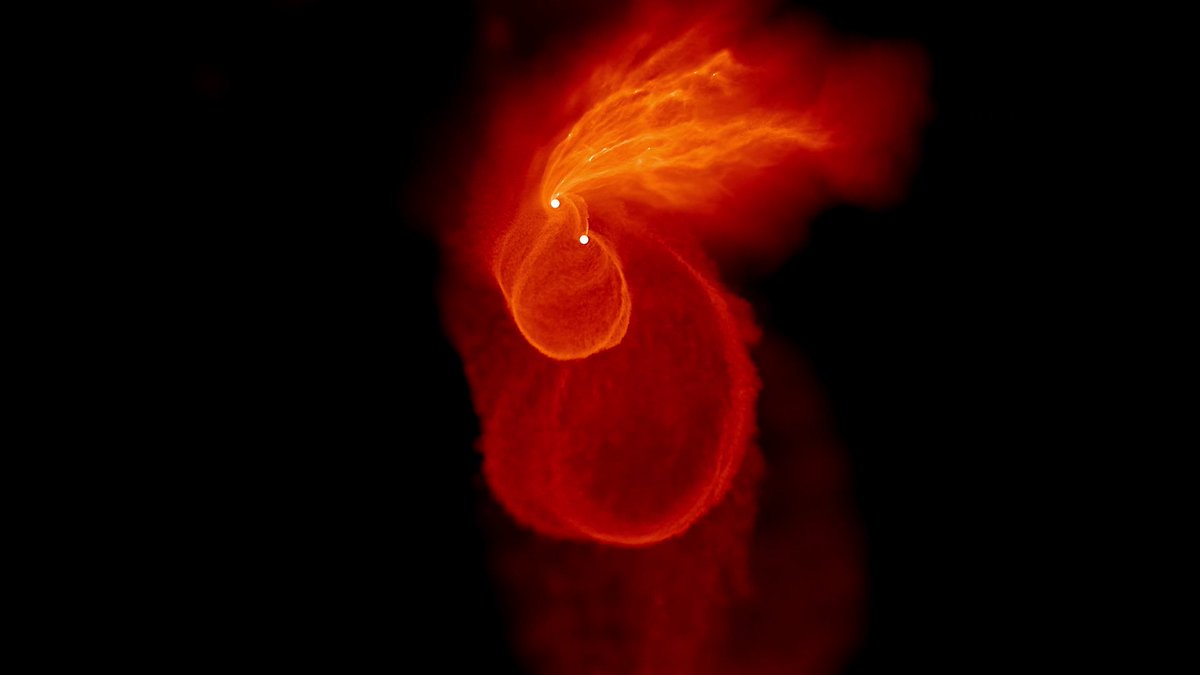
16,000 year evolution 🌌 A computer simulation shows a turbulent molecular cloud and rotating disk of dense gas around a young star. Under the force of gravity, the disk collapses, forming spiral arms and clumps, which could result in the formation of planets or brown dwarfs.

31,741 次观看 • 1 年前 •via X (Twitter)

0 条评论

暂无评论

原始帖子的评论将显示在这里

相关视频

Breaking: Hubble Telescope Opens a "Window" into the Dark Universe — First-Ever Detection of a Starless Dark Matter Cloud! In a groundbreaking discovery announced by NASA, the Hubble Space Telescope has revealed an entirely new class of cosmic object: a vast, starless cloud dominated by dark matter, rich in gas but completely devoid of stars. Nicknamed Cloud-9, this enigmatic structure lies about 14 million light-years away, on the outskirts of the spiral galaxy Messier 94 (M94).This is the first confirmed observation of such a "failed galaxy" or relic from the early universe — a massive dark matter halo that gathered hydrogen gas but never triggered star formation. Hubble's deep imaging ruled out any hidden faint stars, confirming it's truly dark and star-free.Key highlights from the discovery:Massive dark matter core — estimated at around 5 billion solar masses, anchoring a compact reservoir of gas. A cosmic fossil — likely a survivor from the universe's infancy, halted during reionization (when the first stars and galaxies lit up and ionized surrounding gas). Implications — This "phantom" object provides direct evidence for the existence of low-mass dark matter halos that never evolved into full galaxies. It suggests the universe could be filled with similar invisible structures, offering a major boost to our understanding of dark matter and galaxy formation. For decades, theorists predicted these "dark galaxies" or RELHICs (Reionization-Limited Hydrogen Clouds), but Cloud-9 marks the first solid proof caught in the act.Scientists are buzzing — this rare "wow" moment could rewrite parts of cosmic history and hint at countless other hidden building blocks of the universe lurking in the shadows.(Source: NASA/ESA Hubble release, January

Black Hole

10,671 次观看 • 6 个月前

🚨 SCIENTISTS MAY HAVE FINALLY SOLVED ONE OF THE BIGGEST UNSOLVED PROBLEMS IN BLACK HOLE PHYSICS. For years, astrophysicists have struggled with the “final parsec problem”: even after two supermassive black holes get relatively close, they struggle to shed enough angular momentum to merge within the age of the universe. New 3D simulations reveal that magnetic fields in the gas disk surrounding a binary system can solve this. The fields trigger powerful outflows and jets that efficiently carry away angular momentum, allowing the two objects to spiral much closer together. The same mechanism also explains how some binary stars end up in extremely tight orbits. In the simulations, binaries without magnetic fields actually moved farther apart. With magnetic fields present, they rapidly lost angular momentum and migrated inward. Why this matters: • It provides a physically motivated solution to one of the biggest open problems in black hole astrophysics • Magnetic fields appear to be far more effective at removing angular momentum than previously modeled effects • The mechanism works for both star formation and black hole mergers • It shows that the environment around binaries (not just the objects themselves) plays a decisive role in their evolution The deeper implication: We often think of black holes and stars as isolated objects governed purely by gravity. But these simulations show that the magnetic fields threading the gas around them can fundamentally change their fate. By removing angular momentum through jets and outflows, magnetic fields act like a cosmic brake, allowing binaries to reach the tight configurations we observe. This doesn’t just help explain star formation it may finally tell us how the universe’s most massive black holes manage to merge and create the gravitational wave signals we’re now detecting. Sometimes the key to cosmic mergers isn’t gravity alone. It’s magnetism. How important do you think magnetic fields are in shaping the final stages of black hole mergers and binary star evolution? Follow for more frontier astrophysics and the hidden forces that govern the universe.

TheNewPhysics

18,359 次观看 • 1 个月前