Loading video...

Video Failed to Load

Go Home

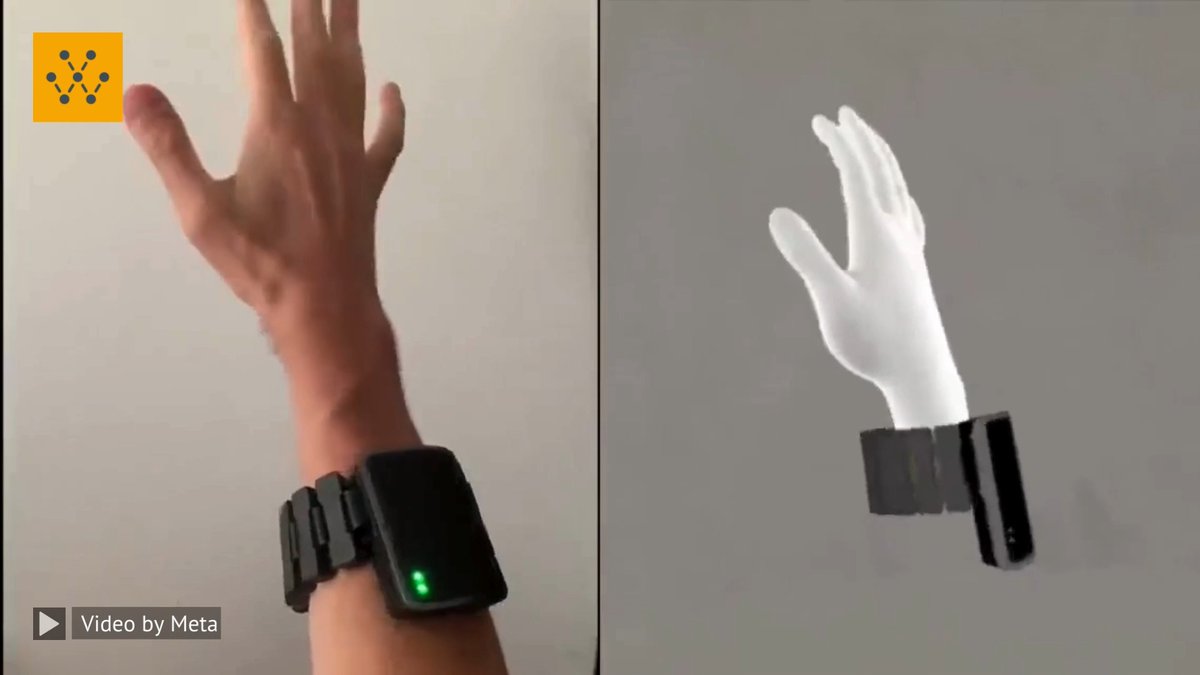
1/7 For the past decade, our team at Meta Reality Labs (previously CTRL-labs) has been dedicated to developing a neuromotor interface. Our goal is to address the Human Computer Interaction challenge of providing effortless, intuitive, and efficient input to computers.

642,357 views • 2 years ago •via X (Twitter)

10 Comments

David Sussillo's profile picture
David Sussillo2 years ago

2/7 We developed a wristband device that can be easily put on and removed to non-invasively sense muscle activations in the wrist and hand via surface electromyography (sEMG). The sEMG technology uses metal contacts on the skin to detect muscle activity, allowing us to transform intentional neuromotor commands into computer input.

David Sussillo's profile picture
David Sussillo2 years ago

3/7 We created generic wrist-based sEMG neural network decoding models trained on data from thousands of paid volunteers who participated in our study. These models generalize across people, eliminating the need for per-person or per-session calibration, which have traditionally been challenges for biosignal interfaces. Below, we show how offline handwriting decoding performance improves as the number of participants in the training dataset increases. For instance, when a model is trained on data from over 6000 users, it achieves an offline performance of 7% character error rate, which translates to about one error every 14 characters and is approaching error rates comparable with mobile typing.

David Sussillo's profile picture
David Sussillo2 years ago

4/7 To evaluate the performance of our decoders with naive users, we conducted closed-loop tests that included 1D continuous navigation (left), discrete gesture detection (middle), and handwriting (right).

David Sussillo's profile picture
David Sussillo2 years ago

5/7 Within minutes of first putting on the band, naive test users demonstrate closed-loop median performance of gesture decoding for: - 1D continuous navigation (wrist control): a target acquisition every two seconds - Discrete gestures: just under one gesture per second - Handwriting: 17.0 adjusted words per minute.

David Sussillo's profile picture
David Sussillo2 years ago

6/7 This is only the start! We’ve discovered that personalizing handwriting models with minimal fine-tuning for individual participants can lead to a 30% improvement in performance. As we gather more extensive training datasets and deploy models in situations where individuals can customize sEMG models to their unique writing style, sEMG decoding models will continue to advance.

David Sussillo's profile picture
David Sussillo2 years ago

7/7 As far as we know, this is the first high-bandwidth neuromotor interface that utilizes biosignals with effective out-of-the-box generalization across individuals. This achievement, led by Patrick Kaifosh and @TRReardon, is the result of the scientific and engineering efforts of hundreds of people and has been documented in a scientific journal preprint (link below).

dave games's profile picture
dave games2 years ago

When I tell people that working at Meta is like working at Hogwarts, CTRL Labs is what I’m talking about.

Krzysztof Woś's profile picture
Krzysztof Woś2 years ago

It's a bit sad how it could have been a dev kit for a community of hackers all those years ago, and then it disappeared into the black hole or Meta Reality Labs. I was very disappointed by that development.

François Fleuret's profile picture
François Fleuret2 years ago

Extremely impressive. Could it translates to prostheses?

David Sussillo's profile picture
David Sussillo2 years ago

We speculate towards clinical directions in the discussion of the linked preprint:
Related Videos

ICYMI: Brains are trending.. OpenAI made a direct investment into Merge Labs' $252M Seed at $850M valuation Merge Labs Labs is a Brain-Computer Interface ("BCI") research lab co-founded by Sam Altman, Alex Blania, & key frontier tech leaders (below) with expertise in neuroscience, bioengineering, hardware, AI systems, & foundational research. Unlike Elon Musk's Neuralink, which utilizes surgical implants, Merge Labs is developing non-invasive, high-bandwidth brain-computer interfaces (BCIs). The company uses a combination of ultrasound, AI-driven signal interpretation, and potentially genetic engineering to read neural activity without surgery. Founding Team: Alex Blania (Alex Blania) – Co-founder of World, an Altman-co-founded digital proof of human protocol; co-founder of Merge Labs. Sam Altman (Sam Altman) – CEO of OpenAI; co-founder of Merge Labs participating in a personal capacity. Altman has been reported as likely to serve in a strategic role but not in day-to-day operational management of Merge Labs. Mikhail Shapiro (Mikhail Shapiro (same on bsky)) – Professor of Chemical and Medical Engineering at Caltech and founding scientific leader for Merge Labs. He has also served as an adviser to Forest Neurotech. Sumner Norman (Sumner L Norman) – CEO of Forest Neurotech, a nonprofit research organization focused on ultrasound-based brain-computer interface technologies; also a co-founder of Merge Labs. Sandro Herbig (Sandro Herbig) – Identified as a technology entrepreneur and co-founder of Merge Labs with prior systems and product experience, including work with Blania on Tools for Humanity and World. While specific current corporate title at Merge hasn’t been publicly detailed, he is recognized as part of the founding leadership team. Tyson Aflalo – Chief Scientific Officer of Forest Neurotech prior to Merge Labs; co-founder and technical lead at Merge Labs with expertise in neural engineering and ultrasound BCI research. . . . "It’s a direct investment from OpenAI, not their venture arm, so it’s an actual collaboration. As we were discussing the investment, there were many different dimensions where collaboration could make sense. One area is protein design. We’re working extensively with proteins, and that’s an area that’s broadly interesting to OpenAI. It’s one of the most compelling applications of AI — for example, the work Google did with AlphaFold. More broadly, AI has significant implications for biology and for accelerating that part of what we’re building. Another area is chips. Eventually, once we have a clear scientific understanding of what we’re building and how it will work, a major focus for many years will be on making these chips highly energy efficient."

Molly O’Shea

38,842 views • 5 months ago