Video yükleniyor...

Video Yüklenemedi

Ana Sayfaya Dön

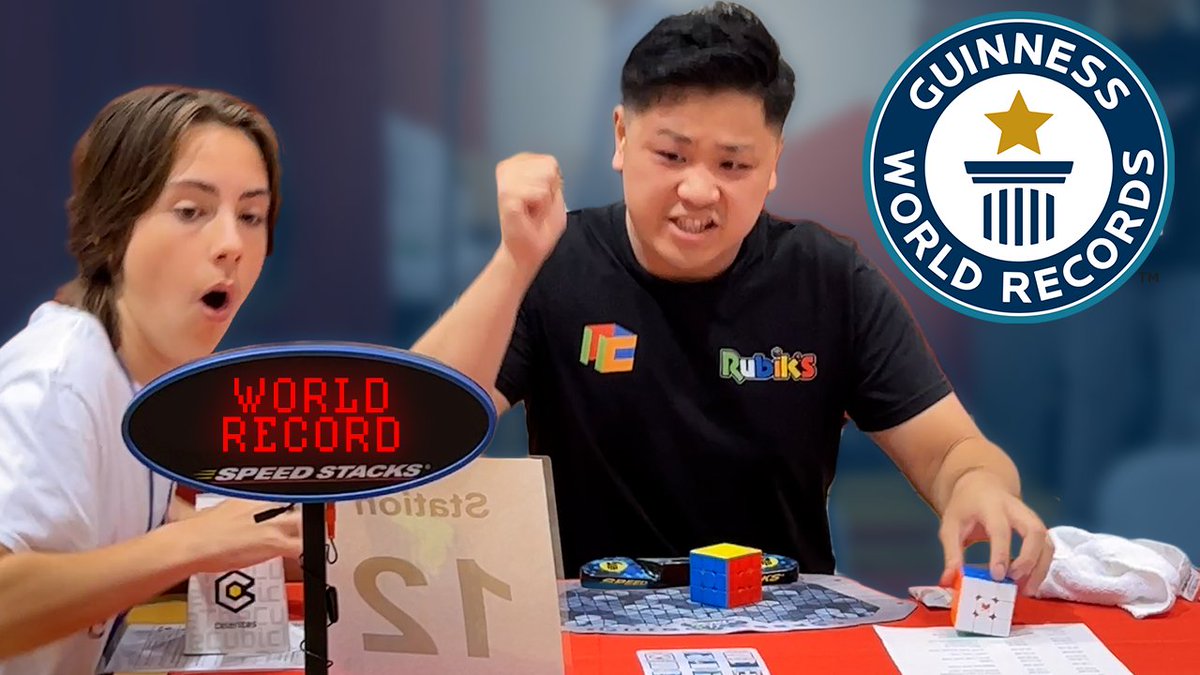
4/ Rubik’s Cube solving has been a long-standing challenging benchmark for robotic manipulation. The task requires fine-grained control under the geometric and kinematic constraints imposed by the cube itself. Prior state-of-the-art is still the single-handed solver from OpenAI’ in 2019. For the first time, we can solve a Rubik's...

46,531 görüntüleme • 2 ay önce •via X (Twitter)

0 Yorum

Yorum bulunmuyor

Orijinal gönderinin yorumları burada görünecek

Benzer Videolar

Every beautiful story has an ending. We honor 10 years of history-making, record-breaking and ever-lasting achievements with CUBE Bikes 🚴 Our journey together began in 2015, and since then, we shared many milestones, rising to the WorldTour and reaching first place in the UCI World Ranking in February 2023. From winning the Amstel Gold Race in the early years of our collaboration to the historic wins in Gent-Wevelgem, the Giro d'Italia, Tour de France, the Vuelta and the German national title, our partnership has been defined by iconic victories that reflect both sporting progress and technical excellence. Together, we celebrated over 120 victories, including 9 in the Grand Tours, making History in the Tour de France 2024, winning the Green Jersey and three stages. Throughout this partnership, the close technical cooperation with CUBE has played a crucial role in the team’s continuous growth and in the many victories achieved across disciplines and terrains : in the mountains, on the cobbles, in sprints, in time trials and in the mud alike. Our partnership extended beyond the WorldTour squad. Since 2023, our development team Wanty-NIPPO-ReUz has raced on CUBE bikes, providing young riders with the same high-performance technology as the elite level. In cyclocross, theCharles Liégeois Roastery CX has been competing with CUBE bikes since 2019, producing multiple World, European, and national champions. We look back with great pride on what we achieved together. We are grateful to CUBE Bikes for their trust, professionalism, and technical expertise throughout this decade-long successful partnership.

Lotto-Intermarché

91,398 görüntüleme • 8 ay önce

Milestone! We (robotic arms for gadgets assembly) finished the first commercial order, which brought the first revenue. Here are some learnings from this: The customer was a smart toy manufacturer. The task was to add a heatsink to Raspberry Pi. We received parts from them and returned the assembled modules back. Currently, it's done by teleoperation. Later it will be done by a remote employee via the Internet. Then it will be automated action by action, reducing the operator's time on this and making the task profitable. ps. If you have an assembly task that we can do for you asynchronically - leave a comment below. Learning 1. It's possible! This task which is usually done by the human arm with 5 fingers can be done with a two-finger gripper with the addition of a couple of simple tooling. The task was not simplified. We peeled off thin films from stickers, unpacked paper boxes, moved PCB boards full of components, etc. And no unsolvable problems have been encountered yet. Challenges: 1) The paper box shifted during the opening Solved with the plastic walls that you can lean against 2) Heat pad, stuck to the gripper instead of heat sync. Can be solved by gripper with a pump, but this time solved with the patience of the operator 3) The film on the pad is very thin. Turned out that sub-millimeter arm precision is enough to peel it off with just a regular gripper. 4) The working area has not enough space. You'll only know this by doing real tasks in bulk. This could be solved by an extra pair of long arms, but in this case, solved with the patience of the operator. I think that in the end, we will have 5-10 types of universal tooling and 5-10 types of grippers to solve almost all the problems in such assembly tasks. Learning 2. It's slow. It took 5 times more time, than doing it with human hands. But the good news is there's a lot of room for improvement. We now have specific “time for task” metrics, which we will decrease with iterations. The main reasons for slowness: 1) To rotate the gripper to a steep angle you are forced to control one robot arm with two hands instead of using both arms. We can fix this by just making more room for rotations. 2) Grabbing PCB board with two arms is hard. A slight difference in rotation can break the board, and it's hard to control these angles visually. To solve this, the best way is to use force feedback so you can feel the pressure applied to the item. 3) Accuracy and steadiness is still can be improved We will try a metal version and double the motors to do this. 4) It is physically difficult for the human hands to move with such precision To solve this, we will add a pad for the hands like in surgical robots Learning 3. It's a good business model The "Factory in the cloud" is a good business model for this stage. You send us parts and we send back assembled modules. Currently, it's more convenient than sending a robot to your place, as we can iterate/fix the robot quickly and utilize it 100% of the time. When we polish the set-up over time - we can send robots to your place. So if we can assemble something for you in the USA with Chinese prices by using modern automation - leave a comment below.

Igor Kulakov

37,266 görüntüleme • 1 yıl önce