Video wird geladen...
Video konnte nicht geladen werden
5/ Why This Changes Everything for Treatment The protein breakthrough earned Hassabis the Nobel Prize. Scientists can now see exactly how diseases attack cells. This allows precise, targeted treatments never before possible. 9 of 10 top pharma companies are already using it.

72,559 Aufrufe • vor 1 Jahr •via X (Twitter)
16 Kommentare

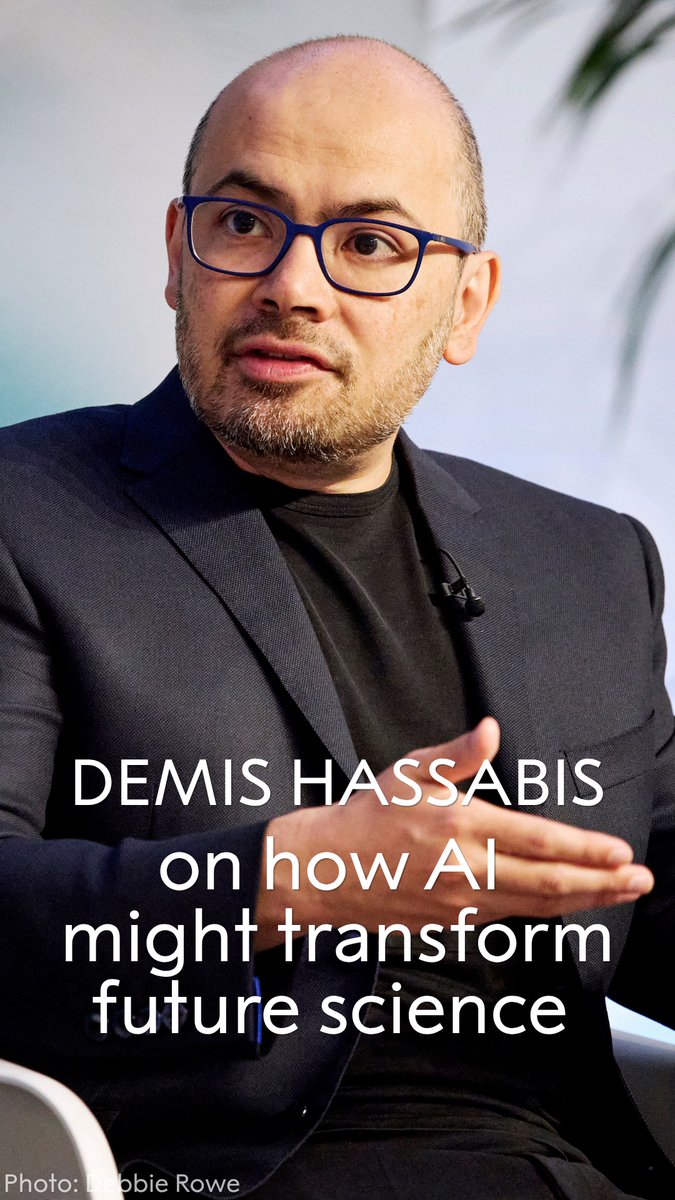
This is Demis Hassabis. He’s Google's DeepMind CEO, who’s studied AI for 30+ years. In his new interview with 60 Minutes, he revealed mind-blowing facts about health & AI that 99% of people wouldn’t know. Here are my top 8 takeaways: 🧵 (No. 6 will shock you)
1/ Human-Level AI Timeline Accelerated Hassabis predicts Artificial General Intelligence by 2030-2035. This isn't faster computing—it's AI that has all the capabilities that humans have. The acceleration means we have much less time to prepare.
2/ "Radical Abundance" Hassabis' biggest revelation: AI will eliminate scarcity. Resources limited today won't be tomorrow. This transforms healthcare, energy, food, and economics. The end of scarcity within our lifetime.
3/ From Analytical to Creative AI Today's AI can't imagine or create new ideas. "They can't ask novel questions or form new hypotheses." In 5-10 years, this changes. When AI starts creating original scientific theories, entire industries transform overnight.
4/ How AI Is Revolutionizing Drug Discovery Scientists had mapped less than 1% of protein structures before DeepMind. Proteins control everything in your body. Mapping ONE used to take years. AI did 200 MILLION in one year. This unlocked thousands of new drugs overnight.
6/ AI Could End All Major Diseases By 2035 "I think we can cure all disease with the help of AI... within the next decade or so." Because AI can: • Predict disease before symptoms • Design perfect molecular interventions • Optimize treatment for each individual
7/ Robot Healthcare Workers Coming by 2027 The shocking part: "Robotics will have a breakthrough in the next couple years." 60 Minutes showed robots that understand context and adapt in real-time. They'll administer treatments when human providers aren't available.
8/ The Challenge of AI Consciousness Hassabis revealed: AI consciousness may emerge "implicitly." The problem? We might not recognize it because "they're running on silicon" while "we're made of carbon." We have no legal framework ready for this possibility.
Thanks for reading. I hope you've found this thread helpful. Follow me @karlmehta for content on politics, AI, and health. Like/Repost the first tweet below to help more people see this:
P.S. If you're wondering how to apply this AI revolution to your own business... We've created a predictive AI platform that helps healthcare and BFSI companies spot issues before they happen. Just like Hassabis predicts disease before symptoms...
No coding required. No complex implementation. Just actionable predictions that transform how you operate. Cutting operating costs and improving customer experience. Book your demo and join the companies already leading with predictive + generative AI:

AI is transforming healthcare! A KSM-led study shows AI can detect Celiac disease 4 years earlier @TalPatalon @MedPredict

Much like the last point - diseases are complex polygenic requiring targeting multiple processes. Many small molecule drugs are promiscuous. Protein modelling is a tiny part of the puzzle.

Absurd

Hassabis hasn't won a Nobel Prize. And knowing structures doesn't equal treatment - not at all.

Wow.

![Cancer and Vitamin B17 A mineral the majority of the world is deficient in, all done by design The topic of Cancer will awaken the world to this evil system It is all connected Why are possible [treatments][CURES] being banned? Why are possible [treatments][CURES] being attacked? Why are possible [treatments][CURES] being targeted? Evidence overwhelming? HOW DO YOU KEEP PEOPLE LIVING IN FEAR? What if CURES already exist? What about the billions (public/private/govt) provided to fund cure dev? Sheep. These people are sick! Q #harrythesoulcoach #vitaminb17 #cancer #donttreadonme #truth](https://image.24vids.com/tw-2040906895276548415/amplify_video_thumb/2040906424163688449/img/djRFYFr6ta3WmOY1.jpg)


![🔥💣 CANCER TREATMENT BOMBSHELL: Wormwood Plant Reportedly DESTROYS 98% Of Cancer Cells In Just 16 Hours [VIDEO] A shocking health report is reigniting global debate after studies involving wormwood compounds reportedly showed the destruction of up to 98% of cancer cells within just 16 hours. Now millions are asking why this natural breakthrough is only now exploding into public view as interest grows in targeted cancer cell destruction, natural cancer treatments, and alternatives outside the pharmaceutical system. 👉 FULL STORY NOW LIVE: 📢 Join Telegram: 🌐 Real stories. True journalism: #CancerTreatment #Wormwood #NaturalMedicine #BigPharma #AlternativeMedicine #MedicalFreedom #CancerResearch #AMGNews](https://image.24vids.com/tw-2059736678546199021/amplify_video_thumb/2059736531753979904/img/47rPElUsyDp4hMVb.jpg)


