Video wird geladen...

Video konnte nicht geladen werden

Zur Startseite

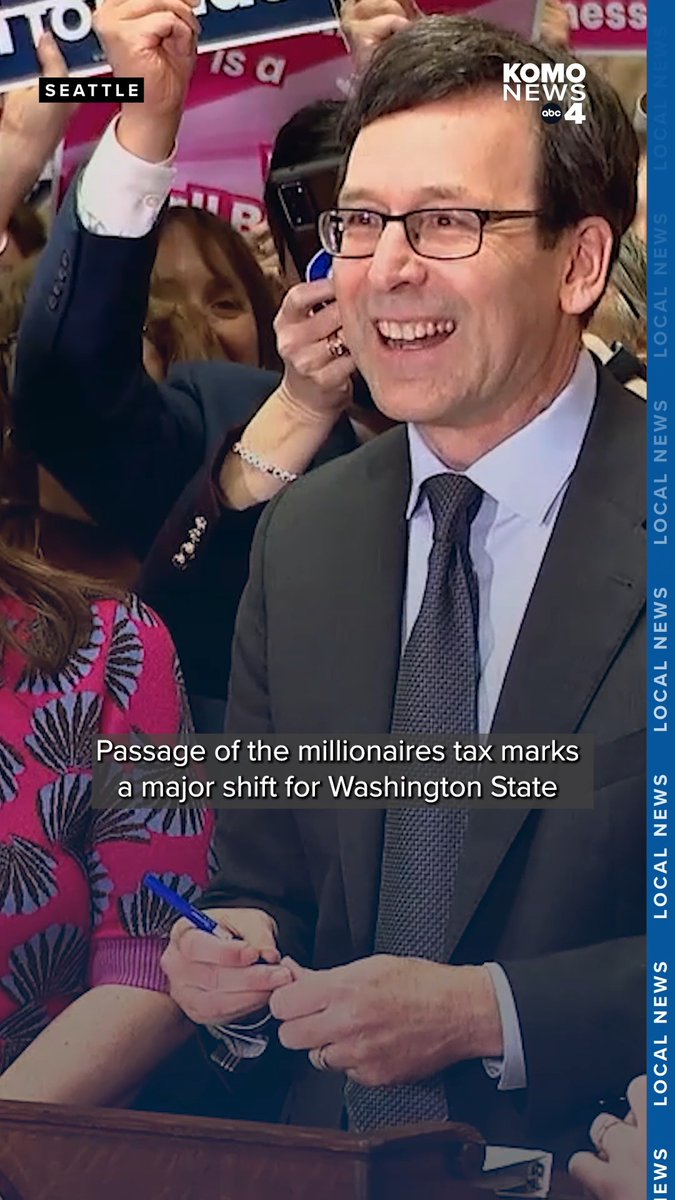
A final vote has now changed what drivers will pay every time they use two specific toll roads. For some motorists, the price will soon be cut in half. For everyone else, the bill will stay the same. In a 6-0 vote, members of the Washington State Transportation Commission...

21,638 Aufrufe • vor 4 Tagen •via X (Twitter)

0 Kommentare

Keine Kommentare verfügbar

Kommentare vom Original-Post werden hier angezeigt

Ähnliche Videos

Toll rates for the Gordie Howe International Bridge were announced today, ahead of an expected spring opening for the new crossing between the United States and Canada The standard toll per crossing for small- and medium-sized personal vehicles will be a flat rate of $5.75 USD/$8 CAD, with a discounted flat rate of $4.35 USD/$6 CAD offered through the new “Breakaway” toll discount program. A flat rate will be added for vehicles in this category that are pulling a trailer or have items on the roof, with the same “Breakaway” discount also available (for example, a driver of a small personal vehicle pulling a small trailer would pay either $11.50 USD/$16 CAD if using the standard toll rate or $8.70 USD/$12 CAD if using the “Breakaway” rate) A per-axle charge will apply for large commercial and passenger vehicles at either a standard toll rate of $8.75 USD/$12 CAD per axle or a “Breakaway” rate of $6.90 USD/$9.60 CAD per axle. Additional fees may apply for oversized vehicles The newly-announced rates are lower than current toll rates at the Ambassador Bridge crossing between Detroit and Windsor, where the toll per crossing for autos, buses, and motorcycles is $10 USD/$14 CAD (a $20 USD/$28 CAD toll applies for autos, buses, and motorcycles with a trailer). The toll per crossing at the Ambassador Bridge for commercial vehicles is $15 USD per axle with a valid A-PASS or E-ZPass account, $20 USD per axle with no account, or $135 USD for a bridge escort for wide/oversize loads with widths of 9 feet to 13.6 feet

Brendan Gutenschwager

19,565 Aufrufe • vor 4 Monaten

'State weighs proposed toll increases on I-405 and SR-167' But its more than just toll increases (to $18). On the table is also tolling 405 during weekends, and requiring 3 people most times for the use of the HOV Flex Pass. Lets take a walk back in time to see how we got here, shall we? * In 2015, the first HOT lane opened on 405 with a $10 Max Toll. The law was written that HOT lane traffic had to be moving at a minimum 45mph for 90% of the time AND revenue goals met. This had to be accomplished by the end of a 2yr trial. * In 2017 when the trial was up, the HOT lanes did NOT achieve the minimum 45mph required to keep operating. That is where then Attorney General Bob Ferguson stepped in. * AG Bob Ferguson told the state the AND was actually an OR, and the state could continue operating the 405 HOT lanes, even though it failed to achieve its goals set in the RCW * In 2024, the Max Toll on 405 was increased by 50% to $15. The state said 'that toll rate would rarely happen'. Data shows it happens on about 80% of the time on morning commutes. Back to 2026. Governor Ferguson appointed the members of the Washington State Transportation Commission. They are not elected. The WSTC is now looking at two options: A) Toll 405 during the weekends (currently free). Extend peak hours for toll requirement. Require 3+ HOV during peak hours B) Max Toll to $18 Extend peak hours for toll requirement Toll 405 during the weekends Require 3+ HOV during peak hours. (It's going to be option B guys, because why wouldn't they?) So to recap; an unelected board is seriously talking about raising the toll rate to 80% over what it was 11 years ago, on lanes that (still) fail to achieve rules set out by the legislature, that require a $15 flex pass to use HOV, which is also about to be raised to 3 people. But they pinkie promise tolls will rarely hit that $18 max toll... Paola Tristan Arruda | KIRO 7 Special thanks to Chris Sullivan at KIRONewsradio Article:

Future 42

22,546 Aufrufe • vor 1 Monat

As the mechanism for staking $vITLG to receive $ITL approaches, winning strategies and models are being developed to maximize accumulated assets and their value. One winning model I will apply in my first migration will be shared with the community shortly. This model ensures users receive a steady monthly income for 180 months while optimizing the conversion rate from $vITLG to $ITL. Specifically: Assuming the $vITLG balance I receive in my first migration is A. 50% of this balance will be locked for 5 years and vested for 120 months to maximize monthly benefits starting from the 5th year onwards. The remaining 50%, let's call it B, will be allocated as follows: B/2 will be locked for 0 years and vested for 24 months. B/4 will be locked for 1 year and vested for 24 months. B/8 will be locked for 2 years and vested for 48 months. B/16 will be locked for 3 years and vested for 60 months. The remaining B will be locked for 4 years and vested for 84 months. In this way, the $ITL balance you receive monthly will progressively increase over time, while in the initial phase you can still own $ITL to experience the ecosystem. This solution provides you with a tool for distributing $ITL monthly for 15 years with a maximized rate. Of course, this is just the first migration; in the future, the system will implement further migrations. If you apply this distribution model, the amount of $ITL you receive monthly will gradually increase over time, along with the value of $ITL as the network grows. The above is a strategy for designing a passive income stream linked to the system's growth. Of course, you can lock in 100% for 5 years to optimize profits. This is not considered financial advice; please consider carefully before making your decision. Have a great weekend. #Interlink #ITL #ITLG

Vyx Interlink

24,822 Aufrufe • vor 1 Monat

We are restoring the NSUI elections across the country, as per the mandate given to us by the AICC In-charge of NSUI. The Congress is the only party that practices democracy in its internal organizational elections. 👉 The election schedule will be announced state-wise, as per the roster provided by NSUI. 👉 The first step will be the membership drive in the states identified by NSUI. Then the Chief Election Authority (CEA) will visit the respective state, hold a press conference, and officially announce the election process. 👉 The entire process will be tech-savvy, with an app-based, online system that is free, fair, and transparent in nature. 👉 The eligible age for membership will be between 16 and 27 years. On the date of the membership process, any student willing to contest the elections must be below the age of 27. 👉 Applicants will be required to upload their college ID card and Aadhaar card while taking membership. 👉 The membership fee will be Rs 45 for a three-year subscription, which works out to Rs 15 per year. 👉 After the college committee is constituted and the college elected delegates are chosen, they will vote in the district committee and state committee elections. The structure and size of the college committee, district committee, and state committee will be announced in the respective states where elections are to be held. 👉 Once the membership process is completed, all uploaded documents will undergo proper scrutiny. A specific period will be provided for raising objections, if any. 👉 The official NSUI website will serve as the primary communication platform. A dedicated mobile app will be launched at the time of announcing the state elections during the respective state-level press conferences. : Kiran Mugabasav/ಕಿರಣ್ ಮೂಗಬಸವ 🇮🇳 ji

Congress

27,447 Aufrufe • vor 20 Tagen