Video wird geladen...

Video konnte nicht geladen werden

Zur Startseite

A Japanese mathematician published a result in 1944 that nobody understood for twenty years. Today it runs inside every options desk on Wall Street. Goldman pays $400K to quants who can derive it from scratch and explain why classical calculus gives the wrong answer without it. His name is...

64,955 Aufrufe • vor 5 Tagen •via X (Twitter)

0 Kommentare

Keine Kommentare verfügbar

Kommentare vom Original-Post werden hier angezeigt

Ähnliche Videos

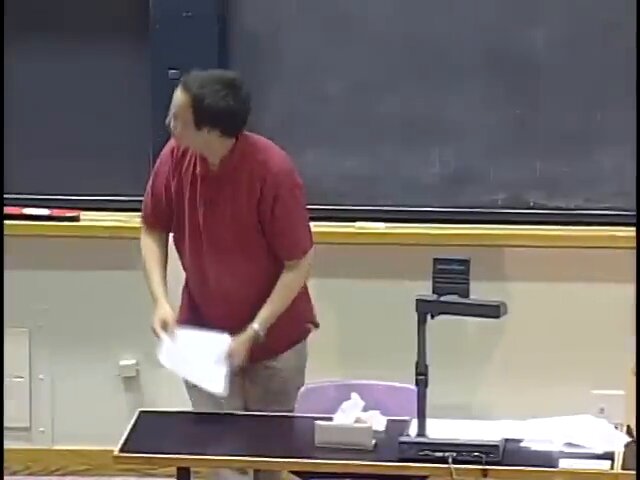
Ten million people have watched an MIT professor teach a course whose first lecture is literally titled "What is a Derivative?" Almost none have written down the two-line answer. He filmed the lecture once in the fall of 2007 and it has been on YouTube ever since. Math tutors charge $200 an hour to teach a diluted version of what he covered in 50 minutes for free. His name is David Jerison. He is a professor of mathematics at MIT and the instructor of 18.01 Single Variable Calculus, one of the most-watched math courses in the history of the internet. The 50-minute clip in this video is Lecture 1, filmed at MIT in the fall of 2007. Jerison is deriving the definition of a derivative from a single tangent line. The whole framework fits on a napkin. A derivative is just how much y changes when x moves a tiny bit. Draw a tangent line to any curve at any point. The slope of that line is the derivative. Memorize one formula, the power rule, and you can differentiate every polynomial on earth in your head. Chain that with a handful of exceptions and you can differentiate almost every function humanity has ever written down. That single set of rules is what every neural network runs on gradient descent, what every rocket landing at SpaceX solves in real time, and what every options desk at Goldman Sachs is running behind every quote you see on the screen. "In mathematics you don't understand things. You just get used to them." That is John von Neumann, the mathematician who helped design the atomic bomb and invent the modern computer. Jerison returns to the same idea in every lecture. Almost no student giving up on calculus has heard von Neumann say it out loud. Every quant fund on Wall Street pays entry-level analysts $250,000 to know the same power rule Jerison derives on the board. Every AI bootcamp charges tens of thousands to teach a diluted version of the same equation on a laptop. The lecture is free on MIT OpenCourseWare. The textbook is under sixty dollars. Almost none of the millions who watched have ever taken the power rule and applied it to their own numbers on their own paper. The math is free. The willingness to actually take one derivative before your next model, trade, or engineering trade-off is the entire edge.

Lumen

24,218 Aufrufe • vor 4 Tagen

Millions have watched an MIT professor accidentally destroy the American sports betting industry in a free 12-lecture undergraduate poker course. MIT charges $85,000 a year to sit in that classroom. He posted every lecture on OpenCourseWare for nothing. Almost no one who has ever placed a DraftKings same-game parlay has finished all twelve. His name is Kevin Desmond. He is an MIT alum, a professional poker player, and the instructor of 15.S50 Poker Theory and Analytics, which MIT gave undergraduates college credit for taking during January of 2015. The 43-minute clip in this video is one lecture from that course, filmed at MIT that same month. The chart on the screen behind him looks like a poker graph. It is the exact math that decides whether a Wall Street quant clears $500,000 a year, whether a FanDuel bettor loses their rent money on a Sunday afternoon, and whether a Silicon Valley founder can walk into a term sheet negotiation without being taken apart in the room. Desmond compresses the mathematical foundation of every adversarial decision on earth into five ideas. Ranges. You never know your opponent's exact hand. You know a distribution of hands weighted by probability. Every FanDuel bettor picking a parlay on a hunch is playing without a range. Every retail trader guessing a competitor's next move is guessing blind. Pot odds. The equation that tells you when a call has positive expected value. Every VC term sheet and every insurance premium reduces to it. Every same-game parlay on DraftKings violates it in ways the app is legally allowed to hide from you. Expected value. Sum every outcome weighted by probability. Casinos are built on it. Poker pros live on it. Sports bettors violate it every time they chase a loss hoping for a hot Sunday. Game theory optimal. The Nash equilibrium of poker. The strategy no opponent can exploit no matter how well they read you. Quant funds pay $500,000 bonuses for one senior who can solve for it under pressure. Exploitative play. When to deviate from GTO to punish a specific mistake. What every senior desk on Wall Street does against retail order flow, every trading session, every day. Every quant fund on Wall Street runs a hiring pipeline that starts with this material. Every prop trading desk drills it into juniors before their first live session. The MIT professor who filmed the whole course posted it on OpenCourseWare for the price of an internet connection. "Every time you play a hand differently from the way you would have played it if you could see all your opponent's cards, they gain." That is David Sklansky's Fundamental Theorem of Poker. Desmond opens the course with it. It is also the exact statement of information asymmetry that every trading floor, casino, and DraftKings promo card on earth is built to exploit. The lectures are free on MIT OpenCourseWare. The problem sets are online. Every equation Desmond derives fits on one page. The math is free. The willingness to spend 43 minutes on one lecture before opening a sportsbook app, placing a parlay, or entering a negotiation is a much rarer commodity than the confidence to walk in without it.

Lumen

57,583 Aufrufe • vor 14 Tagen

This man teaches at a community college in California. His salary: around $800,000 a year. The engineers who passed calculus because of him: $1,800,000 to start. He has more calculus students than Harvard, MIT, and Stanford combined. This is Professor Leonard's Calculus 2, Lecture 6.2. Free on YouTube. Professor Leonard has taught calculus on YouTube for over a decade. His channel has millions of subscribers across 150 countries. Every major university has students who watch him the night before their exam. Then the concept. An inverse function is a machine that undoes another machine. If a function takes 2 and gives you 8, the inverse takes 8 and gives you back 2. Finding an inverse means switching every x and y in the equation and solving for y again. The graph flips across the line y = x like a mirror. Then the problem. Sometimes it is easy to find the inverse. Sometimes it is impossible to write it explicitly. A function like 3π sin x + sin x cannot be solved for x with algebra. You have to think. What angle makes the whole thing equal to 1? You work backwards through the unit circle until the answer appears. Then the shortcut. If you want the derivative of an inverse at a point, you do not need the inverse itself. You only need the derivative of the original function. The formula: the derivative of the inverse at a point equals 1 divided by the derivative of the original function evaluated at the switched point. The inverse flips the coordinates, so you flip where you plug in. Watch the moment he shows why G prime of 8 equals 1/12 without ever writing the inverse function. Every engineering student memorizes the derivative rules. Professor Leonard's lecture is the one that shows why the inverse derivative formula is just those same rules run backwards. A software engineer at a semiconductor company in Austin said Professor Leonard's channel is the reason she passed Calculus 2 on her second attempt. She graduated, joined the company, and now makes $165,000 a year. Bookmark this and watch later - after this lecture every inverse problem on your exam will feel like a question you already answered.

Lupen

528,432 Aufrufe • vor 1 Tag

MIT filmed a mathematician proving the theorem behind every equation Maxwell ever wrote. Most engineers use it daily without understanding why any surface gives the same answer - and the ones who can explain it earn $350K at aerospace firms. Stokes' theorem is the reason Maxwell could write four equations instead of forty. Every result in electromagnetism, fluid mechanics, and differential geometry sits on top of it. Understanding it changes how you see every circulation and flux problem in physics. This is Denis Auroux. MIT, 18.02, Multivariable Calculus, Fall 2007. Lecture 31. It covers Stokes' theorem - the result that unifies line integrals, surface integrals, and curl into one statement. He opens with one confession. Then the statement. The work done by a vector field along any closed curve equals the flux of its curl through any surface bounded by that curve. Not a specific surface. Any surface you want. You pick whichever one makes the calculation easier. Then Green's theorem disappears. The result from the plane that converts line integrals to double integrals turns out to be Stokes' theorem in disguise. Same formula, restricted to a flat surface in the xy-plane. What looked like two separate theorems is one. Then orientation. Walk along the curve with the surface to your left and the normal vector points up. This rule is not chosen for elegance. It is the price of having a consistent coordinate system in three dimensions. Then the proof. Cut your surface into tiny flat tiles. Apply Green's theorem to each one. Sum everything up. All interior boundary edges cancel. Only the outer edge survives. The sum of tiny Green's theorems gives you Stokes' theorem for any surface. Watch the moment he computes the same line integral two ways. First directly - answer is pi. Then through a paraboloid instead of the obvious flat disk. Longer calculation, stranger setup, same answer. The theorem is not an abstraction. You can watch it work. A fluid dynamics engineer I know kept this lecture open during their first week modeling atmospheric circulation. Said it was the first time Stokes felt like a tool rather than a formula to verify on exams. Free on YouTube, MIT OpenCourseWare, 18.02. bookmark this and watch later - after this lecture every circulation, every flux, and every curl you encounter will feel like three views of the same object

Zyphor

10,999 Aufrufe • vor 5 Tagen