Загрузка видео...

Не удалось загрузить видео

На главную

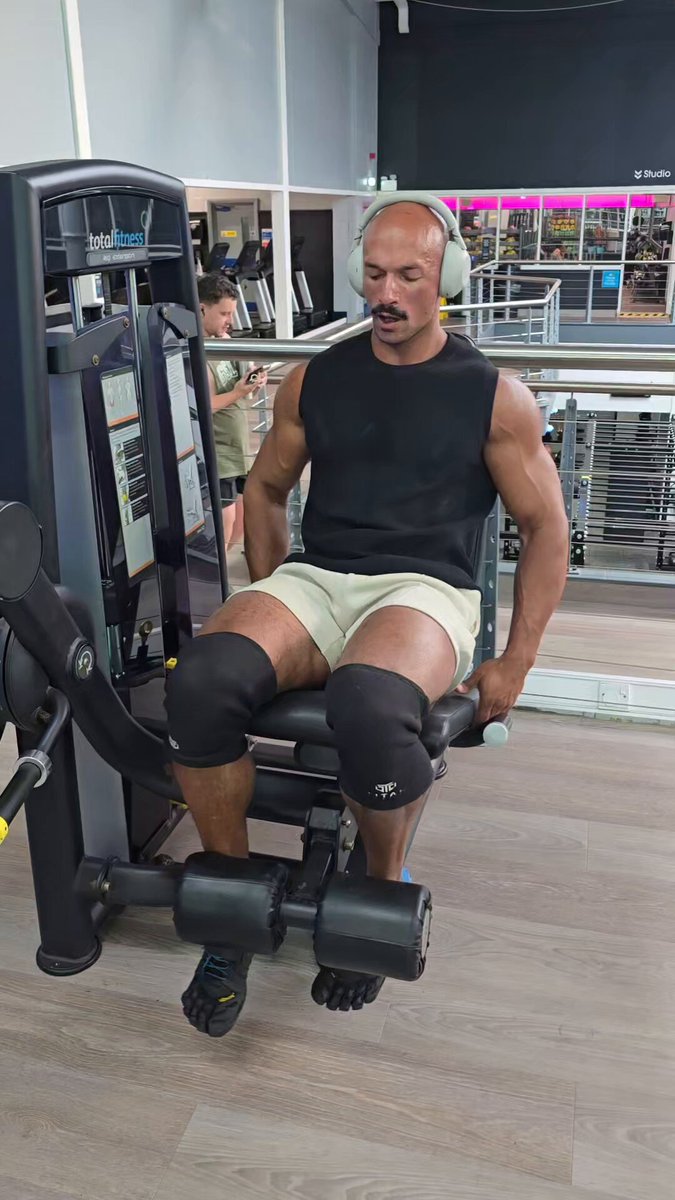
A new 2025 study squashed the idea that more volume increases growth, and suggested that the available growth reps in a set might just be the final four:⠀ ⠀ Trained lifters did 3-5RM on one leg and 20-25RM on the other for 9 weeks: both to failure.⠀ ⠀ Results?⠀...

224,262 просмотров • 6 месяцев назад •via X (Twitter)

Комментарии: 0

Нет доступных комментариев

Здесь появятся комментарии из оригинального поста

Похожие видео

Example of a true working set... You’re probably doing way more sets than you need Trust me ⁠ Back in high school and college, I would lift 7 days a week, doing anywhere from 30 to 50 sets per day I used to think those 30-50 sets were the key to growth, but over time, I realized that most of those weren’t true working sets ⁠ Here’s the thing... If you can do 4 sets of 8 reps with the same weight each set, you’re probably not pushing yourself hard enough A true working set should leave you near failure within the target rep range ⁠ For example, let’s say your plan calls for 2 sets of 6-8 reps After a few warm up sets, you try 135 lbs and hit 8 reps, but you know you could have done 6 more That’s still a warm up set since you’re not reaching failure in the 6-8 rep range You’d then go up to 145 lbs and aim to fail around 6-8 reps If 145 still feels too light, that’s another warm up set You keep going up in weight until you find the load that challenges you to fail within that 6-8 range If you don’t have a spotter, leaving one or two reps in the tank is okay ⁠ This is where true muscle growth happens, by pushing close to your limit Sleep and diet is actually where muscle growth occurs but you never push yourself hard enough in the gym and give your body a reason to grow, hypertrophy will never happen The gym is just the stimulus to give the muscle a reason to grow We then get bigger through sleep and diet ⁠ Back to the working sets... For example, in the video, I hit 540 lbs for 8 reps on this hack squat Looking back, I feel I had one or two reps left, but it’s a solid starting point and it was a new PR for me at the time The next week, I would aim for 540 for 9-10 reps or bump up the weight to 545-550 and try to hit 8 reps aka progressive overload ⁠ I typically keep my quad and hamstring workouts separate and do only about 4-7 sets per muscle group, but each set is intense, and I’m struggling by the last few reps on each set ⁠ Give this approach a shot, and I promise you won’t need nearly as many sets as you think

Bailey Schober | Men’s Fitness & Nutrition Coach

23,353 просмотров • 4 месяцев назад

How I currently leg press to maximize hypertrophy 🤓 1. No quarter or half repping with tons of weight with your feet high up like a BITCH 2. Choose a weight you can take through a comfortable but reasonably deep range of motion 3. Move feet low enough to have deep but comfortable dorsiflexion (toe stretch to shin) 4. Execute a range of motion that stretches the quads but keeps the tension on them through the entire rep, for me this is when I feel light pressure between my calves and hamstring (I could technically let the weight squish me to such a point that my own hamstring and body are removing tension at the bottom 5. Lay hands on knees for a totally useless safety blanket (ok half serious I do think perceived stability neurologically increases large motor unit recruitment regardless of or in tangent with actual stability but this is just a working theory I have 6. Embrace pain feel sadge For Rep schemes personally I think (after warming up) a heavy first working set 5-10 reps 1-2 reps shy of failure to maximize large motor unit recruitment followed by 1-3 lighter sets within 1-3 reps of failure of 12-15 reps works best because lighter sets following a heavy first set seems to offset the fall-off in strength for the second set due to contrast overcompensation of the muscles (think about how after a heavy set the next set FEELS lighter and often you can take the second set FURTHER) it’s almost like having 2 first sets!

Hench D. Kunt🥛

24,198 просмотров • 1 год назад

Training to failure isn’t needed to max gains? Some people believe that you must take every set to failure in order to maximize muscle gains, but emerging literature suggests this may not be the case A new study examined training to failure vs stopping 1 to 2 reps shy of failure & found that the participants gained the same amount of muscle mass from both training styles There are several strengths to this study. First of all, they used a unilateral design where each participant was their own control by training one leg taking each set to failure and stopping 1-2 reps shy on the other. This helps negate any genetic induced differences since each person is acting as their own control Second, they matched training volumes to the participants previous volumes. This is a HUGE strength that is often overlooked in other studies Third, they used participants that were well trained (at least 3 years resistance training experience) Fourth, they had them all eat in a slight calorie surplus This adds to a growing body of literature demonstrating that training to absolute failure isn’t needed for gains & is likely counterproductive for optimal strength gains due to excess fatigue Interestingly, each group had no difference in total reps performed. That may seem strange when one group is going to failure but the other is stopping 1-2 reps shy. This can be explained by lower inter-set fatigue in the non failure group. For example if a failure group hits failure at 10 reps in set 1, they may only get 8 on the next set, and 6 on the next set. Whereas they might have been able to do 8 reps every set if they didn’t go to all out failure. As such, if you do train to failure I recommend only going to failure on your very last set of an exercise If you want to know how to implement this sort of programming make sure you check out the Biolayne Workoit Builder to get access to all my evidence based programs to help you get strong AF & build muscle 👊

Layne Norton, PhD

48,371 просмотров • 2 лет назад

Do you need to train heavy to build muscle? 💪 For years the mantra was you need to go heavy to build muscle. Or you needed to go heavy to stimulate large type II fast twitch fibers but go light for more reps to stimulate smaller type I fibers. But new research has challenged that dogma. Several meta-analysis have shown similar muscle growth with low loads vs high loads when set number is matched & proximity to failure is similar (PMIDs: 28834797, 35015560, 33312275, & 33433148). While muscle hypertrophy was not different between high and low load training, strength increased significantly more with high load training in all these meta-analysis As far as targeting fiber types, it becomes kind of irrelevant when you take an exercise close to failure because fiber types tend to be recruited in order from smallest to largest. So with high load training, small & large fibers get recruited quickly but you don’t do many reps. With low load training, you initially recruit smaller fibers but as the muscle fatigues it is forced to recruit the larger fibers as the exercise is taken close to failure. The net effect is that taking sets close to failure with high or low loads produces a lot of muscle activation and similar hypetrophy The take home is, do what you enjoy if muscle growth is the goal. Just make sure you train HARD & go close to failure (within a few reps) & do enough total sets. But if strength is a priority you’ll need to train heavy & be careful going to failure as it can impair strength gains From my first conversation with Andrew D. Huberman, Ph.D.

Layne Norton, PhD

53,287 просмотров • 1 год назад