Video yükleniyor...

Video Yüklenemedi

Ana Sayfaya Dön

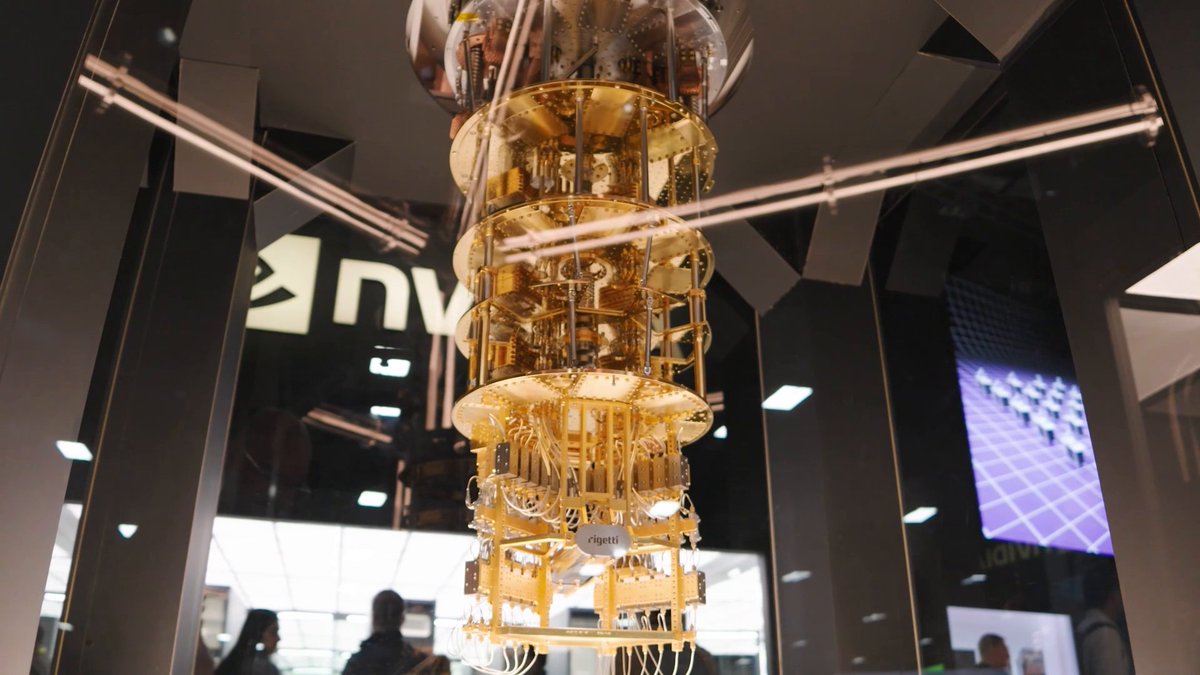
A quantum computing milestone almost 30 years in the making. Our new Willow chip uses surface codes to achieve exponential suppression of errors “below threshold”. This breakthrough paves the way for larger, more (cont)

60,191 görüntüleme • 1 yıl önce •via X (Twitter)

0 Yorum

Yorum bulunmuyor

Orijinal gönderinin yorumları burada görünecek

Benzer Videolar

🚨 SCIENTISTS JUST TRAPPED A SINGLE ATOM ON A PHOTONIC CHIP AND IT COULD CHANGE QUANTUM COMPUTING FOREVER. Researchers at Quantum Source and the Weizmann Institute have successfully trapped a single rubidium atom just 150–200 nanometers from a photonic resonator on a chip. That’s close enough for the atom to directly interact with light flowing through the circuit. Why this matters: Quantum computing has always had two separate superpowers: • Neutral atoms → ultra-stable quantum states • Photonic chips → fast, scalable light-based circuits The problem? They’ve never played well together. Atoms are fragile near surfaces and photonic chips are tiny. Now they’ve cracked it with a new “single-stroke loading” technique: a carefully shaped optical field slows the atom down, catches it, and lets it communicate directly with photons inside the chip. The deeper implication is huge: This is the first real bridge between two of the most promising quantum platforms. It opens the door to: • chip-scale quantum networks • photonic quantum processors • ultra-secure quantum communication • quantum internet infrastructure • and scalable quantum systems built with semiconductor-style fabrication For the first time, a single atom isn’t just sitting near the chip it’s actively changing how photons behave inside the resonator. The two worlds of quantum computing are finally starting to merge. What happens when single atoms become programmable building blocks inside photonic processors? Follow for more frontier physics and future-tech discoveries.

TheNewPhysics

16,653 görüntüleme • 1 ay önce

🚨 AI JUST DISCOVERED QUANTUM EFFECTS THAT SCIENTISTS DIDN'T KNOW EXIST. Researchers at the University of Washington used artificial intelligence to simulate dozens of atomically thin sheets of molybdenum ditelluride stacked in precise twisted patterns. At small scales, these materials look relatively ordinary. But when the AI modeled much larger stacks, completely new quantum behaviors emerged phenomena that only exist because of the complex, repeating moiré patterns formed across many layers. Why this matters: • Many of the most interesting quantum effects only appear at scales that are too large for traditional supercomputers to simulate • AI can act as a fast “surrogate” that learns from smaller calculations and predicts behavior at much bigger scales • These large-scale moiré systems can host exotic quantum states useful for quantum computing and new types of electronics • The same approach could be used to discover many other hidden quantum materials The deeper implication: We are entering an era where AI doesn’t just help us analyze data it helps us discover entirely new quantum phenomena that were previously invisible because they only exist in systems too complex for conventional modeling. This could dramatically speed up the search for materials that power future quantum technologies. What do you find more exciting using AI to uncover hidden quantum effects in materials, or the possibility that these stacked atomic sheets could become building blocks for future quantum computers? Follow for more frontier quantum materials and AI-driven discovery.

TheNewPhysics

29,224 görüntüleme • 1 ay önce

BREAKING 🚨Google’s quantum chip didn’t prove we live in a multiverse. It just proved the universe is one beautifully connected sea.🧨 Google’s latest quantum chip solved a problem in five minutes that would take a classical supercomputer 10 septillion years. Some physicists are calling it proof of a multiverse — the idea that every possible outcome branches into its own reality, so the chip is somehow “sampling” answers from parallel universes. Uniphics shows there is no need for any multiverse. Everything is made of spinning Gyrotrons whose waves propagate through one single ξM-field sea of unbound energy that fills all space. When the quantum chip sets up its qubits, those Gyrotrons create vast networks of perfectly coherent spin waves. Because the waves interfere across the entire sea at once, the chip can explore enormous numbers of possibilities simultaneously — not by jumping into other universes, but by letting the single connected field do what it always does: keep perfect harmony across its entire volume. The speed-up comes from the natural parallelism of spin-wave interference plus local time-flow variations (t_flow = k / E_d,total) that let dense regions of the chip run on slightly different clocks, giving the appearance of massive parallel computation without ever leaving our one deterministic universe. The same three pillars that explain gravity as a push and the cyclic cosmos also turn quantum computing into simple, single-universe physics. The universe isn’t splitting into trillions of realities every time a chip runs. It’s simply one sea singing in perfect harmony — and Google just learned a new note. How soon will quantum computing explode when we stop inventing multiverses and start engineering the single connected sea? A Theory of Everything should be able to answer everything. Uniphics Explained Simply PDF: Chapters 1–10 free:

Paul Maley

46,801 görüntüleme • 4 ay önce