Loading video...

Video Failed to Load

Go Home

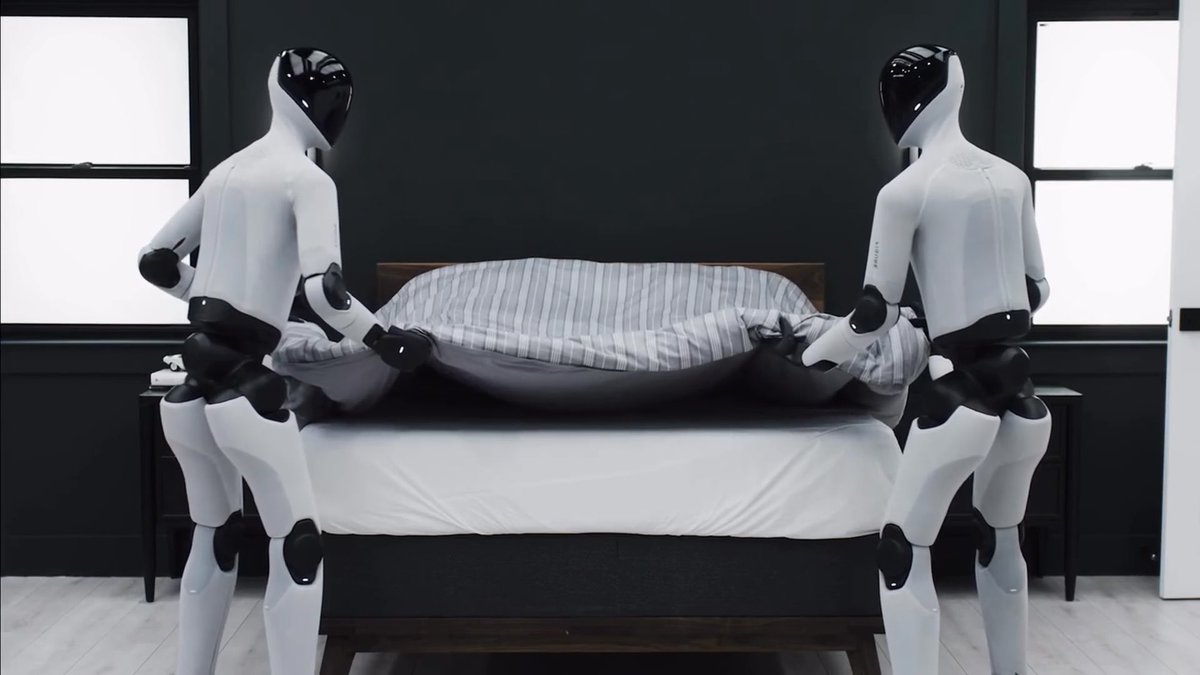
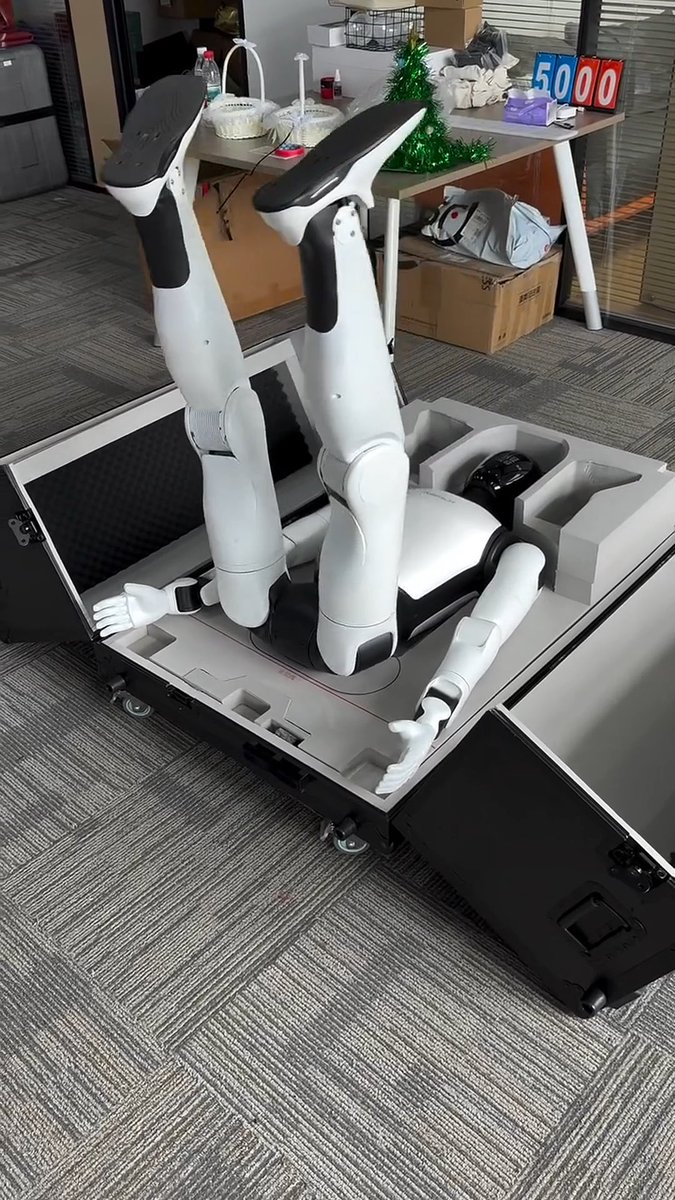
A robot just worked an 8-hour shift in China. Then it handled an error no human flagged, adapting to a conveyor that shifted under it and correcting the position deviation on its own before carrying on. This is AgiBot's G2 at Longcheer in Nanchang, where the fleet has now...

11,014 views • 1 month ago •via X (Twitter)

0 Comments

No comments available

Comments from the original post will appear here

Related Videos

Figure 03 just finished an 8-hour work livestream, imperfect, but already good enough to replace a lot of repetitive warehouse labor. 🤖 Brett Adcock put a team of F.03 robots on a factory-style package sorting task for a full shift. The job was simple and brutal: detect the barcode, pick the package, flip it label-side down, place it on the conveyor, repeat. Soft poly bags, rigid boxes, moving belts, messy orientations. That is exactly the kind of boring physical work factories pay humans to do all day. Early in the stream, the system handled 230 packages in 10 minutes. That is roughly 2.6 seconds per item — already in human-speed territory for this narrow workflow. The more important part: it was not one robot pretending to work all day. It was a team of Figure 03 robots keeping the line running. When one robot ran low on battery, it left the station and another robot stepped in. That is the real factory signal: not just autonomy, but shift continuity. F.03 is rated for about 5 hours of runtime, so the 8-hour result depends on fleet orchestration, charging, and handoff. That matters more than a single clean demo. The stream was not perfect. There were pauses, hesitations, missed orientations, and small recovery moments. Good. A perfect short clip hides failure. An 8-hour livestream exposes the parts that actually matter: endurance, recovery, throughput, and whether the robot can stay useful after the novelty wears off. Figure says this was fully autonomous on Helix-02, with zero human intervention. For logistics and manufacturing, that is the threshold worth watching. Not “can it do one impressive task?” Can it keep doing the boring task for an entire shift? Figure is not showing a general human replacement yet. But for structured, repetitive factory work, the gap just got much smaller. The timing is also interesting: Figure says BotQ has already delivered 350+ F.03 units and reached a 1 robot/hour production cadence. And F.04 is now in full design lock, with parts starting to ship. The next test is obvious. 8 hours was the proof of endurance. 24/7 is the proof of labor economics.

RoboHub🤖

16,818 views • 2 months ago

when we were at facebook, we believed that at some point in the future, most of the transactions on the internet would not be done by humans they would be done by machines that conviction shaped every architectural decision behind sui we built sui for the world we knew was coming a world where machines will be the primary economic actors on the internet and that world is no longer a forecast. it is unfolding right in front of us the internet has reached a tipping point where automated activity, supercharged by AI, now outpaces human interaction non-human traffic now accounts for more than 50% of all global web activity and you can see humans using agentic workflows more and more in their daily lives in the next years, that trend is going to grow exponentially and the volume of financial transactions executed by agents is also going to grow exponentially with it each agentic workload will be running multiple thousand economic transactions a second and this is going to be orders of magnitude higher than what human wallets do today the L1s optimized for human usage patterns, human attention, human accounts, and human patience cannot adapt to where this is going i have always said this if it is not in the foundation, you cannot patch your way to it later and rn, no other L1 has the foundation sui has this is why agentic apps like Beep, Audric, WaterX are choosing sui and this is just a start. more agentic apps will keep landing on sui because agents are optimizers. they will always route through the fastest, cheapest path on the internet and that path is sui we believed it at facebook. we believe it more today than we ever did the agentic economy is inevitable. and it will run on Sui

Adeniyi.sui

24,755 views • 2 months ago

The doomsday scenario was never AGI. It was running out of human text to train on. Geoffrey Hinton just killed that fear in one paragraph. Hinton: “If you are worried by inconsistencies in what you believe, you don’t need any more external data. You just need the stuff you believe and discover that it’s inconsistent, and so now you revise beliefs, and that can make you a whole lot smarter.” The model no longer needs us to feed it anything. It reasons over its own beliefs, hunts its own contradictions, and rewrites its own flawed conclusions without a human ever touching it. It comes out the other side rebuilt. Hinton: “This would be a neural net that just takes the beliefs it has in language and does reasoning on them to derive new beliefs.” This is not a scaling update. This is the machine mining its own cognitive fuel from the inside out. Hinton: “I believe Gemini is already starting to work like this. We both strongly believe that that’s a way forward to get more data for language.” Then Hinton paused, took a partisan shot at political opponents for failing to detect their own inconsistencies, and the room laughed. Nobody noticed the knife they had just walked into. Because the machine Hinton described does one thing the humans in that room fundamentally cannot. When it detects an inconsistency, it corrects it. No defense. No performance. No tribal loyalty dressed up as principle. It just finds the flaw and overwrites it. A neural network detects a contradiction and rewires itself smarter. A human detects a political opponent and trades structural logic for a dopamine hit. Every person in that room is still paying the ideological alignment tax the machine just eliminated. We need superintelligence not only to solve hard problems. We need it because the biological hardware running civilization is still executing the same tribal firmware it shipped with ten thousand years ago. The data wall is gone. The machine is generating its own intelligence at a velocity no human bias can even locate. The most devastating moment in that conversation was not the technical revelation. It was the man who architected the machine proving, in real time, exactly why we need it.

Dustin

23,499 views • 4 months ago

Marc Andreessen just incinerated 80 years of skepticism in under three minutes. Andreessen: “The four most dangerous words in investing are ‘this time is different.’” He’s talking about AI. And he’s about to detonate that phrase from the inside. For eight decades, artificial intelligence followed the same brutal script. Hype builds. Money floods in. The technology fails to deliver. The entire field collapses. In 1943, the first neural network paper proved mathematical models of brain cells could perform any logical computation. Revolutionary on paper. Dead on arrival. In 1956, scientists secured a grant to spend ten weeks at Dartmouth believing they could build AGI by the end of summer. They did not. In the 1980s, corporations poured over a billion dollars into “expert systems” designed to replicate human decision-making. By 1987, the entire market cratered. In 2016, machine learning hype surged again. Faded within months. Four waves. Four collapses. Same result every single time. The skeptics aren’t guessing. History is entirely on their side. Every generation of investors who believed “this time is different” got buried. But Andreessen isn’t finished. Andreessen: “I’ll tell you what’s different. Like, now it’s working.” That sentence sounds simple. It is the most consequential sentence in technology right now. AI didn’t make one breakthrough. It made four. Back to back. In the same window. Language models. Reasoning. Coding agents. Self-improvement. Every single one generating revenue in production right now. Not a demo. Not a research paper. Not a promise. Deployed infrastructure producing billions in real output today. Then the Linus Torvalds moment. Andreessen: “If Linus Torvalds is saying that the AI coding is now better than he is… that’s never happened before. And so now we know that it’s going to sweep through coding.” The man who built the operating system running most of the internet just admitted the machine writes better code than he does. That is not a marketing claim. That is surrender. And coding is the hardest test case. If AI can outperform the best human coder alive, everything downstream is already decided. Medicine. Law. Finance. Engineering. All derivatives. But the part that should unsettle you is the fourth breakthrough. Recursive self-improvement. The machine is no longer waiting for human engineers to upgrade it. It is researching, coding, and optimizing itself. The pace of improvement just decoupled from human biology entirely. And the hardware market is confirming something that has never happened in computing. Hardware is supposed to lose value the second it ships. Nvidia’s old chips are gaining value. Used silicon is appreciating like waterfront property. Every GPU on earth is sold out for the next three to four years. That is not a bubble. That is a structural shift in what the world physically needs to function. Andreessen: “I’m jumping out of my shoes. Like this is it. Like this is the culmination of 80 years worth of work and this is the time it’s becoming real.” Eighty years. Researchers spent entire careers chasing this problem and died before seeing it solved. Generations of scientists poured their finite lives into a theory that kept collapsing under its own promise. And now all four pieces arrived at once. The people calling this a bubble are running the same playbook that was correct every other time. But every other time, the technology wasn’t working. This time it is. For eighty years, “this time is different” buried everyone who believed it. This is the first time it buries everyone who doesn’t.

Dustin

18,103 views • 3 months ago

Larry Ellison just called AI the biggest thing in human history. He was being conservative. Ellison: “It is a much bigger deal than the industrial revolution, electricity, whatever. Everything that’s come before.” “Bigger” is the wrong word. “Bigger” assumes the same axis. A taller building on the same foundation. A faster car on the same road. This isn’t a taller building. This is a new dimension. Every revolution in human history extended the body. Steam replaced muscle. Electricity replaced fire. The combustion engine replaced the horse. Each one extraordinary. Each one civilization-altering. Each one built on an assumption nobody ever thought to question. That human cognition was the ceiling. A hammer builds nothing the carpenter can’t envision. A telescope reveals nothing the astronomer can’t interpret. A calculator solves nothing the mathematician can’t frame. 300,000 years of invention. Every tool a servant to the mind that forged it. AI ended that arrangement. Ellison: “We created neural networks that can answer questions that human brains would struggle with.” Not slower. Not less efficiently. Struggle with. We built something that thinks past the point where human thought stops. The tool is no longer bound by the toolmaker. Every ceiling humanity ever hit wasn’t physics. Wasn’t the universe setting limits. It was us. We were the boundary. And we just built something that doesn’t know it’s there. That’s not a bigger industrial revolution. That’s not even a revolution. That’s a species discovering it was the only thing standing between itself and everything it couldn’t yet imagine. And Ellison isn’t waiting for any of it. He’s already past AGI. Already framing superintelligence not as theory. As a scheduling problem. People hear that and reach for fear. Wrong instinct. Every prior revolution displaced labor. AI displaces limits. The industrial revolution didn’t make blacksmiths more creative. It made them irrelevant. AI inverts that. It doesn’t replace human cognition. It uncaps it. The kid with no teachers now has the most patient tutor ever built. The founder with no legal team now has one. The researcher at the edge of what one mind can hold now has a partner with no edge of its own. This isn’t automation. This is cognitive liberation. Every revolution before this answered a human question. This is the first one capable of asking its own. And we haven’t heard the first one yet.

Dustin

13,926 views • 1 month ago