正在加载视频...

视频加载失败

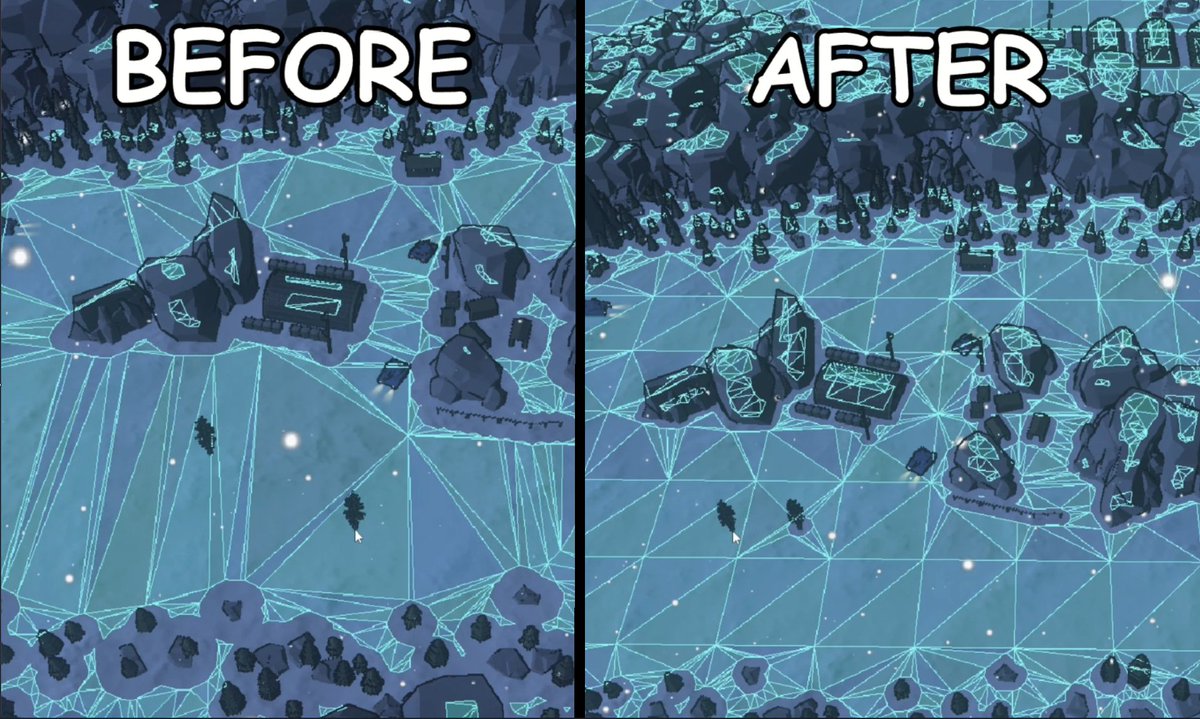
A SCRIPTER IS PLANTING ENTIRE ROBLOX FORESTS WITH CODE INSTEAD OF DRAGGING TREES ONE BY ONE Most builders still open Studio's terrain tool and hand-paint grass, then place every tree by clicking it into the world individually. He wrote a Luau script that reads the terrain height map first...

27,782 次观看 • 20 天前 •via X (Twitter)

0 条评论

暂无评论

原始帖子的评论将显示在这里

相关视频

Rio de Janeiro just became the first city in the world to start reforesting itself with AI drones and the more i read about how it works the cooler it gets: the reason a city would even need this is that dead land is brutally hard to bring back when cattle farming or mining wrecks a piece of land, the soil turns hard and dry and basically dies. left alone it can stay like that for decades the only fix used to be huge crews planting seedlings by hand. one person covers about a hectare a day. at that pace a real forest takes years and a fortune, so most wrecked land just stays dead the company Rio hired is called MORFO. their answer is one drone plus an AI model doing the work of that entire crew it starts with the drone scanning the whole area from above from that scan, the AI studies the soil, the water, the slope, the plants already growing nearby it uses all of that to pick which native species have the best shot at surviving in each exact spot, choosing from a catalog of 300+ local plants once it knows what goes where, the drone flies back over and fires biodegradable seed pods into the ground, 180 every minute each pod holds seeds, nutrients, moisture. a little starter kit for surviving in dead soil flying like that, one drone covers up to 50 hectares a day. the work of a 50-person planting crew and it actually works. they tested it on Brazilian pasture that years of cattle farming had killed. a few months after planting, that same land had grass, bushes, small trees growing again the system keeps learning after the drones leave too. satellites watch what actually grows back, so each new project starts smarter than the last my favorite detail: the AI even decides where NOT to plant it left 16% of one 8,420-hectare site untouched because it detected the forest there was already regrowing on its own easily one of the coolest AI applications i've seen this year

Ole Lehmann

13,123 次观看 • 1 个月前

They did not take cursive from the schools because children no longer needed it. They took it because of what it was quietly building in them. Consider what the exercise actually is. A child, six years old, is handed a pen and asked to draw a single unbroken line that becomes a word. The wrist must float. The fingers must hold a living pressure, never quite the same twice, always correcting. The eye must follow the ink forward and trust the hand to finish what it has begun. There is no lifting, no stopping, no starting over mid-word. The loop must close. The ascender must rise and return. The sentence must travel from one margin to the other as a single continuous gesture, and at the end of it the hand must still be steady. Twelve years of this. Every day. Ten thousand small acts of sustained, self-correcting attention, carried out below the level of conscious thought, until the motion belongs to the body and the body belongs to the motion. This is not penmanship. It is the slow construction of an interior form. The hand that has learned to carry a line without breaking it is the hand of a mind that has learned to carry a thought without breaking it. The two are not metaphors for one another. They are the same faculty, trained in the same child, by the same daily discipline. Continuity of the stroke becomes continuity of the reasoning. The patience of the loop becomes the patience of the argument. The commitment to finish a word one has started becomes the commitment to finish a sentence, a paragraph, a life's idea, without reaching for the nearest distraction halfway through. Print is a different creature entirely. Print lifts. Print stops. Print assembles a word out of separate, stamped, interchangeable pieces, each one beginning and ending in isolation. A mind raised only on print learns to think the way print is made, in discrete tokens, in replaceable units, in fragments that can be recombined by any outside hand without the owner noticing the substitution. It is precisely the shape of thought a language model produces. It is precisely the shape of thought a language model can steer. Cursive is kata. This is the whole of it. A form repeated daily, for years, not for the sake of the form but for what the repetition lays down in the practitioner beneath the form. The swordsman does not train kata so that one day he may fight in kata. He trains it so that when the moment comes and there is no time to think, the movement is already inside him, older and deeper than thought, and it rises on its own. Cursive was the kata of the literate mind, the daily quiet drilling of continuity, of patience, of a line held steady under the long pressure of its own length. And the signature it produced at the end, that small flourished mark unique to a single human being on earth, was only the outward proof of an inward form no machine and no other hand could ever reproduce. Take the kata away and the practitioner is left with vocabulary in place of faculty. He can recognise a whole thought when he encounters one. He cannot carry one himself. He can admire a finished argument. He cannot sustain one long enough to close its loop. He begins books he does not finish, sentences he does not end, ideas he abandons the moment the screen in his palm offers him a brighter one. And when the machine begins feeding him tokens in the exact shape his schooling taught him to receive, he meets it with no interior resistance at all, because no interior form was ever built in him to push back with. They removed it quietly, across a generation, and they removed it in the last years before the machines arrived. Twelve years of daily practice in unbroken, embodied, self-authored thought, gone from the curriculum of almost every child in the Western world, just as the instruments designed to complete their sentences for them came online. The hand forgets. The mind, having never been taught the kata, forgets a thing it never knew it had. That is what cursive was. That is what was taken. And that is why the thought of anyone who still writes by hand, in long unlifted lines, remains, quietly, stubbornly, and without their ever needing to announce it, their own. Now the question stands open. What else has been banned, phased out, quietly retired from the curriculum and from common life over these same decades, under the same soft excuses? Mental arithmetic. Memorisation of poetry. Latin. Logic as a formal subject. Map reading. Knot work. The keeping of a commonplace book. The reading aloud of long passages in class. Singing in parts. What was each of those actually building in the child, beneath the surface of the lesson, and whose interest was served by its disappearance?

SiriusB

442,795 次观看 • 3 个月前

I built a custom TradingView indicator with Claude Code & Fable 5. It's called the Storm Gauge and is built off a real quant trading strategy. I open-sourced the full code on GitHub. Free to install, free to fork, yours to improve. Here's how to install a quant indicator on your TradingView chart: What it actually is The Storm Gauge is a live implementation of the GARCH model, a Nobel Prize-winning volatility framework that real quant desks run daily. It forecasts how "violent" tomorrow's market could be by combining three inputs: an asset's baseline volatility, yesterday's shock, and where volatility was already sitting before that shock happened. It doesn't predict market direction. Instead, it measures risk, in real time, on your actual chart. How to install it Method 1. Plugin command Open the GitHub repo: Find the installation section, copy the command, and paste it into Claude Code. It runs the plugin install automatically. Method 2. Manual config Open garchmethod.md in the repo, copy the entire file, and paste it into Claude Code. It fetches the skill files directly and verifies the strategy for you. (you only need one method; I'm just showing both) Getting it onto your TradingView chart Inside the repo, there's a Pine Script folder. Open it, copy the entire file. Go into TradingView's Pine Editor, paste it in, hit Enter, and refresh. That's it. The Storm Gauge now runs live on your chart as a real number. Once it's installed, just talk to it: → "What's the volatility forecast on Bitcoin?" → "Explain what the current volatility forecast means on $BTC and how it should impact my position sizing" → "Help me size my S&P500 position according to current market volatility" Does it actually work? I backtested the same EMA cross strategy two ways across 15 years of BTC data. Same entries, same exits. → Fixed position sizing: $17,957 final equity → Storm Gauge (GARCH) sizing: $21,205 final equity Fewer drawdowns, less risk, better result. Full breakdown of the entire build process in my recent article - pinned on my profile.

Miles Deutscher

56,026 次观看 • 11 天前

Elon Musk gave the entire entertainment industry its expiration date, and he is the one building the thing that kills it. Musk: “My guess is that we see the first compelling half hour, pure AI show next year.” Next year. A complete show generated entirely by AI. No writers. No actors. No cameras. No sets. No crew. No studio. Just a prompt and enough compute to render a reality that never physically existed. And shows are the easy part. Musk: “I say probably we’re maybe three years away from AI does the whole video game.” A show plays the same way every time. A game has to generate a living world that reacts to every decision in real time across every single frame. That is a fundamentally harder class of problem. And Musk put three years on it. Right now a single AAA title takes seven years and half a billion dollars across thousands of engineers and artists just to ship it. Musk is describing a world where one person types a paragraph and gets something comparable. The entire value proposition of a multi-billion dollar industry lives inside that gap. And it closes in thirty-six months. But the prediction is not the story. The person making it is. This is not an analyst speculating from the sidelines. This is the man building the largest AI compute clusters on the planet. The man who built xAI from zero in under two years. The man stacking hundreds of thousands of GPUs into facilities designed to do exactly what he is describing. When Musk says three years, he is not guessing about what someone else might eventually ship. He is reading you a delivery date off his own roadmap. Every media company on Earth is valued on a single assumption. That quality content is expensive and difficult to produce at scale. That one assumption is the structural foundation underneath every studio, every network, and every publisher in existence. Musk is dismantling it with raw compute. The studios still parading thousand-person production teams are not demonstrating strength. They are advertising the exact cost structure that one person with a prompt and a GPU allocation is about to make irrelevant. And it does not stop at entertainment. If AI can generate an interactive world that responds to human input in real time, it can generate anything. Advertising. Architecture. Training simulations. Product design. Every industry built on humans manually constructing visual experiences frame by frame is sitting on the same countdown Musk just read out loud. Now zoom out. Because this is not just an industry story. For the entire history of human civilization, the distance between imagining a world and actually creating one required thousands of people, millions of hours, and billions of dollars. That distance built Hollywood. That distance built the gaming industry. That distance made content scarce and studios powerful. Musk is collapsing that distance to zero. When the gap between imagining something and it existing disappears, every business model built on the difficulty of creation disappears with it. That is not disruption. That is a full inversion of how human beings create. Musk did not make a casual prediction on that podcast. He told you what he is building. He told you the timeline. And he told you which industries do not survive it. The entertainment industry is still debating whether this future is real. Musk is not part of that debate. He is building. And he just told you the delivery date.

Dustin

21,842 次观看 • 19 天前

A SOLO CREATOR JUST SHIPPED A $35,000-TIER ANIMATED SITE IN ONE WEEKEND - WITH CLAUDE CODE + HIGGSFIELD, FOR THE COST OF A SUBSCRIPTION. What you're looking at isn't a template. It's a fully animated, scroll-driven site, generated end to end in a single agentic session. What's actually on the page: → Cinematic motion clips pulled from 30+ generative models → Scroll animations written automatically - not a single hand-coded keyframe → 6 cinematic effects baked in with zero config: film grain, particles, vignette, glass cards, color tints, scroll pacing Scroll the demo and one question keeps surfacing: a person didn't build this by hand… did they? For studios billing $100-149/hr, that question lands like a verdict. What this normally takes: → A designer, a motion artist, and a developer → Weeks of handoffs between all three → 6 systems wired by hand - GSAP ScrollTrigger, Lenis smooth-scroll, frame extraction, asset optimization, layout, copy That pipeline was the moat. It's what justified the invoice. Here's the part the agency won't put in its pitch deck. The price gap: → Boutique agency build: $6,000-$35,000+ → Industry average project: ~$5,280 → Your cost: a Claude subscription + a few dollars of Higgsfield credits → Timeline: weeks of production → one session One operator now runs all six systems in a single pass and ships a working site - without opening a frame extractor or writing one CSS keyframe. Full breakdown of how it's built in the article below. Save it & read today 👇

ZEUS⚡️

21,598 次观看 • 1 个月前