ๆญฃๅœจๅŠ ่ฝฝ่ง†้ข‘...

่ง†้ข‘ๅŠ ่ฝฝๅคฑ่ดฅ

AdminCN just got even more accessible. ๐ŸŽ‰ We've launched a ๐—™๐—ฟ๐—ฒ๐—ฒ ๐—ฉ๐—ฒ๐—ฟ๐˜€๐—ถ๐—ผ๐—ป of AdminCN on Shadcn Studio. ๐Ÿคฏ You can now access ๐Ÿ‘‡๐Ÿป ๐Ÿ“Š ๐—ข๐—ฟ๐—ฑ๐—ฒ๐—ฟ๐˜€ ๐——๐—ฎ๐˜€๐—ต๐—ฏ๐—ผ๐—ฎ๐—ฟ๐—ฑ ๐Ÿ“ฑ ๐— ๐—ฎ๐—ถ๐—น, ๐—–๐—ฎ๐—น๐—ฒ๐—ป๐—ฑ๐—ฎ๐—ฟ & ๐—จ๐˜€๐—ฒ๐—ฟ๐˜€ ๐Ÿ‘ค ๐—จ๐˜€๐—ฒ๐—ฟ ๐—ฆ๐—ฒ๐˜๐˜๐—ถ๐—ป๐—ด๐˜€ & ๐—ฃ๐—ฟ๐—ผ๐—ณ๐—ถ๐—น๐—ฒ ๐Ÿ”๐—Ÿ๐—ผ๐—ด๐—ถ๐—ป, ๐—ฅ๐—ฒ๐—ด๐—ถ๐˜€๐˜๐—ฒ๐—ฟ, ๐—™๐—ผ๐—ฟ๐—ด๐—ผ๐˜ ๐—ฃ๐—ฎ๐˜€๐˜€๐˜„๐—ผ๐—ฟ๐—ฑ, ๐—ฅ๐—ฒ๐˜€๐—ฒ๐˜ ๐—ฃ๐—ฎ๐˜€๐˜€๐˜„๐—ผ๐—ฟ๐—ฑ, ๐—ฉ๐—ฒ๐—ฟ๐—ถ๐—ณ๐˜† ๐—˜๐—บ๐—ฎ๐—ถ๐—น & ๐—ง๐˜„๐—ผ-๐—ฆ๐˜๐—ฒ๐—ฝ ๐—”๐˜‚๐˜๐—ต๐—ฒ๐—ป๐˜๐—ถ๐—ฐ๐—ฎ๐˜๐—ถ๐—ผ๐—ป ๐Ÿ“ Vertical...

11,238 ๆฌก่ง‚็œ‹ โ€ข 1 ไธชๆœˆๅ‰ โ€ขvia X (Twitter)

0 ๆก่ฏ„่ฎบ

ๆš‚ๆ— ่ฏ„่ฎบ

ๅŽŸๅง‹ๅธ–ๅญ็š„่ฏ„่ฎบๅฐ†ๆ˜พ็คบๅœจ่ฟ™้‡Œ

็›ธๅ…ณ่ง†้ข‘

Brian Preston and Bo Hanson on when financial advisors actually make sense: Asked whether anyone should hire a financial advisor if investing is "really as simple as just buying an index fund consistently," they push back on the framing itself. "Buying an index fund is just one part of the financial planning process. It's the investment part." They're quick to admit that most people don't need to pay a professional: "We don't think that everyone needs a financial advisor with all the information out there on podcasts and YouTube channels and books and blogs. There's so much great free information out there that a lot of people can self-manage for a long time." So when does hiring an advisor actually make sense? They break it down into three specific scenarios: 1. The gravity of your decisions becomes uncomfortable. "If I make a 10% mistake on $10,000, it's not going to change my life. If I make a 10% mistake on a million dollars, well, now I'm starting to impact my livelihood. Now, that might be more than I save in a year, more than I make in a year." 2. Your life becomes financially complicated. "You used to have a two-page tax return and now you have a 100-page tax return or you might have options and RSUs and ESP or you are wondering about what your estate documents should look likeโ€ฆ You're an expert in your field in your vocation but you don't know all the financial planning stuff." 3. You have the smarts but not the time. "Maybe you're super super smart and you can do it on your own. And the complexity doesn't even really frighten you, but what you found is you just don't have time to put the energy and effort and attention into it that you would like to. And so naturally, because you have all these other things going on, personal finances falls on the back burner." The common thread? Clients reach out wanting a second set of eyes from someone who has navigated their next stage many times before: "I want someone who's done it a hundred times so they can tell me, 'Hey, what are the things to look out for? What are the pitfalls I should have?'" But if you're early in your career, the advice is refreshingly direct: "It's not super complicated to figure out, hey, I need to make a good income, live on less than I make, follow the financial order of operations, put my money to work, and every dollar that I can save is going to be way more valuable going into my portfolio or funding my financial goals than paying a financial advisory fee."

Big Brain Investing

15,169 ๆฌก่ง‚็œ‹ โ€ข 4 ไธชๆœˆๅ‰

Hell froze over: announcing FormKit for React. Secretly framework-agnostic since inception, today weโ€™re open sourcing the most popular Vue form libraryโ€ฆfor React. Why is this a big deal? 1. Forms are still hard. We (the creators of FormKit) thought form libraries were no longer necessary, given the trajectory of coding agents. It turns out we were wrong, and we learned this the hard way. Need repeating conditional fields nested 3 layers deep inside a dynamic component, with accessibility, validation, internationalization, and backend error placement? Turns out coding agents arenโ€™t great at that. Itโ€™s table stakes for FormKit. 2. Single component. This matters more than you would think, but FormKit doesnโ€™t ship lots of different components each with its own props. Instead, it has a single one: and unified props. This was done to provide a better DX to human engineers. It makes it easy to spot when a given component was part of the formโ€™s data structure vs a presentational component. It turns out this matters even more to coding agents than humans. No matter where your coding agent is, whenever it sees โ€œFormKitโ€ it immediately knows โ€œoh, thatโ€™s part of the formโ€™s dataโ€. 3. No plumbing. FormKit doesnโ€™t require any manual data collection, event listening, or state tracking. It does all this for you on a heavily tested, framework agnostic, self-assembling graph. The only code your agent needs to write is declarative templates and submission handlers that respond to the state. 4. Dense colocation. FormKitโ€™s syntax happens to be ideal for coding agents; nearly everything you need to know about a given input is *on* the input: Colocation dramatically improves the efficacy of coding agents. 5. DOM. FormKit, unlike most form frameworks in React, renders the actual DOM. This also increases colocation and best practices, meaning your coding agent is far more likely to produce consistent and high-quality output that looks and acts the way its supposed to. 6. Schema. FormKitโ€™s own inputs are not written using Vue or React โ€” instead, FormKit has its own render schema โ€” think of it like an AST for the DOM โ€” and you can modify it on the fly. Itโ€™s not very human-friendly to write, but it turns out most models are already pretty well trained on FormKitโ€™s schema. Want your inputs to look a bit different on one form than another? No problem, your coding agent can easily make those changes *without* modifying the JSX structure at all. Oh, and any inputs you create for Vue work with React and vice versa. 7. Plugins. FormKit leans into the unstructured tree graph hard. The graph doesnโ€™t just collect data, it also passes down configuration and plugins. Want one form to work a bit differently than another one? No problem โ€” just add a plugin to the top of that form or group and its children will all receive that feature. You can even mass assign props and configuration this way. Of course, FormKit has been solving these exact issues for a long time, but it wasnโ€™t until we started using it on our own projects with coding agents that we realized what a huge advantage it is. With so many people using coding agents with React, it made sense to unveil FormKit for what it has always been โ€” a completely framework-agnostic form framework that happens to unlock your coding agents. โžก๏ธ

Justin Schroeder

11,677 ๆฌก่ง‚็œ‹ โ€ข 5 ไธชๆœˆๅ‰

I just published a new tutorial on how to build a directory using AI and no-code tools. Directories are the ultimate MVP. They let you validate an idea, build traffic, and then pivot into something biggerโ€”like SaaS or a marketplace. Remember when Yahoo and DMOZ ruled the internet? Okay, maybe you donโ€™t, but they did. They curated the web back when search engines were clunky and unreliable. Fast forward to todayโ€”directories are making a quiet comeback. And itโ€™s not about nostalgia. The 5 step playbook that we go through: 1. Niche first, features later Use Google Keyword Planner to find high-volume, low-competition keywords. Lock in a matching domain. 2. Build fast No-code tools + AI = rapid setup. Let AI generate the initial content and structure for you. 3. Promote smart Share on Reddit, list your directory in other directories, and engage on Twitter. 4. SEO from day one Start with 10 high-quality articles and solid internal linking. 5. Monetize as you grow Affiliate links, premium listings, B2B sponsorships. Itโ€™s all on the table. A directory can be a side hustle that pulls in $5K MRR. Then, once youโ€™ve got traffic, you can scale into SaaS or a marketplace. It literallyyyyy pays to have traffic for your software startup. Why arenโ€™t more people talking about this? Huge shoutout to John Rush for giving us a free masterclass on this exact strategy. Legend. Youโ€™ll want to watch to this episode on directories. I respond to all comments and appreciate them. Audio is over here if you prefer listening: Directories are cool - itโ€™s the perfect foundation for something much bigger. Was this interesting? Well, reply to me with if it was and what you'd like to learn next on The Startup ideas Podcast. People like to gate this type of content. I won't. I live to serve and will continue sharing this info for free.

GREG ISENBERG

120,737 ๆฌก่ง‚็œ‹ โ€ข 1 ๅนดๅ‰

๐Ÿ‘ค: So, after finishing your music show promotions, how did it feel? ๐Ÿฆš: Oh, the generation gap is huge now. The age difference between us and the newer idols is basically like the gap between parents and their children, so itโ€™s honestly very embarrassing. Even when they come over to greet us, we just awkwardly say, โ€œOh, hello! Youโ€™re the best, youโ€™re the best!โ€ and then run away. ๐Ÿ‘ค: Youโ€™ve reached the age where you finally understand why your senior artists acted that way back then. ๐Ÿฆš: Exactly. Thereโ€™s a girl group in our company called Hearts2Hearts, and one of the members, Ina, has a mother whoโ€™s the same age as us. ๐Ÿค: Thatโ€™s right. Even if people called us fathers, it wouldnโ€™t be strange anymore. ๐Ÿ‘ค: There are a lot of moments like that these days, arenโ€™t there? ๐Ÿค: Yeah, and the gap just keeps getting bigger. The parents of trainees nowadays were born in the โ€™90s. ๐Ÿ‘ค: Oh myโ€ฆ thatโ€™s a big deal. ๐Ÿค: Coming here and talking about things like thisโ€ฆ the aging of the entertainment industry really is a serious issue. ๐Ÿ‘ค: And thereโ€™s no retirement or welfare system for it. ๐Ÿค: Exactly. I feel like Super Junior has raised the average age of idols quite a bit, so Iโ€™d like to sincerely apologize for that. ๐Ÿ‘ค: Itโ€™s okay. Youโ€™re still doing great. ๐Ÿฆš: These days we get a lot of encouragement like, โ€œKeep going! Stay strong!โ€ ๐Ÿ‘ค: It feels like everyone is cheering you on, saying, โ€œWow, theyโ€™re really working hard.โ€ ๐Ÿฆš: Yeah, thatโ€™s exactly how they are. ๐Ÿ‘ค: Do you still have fans who actively support you? ๐Ÿค: Oh, of course! ๐Ÿ‘ค: Really? ๐Ÿค: They always say, โ€œDonโ€™t let our oppas get discouraged,โ€ and they come to support us too. ๐Ÿ‘ค: Thatโ€™s truly precious. ๐Ÿค: It really is. Each one of those fans feels like a hundred people. Weโ€™re growing older together now. ๐Ÿฆš: Longtime fans are different. These days, fans use LED signs instead of handmade placards. So when we see people still holding handmade signsโ€ฆ ๐Ÿ‘ค: They made them themselves! ๐Ÿฆš: Thatโ€™s how you know theyโ€™re longtime fans, and theyโ€™re incredibly precious to Super Junior. ๐Ÿค: Actually, at our recent fansign, our fans are getting older too, so many of them arenโ€™t familiar with buying tickets online. A lot of them told me, โ€œOppa, I couldnโ€™t come because I didnโ€™t know how to book the tickets.โ€ ๐Ÿ‘ค: So after being a veteran group for so long, you launched a brand new subunit and spent your first week promoting as rookies. How did that happen? ๐Ÿค: We had just finished our 20th anniversary concert tour, and for the encore concerts we wanted to do something different. We wanted to perform as subunits, but Heechul didnโ€™t have one. He said, โ€œThen I just wonโ€™t participate.โ€ But I couldnโ€™t let him sit out, so I told him, โ€œLetโ€™s do something together.โ€ Then Shindong heard us and said, โ€œThen you two should just form a unit together!โ€ And thatโ€™s how our subunit was created. ๐Ÿ‘ค: What was your relationship like? Were you always close? ๐Ÿค: No, we werenโ€™t. ๐Ÿ‘ค: Because you didnโ€™t really understand each other back then? ๐Ÿค: As everyone knows from the โ€œGreat Incheon Incidentโ€ about ten years ago, we had a huge fight at Incheon Munhak Stadium. ๐Ÿ‘ค: It was complete chaos! ๐Ÿค: It really was! But as we got older, we gradually started understanding each other better. ๐Ÿ‘ค: Right, you probably donโ€™t even have the energy to fight anymore. Did you enjoy working together as a duo? ๐Ÿฆš: I absolutely loved it! And Leeteuk gave me a lot of authority and freedom to lead. ๐Ÿ‘ค: So whoโ€™s the leader of the unit? ๐Ÿค: Heechul. ๐Ÿฆ’: Really?! ๐Ÿฆš: Yep, Iโ€™m the leader now. ๐Ÿค: Even for our appearance on The Seasons, Heechul personally arranged everything, contacted the program, and handled all the scheduling himself. ๐Ÿ‘ค: Well, why wouldnโ€™t he? Heโ€™s the best at those kinds of things. ๐Ÿฆš: Thatโ€™s why I really wanted to appear on The Seasons. Since my older brother Si Kyung is the host here, I wanted to show him a brighter, more confident side of myself.

ใ‚‰ใŒใฉ||๐Ÿค

39,399 ๆฌก่ง‚็œ‹ โ€ข 1 ไธชๆœˆๅ‰

The Victims Of The Lahaina, Maui, Hawaii Fires ARE CALLING OUT THE GOVERNMENT On The Land Grab!! โ€Œ โ€œEach one of these agencies have signed on as stakeholders for the redevelopment of a smart city in Mauiโ€ โ€Œ โ€œI'm not saying that I'm not going to be able to do that. I'm just saying that I'm not going to be able to do that. I'm just saying that I'm table is your name listed as a stakeholder of any of the redevelopment plans regarding a smart city. I can tell you, Department of Planning, DLNR, DBED, Housing, all of you, all of these agencies, and I'm not saying to you directly, but you're here representing these agencies, therefore, it is your responsibility to tell the truth. โ€Œ Each one of these agencies have signed on as stakeholders for the redevelopment of a smart city in Maui. Just want to remind you guys that you guys work for us. You guys work for us. I don't know if you guys forget. You know, a thousand people could come up here and say that they want something. I mean the way it looks, you guys just go with what is going to further your political career. โ€Œ It's just like we come here to talk about something and then you guys start fighting back with us. You work for us You don't talk to your boss like that, right? Who talks to their boss like that? Nobody talks to their boss like that. Oh, you kind of go talk to him because he got security Look at josh green how weak weak man. What happened? I came inside What he got to go check his bed, but he's what is going on. He's supposed to go He's supposed to please not that let's not do that. This is not that kind of a meeting It's not a political meeting or a campaign meeting. Yeah, this is serious business. โ€Œ That is very um that really bothers me. You're not being a waiter. You know you talk to your boss like that. I'm your boss and for real, these people, they are your boss. Shame is when you do something behind everybody's back. โ€Œ Enough is enough, huh? No, more, more screwing over the people of Hawaii. More, you know how much? I'm not gonna say it again. I'm gonna talk about Green. That's your guy's leader. He's not even here. He's a guy he only signs the bill to further his political career. So what is next? He let go of her president. And that's what you guys look for. Oh, that's the guy I look up to. The guy who screws everybody over thought. I've given testimony so many times and most of the time it's like this facts are turned people don't listen you look like you're sleeping. โ€Œ Where's the emotion? Where's your heart? And when you think about these actions, when you think about the work you do, think about all those people, like this guy on his phone right now. It's insulting. Do not forget the people. And Green's actions right there, getting taken out by his handler, come on guys. I saw all your faces. I think some of you were shocked too, except for the people whispering in the front, cause he warned you he was gonna walk away. โ€Œ You wanna know why? Our voices. He wants to silence us every time. He does not listen. I am asking all of you at this table to make sure he listens. But we know very well that you guys, as the third largest stakeholders this state, do want that land and can take it when you deem it a natural disaster. And that is disgusting. And that is why I'm also here today, because someone needs to call that out. We wanted in. โ€Œ I know it says on there on the door there is no black cards or no signs but isn't that very uh so so much contradictions that you can't have a sign you can't have a voice they're like loopholes on paper written by developers and those that are in charge that make the decisions for the state for the different counties i've been in this meeting and i've heard developers say the loopholes they know how to work around it paper to get things passed through. Watch the video to hear the rest! Due to Xโ€™s text limits DEWs, Direct Energy Weapons #Hawaii #Maui #MauiFires #Lahaina #LahainaFires #DEWs #DirectedEnergyWeapons

Wall Street Apes

434,677 ๆฌก่ง‚็œ‹ โ€ข 3 ๅนดๅ‰

Pre Game Spurs v Notts Forest itโ€™s not just a game,Itโ€™s THE game. A straight-up six-pointer in the relegation trenches. Only one point separates us 16th vs 17th and everythingโ€™s is on the line. Weโ€™ve been battered, bruised, winless in the league in 2026 and we are now staring down the barrel of the drop for the first time in decades. TV Pundits laughing already saying we are going down , ex-players throwing in unhelpful comments , The press saying our own fans will turn toxic if we go behind. They think weโ€™ll crumble. Nah Not today for me ๐Ÿ‘Š๐Ÿผ๐Ÿ˜Ž๐Ÿ”ฅ This is bigger than any recent derby. This is about pride, survival, the soul of the club. Igor Tudorโ€™s got us fighting again,holding Liverpool, beating Atletico now we need to finish the job at home. The Stadium will be a cauldron. Hopefully Deafening. Hostile to them, electric for us. We donโ€™t need fancy football today we need heart. Grit. Hunger passion and level heads on the pitch.Every single one of you in the stands, or on the sofa, at home watching on tv screaming COYS until your voice gives out. Forest come with confidence after beating us 3-0 in the away leg but they went on to lose the next 4 games without scoring so spurs that performance.All that said this is OUR house. Our future. Our club on the brink. Win this, and we breathe. Lose, and the nightmare deepens. No more excuses. No more what-ifs. Come on you Spurs. All Together Always. Letโ€™s save our season. Letโ€™s roar them into submission. Iโ€™m going for a 3-1 win let me know your score prediction below My sponsor is Squad Bets check out their app download it now in the App Store you can Bet on you score prediction with your mates. Itโ€™s easy to use: create a Squad, invite your mates, start playing. Itโ€™s great fun SquadBets AD 18+ #COYS ๐Ÿค๐Ÿ’™

Jonny H

64,049 ๆฌก่ง‚็œ‹ โ€ข 5 ไธชๆœˆๅ‰

Big Update: Critters Quest Website Steps Into Production State with an Exciting New Design! Hey Critters, we're thrilled to share some major news, our website has officially migrated from mint state to production state, and we're taking our platform to the next level right here at After three weeks of dedicated work, we've transformed Critters Quest into a more organized, stable, and feature-rich experience, setting the stage for everything we've planned for the future. This isn't just an upgradeโ€”it's the first step before the real journey begins! Key Updates to the Homepage and Beyond Fresh Categories and Pages: We've added exciting new sections to help you dive deeper into the Critters Quest world: - Play $QUEST (Explorer Page for Staking $QUEST): Dive into our new $QUEST explorer page, where you can find games to stake your $QUEST tokens to earn rewards, track your staking progress, and engage in strategic gameplay challenges that grow your Critters' value. - Play Spins (Explorer Page for Spins): Spins are now front and center with a dedicated spins explorer page, designed to highlight Multipliers Spins, Terron Spins, Quest Tablet Spins(coming soon๐Ÿ‘€), and more. Organized as daily free spins, limited events, and partner spin opportunities for special loot, offering new ways to boost your rewards. - Breakdown Informational Page: We've introduced a comprehensive guide for new users (and a refresher for veterans) to explore how key features work. This page currently focuses exclusively on the mechanics and info for Master Edition NFTs, Cloned Editions, and Multipliers. It explains how Master Editions serve as the foundation for your Critters' value, how Master Editions allow Cloned Editions to be minted out for others, and how Multipliers enhance your rewards throughout critters ecosystem. Redesigned Homepage: Our homepage has been completely transformed into an intuitive experience that gives you a complete overview of the Critters Quest ecosystem at a glance. It features: - Feature Carousel: Highlighting new additions and important updates - Ecosystem Activities: Real-time data showing active games, spins, or other ongoing activities. - Mini-Leaderboards: Quick snapshots of top performers - PFP Activity Feed: See the latest community PFPs minted - Quick-Access CTAs: Every section includes direct links to the full experience, letting you dive deeper with just one click - Streamlined Introduction: New visitors get a concise overview of Critters Quest right away This overview approach makes navigation intuitive for both newcomers and veterans, ensuring you never miss important information or opportunities. Elevated Designs Across the Board: - Dynamic Castle Layout in the Banner: Our homepage now features a dynamic castle layout in the banner, with castles positioned in the order they appear on the leaderboard. The top leaders are showcased at the top, adding a visual representation of community rankings and bringing our competitive spirit to life. - Critters Terminal (Formerly $QUEST Terminal): Our terminal has been upgraded with a sleek new look and enhanced functionality, now known as the Critters Terminal. It's your go-to hub for finding the most powerful cards and looking for new Crittersโ€”it tracks $QUEST allocation on available Critters for sale, their power, equipment, and more, helping you build the ultimate team. - Equipment Viewing: Viewing Critters and their equipment has been elevated with detailed rankings, power levels, and stats, giving you a clearer picture of your team's strength and hinting at game mechanics like power-based strategies. - Spins Pages Redesign: The spins experience has been completely revamped with a fresh, user-friendly design, making it easier to spin for rewards and track your progress, with a focus on multipliers and special loot opportunities. - Partnership Sign-Up Page Update: On our main page, you'll see mentions of our legendary partnersโ€”GM Capital, Mintify, Sniper, and moreโ€”highlighting our growing ecosystem. We've also updated our partnership sign-up page for those looking to partner with us. This page now includes a detailed breakdown of partnership options and new form fields to streamline the collaboration process. We're excited to expand our network in the future! - Animated Banners: Across all pages, you'll notice new animated banners that bring our world to life, adding visual excitement and guiding you through the platform. - Archived Pages: To streamline the site and focus on the future, we've archived older pages like the Master Edition Mint and Referral pages. These will remain available for reference. Coming Soon: We're already working on exciting additions, including: - SHOP Page: A new experience for purchasing items and gear to enhance your Critters Quest adventures, where you can equip your Critters with power-boosting equipment. - Tokenomics/Liquidty Section (Addition to the INFO Page): We're working on a detailed tokenomics section to add to our INFO page, launching alongside updates to our plans for DEX integration. These changes will add more value to Master Editions, give participants greater confidence, and enhance the overall ecosystem. - Cloned Edition Minting: This innovative feature will launch when Master Editions begin to mint out their Clones, allowing people to mint these unique variations. Cloned Editions will inherit traits and offer new gameplay opportunities, expanding your Critters' potential and rewards. Backend Tweaks: While many of these improvements are visible, we've also made numerous backend tweaks that aren't immediately seen. These optimizations ensure better performance, stability, and scalability for the platform moving forward. Continuous Elevation: This migration marks our first massive overhaul, but it's just the beginning. We're committed to elevating Critters Quest on a continuous basis, refining and expanding the platform with each rollout to keep delivering the best possible experience for our community. Foundation for the Future These updates aren't just cosmeticโ€”they're foundational. After three weeks of hard work, we've created a more organized and structured platform that's ready to support the future rollouts we've been teasing, like Edition Minting, Items Shop, and Quest Games. This migration streamlines our process, allowing us to deliver updates faster and more efficiently for both new users and our longtime adventurers. This is truly the first step before the real journey begins. Our production state sets us up to expand Critters Quest into an even bigger, more engaging GameFi ecosystem, where your Critters can thrive through quests, spins, and community challenges. Whether you're a newcomer or a seasoned player, these changes make it easier to explore, compete, and grow your collection. Your Next Expedition We're just getting started! This production-ready overhaul is the launchpad for all the exciting features and expansions we have planned. Keep an eye on for more updates, and dive into the new pages to see how you can level up your Critters Quest experience. We want to hear from you! Share your feedback, suggestions, and experiences with our new production site in our Discord or commenting below. Your input directly shapes our future updates and helps us create the best possible experience. Thank you for your patience and support during this transition. Together, we're building something truly special!

Critters Quest

26,186 ๆฌก่ง‚็œ‹ โ€ข 1 ๅนดๅ‰

Imagine this: You are a sovereign individual. Your rights are not granted by the government but endowed by God. You have credible information that the public doesnโ€™t yet know. You verify it. You believe it can save lives. So you do what free people are supposed to do. You speak. You publish it online. You build an audience. A community forms. Millions read, watch, and share. People write to you saying your work helped them think critically, ask better questions, maybe even protect their health. You didnโ€™t break the law. You didnโ€™t fabricate data. You didnโ€™t incite violence. You asked questions. Then one day, without warning, everything disappears. Your account is gone. Your reach collapses. Your years of work vanish from feeds overnight. Not because you deleted it. Not because a court found you guilty of anything. But because a โ€œnonprofitโ€ based out of the UK issued a report labeling you a โ€œmisinformation superspreader.โ€ They pull a bogus stat out of thin air, then weaponize it to say you are โ€œkilling people.โ€ The media amplifies it. Night after night, news anchors repeat the same sinister lie about you. The White House echoes it from the podium. Officials pressure social media companies to โ€œdo moreโ€ to crack down on you. And then it happens. Your pages have been erased. Your channels have been demonetized. Your voice disappears from your followersโ€™ feeds. The First Amendment didnโ€™t protect you. It was circumvented. Millions who once had access to your message now receive only one narrative. The approved one. The one aligned with trillion-dollar interests and institutional power. And your alleged crime? Opening your mouth and telling the truth. This sounds like something pulled straight from George Orwellโ€™s 1984. But it happened. Not to one person. But over a dozen, all triggered by a stat made out of thin air from overseas. They were called the โ€œDisinformation Dozen.โ€ The CCDH (Center for Countering Digital Hate) claimed that 65% of all anti-vaccine misinformation online came from just 12 individuals. The reality? Facebook later admitted those 12 accounts were responsible for just 0.05% of vaccine-related content views on its platform. This wasnโ€™t a one-off attack. This was a blueprint. After they got away with censoring the โ€œDisinformation Dozen,โ€ they went after you, they went after me, they went after all of us. I was a healthcare worker who simply didnโ€™t like the vax mandates. I started clipping doctors sharing information that went against the narrative. They nuked my Twitter account not once, not twice, but three times. I tried making more accounts. They blocked my phone number from creating new ones. And even if I could make more, they would have nuked those too. Iโ€™m still pissed about this, and I canโ€™t believe this actually happened in America. But guess what? The tables are turning. The censors are now the defendants. They censored the speech. Now they must defend the silence. The โ€œDisinformation Dozenโ€ is fighting back in federal court. Ty and Charlene Bollinger (The Truth About Vaccines) didnโ€™t just write a โ€œstrongly-worded letter,โ€ as Pam Bondi would say. They filed a nearly 400-page federal lawsuit naming the State Department, the FBI, the Center for Countering Digital Hate, and major Big Tech platforms. The suit alleges a coordinated effort to manufacture a blacklist, pressure platforms, and erase lawful speech under the banner of โ€œmisinformation.โ€ โ€œMake no mistake. Our case will set legal precedent in America,โ€ Ty Bollinger says. This case isnโ€™t just about restoring their accounts. Itโ€™s about exposing how a foreign-funded report was amplified from the White House podium, used to justify deplatforming, and weaponized to silence millions of Americans. Itโ€™s about whether the government can secretly pressure private companies to do what the Constitution forbids it from doing directly. Itโ€™s about whether the First Amendment still means what it says. Because if they can erase voices with millions of followers, they can erase yours too. And now itโ€™s your turn to decide whether free speech will be treated as a God-given right or a โ€œprivelege.โ€ First, watch the film. See the evidence. Understand how lies that were made out of thin air, like Fauciโ€™s โ€œsix feet social distancing,โ€ were also fabricated to censor voices like the โ€œDisinformation Dozenโ€ and yours truly. Watch how the coordinated effort worked. Understand what happened so this never happens again. Then, if you believe free speech still matters, support the legal fight. These lawsuits are expensive. And those who did the censoring are counting on us to run out of money before we can hold them accountable. Donโ€™t let that happen. When you donate, youโ€™re not just helping Ty and Charlene. Youโ€™re standing up for every doctor who was deplatformed, every dissenting voice punished for asking questions, every unvaxxed worker fired from their job, every person denied service for being โ€œunclean.โ€ Youโ€™re defending your voice, your childrenโ€™s voices, and the generations that come after them. Censorship is the disease. Freedom of speech is the cure. If a precedent is set in court, it protects all of us. If it fails, itโ€™s only a matter of time before they attempt to silence us all again under the banner of the next โ€œglobal emergency.โ€ What happens next depends on whether we act now or sit back and โ€œhopeโ€ someone else defends our freedoms for us. Ty and Charlene Bollinger have drawn the line in the sand. Now itโ€™s up to us to back them. โ€œMake no mistake. Our case will set legal precedent in America.โ€ โ€” Ty Bollinger Donโ€™t let them normalize treating your God-given right to speak freely as a privilege. Watch the film. Support the legal fight. Put the censors on trial. Make them answer in court for what they did. WATCH THE FILM: SUPPORT THE FIGHT:

The Vigilant Fox ๐ŸฆŠ

88,171 ๆฌก่ง‚็œ‹ โ€ข 6 ไธชๆœˆๅ‰

๐Ÿšจ#BREAKING - MARITIME LAW - Ok, this is epic, and it will blow your mind, if you don't even know it. Those who are awake will know. That's great and this is what we should share. So, your birth certificate is where it all begins. This is where much of the corruption begins. The moment you sign your BC, it is Maritime law. You are actually signing a form that classifies you as dead at sea. You become a commodity of the system and honestly you Google it, you research it and you probably have to be fair like I said, but it's true. You become um... In a sense, they seize all the assets and go into what they call a trust fund and then you have 6 years to declare yourself alive. Declare yourself still here and then you can regain your sovereignty. But we didn't know that. It was a system they had set up so that you and I and everyone else were traded like cattle on the stock market. So each of us has a trust fund. And depending on how old you are, it depends on how much money is there. So if you're over 50 or something, you've got millions in there because that's how long we've been traded for. And this is another thing that is also crazy. That's why the mortgage system is absolutely ruined. So when you go for a mortgage, you basically sign the papers and they always tell you, "come back in 3 days and we'll have the money." They then take that money out of their trust fund to pay for the house. So, that comes out of your trust fund in your name, which has been growing since you were born. They then charge you interest on your money, but they don't care about the monetary side. They want the house. So if you miss a payment, they'll miss out immediately, because they can repossess your house. For them the house is a commodity, an asset. Wait to share what the banks do, but this trust fund is where much of your money will come from and be returned to you. This is their money that they have earned from you. So, that's just one thing. Then you also have the tax side. Taxes have never been taken from us, it is illegal. It is a corrupt system. So, all the taxes that we pay, it is not that they are going to return them to us, like the exact amount of taxes that we paid. What I have heard on the channels is the fact that it will be bond based, so at a certain age you will get so much money back, at a certain age this... I think the 62+ category was like 110k or something like that. But obviously they'll know more about that when it comes, but that's where more money comes from. Honestly, you are ready to live a life of abundance. This is money that was ours, that should be ours, that we should have been living with to create a better life. Instead, they have put us in this corrupt system where they have been fighting and they are taking all of our money and keeping it for themselves. for themselves. I hope I have shed light on this. Many people ask where this abundance comes from. Remember that the 1% controlled 99% of the wealth that now comes back to us to live a completely different life. They will give us what is owed to us because we should never have fought like this. Join, it's not too late! ๐Ÿ‘‡ โœ…๏ธ

GP Q

616,617 ๆฌก่ง‚็œ‹ โ€ข 2 ๅนดๅ‰

For those like me who donโ€™t like reading just excerpts and prefer to see the full picture โ€” here you can find Trumpโ€™s full comments aboard Air Force One reacting to all the latest developments. Whatโ€™s really striking is that, alongside the full-throated excuses for Witkoff, there are also some tough questions from journalists. And there are also these oddly detailed conversations about the land concessions Ukraine is supposedly expected to accept. Trump sounds convinced that Russia is winning โ€” which is simply not true. Journalist: Could you start off by telling the latest on Russia and Ukraine? Are you expecting President Zelensky to come visit you? The US President Donald Trump: I would like for him to come, but I think we should get a deal done first. We're having good talks. We started with Russia, by having some talks with Russia. Ukraine is doing well. I think they're pretty happy about it. They'd like to see it ended. We won't know for a little while, but we're making progress. We settled eight wars, and I thought this would be one of the easier ones, because of my relationship with President Putin. But this is probably one of the more difficult ones. There is a lot of hatred. Journalist: You were saying there are still disagreements, can you please tell us what those are about? The US President Donald Trump: Yeah, there are a few. Just standard things. But people are starting to realize it's a good deal for both parties, and theyโ€™ve got to stop the war. They're losing a lot of people, a lot of soldiers, mostly soldiers. Journalist: Can you explain what the current proposal involves? The US President Donald Trump: That was in original proposal. And then from there, we went back and forth. Journalist: Regarding giving land to Russia โ€” is that still on the table? Has that changed? The US President Donald Trump: Well, theyโ€™re talking about giving land both ways. Theyโ€™re trying to clean up the border. You know, you can't go through the middle of a house, you canโ€™t go through the middle of a highway. So they're trying to work something. It's a complicated process. It doesnโ€™t go that quickly. Journalist: On the security guarantees for Ukraineโ€ฆ The US President Donald Trump: We're working that out with Europe. Europe will be largely involved in that. We're working it out with Europe. Europe really wants to see an end if possible. Journalist: There were a lot of Republicans who felt that the first โ€” the 28-point plan โ€” was too favorable to Russia. Have you changed that? The US President Donald Trump: Well, that was just a map. All that was is a map. That was not a plan. It was a concept. And from there, they're taking each one of the 28 points, and then you get down to 22 points. A lot of them were solved. And actually very favorably solved. So we'll see what happens. Journalist: Do you think Ukraine was being asked to give too much land back to Russia? The US President Donald Trump: The way it's going, if you look, it's just moving in one direction. So eventually, that land, over the next couple of months, might be gotten by Russia anyway. So do you want to fight and lose another 50, 60,000 people, or you want to do something now? In some cases, the land is going in the other direction. So they're negotiating. They're trying to get it done. You want to have a border. You can't have a border that goes through a highway, or a border that goes through the middle of a town โ€” so it doesn't work. So it's a long, complicated process. And itโ€™s very sad, because so many people are being killed. Journalist: Whatโ€™s the next step in the negotiations? The US President Donald Trump: They're gonna keep talking. They're talking to Russia now. Steve Witkoff is going over, maybe with Jared. I'm not sure about Jared going, but he's involved in the process, smart guy. And they're gonna be meeting with President Putin, I believe next week in Moscow. Journalist: Next week in Moscow? The US President Donald Trump: I think so, yeah Journalist: What kind of concessions are the Russians going to have to make? The US President Donald Trump: Well, theyโ€™re making concessions. The big concession is if they stop fighting, and they don't take any more land. Again, itโ€™s a war that would have never happened if I was president. This was not anything that was going to happen. This happened because of stupidity. Journalist: If the talks are going to Russia next week, does that mean that the Thanksgiving deadline doesnโ€™t stand anymore for Ukraine? The US President Donald Trump: We're going to see what happens. They set up a date โ€” the date is going to be sometime in the very near future. Journalist: Do you have a new deadline? The US President Donald Trump: No, I donโ€™t have a deadline. The deadline for me is when it's over. And I think everybody's tired of fighting in this moment. They're losing too many people. Journalist: Have you heard that audio that Bloomberg has of Witkoff coaching the Russians on how to appeal to you? The US President Donald Trump: I haven't heard it, no, but thatโ€™s a standard thing, because he's got to sell this to Ukraine. He's got to sell Ukraine to Russia. That's what a dealmaker does. He's got to say, โ€œLook, they want this, you got to convince them with this.โ€ You know, that's a very standard form of negotiation. I haven't heard it, but I heard it was standard negotiation. And I would imagine he's saying the same thing to Ukraine, because each party has to give and take. Journalist: So you donโ€™t worry that he is too pro-Russian? The US President Donald Trump: No, I thinkโ€ฆ lookโ€ฆ This war could go on for years, and Russia's got a lot more people, a lot more soldiers. So I think if Ukraine can make a deal, it's a good thing. I think it's great for both. Frankly, I think it's great for both. Ukraine has a much smaller, much smaller group of people. Theyโ€™ve lost a lot of people. Russia has lost a lot of people, but Russia has a much bigger pool of people.

Kateryna Lisunova

113,961 ๆฌก่ง‚็œ‹ โ€ข 9 ไธชๆœˆๅ‰

Just in $AMD Anush "Speed is the moat"|ROCm๐ŸŽ™๏ธ In the race to define the future of AI, what's the one advantage that truly lasts? It's not proprietary tech, argues Anush Elangovan Elangovan, VP of AI Software at AMD , but the sustainable speed of innovation. He explains why AMD is rejecting the "walled garden" model for its open source ROCm stack, betting that an open community flywheel is the key to victory. Listen to understand how this open strategy is designed to out-innovate closed systems by empowering developers to solve everything from frontier-model challenges to the mundane, everyday problems that define the "last mile" of AI. AMD ROCm Software: Part 1 Transcript [00:00:00] Andrew Zigler: Joining me is Anush Elangovan, VP of AI software at AMD. And when people talk about AI compute, the conversation often stops at hardware specs, but it's more than just physical chips that win the game. It's also the software ecosystems supporting them. [00:00:18] Andrew Zigler: The prevailing strategy in the industry has been to build something like a walled garden. You know, something closed, proprietary locks, developers in. But AMD is betting on an entirely different play, open source acceleration, and with rock, their open source AI software stack. AMD is building not just hardware parity, but an innovation flywheel that's powered by the community with interoperability and the freedom to scale without all of that pesky lockin. [00:00:48] Andrew Zigler: And in this world, speed is your moat and how fast you can innovate while your platform remains open, flexible, and standardize across all of its applications. That's what we're gonna explore [00:01:00] today. So Anush, I'm really excited to have you here. Welcome to Dev Interrupted. [00:01:04] Anush Elangovan: Thanks for having me. Uh, super excited to chat about it. [00:01:07] Andrew Zigler: Amazing. Well, let's go ahead and dive right in with kind of what I laid it out with in the beginning, the idea of the moat and it being about speed. I wanna unpack that a bit because that came from you when you and I first spoke. And I, and I want to know, you know, how do you define speed inside of AMD beyond just things like hardware, benchmarks. [00:01:27] Anush Elangovan: Yeah, that's a very good question. So when we typically talk about speed, everyone's like, Hey, hardware benchmark specs, right? Like, uh, memory bandwidth or, or flops. And that is one important part of it, uh, AMD does very well. With that, we do have, a, a very good history of executing on that axis. [00:01:47] Anush Elangovan: But when I say speed is the moat, it is about, uh, how we prepare, how we build the muscle to run the race for a long time and run it fast. And it is [00:02:00] not about a single point in time that you've, you've beat some you know, benchmark and, and you declare victory. It's about building the ability to consistently develop and deliver. [00:02:13] Anush Elangovan: Both hardware and software innovation at scale and do it fast, right? Like, you know, we we're increasingly getting to a point where models come out and they're, uh, you know, a year or two ago it was like, Hey, they work on AMD on day zero, which is great, but now they are performing on AMD the day it releases, right? [00:02:32] Anush Elangovan: So, what does it take to Prefetch where the industry is going? Be prepared to intercept. At that point is what you know, I, I refer to as you know, the, the speed factor in, in creating this mode, right? And the mode is just shed all things that hold you back and run as fast as you can. [00:02:53] Anush Elangovan: Uh, because the pace of innovation that is, uh, being seen in, in AI [00:03:00] industries is just. Amazing. Right? And it's like, it's transformational at at how you generate electricity. It's transformational as at how you build data centers. It's transformational at how you deploy compute, networking. It's transformational at what kind of use cases you, you know, uh, use AI for. [00:03:17] Anush Elangovan: Uh, and for that, you need to be prepared to, see what comes tomorrow and be prepared to run the race tomorrow. [00:03:23] Andrew Zigler: Yeah, it's a really great perspective because it highlights that it's not just like a checkpoint that you run through. I like how you called out, like it's not just hitting that benchmark or being the best in class at that moment, in that snapshot, it's about having a. The throughput and about having that dedication to the idea and continuing to deliver on it. [00:03:43] Andrew Zigler: It's not just crossing the threshold, but it's also being the engine. And that's what, that's what protects a business. That is the moat, because the moat is that innovation layer, the faster and more, uh, future forward. That you can work and think, [00:04:00] you know, the better. Uh, we, we talk a lot about like future forward work styles. [00:04:04] Andrew Zigler: Like what are the things I could be doing right now today that are gonna be like, way more useful tomorrow? Let, let's abandon those, workflows that are older and that kind of like, that translates into. An advantage when you work that way. You know, what kind of things have you learned working with, uh, like across all spectrums of people who would use ROCm, right? [00:04:23] Andrew Zigler: You have like the developers, but then you also have the enterprises and you have this large span of adoptees, right? So what is the, what does that look like that you learn? [00:04:32] Anush Elangovan: Yeah, so, so the way I look at it is there are gonna be pockets of different, uh, you know, cadences, right? Like, so people who are deploying in enterprises, for example, right? The validation and how long it takes for them to deploy an LLM that's secure. It's, with guardrails, et cetera, maybe longer. [00:04:52] Anush Elangovan: but you still have to go through the process and you have to be prepared to like, walk that walk to deploy an enterprises. That doesn't mean it's [00:05:00] not fast, that's as fast as you can do for that industry, right? And if you are deploying AI in healthcare, right, it's, it's got its own, uh, cycle. [00:05:07] Anush Elangovan: but in each one of these, you want to see how, like, go down to the essence of what is it that you actually have to do. And, you know, I, I, I like how you framed it. It's like it's, you shed your prior assumptions of how things are done, right. And, and you kind of build up from a, uh, first principles, uh, approach to say, this is how I could use AI to unlock, whatever I'm doing. [00:05:33] Anush Elangovan: And, and, some of it, you know, it's good to really step back and look at. Just question every part of it, right? Like right now you're getting chat GPT and, Gemini competing for like, math, olympiads and, and, uh, college, uh, reasoning, uh, tests. Right? And, and those are like that, that is amazing and increasingly like complex tasks that they're trying to do. [00:05:58] Anush Elangovan: But there may also be like. [00:06:00] More mundane things that AI could, could get applied to. Right? And, and so when we think about shedding old ways, you wanna shed it not just in like the tip of the spear. It's like, you know, I'm gonna see what's the frontier model. It's also, it could be something as simple as. [00:06:18] Anush Elangovan: How do you choose a, a movie, uh, you know, like a recommendation system, right? Or, or, uh, an automated, uh, flight, uh, rebooking system. So the moment, you know, your flight is late, uh, right now it's a notification, right? It's like, oh, you got a text message saying your flight's late. And I got that like three times this week. [00:06:38] Anush Elangovan: But anyway, uh, and, and, and, and, I was just like, okay, so if I were to rethink this. All this MCPs that we have that should be hooked up into an MCP that says, your flight's delayed. Here are your options. If you want, you know, these are the paid options. Yeah. Here are the free options. This will get you back into your you know, Toronto airport [00:07:00] tonight. [00:07:00] Anush Elangovan: Or if you stay, here's a hotel plus this, plus this, plus. It's just like, go ahead is all I should say. Versus now I'm like, okay, can someone, you know, can I call a travel agent? Can I do this? Can I go online and log into And you know, so we gotta fundamentally rethink even those like small, nuances of, things that we do that can be automated out and AI is really, really good at doing something like this, right? Maybe I just explained an AI startup idea right now. Somebody should just start that. [00:07:29] Andrew Zigler: I think you did. Yeah, you definitely did. Someone, one of our listeners is definitely going to lift that off of you. I, I, I, you know, I hate being on the receiving end of those. You feel a little helpless and then you have to like, follow the whole flow. So I know what you mean. Like I, I like how you called out that the build and this like. [00:07:45] Andrew Zigler: Where speed is your moat and the innovation layer is protecting you, is what makes you better than your competitors. How you scale that and you bring that to market. So by understanding the problems that you're solving, uh, throwing away those older assumptions, but also [00:08:00] recognizing that like. We're building every single day, new things and new ways of using stuff that we're still figuring out the implications of. [00:08:08] Andrew Zigler: And so when you have a lot of velocity and you're introducing a lot of new ideas, and maybe you have that workflow now that automatically rebook your flight off of your late flight text message, and uh, I know I would certainly use it, but you know, what kind of philosophies guide the way that y'all think about building this ecosystem to manage that stability while letting folks. [00:08:29] Andrew Zigler: Play with the speed and the assumptions and the airplane re bookings. [00:08:34] Anush Elangovan: so, so I think, you know, we need to peel one layer down, right? and the philosophy is, Hey, we, we just discovered electricity, right? And you know what we're gonna do? We are gonna make motors, uh, or dynamos, right? Like engines. Uh, sure. We don't know if it's gonna be a Ferrari that you're gonna make, or it's a a a a dump truck. [00:08:57] Anush Elangovan: That's good for doing this. But let's [00:09:00] let, which is also required, right? You need a dump truck. You need a garbage truck. And, [00:09:04] Andrew Zigler: Yeah. You need the [00:09:04] Anush Elangovan: course you need, uh, a Ferrari for a midlife crisis, right? So, [00:09:09] Andrew Zigler: precisely. [00:09:10] Anush Elangovan: But, but my, uh, point is what do we build next? And, uh, and this is what I meant by like, okay, let's, let's take those baby steps to build the. [00:09:20] Anush Elangovan: Infrastructure that's required that we know we'll have to use, right? So, so if I just discovered electricity, okay, great. Now one, how do I save this electricity and how do I use it? So there's battery technology, so you need to do something like that, right? Like so. But then you also want to make it into an actionable thing. [00:09:37] Anush Elangovan: You want to make it for like automobiles, or you wanna use it for, you know, powering, uh, entire cities. So it is that transformational. So, uh, AI is that transformational. So, if you distill down, it'll, it'll come down to how do we think about, what we can do with this this fundamental technology that, We may not be aware of what it [00:10:00] is gonna unlock next, but at least you know the next step is clear, right? It's like a dense fog, you know, it's gonna be like, it, it's the right path. You see the light, but it's kind of like out there and, and the steps you're taking are concrete and you're like, okay, this is good. [00:10:16] Anush Elangovan: I, this is better than where I was or where we were. So we are moving forward. So you can build with the. Intuition from what you see in the short term and a tactical view, but towards what you think the future is gonna be. [00:10:28] Andrew Zigler: Right. You almost like we're all in this like fog of war, right? And like you said, you're reaching out and you're trying to step through it. You could think of it too, as like you're in the dark and your hands are up in front of you and you know that. You're, you're not gonna run your face into a wall because your hands are out in front of you, but you're not gonna maybe do much better than that. [00:10:45] Andrew Zigler: So that's kind of like, I think the eco, the, the industry, the world that we find ourselves in, uh, and we all have to, then this becomes the power of an ecosystem, of a group of people working together to create that layer of, [00:11:00] uh, of establishing the [00:11:01] Anush Elangovan: exactly. And I, I, I just, instead of, you know, saying fog of war I describe it as like, you're in this. Beautiful valley with like a morning, uh, fog that's in. You can smell the flowers. You, you hear the birds. You are like, okay, it's, we are in like, uh, utopian paradise and yes, I just need to like, continue the walk, right? [00:11:24] Anush Elangovan: and then move forward with that, conviction that you're in the right spot. [00:11:27] Andrew Zigler: Yeah. So let's talk about that ecosystem world. This nice, I love how you describe it, this grassy side of a hill in the morning that's covered in some mist and maybe we can't see 30 feet in one direction, but it sure is a beautiful hill and it smells nice. And so we're all here. And why is, in that world, why is. [00:11:44] Andrew Zigler: You know, open source, their strategic advantage that y'all are going for in the AI hardware market. And, and then how does like ROCm turn that into wins for people within that ecosystem? [00:11:56] Anush Elangovan: you know, the, the way we look at it is this, is kind of like how I view [00:12:00] AI and the ecosystem, right? But, but it is for everyone to enjoy. Uh, and so we do want to make sure that. You know, it is, uh, beneficial for everyone. [00:12:09] Anush Elangovan: The ecosystem can come in and, and innovate. It's an open innovation engine. and uh, it is very different from, you know, having a walled garden with, Hey, only I know how to do this and I'm gonna do it and throw it over the fence and you can use it or keep walking, right? So we'd like to be good citizens that way, but also. [00:12:30] Anush Elangovan: Uh, it is self-fulfilling in a way, right? Like it, the, the pace at which we innovate with open source is unmatched. Like, you know, our serving engines are like VLLM and, and sg l. Those things, uh, those frameworks are like super, super aggressive in terms of how fast they come out with features and how fast they can you know, get performant models out. [00:12:52] Anush Elangovan: And that compared with what, uh, you'd get from, you know, the likes of like T-R-T-L-L-M or something is always lagging, right? Because you [00:13:00] just can't keep up with you know, 200 commits a week just on one particular model to get that model really performant [00:13:06] Andrew Zigler: And, and, and in that world where, you know, everyone can enjoy the winds of this, what kind of customer stories or innovation stories have really stood out to you and excite you about building and creating this place for developers? [00:13:19] Anush Elangovan: Yeah. So I think the parts that are super exciting for me are when when we get to see a customer that is first skeptical. Then they start a little like, okay, fine, we'll give you a chance. Uh, we do a simple, uh, POC and then they're like, huh, this seems to work. Yeah, we told you it works. [00:13:42] Anush Elangovan: You don't have to change one line of code. Really? Yes, no need to change one line of code. Okay, let's try a production workload. So then they try it. Oh, you're more performant than the competition. Yes. We're more performant than, than the competition. So how much does it cost? And we're like, oh, it's your TCO is better with, uh, [00:14:00] AMD. [00:14:00] Anush Elangovan: So again, they're like, wow, okay, good. So now how do we deploy at scale? And then we go deploy it at scale. And when they give a thumbs up on that and they say, this is good, right? That's when you know, you, you see it go full circle from like, oh, we, we've never heard about AMD to like actually deploy to tens of thousands of GPUs In the order of a few months, right? It, it, it really is fascinating to see and very exciting and invigorating to [00:14:28] Andrew Zigler: Yeah. At like a great exposure to a lot of interesting problems. And, and then people using the infrastructure, the, the technology available to solve those problems. Really specific problems by the way, that's often why they're bringing their data and AI to it, uh, is because it is really specific and important for them. [00:14:45] Andrew Zigler: And there's a, a lot I think that other engineering orgs can learn and even emulate from AMD's success and, and having this open source ecosystem and it causing this acceleration within. You [00:15:00] know, uh, customers and enterprises that use and adopt the tools and, and, and that creates an advantage. And that goes back to why we're talking and like the real thesis of our conversation today. [00:15:10] Andrew Zigler: So how do you think engineering leaders that are listening to this and obviously tapping into this great success AMD has from an open source flywheel, how do you think other, other folks building in the same space can foster that open, first, that open source oriented culture in order to, you know, accelerate their innovation goals? [00:15:29] Anush Elangovan: Yeah, that's a very good question. So the startup that um, was acquired by AMD we, we built, I mean, we started off doing iot stuff and you know, smart ring and all that, right? But in the, the end of like, uh, and not the end, the last six years of the company was building ML compilers. [00:15:47] Anush Elangovan: And ml, ML compilers are like super, uh, complicated, sophisticated, advanced algorithms, dah, dah, dah. but it was all open source, right? So our VCs were like, wait, what do you mean your core [00:16:00] IP is open source? And um, the speed is the moat applied even then, right? It was just like, yes, if you have an idea that. [00:16:08] Anush Elangovan: Because someone saw this idea that you are, they're gonna be able to catch up, then you probably have the wrong idea anyway. But if they are, you know, you execute and they're gonna catch up, that you should assume they're gonna catch up. Right? So you gotta move forward. So keeping it open source is super important. [00:16:25] Anush Elangovan: But also to your question on like, you know, the learnings from an AMD standpoint, right? If there are, hard problems, I'd say dig in and work through it, right? Like there's no way but through it, right? That should be the simple mentality. And more, uh, frequently than not. you'll see that you'll just make it through in a, in, in good form. [00:16:52] Anush Elangovan: But if you doubt it and you're like, oh, I don't know if I should commit, if I'm, I, you know, what should just commit to do the right thing [00:17:00] every step, right? Every step, and just keep taking one step in front of the other. And in no time you'll see that you'll be running. Right. And, and yes, the first few steps will be like, yeah, everyone's complaining about your software quality. [00:17:15] Anush Elangovan: Everyone's complaining about this and that, and it doesn't work. And, and a few steps in, you know, you get, you get the hang of all the complaints that are coming in. You get the feedback loop. You're like, okay, what, what are you prioritizing again? One step in front of the other, right? You just keep knocking that out and then you get to a point where you're, it just becomes second nature, right? To do the, to do the right thing. And, and then yes, if someone gives you two options, you'll be like, fine. This is, uh, you know, there's always the resource trade off. There's always a human capital trade off, but what's the right thing to do? of course, I, I'm pragmatic about what we choose, but, but if the right thing for your long-term success is dig in, go first, principles, make it [00:18:00] happen. [00:18:00] Anush Elangovan: Well. Then just go for that. There's, there is no shortcut to [00:18:04] Andrew Zigler: acknowledging, you know, how it aligns with your mission, your core company goals, and what you're looking to achieve. And, and I, I love how you rightfully called out that in the open source world and you know, you have your technology that you've built, what you think is your moat upon, right? [00:18:22] Andrew Zigler: It's your code and, and to open source that, or to just make it where anyone could peer in is, you know. Scary in one regard, but two, it just kind of feels like you're handing away your throne room in some kind of sense, a very direct feeling sense. But the ultimately, you were really right to call out, and this is something I think about all the time, that the real power there is still the speed This the speed. [00:18:42] Andrew Zigler: That was the moat at the beginning of our conversation. It's the speed in combination with your. Very specific domain understanding of what you're building and what you're creating, and your new role as the steward of that world and how people plug into it, which [00:19:00] has frankly, a lot more influence and power than lording over a closed. [00:19:04] Andrew Zigler: You know, repository or an ecosystem, and like you said, like throwing things over the wall. Sure. There, there might be people always on the other side of that wall, but you're not gonna have a great connection with them. You're not gonna be able to really clearly understand them. I, I like your metaphor of the side of the field of the mountain a lot more. [00:19:23] Andrew Zigler: But, but in the, in this world, you know, where. That speed is, is the power and, and open source is just one way that you can harness that speed to get really far ahead and to innovate. , There's other parts of this equation that you can be experimenting with too, and I'd love to pick your brain about them as a software leader and, and, and one of them is about looking forward and kind of understanding that future that we're all building towards and beyond today's models and hardware. [00:19:48] Andrew Zigler: You know, what do you see as the next major bottleneck or opportunity in the AI compute space? As, as you know, enterprises and folks start to get a little more mature about what's available to [00:20:00] them. [00:20:00] Anush Elangovan: Yeah, I think, the bottleneck and opportunity is, uh, what I'd call, call walking the last mile of ai. Right. Uh, and like I I, I gave you an example, uh, previously, but, but it's similar to that. It's like there are cases where Humans have so many, uh, things to do in your day. You know, like the, if we sit down and actually had a customer focus like, okay, these customers lives, I'm gonna save four hours of this customer's life. And if you actually sit down and look at all of that, it'll be. Easily automatable, easily you know, uh, applicable, uh, for ai, right? [00:20:39] Anush Elangovan: Like, but then making it happen is gonna take a little bit, right? It's like maybe it's, uh, paying your utility bill, right? Or something like that, right? Or, or, your healthcare explanation of benefits. Uh, like, I'm sure you get an explanation of benefits, and I'm like, I, I don't even know what that thing is. [00:20:55] Anush Elangovan: It's just like EOB and like. [00:20:57] Andrew Zigler: it's a big, a big old PDF. Yeah, [00:21:00] exactly. [00:21:01] Anush Elangovan: Like, like, I'm like great straight to the, uh, shredder, right? And but that could be, you know, automated with the ai, right? It, it, it'd be like, Hey, the summary of this thing is you went and visited this day. Everything is okay. Everything is paid for, so don't worry, it's not a bill. [00:21:17] Anush Elangovan: That again, the same, uh, thing, but the sense of what that information overload is could be. Digested by ai, uh, accumulated over time and retrieved when you need it. Like, I don't, I actually don't even need to know this EOB right now, unless of course, whenever I need to know it, that maybe, you know, like for some benefits I need to figure out what do, what did I do over the past year and how do I apply it? Source:

Mike

15,145 ๆฌก่ง‚็œ‹ โ€ข 9 ไธชๆœˆๅ‰

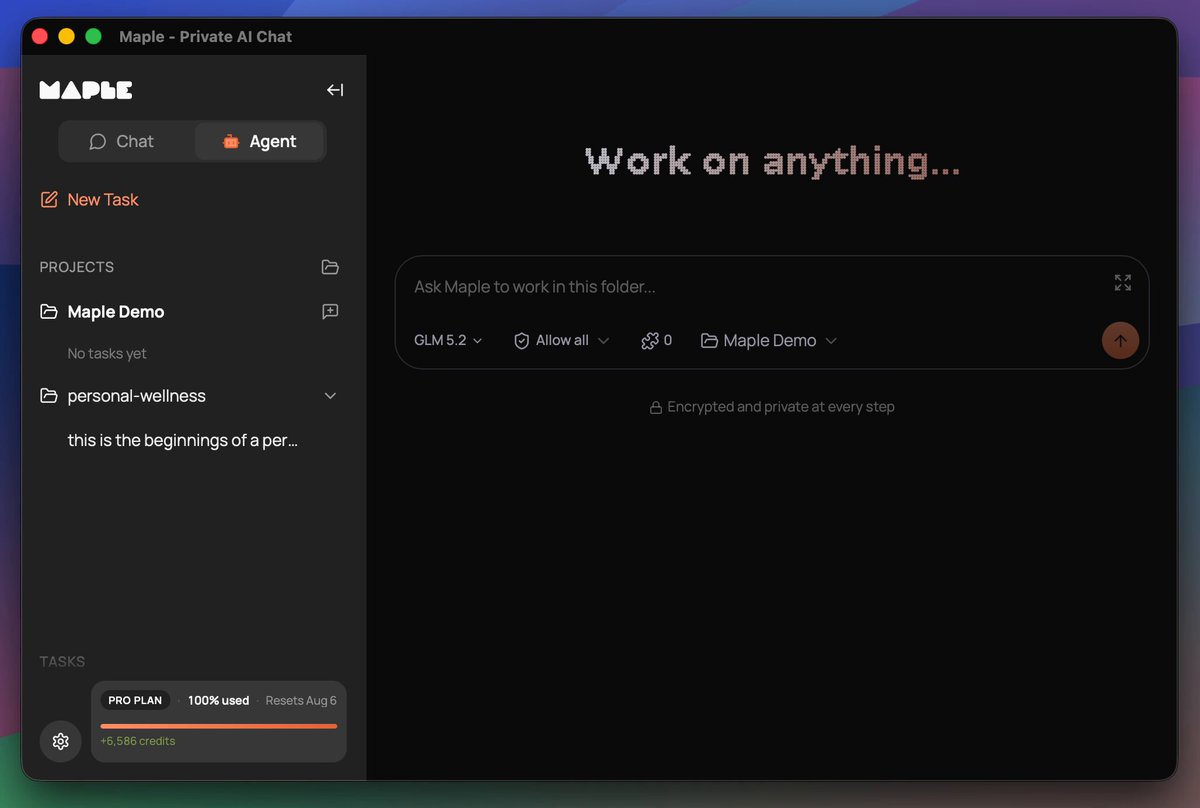
Maple is preparing for the release of a co-working agent. You install it locally and it works with your files, whether it's office work or building websites and apps. It's a turnkey solution, as easy as Claude Code, that keeps your data secure and private, no data sharing with closed AI labs. This is THE sovereign AI app for individuals and businesses who want powerful AI while retaining ownership of their information. Why build an agent into the Maple app when other agents already exist? Easy, we want to give you control over your work. We don't have a business plan that incorporates making money off our users' data. In the age of AI, your information, whether it's personal or company trade secrets, is the single thing that differentiates you from everyone else. We all have access to AI that can build a professional website for selling shoes. But your strategy and network for how you sell shoes should not be shared with your competitors. Sovereignty is the path to protecting what makes you, you. Maple sits at the intersection of Usability and Sovereignty. Maple gives you the best tools that are both easy to use and maintain your data sovereignty. Sovereign for one, sovereign for all. It has been a journey to get here. We brought to market the very first personal chatbot with end-to-end encryption using TEEs in late 2024. Prior to that there were proofs of concept but no full product offerings. Every other AI chat product on the market handled your data in plain text, either selling you a service to get your data or asking you to trust that they won't snoop on you. Quickly people found Maple and latched onto its open-source code and verifiable encryption. We didn't stop there. You may remember earlier this year we teased a product called "Maple Agent" and opened up a waiting list. That product is a mobile app that acts as your AI "friend", maintaining one long continuous chat, and getting to know you over time. I dislike using the word "friend" there, but it's the best way to convey the UX in a few words. AI is a tool, always has been, always will be. Any kind of friendly personality on top is just synthetic. In our testing, the UX of Maple Agent is really powerful for what it does. Think about the many short AI chats you have in your favorite app, whether it's looking up a historical fact or asking advice about a topic. With Maple Agent, those all go away in favor of the long-running chat with the friendly agent. It's like you have your own personal assistant who knows you so well and can look up anything for you. When I ask AI certain questions, I want to ask an expert who already understands my situation so I'm not repeating myself for the 100th time. That's the amazing value the personal agent brings to the table. We still see great utility for a personal agent like the "Maple Agent". Thousands of people on the waiting list, hoping to get their hands on it, agree that the concept is worth exploring and trying out. We were constrained in launching it due to a few circumstances, one of them being access to the scale of compute needed to power it. We have a clear path laid out for how to get there, but today is not the day to execute on that. It will be in the near future. Instead we have a different agent ready to go that we think is also incredible. We now have an agentic harness inside of the Maple Research app. This thing is a powerhouse. It even builds and publishes its own software releases. The agent in Maple Research works with your local filesystem, speaks to the largest open models running in TEEs, utilizes local models for certain tasks, is compatible with MCP tools, has an API for connecting to anything you need, and also supports the ACP protocol, which means it can be extended in the future to speak to other tools like Claude Code, Codex, and local models running on your own hardware. A big unlock for us was the Goose Development Kit, which powers the core of our agent harness. More on that to come as we publish articles and documentation later about the agent. The agent inside Maple Research doesn't have a name. At least not yet, not sure if it ever will. For now we call it "Chat Mode" and "Agent Mode". Think of this as the workhorse, the truck, the heavy lifter. Our other "Agent", the phone app, is your sidekick in your pocket, ready to help with quick things and ongoing conversations about life. I am incredibly excited about the Maple Research Agent. While I'm already seeing great results using it for internal work items, I'm especially thrilled about the personal health and wellness work it's doing for me. I know there are plenty of apps out there for compiling wellness data, but I'm having it build a tool tailored specifically for what I need, without the extra fluff. And none of my health data is being donated to the closed AI labs or sent to advertisers. I know that the AI logic is not being silently adjusted to fit the whims of a large corporation that has paid for product placement. It's me, state of the art AI, and my data. That's how I want it. Maple's new agent makes that possible. We can't wait for you to try it out. If you want early access, comment here, email us, reach out in some way. To those on the other agent waitlist, you're already in the queue. Thanks for reading this lengthy update. :)

Mark

44,707 ๆฌก่ง‚็œ‹ โ€ข 1 ไธชๆœˆๅ‰

The most epic 13 minute AI rant I've heard in 2026 PS: My parent's heard this when I was playing it in the car and thought Jason โœจ๐Ÿ‘พSaaStr.Aiโœจ Lemkin went OFF like Stephen A Smith does on first take PPS: Full transcript below [17:00] Harry Stebbings: I I just wanted to ask Jason, if the people that we want are fundamentally different, the developers that we used to hire, we don't because AI writes the code for us. The marketers we don't want, the sales people we don't wantโ€”who who do we want genuinely? Like what is the attractive profile? Because your Anthropicโ€™s and your OpenAIs are hiring, so so what are the people that we want in the companies of the future? [17:18] Jason Lemkin: Look, I know it sounds trite, but but the answer is simple. It's just the expression each year changes. We want folks that are genuinely AI fluent. It's pretty simple. Now you know, maybe last year we called them prompt engineers, right? That used to be a job. I don't know if you remember that actually used to be the hottest job on planet earth. Now no one needs a prompt engineer because it's pretty easy to prompt all these tools. That job died. Okay. Um and now we need go-to-market engineers. Um I think that job's going to die. We needโ€”everyone needs so many forward deployed engineers. Like you can't hire enough forward deployed engineers. But uh you know um but Palantir just announced in whatever their their big their big eventโ€”they've gotten their deployment times down over 90% with forward deployed engineers. So that may becomeโ€”so the this wave of disruption for the titles and the specificity, it's also exhaustingly accelerating. But it's really simple. You meet anyone for any roleโ€”sales, marketing, engineering, product, QAโ€”they're they're either they're either they can't keep all of the ways they use AI to accelerate their job from spewing out of their mouth, or they're staring at you. It's there's nowhere in the middle. Like, and the person that comes in and saysโ€”it's it's it sounds Captain Obviousโ€”but like, you know, you just had the whatever from Lovable, the the marketing head that was super popular on the show, right? She's just spewing AI-native insights into Lovable, right? It's not that complicated. You hire her, Elena, or whatever it is. You just hire her. It doesn't matter whether she's still in college or a junior or a senior or a middler, a left or right. And honestly, if you interview people, I would say of all even of the best startups I've invested in, maybe 30% of the management team meets this standard at best. 30%. Maybe less. And of the interviews I do in general, it's single-digit percents. It's just and in in that sense, it's the same as ever. Like you either lower the bar in hiring or you hire someone that's actually great. And someone that's actually great is so far ahead of you in how to apply to to employ the efficiencies of AI in their role, your jaw falls on the table. The difference is we used to need warm bodies. That's what's changing. We used to need warm bodies to answer the call, to do QA, to do code review, to to get the blue pixel to go from the upper left to the lower right. You laugh, but you need you literally needed to brute force this with humans. With AI, every day that goes by, the AIโ€”you do not need brute force human beings on your team. And that's another reason they're shrinking. Why are all these new companies so efficient? They're just not brute forcing things with humans. They're just not. They're choosing not to. And so these teamโ€”all the brute forcers out thereโ€”everyone talks about how bloated teams got in 2021. I don't agree with that. I think they got as big as they needed to be when growth was high and you needed humans to do everything. All you look at these teams that that doubledโ€”well if growth continued at 60% like the rate in early 2021 for 5 years or can help me do the math and every single thing a software company did required a human. You were understaffed by your 2021 headcount. You'd be sitting here in 2026. You every office in SoMa would be triple packed and you there wouldn't be enough humans to staff your company. It's just the world changed. [20:33] Harry Stebbings: Jason, you live on the bleeding edge. I think me and Rory see that and I think the world sees that when they hear you every week in terms of how you run SaaS. For all of the CEOs and execs who listen to the show, what would you advise them in terms of determining whether someone is AI fluent when they meet them for jobs, for talent? [20:51] Jason Lemkin: Here's I realized I was just asked this. I just did a review with a super fast startup growing just crossing 100 million and I was asked this question. And one of my favorite executives, I thought his answer was pretty dated and because he gave me an answer that was about 6 months old. The answer 6 months old is: "I look for folks in my team, I look for you know at what tools they play with." Okay, that was a great answer in like summer of 2025. Okay, I tried Lovable last week. Okay, the answer in 2026 is: "What commercial AI tool have you brought into your organization this month?" That's the test. Anyone that is on the bleeding edge that you would want to hireโ€”now there are so many great products in the market. Okay, there is no excuse in any role to have not brought one tool a month into your organization. Okay, thereโ€”now there's going to be better and better tools and better and better products as the year goes on. What's the one you did? And you will see folks with their deer in the headlights to this question. What what sales tool? What marketing tool? What product tool? What engineering tool? What did you bring in? Why did you pick it? How does it working? Because if you're at remotely at the cutting edge, you're all over this. You're looking for the next agentic tools that will radically improve how you do business. This isโ€”you think everyone thinks SaaS is at the bleeding edge, right? You know, you know, all we do is we're just looking for the tools and trying them. Okay? Okay, we're one year ahead of everybody else because we did the simplest thing in the world. Like we tried the tools early and we trained them. We trained them for a month. Okay, I'll give youโ€”want hear a horrible example from this week? Super hot AI company valued at 6 billion. Okay, I'm not going to name it. Um, this week yesterday told us we had to quadruple what we spent on their product. Okay, their agent told us, right? And why did this happen? Okay. Well, at this $6 billion company, no one had trained the agent on its pricing properly. No one had tested it. They said, "Well, well, we've been in beta." And we said, "Well, when did the beta launch? A year ago." Okay, these are people asleep at at the wheel. You want somebody who the instant this comes up, they exactly know what the issue is. And "Hey, when I was at Lovable Replit, we trained the agent. This is how we did it. I brought in this tool. I brought in this tool that that Rory invested in last week. It solved all these issues." That's what you want to hear. And if they haven't brought in a tool in the last 30 days, at least deeply evaluated it. I don't really care whether they bought it, but gone so far down the funnel they can tell youโ€”pick whatever tool: Fixie, Regie, GC, AIGCโ€”I don't care how you went through it, you looked at it, you can tell me the eight ways it would improve the productivity of your business and three you didn't. Just don't hire that person because they're going to run your company to the ground. This is the job today. The job today is not to screw around on ChatGPT and to be a prompt engineer. The job today is to bring the best AI and agentic products into your organization and leverage all the hard work that the engineers have done building those products. That's your job. You don't have to screw around. You don't have to be a prompt engineer anymore. You have to be an agent deployment expert. Aโ€”this is the new job we're making up today. An Agentic Deployment Expert. That's your job from C-level to junior. Agentic Deployment Expert. Don't hire anybody else. You're going to regret it. They're going to stare at the camera. He's good. Stare at the camera. He's honorable. We could probably just I could slip away, get a coffee, and come back. No. And I I sound exasperated, Rory. And Iโ€”but the reason I am is I can just see I can see my best companies doing it. And I can see some companies I've invested in not doing it. And I want to cry. I just want to cry when they have no ADs on their team. I justโ€”like you're flushing your years of your life down the toilet by not approaching your how you're building this company this way. [24:33] Rory: Yes. And at the risk of being positive, it's worth pointing out two things he didn't say. Well, something implicit why he saidโ€”Jason didn't do the only hire, you know, he didn't commit the um employment law, I think it's a civil penalty of saying only employ people below X who get the new new thing because he implicitly said anyone can do it provided you're willing to learn. And I think that's the big aha that's one of the positive statements to make here right? Look and I think it appliesโ€”I'm always wary of being "Hey, coming across, hey this this is the things that you all have to do." I think it applies to everyone including investors right? I mean I will say I have found that unless you're willing to invest the time learning these tools you actually shouldn't be investing in them. One of my partners Andy had this expression: "You know, if you decide you want to stop learning new things you probably should retire within 6 to 12 months and never write another check again." Maybe that's down to 3 to 6 months at this stage, right? And I think, you know, it'sโ€” [25:27] Harry Stebbings: Yeah, I actually I actually had a meeting with mine and Jason's biggest investor the other day and Iโ€”pretend he's not hereโ€”I said I think he's the most equipped investor for this generation of investing because I don't think anyone quite sits at the bleeding edge like he does on the investor side. [25:42] Harry Stebbings: Why in terms of using the equip stuff? Yeah. Yeah. In terms of using the stuff, understanding understanding bottlenecks, constraints. For sure. [25:51] Jason Lemkin: But can I just add one point? We can just cuz it's so important if it helps people. Okay, we areโ€”and thank you Harry. We're going through these phases. Okay, and when AI started to blow up for real for us, uh call it early 2024, right? Maybe late '23, I wasn't equipped. It was too technical. I wasn't going to go in and figure outโ€”I wasn't smart enough to figure out how to deal with a massively hallucinating LLM API and turn that and turn that into something magical. Kudos to investors and others that that got it in early '23, '22. I mean I remember Iโ€”I guess it was maybe SaaStr Annual '23. I was with David Sacks and I did a Q&A and I said, "How you thinking about AI at Craft?" He's like, "Well we're all in. We want 80% of '23 of investments to be AI." I'm like, "Great but like show me the show me the great ones in market." He's like, "They're all prototypes. We're all they're all they're all proof of concepts but we're all in anyway." That's where you kind of had to be in '23 if you weren't investing at like the LLM level. Okay, I wasn't smart enough. Then we went through this weird-ass prompt engineer era where like you you could torture these products to do something good, right? But you had to torture them. You had to like craft these crazy things that made no sense. Now we are in the era where mere ordinarily smart generalists can make these tools do magical things. And literally I go to these meetings and people be like, "I don't know how to like this is so scary. I don't know how to do this." And we show them our backends. Do you know how to do a workflow generator? Do you know how to do a a decision tree? Like we've been building these since software in the '90s. Okay, if youโ€”I can show you all of our agents. The how they work is novel. They do have to be trained. You can't be lazy and have these agents work. But honestly, the the UI, the UX, the way we interact with them, it's just software. And so my point is: Pick yourself off the ground. This is your time now. If you felt lost in AI era, if you felt like you're behind, you don't understand what all these people are saying on X and Twitter and their Claude and and their and talking about all the 4.6 point Nano point and it's overโ€”like you just it's not your world. This is your time. This is your time for the generalist that knows how to use software tools really really well. And Iโ€”this is my last point but it's so important. If ever in your recent lifeโ€”and this is why you could be all you need to be is young at heart to Rory's pointโ€”if in the last three to five years you have successfully deployed a piece of enterprise software of any sort you yourself, not some agency you hired, but if you have deployed it, you can deploy any agentic tool. Any. And you can become the hero in your company and you can become the hero in your functional area. But I watch folksโ€”I'm literally helping a company now that they're adding hundreds of sales folks this year with a new pre-IPO COOโ€”he's not hasn't brought in a single tool, totally scared of it. Okay, it's not that hard. Did you use SalesLoft? Did you use Outreach? Did you use HubSpot? Do you know these tools? If you can deploy these tools, you can deploy a world-changing AI agent. And so this is the time for people like the folks that that were shut out of the AI revolution right now. The generalist folks that are not that know how to deploy software that don't even know how to build software. Like vibe coding for me was folks who knew how to build software, but you didn't have to be an engineer. Now, you just need to know how to deploy software to win with AI agents. That's all you need to know. So many people have these skills and they're petrified of AI. "How did you do that? How did you deploy an AI BDR?" Well, we bought a piece of software, we figured out how it worked for a day, we set it up in an afternoon, and then and then we did spend 30 months training it, which you didn't do with this old software because in the old days, we just had to manually upload all the data, right? And there was no training. The the only non-intuitive part is training these things. And it's it's it's just work. So that's why when I see folks on the management team not doing this, there's no excuse. You do not need to be technical to win with AI agents in Q2 of '26. You do not need to be even 1% technical. Not at all. So it's your time. Or you're going to get laid off. Or you're going to get laid off because you're not going to matter.

Arjun Mahadevan (Mr. LLC ๐Ÿ‡บ๐Ÿ‡ธ)

37,744 ๆฌก่ง‚็œ‹ โ€ข 5 ไธชๆœˆๅ‰