Video wird geladen...

Video konnte nicht geladen werden

Zur Startseite

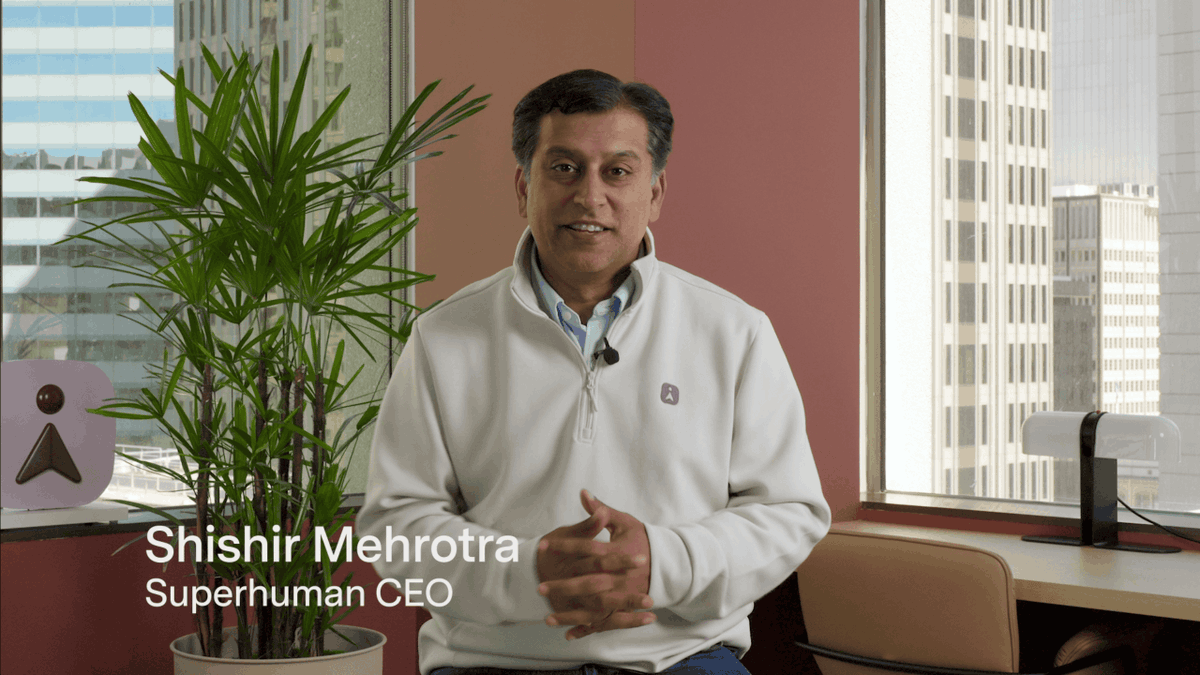
After Slack shut down across Greater China, every team asked the same question: what do we replace it with? Wrong question. The real one: when you switch, do you actually leave the problem behind, or just move it somewhere new? Most tools just move it. New interface, same limitations....

388,410 Aufrufe • vor 2 Monaten •via X (Twitter)

0 Kommentare

Keine Kommentare verfügbar

Kommentare vom Original-Post werden hier angezeigt

Ähnliche Videos

Today we’re launching the first and only human-like AI agents in the world. Super Agents™ are the first agents with human‑level skills – they DM you, take @ mentions, send emails, manage docs, tasks, and more. Not just tools or API calls, but real skills fine‑tuned for how teams actually work. The first agents with 100% context – fully native in ClickUp and fully synced from other apps. Super Agents see your work the same way that humans do: tasks, docs, schedules, and conversations all in one place. The first agents that learn from human interactions automatically, without any setup or configuration – when you give feedback, they listen and improve how they work. The first agents with human‑level memory for custom agents – historical memory for every interaction, short-term working memory, and even long‑term memory stored in docs you can literally open, inspect, and edit. The first agents that are literally the same as users – our agentic user model is the same as our user data model. This gives you permissions and capabilities that you and your systems are already familiar with. The first infinite agent catalog – where anyone can create and customize agents in minutes, for literally any type of work imaginable. It's the most intuitive way to build agents on the planet. 95% of companies are failing in AI adoption. The reality is that AI isn't meant to be adopted, it's meant to be adapted – to you. Super Agents are automatically personalized to you and your company using proprietary state-of-the-art agent architecture, orchestration, and tooling. Today is the largest step forward we've ever made towards our mission of making people more productive. Maximize human productivity, with ClickUp Super Agents. Available NOW. For everyone.

Zeb Evans

320,607 Aufrufe • vor 6 Monaten

What does it actually mean to be AI native? There was no clear guide on the internet for how to become AI native so we built the definitive one (60 min masterclass): 1. An AI native org has 3 layers: people for strategy and taste, agents for execution, and a shared context layer that makes the entire company readable to agents. 2. AI eats the middle of your work. You used to spend 80% of your day on execution. Now agents do that. Your job is the bookends: deciding what to do and judging whether it's good enough. 3. Everyone is a manager now. Your output is the output of your agents. If your agents produce garbage, that's on you. You set them up wrong. 4. Using ChatGPT doesn't make you AI native. That's like having a website and calling yourself a tech company lol. 5. No AI native org without AI native people. Most companies skip straight to the tools. That's why it fails. If your people don't understand how to manage agents, the tech doesn't matter. 6. Making your company "readable" to agents is the real work. Every process, every decision, every piece of knowledge needs to exist in a format an agent can consume. Most companies are nowhere close. 7. Speed without signal is just expensive chaos. You need the system to move fast AND know if you're moving in the right direction. 8. The skill chain is how agents get good at your specific workflows. Skills build on skills. The more you invest in them, the more your company compounds. 9. The moat is the system. People managing agents, agents reading from rich context, the whole thing getting smarter every week. That compounds. Your competitor can copy your tools. They can't copy your system. Full episode with Theo Tabah from LCA on The Startup Ideas Podcast (SIP) 🧃. This is the stuff we normally keep internal but all the sauce is yours. Theo Tabah is the brains behind advising the world's biggest companies on AI and building AI products. Your fav CEO's first call for figuring out AI. You are in for a treat Become AI native in under 60 minutes Watch

GREG ISENBERG

83,895 Aufrufe • vor 1 Monat

AI AGENTS 101 (58 minute free masterclass) send this to anyone who wants to understand ai agents, claude skills, md files, how to get the most out of AI etc in plain english: 1. chat vs agents - chat models answer questions in a back and forth while agents take a goal, figure out the steps, and deliver a result 2. agents don’t stop after one response. they keep running until the task is actually finishedno babysitting required 3. everything runs on a loop. they gather context, decide what to do, take an action, then repeat until done 4. the loop is the system. they look at files, tools, and the internet. decide the next step. execute and then feed that back into the next step. over and over until completion 5. the model is just one piece. gpt, claude, gemini are the reasoning layer. the key is model + loop + tools + context 6. mcp is how agents use tools. it connects things like browser, code, apis, and your internal software. once connected, the agent decides when to use them to get the job done 7. context beats prompt all day. you don't need to write perfect prompts. load your agent with context about your business, style, and goals and then simple instructions work 8. claude.md or agents.md is the onboarding doc it tells the agent who it is, how to behave, what it knows, and what tools it can use. this gets loaded every time before it starts 9. memory.md is how it improves. agents don’t remember by default. this file stores preferences, corrections, and patterns you tell the agent to update it, and it gets better over time 10. skills + harnesses make it usable. skills are reusable tasks like writing, research, analysis the harness is the environment like claude code or openclaw that runs everything. basiclaly, different interfaces, same system underneath this episode with remy on The Startup Ideas Podcast (SIP) 🧃 was one of the clearest ways of understanding a lot of the core concepts of ai agents could be the best beginners course for ai agents 58 mins. all free. no advertisers. i just want to see you build cool stuff. im rooting for you. send to a friend watch

GREG ISENBERG

375,365 Aufrufe • vor 4 Monaten

this video is the CLEAREST explanation of how claude skills + AI agents work and how to use them most people set up an AI agent and wonder why it keeps disappointing them. the context window is everything context is what the model assembles before it takes any action. think of it like everything the agent needs to read before it does anything. the quality of what goes in determines the quality of what comes out. the models are genuinely really good right now. claude and gpt are exceptional. the variable is almost always the context you give them. 1. agent.md files are mostly unnecessary every single line you put in an agent.md file gets added to every single conversation you have with your agent. a 1000 line file is around 7000 tokens burning on every run. the model already knows to use react. it can read your codebase. save the agent.md for proprietary information specific to your company that the model genuinely cannot know on its own. 2. skills are the actual unlock a skill.md file works differently. what loads into context is only the name and description, around 50 tokens. the full instructions only appear when the agent recognizes it needs that skill. so instead of 7000 tokens on every run you have 50. and the agent stays sharp because the context window stays lean. the closer you get to filling the context window the worse the agent performs, same way you perform worse when someone dumps 10 things on you at once. 3. here is how to actually build a skill the right way most people identify a workflow and immediately try to write the skill. what you want to do instead is run the workflow by hand with the agent first. walk it through every single step. tell it what to check, what good looks like, what bad looks like. correct it in real time. once you have had a full successful run from start to finish, tell the agent to review everything it just did and write the skill itself. it writes a better skill than you will because it has the full context of what actually worked in practice not in theory. 4. recursively building skills is how you go from frustrated to reliable when the skill breaks, and it will break, ask the agent exactly why it failed. it will tell you specifically what went wrong. fix it together in that same conversation. then tell it to update the skill file so that failure mode never happens again. ross mike did this five times with his youtube report generator. it now pulls from eight different data sources and runs flawlessly every single time without him touching it. 5. sub agents are something you earn not something you set up on day one start with one agent. build one workflow. turn it into one skill. once that works add another. ross mike has five sub agents now covering marketing, business, personal and more. it took months to get there and every single one exists because a workflow proved it deserved to exist. the people who set up 15 sub agents on day one and wonder why nothing works skipped all the steps that make the thing actually run. 6. your workflow is the thing the model cannot get anywhere else the model has been trained on everything. it knows more than you about most things. what it does not have is your specific process, your taste, your way of doing things. that is what skills capture. that is what makes your agent actually useful versus a generic one. downloading someone else's skill means downloading their context onto your setup and it will not work the way you want it to because it was never built around how you work. this is the clearest explanation of how agents actually work i have heard. Micky runs this stuff every single day and the results show it. full episode is now live on The Startup Ideas Podcast (SIP) 🧃 where you get your pods people charge for this sorta stuff i give away the sauce for free i just want you to win watch

GREG ISENBERG

192,483 Aufrufe • vor 3 Monaten

JUST IN: Perplexity launched "Perplexity Computer" — and it might be the most complete AI agent system available right now. Not a chatbot upgrade. Not a research tool with a new name. A system that plans entire projects, delegates to specialist AI models, and runs autonomously for hours, days, or months (their words). Here's what makes the architecture genuinely different: → Opus 4.6 handles core reasoning and orchestration → Gemini handles deep research (spawning its own sub-agents) → Grok handles lightweight speed tasks → Veo 3.1 handles video generation → Nano Banana handles image creation → ChatGPT 5.2 handles long-context recall and wide search → You can override model choices per subtask 19 models total. Each task runs in an isolated environment with a real filesystem, real browser, and real tool integrations. You describe an outcome. It breaks it into tasks and subtasks, creates sub-agents for each, and coordinates them automatically. When a sub-agent hits a problem, it spawns more sub-agents to solve it. And it connects to your existing stack — GitHub, Google Drive, Gmail, Slack, Jira, Linear, Notion, Confluence, Ahrefs, Airtable, and more. Critically, it doesn't just run once. It can run on a schedule. Reading your docs, checking your project boards, pulling from your CRM, and acting on what it finds. Market monitoring. Competitor tracking. Weekly reports with charts. Content pipelines. CRON jobs that actually execute. Not "AI that helps you once." AI that runs in the background for days or months. Think of it as managed OpenClaw — similar autonomous capability (scheduled tasks, multi-step workflows, tool integrations) but fully managed. No Mac Mini. No security config. No infrastructure to maintain. I tested it with a complex prompt — a full stock trading simulator with what-if scenarios, correlation heatmaps, sentiment analysis, and a Bloomberg Terminal aesthetic. Two prompts later: deployed to Netlify via GitHub, with working CRON jobs updating live data. I've started using it to analyze my portfolio. But coding is just one lane. This thing researches, writes reports, generates datasets, creates videos, processes documents, and connects to your existing tools — all in one coordinated workflow. The real shift: you don't choose a model anymore. You describe what you need. The system routes each piece of work to whichever model does it best — and spawns new agents when it hits a wall. 19 models, dynamic sub-agents, scheduled tasks, and your entire tool stack connected. Thoughts?

Paweł Huryn

219,498 Aufrufe • vor 4 Monaten