Video wird geladen...

Video konnte nicht geladen werden

Zur Startseite

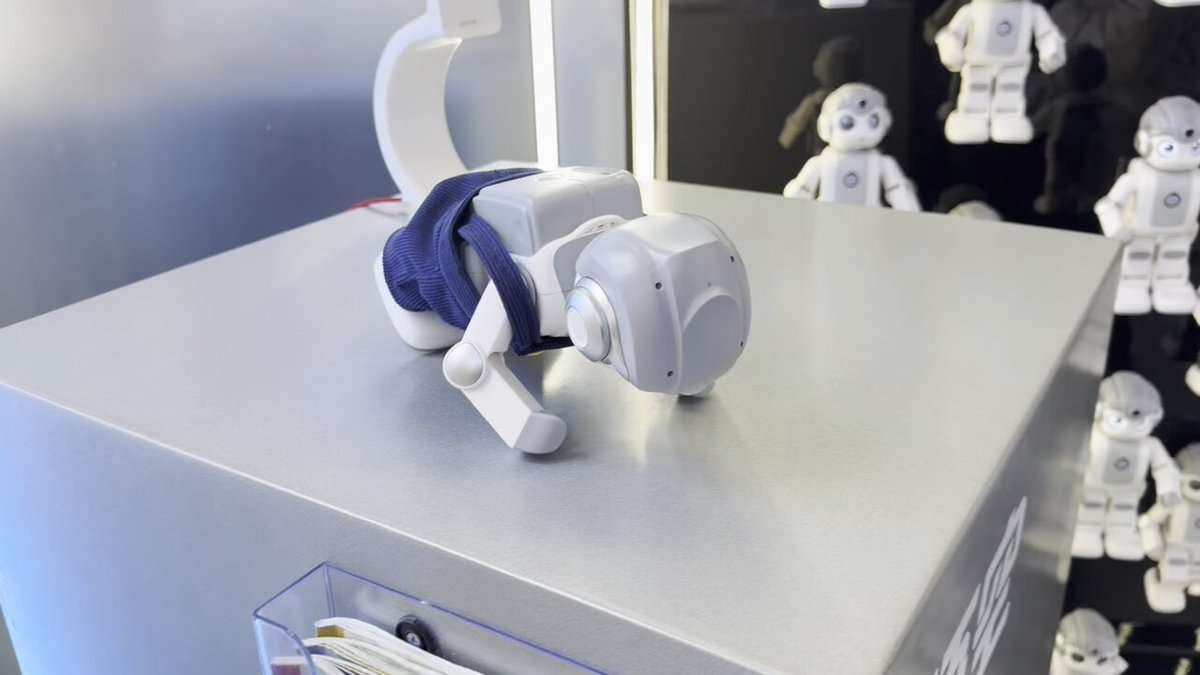
🇨🇳 Almost no foreign faces at Beijing’s World Robot Conference this week. Hundreds of Chinese firms packed the halls with humanoids, sorting robots, and new hardware. Officially, it’s global. On the floor, it feels much more self-contained. U.S. export controls, FCC restrictions, and fears around dual-use tech are keeping...

81,316 Aufrufe • vor 1 Monat •via X (Twitter)

0 Kommentare

Keine Kommentare verfügbar

Kommentare vom Original-Post werden hier angezeigt

Ähnliche Videos

I spent a month in Shenzhen visiting factories and robotics companies, and the contrast with the U.S. was striking. While Figure and Boston Dynamics hide their humanoids behind closed doors, Chinese companies have massive showrooms open to the public. But what really stood out wasn't just the transparency, it was how good they are at selling. Take UBTech: they've already sold 1,200 humanoid units at $200k each to factories. And here's the kicker, these robots aren't even that useful yet. They can only pick up and drop boxes at 1/10th the speed of a human, and factories still need to hire system integrators to train them for specific tasks. My theory is that these factories are terrified of getting left behind in the robotics/AI wave. They're investing in new tech not because it's ready, but because they can't afford to wait. The second surprise was the breadth of their robotics portfolio. These companies aren't just building humanoids, they're deploying service robots everywhere: restaurants, hotels, apartments. Consumer robots are cleaning houses, pools, pet waste, dishes. They're covering the entire spectrum. But the education piece shocked me most. I picked up what I thought was a high school or college robotics textbook, it was for primary school. The government mandated AI and robotics education starting in elementary school. Almost every single school in China now has AI and robotics curriculum, complete with education robots so kids can learn by building. They're creating a generation that grows up fluent in robotics and AI. China owns the supply chain and the hardware stack. But here's what I think people are missing: the race isn't just about who can build robots faster or cheaper. The U.S. advantage has always been in the layer between hardware and human, the interaction design, the software intelligence, the intuitive interfaces that make complex technology feel natural. China is building the physical infrastructure, but they're also learning fast. Every deployed service robot, every classroom full of kids building with education kits, every factory running humanoids, that's all data collection at scale. The window for the U.S. to establish its wedge is narrowing. It's not enough to be better at AI or software anymore. We need to be building the integration layer, the intelligence that makes physical AI actually useful, not just impressive in a showroom. Because right now, China isn't just manufacturing robots. They're manufacturing a robotics-native culture, and that might be the most defensible moat of all.

Miyu Horiuchi

90,718 Aufrufe • vor 8 Monaten

JUST IN: Reimagine Robotics has just emerged from stealth! 🥷🏻 Its approach to robot training is one of the most human-centric I've seen. The founder is Jonathan Scholz, the person who built and led Google DeepMind's Applied Robotics team in London for seven years. This is not a first-time founder taking a swing at robotics. He has spent a decade at the frontier of the field. The philosophy is powerful. He calls it "monkey-see, monkey-do." 🐒 A worker shows the robot what to do. Watches it attempt the task. Corrects it on the spot. The robot learns. No specialist programmers. No months of integration. And it's already working in the real world: → A made-to-order plastics business trained robots to tend 3D printers overnight, removing print beds, operating latches, pressing controls → A hard drive disassembly facility built a three-robot cell combining robots and people to recover critical materials → Time to prototype and test a new robot behaviour reduced from one day to 10 MINUTES That last number is the one that changes everything. When testing a new behaviour takes 10 minutes instead of a day, the entire pace of deployment transforms. Scholz's framing of the human-robot relationship is worth reading carefully: "A robot that learns on the job depends on people. The worker identifies the bottleneck, shows the robot how to help, and corrects it until it is useful." It's August, and we keep getting robotics bangers week in week. ~~ ♻️ Join the weekly robotics newsletter, and never miss any news →

Lukas Ziegler

23,404 Aufrufe • vor 2 Monaten

🚨 HOLY SH*T, CHINA IS BUILDING A GOLD-BACKED FINANCIAL SYSTEM And almost nobody understands how BIG this could become. China is pushing to internationalize the yuan through GOLD, new payment infrastructure, and alternatives to the U.S. dollar. Hong Kong’s government-backed gold clearing system began trial operations in July 2026, linked to the Shanghai Gold Exchange. Bloomberg Research also reports that China is developing a global network of gold vaults that could strengthen the yuan’s role in global finance. At the same time, China is building blockchain-based payment infrastructure with BRICS countries designed to reduce reliance on the U.S. dollar. And GOLD is at the center of everything. China has now bought gold for 20 consecutive months. In July, the UK, China, Japan, South Korea, and India all reduced their U.S. Treasury holdings while increasing exposure to gold. South Korea is buying gold again for the first time in 13 YEARS. Gold has now overtaken U.S. Treasuries as a more important reserve asset. Even Venezuela is moving its $4 BILLION, 31-ton gold reserves out of London after 8 years. The bigger picture is becoming impossible to ignore: GOLD → MORE U.S. TREASURIES → LESS DOLLAR DEPENDENCE → LESS China isn’t just buying gold. IT’S BUILDING AN ENTIRE FINANCIAL SYSTEM AROUND IT. And if other countries follow, the pressure on the U.S. dollar could become much bigger than anyone expects. China is moving toward gold. WHO’S NEXT? 👀

DANNY

226,990 Aufrufe • vor 1 Monat