Video wird geladen...

Video konnte nicht geladen werden

Zur Startseite

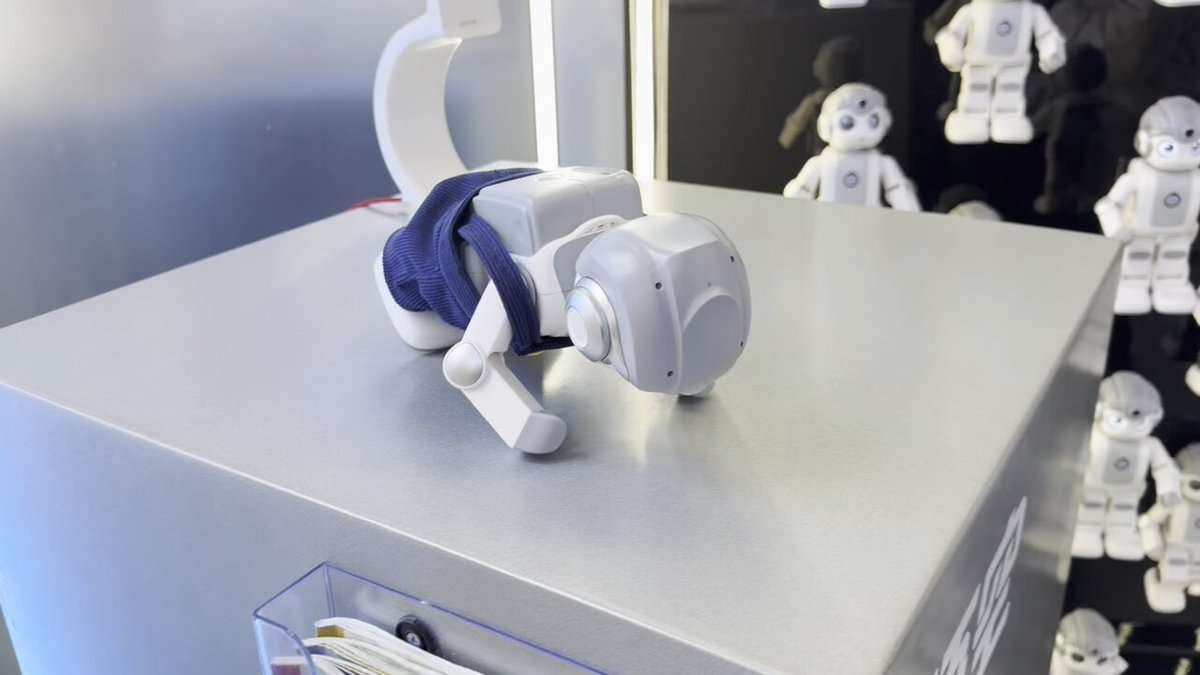
two weeks in Shenzhen and it’s an been eye-opening experience im here for a month with MIT SCALE and the speed of hardware production is easily 10× faster than sf. from product concept to production, everything is streamlined within a single building. Nearly every component you could need is...

149,572 Aufrufe • vor 8 Monaten •via X (Twitter)

0 Kommentare

Keine Kommentare verfügbar

Kommentare vom Original-Post werden hier angezeigt

Ähnliche Videos

I spent a month in Shenzhen visiting factories and robotics companies, and the contrast with the U.S. was striking. While Figure and Boston Dynamics hide their humanoids behind closed doors, Chinese companies have massive showrooms open to the public. But what really stood out wasn't just the transparency, it was how good they are at selling. Take UBTech: they've already sold 1,200 humanoid units at $200k each to factories. And here's the kicker, these robots aren't even that useful yet. They can only pick up and drop boxes at 1/10th the speed of a human, and factories still need to hire system integrators to train them for specific tasks. My theory is that these factories are terrified of getting left behind in the robotics/AI wave. They're investing in new tech not because it's ready, but because they can't afford to wait. The second surprise was the breadth of their robotics portfolio. These companies aren't just building humanoids, they're deploying service robots everywhere: restaurants, hotels, apartments. Consumer robots are cleaning houses, pools, pet waste, dishes. They're covering the entire spectrum. But the education piece shocked me most. I picked up what I thought was a high school or college robotics textbook, it was for primary school. The government mandated AI and robotics education starting in elementary school. Almost every single school in China now has AI and robotics curriculum, complete with education robots so kids can learn by building. They're creating a generation that grows up fluent in robotics and AI. China owns the supply chain and the hardware stack. But here's what I think people are missing: the race isn't just about who can build robots faster or cheaper. The U.S. advantage has always been in the layer between hardware and human, the interaction design, the software intelligence, the intuitive interfaces that make complex technology feel natural. China is building the physical infrastructure, but they're also learning fast. Every deployed service robot, every classroom full of kids building with education kits, every factory running humanoids, that's all data collection at scale. The window for the U.S. to establish its wedge is narrowing. It's not enough to be better at AI or software anymore. We need to be building the integration layer, the intelligence that makes physical AI actually useful, not just impressive in a showroom. Because right now, China isn't just manufacturing robots. They're manufacturing a robotics-native culture, and that might be the most defensible moat of all.

Miyu Horiuchi

90,718 Aufrufe • vor 7 Monaten

A machine like this can cost $500,000 to well over $1 million to make parts that may be worth only $10-15 This is the real manufacturing story. This INDEX six-spindle automatic carries 6 motorised spindles, up to 12 CNC tool carriers, operates at 8,000+ rpm, and weighs 7.2 tonnes. Different operations happen simultaneously as the spindle drum indexes each workpiece from station to station. A real scale production example produced a precision component in 11 seconds, versus 38 seconds on a conventional single-spindle lathe. That's roughly 327 parts per hour before downtime. But the machine is only the hardware. Tool geometry, CNC programs, cutting parameters, spindle synchronisation, tooling, bar feeding, chip evacuation, coolant, inspection and collision checked simulation all have to be engineered around the exact part. That is what it takes to integrate this machine into a factory workflow. This accumulated capability is what kept Germany and Japan at the pinnacle of machine-tool manufacturing for decades almost unchallenged. The advantage wasn't just building the hardware, but knowing how to program, tool and integrate these machines for thousands of different manufacturing requirements globally. China has now built much of that ecosystem at extraordinary scale, machines, controls, tooling, software, automation and integration. Its huge domestic manufacturing base has accelerated that learning curve dramatically. Today, Chinese manufacturers can increasingly offer sophisticated CNC and multi-spindle systems at 30-40% lower total costs in most applications, putting serious and relentless price pressure on German and Japanese builders. China produced 37% of the world's machine tools in 2025, compared with 12% for Germany and 10% for Japan. These are the machines that make the machines and ultimately determine how much an economy can manufacture. China is the biggest player as of now and growing faster than anyone else in manufacturing high-end machining tools. Source, Daniel Jansson

Ammanichanda

38,359 Aufrufe • vor 1 Monat

One of the most common mistakes manufacturers make is relying on engineering logic to shape user behavior, while ignoring how users actually feel. Engineers often believe that as long as a feature exists, moves, or looks different, users will appreciate it. Users, however, care about something much simpler: whether the experience feels natural, refined, and intuitive. Great user experience is never created by stacking options. It is created by coherence and emotional consistency. Samsung’s recent update to Lock Star is a clear example. The new version introduces unlock animations that appear to add playfulness, yet the real experience feels disappointing. Many of these animations come across as childish, low level, poorly connected, and mechanically rigid. They feel closer to children’s UI effects than something designed for Samsung’s broad premium user base. The issue is not the presence of animations themselves. The problem lies in the mindset behind them. These effects are clearly driven by implementation logic rather than user perception. The assumption seems to be that adding visual flair automatically creates delight, while ignoring rhythm, emotional tone, and aesthetic maturity. This reflects a long standing pattern in Samsung’s software design. Random stickers, cartoon like emojis, and decorative elements often appear without a cohesive design language. There is a belief that younger users are attracted to these visuals, yet for Gen Z, such elements often feel outdated, immature, and disconnected from a premium identity. Strong product design allows user experience to constrain engineering decisions. When engineering begins to entertain itself, users quietly begin to disengage. Let's see how far apart Samsung and Xiaomi are.

Ice Universe

59,712 Aufrufe • vor 8 Monaten

🚨 AMERICA JUST BUILT THE WORLD’S MOST POWERFUL METAL 3D PRINTER AND IT’S ABOUT TO MASS-PRODUCE ROCKETS AND MISSILES. Divergent Technologies has unveiled the Monolith One, a giant industrial metal printer standing over 8 meters tall and armed with 12 high-powered lasers delivering a combined 24 kilowatts of energy. Unlike typical 3D printers used for prototypes, this machine is built for serious, high-volume production. It can print large, complex aerospace and defense parts in aluminum, titanium, steel, and nickel alloys and it roughly doubles the output of current systems. Why this matters: • Divergent plans to install 64 more of these machines in a massive new 430,000 sq ft factory in Long Beach, California • Once running, the facility aims to produce tens of thousands of munition airframes per year plus hundreds of thousands of critical metal components • It slashes manufacturing time from months down to weeks or even days • The company already supplies major players like Lockheed Martin and RTX The deeper implication: This isn’t just another 3D printer. It represents a shift toward software-defined, on-demand manufacturing at industrial scale for mission-critical hardware. As defense and aerospace demand skyrockets, traditional supply chains are too slow. Systems like Monolith One could become a cornerstone of faster, more resilient domestic production especially for complex structures that are difficult or impossible to make conventionally. We’re watching the industrialization of additive manufacturing in real time. How do you think large-scale 3D printing will change aerospace and defense manufacturing over the next decade? Follow for more frontier manufacturing and defense technology.

TheNewPhysics

80,575 Aufrufe • vor 3 Monaten

Furniture assembly is the task everyone name-drops and nobody actually attempts at real scale. Every demo I have seen is a scaled down IKEA leg or a single arm on a toy chair. This paper does it properly, real scale, bimanual, up to 7 subtasks and 1,550 control steps per episode, and it is validated on a real Kinova Gen3, not just in sim. That real-robot number is the one that matters: only a 16 percent drop on the hardest task going from simulation to hardware. That is a small enough gap to take seriously, and it did not happen by accident. They built a VR teleoperation rig specifically for coordinated dual-arm collection, because generic single-arm teleop setups do not capture the coordination real assembly needs, and the model predicts a continuous progress signal alongside the action chunk rather than a discrete subtask label, letting it auto-transition and catch drift before it compounds into total failure. The simulation ablation is what got them there, 48 to 80 percent over baselines, with another 21 points from their perception and control design study alone, but that is groundwork, not the headline. Watch the video, there is a clip of the robot misgrasping the seat panel, reopening the gripper, and regrasping on its own. That is not scripted recovery behaviour, it emerged from training, and it emerged on hardware. Excellent work from the team from Mitsubishi Electric Research Laboratories, with Oxford and UNC Chapel Hill Clinical Laboratory Science. Video and project page in comments. #Robotics #Manipulation #VLA

Stephen James

14,952 Aufrufe • vor 2 Monaten