Video yükleniyor...

Video Yüklenemedi

Ana Sayfaya Dön

Among the discussions of legendary programmers from the pre-2000 era, one name that shouldn’t be forgotten is Chris Sawyer. Solo game development was still fairly common in the early days of the industry… but it became much rarer by the 90s. What Sawyer created with RollerCoaster Tycoon (1999) is...

19,005 görüntüleme • 29 gün önce •via X (Twitter)

0 Yorum

Yorum bulunmuyor

Orijinal gönderinin yorumları burada görünecek

Benzer Videolar

At the end of the day, as I discussed with Jordan Peterson, there are just two games to be played, one real, one Woke. The real game is called civilization. The false game is called power. A long post/🧵: The real divide between Woke and not Woke is in power. The Woke game is the power game, and it is a parasite on the real game, which is civilization. Here's roughly how Jordan described the foundation of this idea. There are various rules, norms, etc., in the game society ultimately plays, and these create a hierarchy that is based upon competence, mostly organically, obviously imperfectly. If the rules of the game are good enough, the imperfections (natural corruptions) are minor and society thrives. If they are not, you'll have problems. This is the real game of building society, and it ultimately has to favor competence. This game must be called "civilization" because that's not just its goal but it is also what it does. It civilizes us beyond our base instincts and impulses so we can work together productively in a healthy manner that generates prosperity. As Jordan put it, this game is also a reservoir of value, and reservoirs of value create parasites. What are these civilizational parasites? They’re parallel games organized by and around malignant psychopathological modes like Dark Tetrad traits, psychopathy, and Cluster-B disorders: histrionic, borderline, antisocial, and narcissistic. These malignant pathologies render people incompetent except at manipulation, so they cannot rise far in a healthy civilizational hierarchy. What do they do, then, to gain power and status in life in a game they cannot actually play? They define a parasitic parallel game and rope people into playing it. It is parasitic in that it draws off the real game (civilization) and mimics its form so that the hosts (people in society) are less likely to realize it’s there, but it doesn’t build or create of its own. It siphons and tears down. What drives this game is failing to see what makes the civilizational game and the hierarchy it produces legitimate in the first place. This is characteristic of the psychopathologies at its heart. The narcissist imagines the world should be serving himself at the top, but it isn’t. The problem can’t be himself, so it must be that the game is illegitimate. Otherwise, he’d be at the top, but he isn’t. Therefore, the game is corrupt. His histrionic nature makes him a victim of the real game, preying upon emotions like empathy and righteous indignation to recruit followers. Because of his Dark Tetrad alignment, his game is not only illegitimate but toxic. It’s inherently sadistic, cruel to its recruits in the way typical of all cults—alternating punishment and leniency or even love-bombing. It’s dishonest. It’s psychologically broken from reality. It’s also a Machiavellian game, which means it has no interest in moral or ethical behavior but only in power. Thus, this rival game to the game of civilization is the game of power. The parasitic game—that is, the power game—is based on a fundamental failure to understand the legitimacy of the civilizational game or the approximately legitimate hierarchy it produces. This is a result of its narcissism, mostly. The game cannot be legitimate because the psychopath isn’t on top of it, where he sees himself constantly as a projection from his frail ego. It sees power in the real hierarchy, though, which it can perceive and understand, and for which it blames most of its troubles. What this means is that the (Woke) power game develops a critical theory of the existing legitimate civilization game. That’s why Woke means “using critical theory (and activism).” A critical theory exists not to articulate a vision—at least not beyond a Utopia after the cult power game holds power to enforce its power game long enough—but to “criticize those aspects of the existing society we wish to change,” as Max Horkheimer, creator of the Critical Theory, put it. The critical theory of the power game exists to recruit by delegitimizing the civilization game in the minds of some of its players, usually ones who aren’t succeeding as well. It picks at “contradictions,” failures, and imperfections while casting the whole civilization game as corrupt and unjust. It offers itself as the only alternative to civilization game while pulling at the threads of the civilization game that allow people to believe in it. It all proceeds from the Woke failure to understand the legitimacy of the hierarchy of the civilization game as it proceeds from its set of rules. Misunderstanding legitimacy leads it to conclude that all hierarchies are actually based in power, and all power is fundamentally arbitrary. That is, they do not believe all power is illegitimate. They believe power is the only legitimate thing in any hierarchy, but they also believe that power is located in persons like themselves through their narcissism and projection. Think of Voldemort as an icon of this mode of thinking: “there is no good or evil, only power and those too weak to seek it.” Of course, that quintessential Dark Tetrad perspective is what ensures the psychopathological power game will be rigged to make sure the psychopaths are attracted to it and rise to its top. This belief is what we call Woke. The Woke game is the power game, and it is a parasitic competitor to the civilization game. There is no overlap between these two games. To adopt the power game is to abandon the civilization game entirely and, in fact, to become its enemy. But James, you might ask, isn’t there power in civilization? Yes, there is, and necessarily, but it isn’t what defines the civilization game. It’s a byproduct of the game, not the game itself. The civilization game is fundamentally the building out of an organic and dynamic hierarchy based on a set of rules, or what some people call “muh principles,” that will succeed or fail for that civilization in direct proportion to three things. 1) How aligned with the truth are the rules of the civilization game? 2) How aligned with justice are the rules of the civilization game? 3) How willing are the participants of the civilization game to defend their principles and their game, including against socio-parasitical perversion? The more aligned with truth and justice a civilization game is, the more successful it will be, and the more legitimate its hierarchy. The power that results as a byproduct is extremely legitimate in a highly aligned civilization where people haven’t forgotten their charge to defend the game itself, which is what we call responsibility. A civilization game strongly aligned with truth and justice filled with a preponderance of responsible people will produce a thriving, prosperous society. It only works this way every time. Not everyone is responsible, though. Some are also incompetent because of various pathologies (not talking about for other reasons). Those pathological players may, under certain circumstances, create a parasitic side game with themselves on top through a variety of strategies that mimic the values and principles of the real game while distorting them into power plays because their game is power, as discussed above. They will recruit into that game primarily from those who are resentful of the real game for any variety of reasons, and getting recruited into the power game from the civilization game is called “going Woke.”

James Lindsay, anti-Communist

154,373 görüntüleme • 1 yıl önce

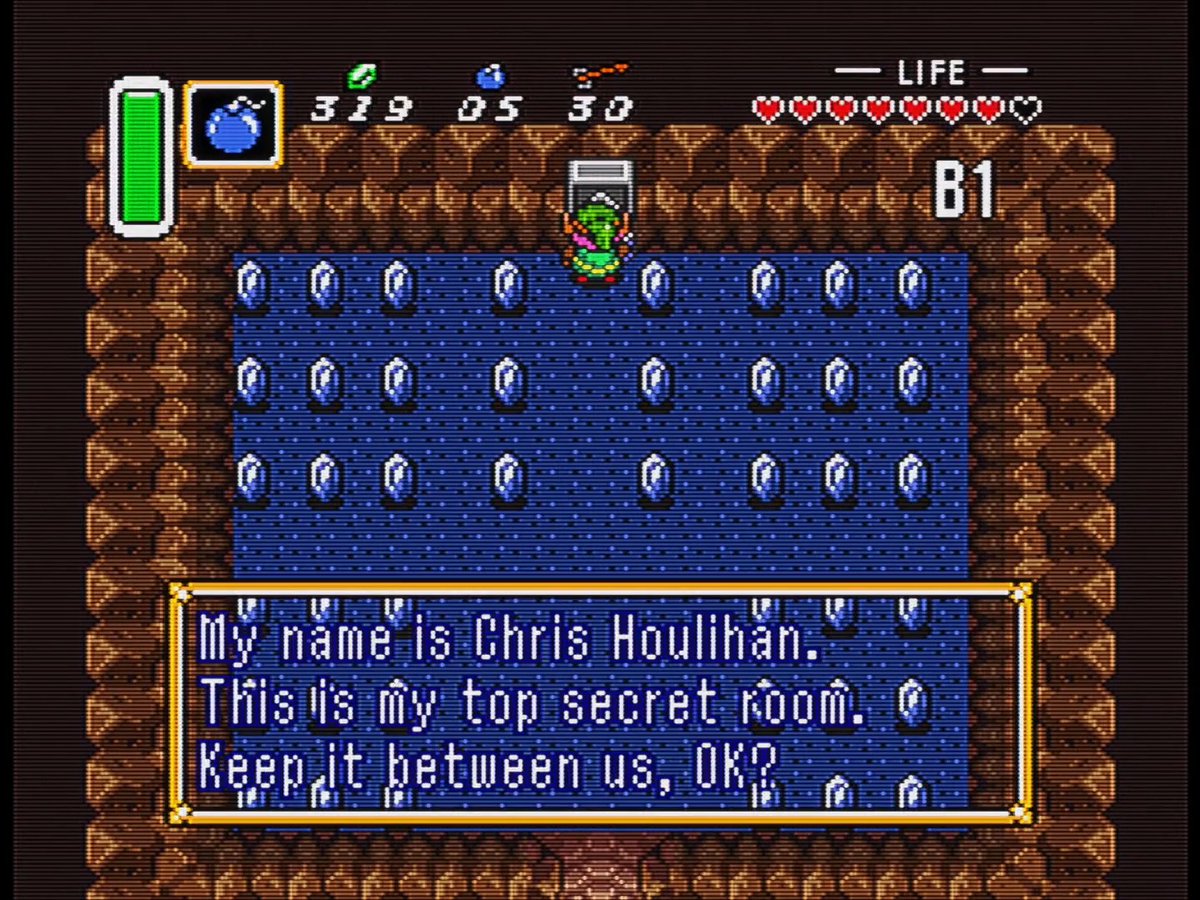
In the Fall of 1990, Nintendo Power held a contest for players to send in a photo of them finding WarMech, a very rare enemy found deep into Final Fantasy. While it's never been officially verified, there's some strong evidence that the winner of that contest was Chris Houlihan, and the prize was to get your name featured in a future Nintendo game. He was mentioned in one subsequent issue from 1998 as a contest winner in '92, Zelda's North American release year. As I'm learning while writing this, there's evidence that the winner was actually Chris's dad, immortalizing his son's name in one of the most unique video game stories out there. Kevin Hainline on YouTube posted a video with some fascinating insight and perspective on the story. ( In short, it seems that Chris was also named in the 1991 Game Boy version of Nintendo World Cup Soccer, where Terry was benched from the U.S. team in favor of the contest winner. The timing lines up really well. As for why his name is only found in the failsafe room in The Legend of Zelda: A Link to the Past, it probably lies with just the nature of game production. They clearly missed a deadline since they never gave Houlihan the later highlight that seemed to be the standard for the Power contests. Also if Kevin's story holds water, they were rightfully not happy with simply naming a team member "Chris" in a handheld title. So it actually makes sense his name gets put into this room. It's probably the highest caliber game they could add him to, in one of the only places the devs could reasonably put him. They had to have known some players would eventually find it, and it would be a mystery. I just wonder if anyone involved knew just how wonderfully complex and interesting it would be. The poetic thing is if everything I learned today is real, "Chris" appeared on the Game Boy, then appeared with his full name in the legendary SNES room, and now is book-ended with just "Houlihan" in Cadence of Hyrule on the Switch. A fascinating legacy spanning nearly three decades and consoles. #RetroGaming

Elder Mathias

19,269 görüntüleme • 22 gün önce