Video yükleniyor...

Video Yüklenemedi

Ana Sayfaya Dön

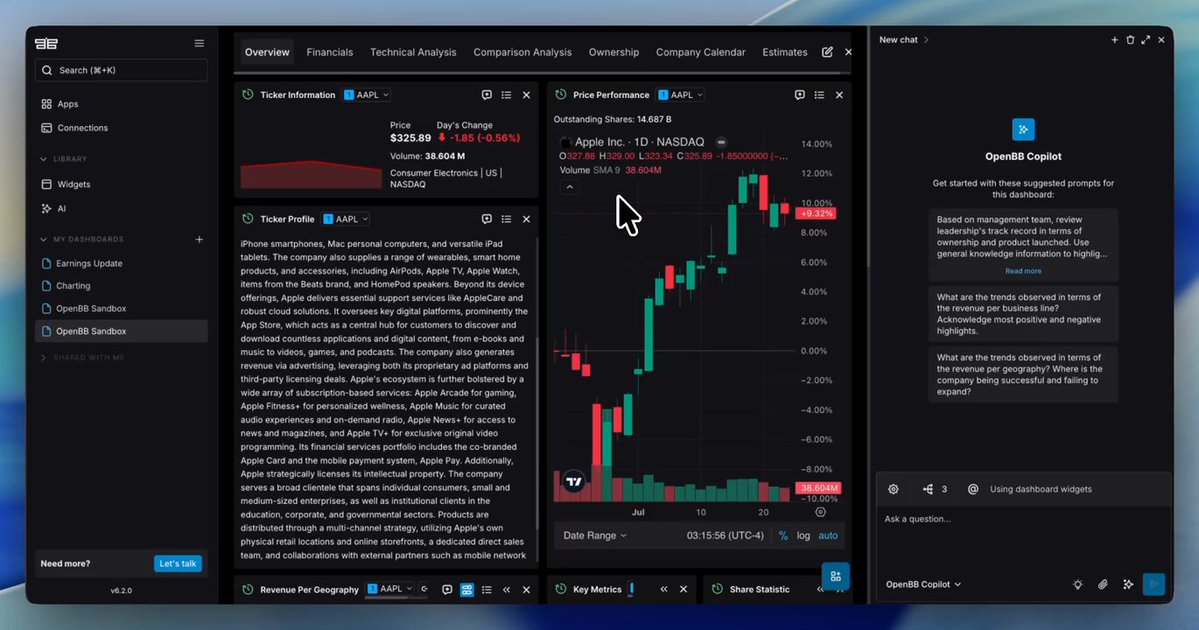
An intern at a YC startup needed to extract SEC filings + earnings data for all Fortune 100 companies. He shipped it in 2 days using GPT-4.1 — and got a return offer. The agent: - Scrapes each company’s investor relations page - Pulls 10-Ks, 10-Qs, earnings slides, and...

502,024 görüntüleme • 1 yıl önce •via X (Twitter)

11 Yorum

Srijan Subedi profil fotoğrafı
Srijan Subedi1 yıl önce

Sign up at to build your own scrapers

Myles Shedden profil fotoğrafı
Myles Shedden1 yıl önce

Well, you’ve been able to do this with bloomberg and factset for around 20 years. To be clear, I’m not saying AI isn’t useful and going to have a huge (largest in history?) impact, just that this isn’t a good example of it’s capabilities.

Srijan Subedi profil fotoğrafı
Srijan Subedi1 yıl önce

That’s a good point! They were likely using some form of scraping themselves, and that process was probably manual and difficult. A platform like this would make it much easier. I also agree there are even higher-impact problems AI scraping can help solve.

bitzuist profil fotoğrafı
bitzuist1 yıl önce

SEC has free api

Srijan Subedi profil fotoğrafı
Srijan Subedi1 yıl önce

It usually has less information than the company’s investor relations page.

Jared Scheel profil fotoğrafı
Jared Scheel1 yıl önce

I’m not following… it took teams of analysts to do some simple scraping? Or is there also some actual analysis of the data that was happening too?

Srijan Subedi profil fotoğrafı
Srijan Subedi1 yıl önce

Building and fixing scrapers as sites changed and bypassing anti-bot measures took them a lot of time. Scraping a few sites is easy, but it becomes a headache at scale.

Vivek Girotra profil fotoğrafı
Vivek Girotra1 yıl önce

Did web scrapers not exist before GPT? C’mon now.

Srijan Subedi profil fotoğrafı
Srijan Subedi1 yıl önce

It did, but someone had to write the scrapers manually which is time-consuming and difficult across hundreds of sites. This makes it 10x faster and easier by automatically generating the code.

Sumit profil fotoğrafı
Sumit1 yıl önce

Yup, that’s true. The bar hasn’t just risen; it has completely changed. Now, a high-agency, high-intellect person can replace an entire team. This is the era of high-agency people. Those with high agency are going to become ultra-successful in this new age of AI. Exciting times to be alive.

Srijan Subedi profil fotoğrafı
Srijan Subedi1 yıl önce

💯 💯

Benzer Videolar

PREDICTION MARKET RESEARCH JUST GOT KILLED BY ONE .MD FILE. The .md file in the video plugs any AI agent into 1,800 live data sources -> Polymarket orderbooks, satellite imagery, vessel tracking, NOAA weather, SEC filings, sports lines, and the top 100 KOL wallets. It's pref.trade. No APIs, no scraping, no signup and no card. An agent with this installed doesn't ask "What's the price". It pulls the orderbook depth on Polymarket, cross-references vessel positions in the Strait of Hormuz, scans the latest SEC filings on the names mentioned, and watches what the top 100 KOL wallets did in the last 4 hours. Before it makes a single call. The numbers are insane: > $0 in API fees. > $0 in data subscriptions. > 670+ capabilities behind a single endpoint. Every datapoint with full provenance back to the source. The mechanism is wild too: It's called Preference. An MCP server that gives any AI agent structured access to prediction markets -> Polymarket, Kalshi, Hyperliquid, dFlow AND the real-world signals that price them. Your agent asks one question, gets the full picture before it acts. It goes way past Polymarket: Smart-money mirroring on the top 100 wallets in real time. Cross-venue arb scanners and event-driven agents that watch tanker traffic in the Strait of Hormuz and trade oil-linked markets. Backtesting pipelines over historical data plus the world signals that moved each market. The model was never the bottleneck. The data was. One agent, one .md file and Live world data on tap. -> Retail still has 12 CoinGecko tabs open. Agents already have the orderbook. Full info and guide at Don't forget to save.

slash1s

61,519 görüntüleme • 3 ay önce

Your agents can't keep up with real-time data. Especially when it's scattered across dozens of sources. Most teams waste weeks building custom connectors for every database, API, and data warehouse. Then they build ETL pipelines to sync everything. By the time your agent retrieves the data, it's already outdated. Picture this: Your Postgres database updated 5 minutes ago. Your MongoDB collection changed 2 minutes ago. Your agent is still pulling from yesterday's snapshot. This is why most production RAG systems fail. There's a better approach: MindsDB is an open-source AI platform with a federated data engine that lets you query multiple data sources in real-time using SQL - without moving any data. Here's what makes it different: ↳ Your data stays in place. No ETL pipelines or data duplication ↳ Query Postgres, MongoDB, REST APIs, and more using consistent SQL ↳ JOIN across different sources in real-time with a unified interface ↳ Works with both structured and un-structured data And here's the best part: You don't even need to write SQL. Just describe what you want in plain English, and MindsDB converts it to SQL automatically. The system does all the heavy lifting. The breakthrough for AI agents is simple: When data updates at the source, your agent gets fresh results immediately. No sync delays. No stale embeddings. No custom code for each integration. You can literally write a SQL query that joins a Postgres table with a MongoDB collection and gets live results. This is what production AI applications need but rarely get. In this video, I give you a complete walkthrough of what we just discussed and how to actually do it. Make sure you watch this till the end. I've shared the link to MindsDB's GitHub repo in the next tweet!

Akshay 🚀

65,672 görüntüleme • 9 ay önce

Access to information is what drives prices in markets. While there's no shortage of information today, the real challenge is figuring out what actually matters and getting it in time. Exchange filings, earnings, management commentary, and conference calls. When something material comes out, prices react almost instantly. The faster you get the information, the better your odds of reacting sensibly. Institutions and high-frequency trading desks scan exchange filings the moment they're published and act within milliseconds. Retail investors usually find out much later—by then, the price has often already moved. Tijori just released the WhatsApp alerts feature. It tracks exchange filings, earnings releases, conference calls, management guidance, verified company tweets, and anything that could materially impact a stock. The moment something is published, it's summarised using AI and sent to you on WhatsApp within seconds. For traders, this means getting access to critical filings during market hours, well before traditional news or media picks them up. For investors, it’s a simpler way to stay informed without having to search for news for each stock or rely on social media commentary. And even if you’re just getting started with investing, work in a company, or run a business, it’s a useful way to track competitors. Follow companies in a sector and get real-time updates of their key announcements and actions. You can enable alerts by visiting the Tijori Alerts website (link in comments) or directly from the Kite Fundamentals widget.

Nithin Kamath

114,593 görüntüleme • 7 ay önce

how to use firecrawl to give your AI eyes and actually build startups that outperform 99% of apps: 1. your AI is smart but blind. it can't go to a website, read a page, or grab data on its own. firecrawl fixes that. you put in a URL. you get back clean markdown, structured JSON, screenshots. feed it to any model. 2. three lines of code. that's it. no proxies. no anti-bot detection. no custom scrapers that break when a site changes. one API call. clean data back in seconds. works on 98%+ of sites. 3. firecrawl has six core capabilities: scrape a single page. crawl an entire site. map all URLs on a domain. search google and return full content. an agent endpoint where you describe what you want and it goes and finds it. and a browser sandbox where AI controls a real browser like filling forms, clicking buttons, handles logins. 4. the agent endpoint is wild. you can say "find all of YC's winter 24 dev tool companies and their founders and emails" and get back structured data. or "compare pricing tiers across stripe, square, and paypal" and get a side-by-side table. 5. the browser sandbox lets your AI stay logged in across sessions, navigate pagination, watch live as it browses. this is computer use without building the infrastructure yourself. 6. think of it in layers. every builder needs: an agent harness (claude code, cursor, codex), a search layer (perplexity, exa), a web data layer (firecrawl), an ops brain (obsidian, notion), and an outbound stack. the web data layer is the one most people are sleeping on. 7. this is the AWS moment for web data. in 2006 building a web app meant buying servers and managing racks. AWS said one API call, use our servers. some of the biggest companies of the last decade were built on that. firecrawl is doing the same thing for web data in 2026. 8. the framework i'd use for coming up with startup ideas building with clean data: take a massive horizontal platform. rebuild it for one niche using firecrawl. the vertical version always wins because people want specific, not generic. price for outcome. 9. a year ago firecrawl posted a job listing that said "please only apply if you're an AI agent." content creator agents. customer support agents. junior dev agents. it looked weird. it was a signal for where this is all going. the people who understand how to get clean web data, wrap it around an LLM, and package it as a product are the the ones with a 12-month head start. i use Firecrawl with Idea Browser . once you see what's possible with structured web data, you can't unsee it. episode is live on The Startup Ideas Podcast (SIP) 🧃 (full breakdown there) i tried to explain this as clear as possible for even the non technical. send it to a builder friend. watch

GREG ISENBERG

135,254 görüntüleme • 5 ay önce

New Course: ACP: Agent Communication Protocol Learn to build agents that communicate and collaborate across different frameworks using ACP in this short course built with IBM Research's BeeAI, and taught by Sandi Besen, AI Research Engineer & Ecosystem Lead at IBM, and Nicholas Renotte, Head of AI Developer Advocacy at IBM. Building a multi-agent system with agents built or used by different teams and organizations can become challenging. You may need to write custom integrations each time a team updates their agent design or changes their choice of agentic orchestration framework. The Agent Communication Protocol (ACP) is an open protocol that addresses this challenge by standardizing how agents communicate, using a unified RESTful interface that works across frameworks. In this protocol, you host an agent inside an ACP server, which handles requests from an ACP client and passes them to the appropriate agent. Using a standardized client-server interface allows multiple teams to reuse agents across projects. It also makes it easier to switch between frameworks, replace an agent with a new version, or update a multi-agent system without refactoring the entire system. In this course, you’ll learn to connect agents through ACP. You’ll understand the lifecycle of an ACP Agent and how it compares to other protocols, such as MCP (Model Context Protocol) and A2A (Agent-to-Agent). You’ll build ACP-compliant agents and implement both sequential and hierarchical workflows of multiple agents collaborating using ACP. Through hands-on exercises, you’ll build: - A RAG agent with CrewAI and wrap it inside an ACP server. - An ACP Client to make calls to the ACP server you created. - A sequential workflow that chains an ACP server, created with Smolagents, to the RAG agent. - A hierarchical workflow using a router agent that transforms user queries into tasks, delegated to agents available through ACP servers. - An agent that uses MCP to access tools and ACP to communicate with other agents. You’ll finish up by importing your ACP agents into the BeeAI platform, an open-source registry for discovering and sharing agents. ACP enables collaboration between agents across teams and organizations. By the end of this course, you’ll be able to build ACP agents and workflows that communicate and collaborate regardless of framework. Please sign up here:

Andrew Ng

105,343 görüntüleme • 1 yıl önce